The Biologos Foundation recently posted a paper by Oliver Barclay. Barclay has been active in a UK organization which considers questions of science and faith, apparently for many years.
In his paper, Barclay considers the position, mostly implied, of the Intelligent Design movement on God's providence in nature. He finds ID to have a belief that is potentially dangerous. What is that belief?
ID usually makes no direct claim that the natural world is entirely designed, but only that some features of it, for example, certain enzymes, were so designed, or that the Cambrian Explosion resulted from intervention by a designer. (ID also claims that it would have been impossible for these features or phenomena to have arrived by natural selection. The ID movement generally does not claim that the designer was the Judeo-Christian God.)
What's wrong with that? What's wrong, as Barclay points out, is that ID thus relegates the activity of the designer to the spectacular, the unusual, the inexplicable. The Bible indicates, as Barclay says, that God is involved in the world around us all the time. (He does not use Colossians 1:15-18, which also makes this point, but he uses other scripture.) God is the Provider, and we, and earthworms and petunias, are here because God sustains and protects us, through His providence. So the ID view tends to limit God, and does not express the Biblical truth of God's constant involvement in the world.
The ID view, says Barclay, is also a variety of the "god-of-the-gaps" idea, which is that God must have been responsible for events we can't explain. If we can't explain the origin of, say, color vision, by natural means, then God must have intervened to bring about color vision. The problem with that idea is that it tends to reduce God, or make Him irrelevant, if we subsequently discover a gradual evolutionary pathway to color vision. God was involved, whether or not we think we understand how He did something!
Much of Barclay's article is quotations of relevant scripture. That, and his ideas, make the article worth reading.
Thanks for reading.
Musings on science, the Bible, and fantastic literature (and sometimes basketball and other stuff).
God speaks to us through the Bible and the findings of science, and we should listen to both types of revelation.
The title is from Psalm 84:11.
The Wikipedia is usually a pretty good reference. I mostly use the World English Bible (WEB), because it is public domain. I am grateful.
License
I have written an e-book, Does the Bible Really Say That?, which is free to anyone. To download that book, in several formats, go here.

The posts in this blog are licensed under a Creative Commons Attribution-NonCommercial-ShareAlike 3.0 Unported License. You can copy and use this material, as long as you aren't making money from it. If you give me credit, thanks. If not, OK.
The posts in this blog are licensed under a Creative Commons Attribution-NonCommercial-ShareAlike 3.0 Unported License. You can copy and use this material, as long as you aren't making money from it. If you give me credit, thanks. If not, OK.
Saturday, March 26, 2011


Friday, March 25, 2011
The Hobbit, by J. R. R. Tolkien
Nearly six years ago, I posted a series on several aspects of three of my favorite fantasy books, or series, namely the Earthsea books, by Ursula K. Le Guin, the Lord of the Rings series by J. R. R. Tolkien, and Watership Down, by Richard Adams. The last of those posts is here. They are not reviews of the books, but thoughts about various things that they have in common, such as a love for nature.
I recently realized that I have never posted on Tolkien's The Hobbit, a book written for a younger audience than that author's subsequently published works. (See here for the Wikipedia article on Tolkien, and here for the article on the book.) I first purchased a copy of The Hobbit while I was in graduate school, perhaps 50 years ago, and have cherished it, and read it several times. The plot of the book is, I suppose, well known, or can be readily obtained from the Wikipedia article on it. I shall confine myself to a few impressions from my most recent reading.
My first impression, this time I read the book, was that there are no important females in it. There are a few females in the background, and a number of unnamed spiders in one part of the book, which may or may not have been meant to be female, but it's a book with no significant female characters at all. Tolkien was capable of using females, such as Galadriel (arguably his most complex character), Arwen and Eowyn, in strong supporting roles, in his longer and more adult works, but he did not do so in The Hobbit. As a matter of fact, there are whole species that don't seem to have any females in his subsequent works. No female ents at all, perhaps a very few female dwarves, and maybe no female orcs. Well, it's fantastic literature. That aspect is surely not realistic. It says something about Tolkien. I'm not sure what.
One aspect of the book that I also hadn't really tuned in to is the amount of walking that the characters do. Lots of it. It's my understanding that Tolkien belonged to a generation of English men who went for walks lasting several days, as one form of vacation, so walking for days and days, and miles and miles, would have been natural to him, but it isn't to most of us.
Tolkien's dragon, Smaug, is a fine creation, living on a hoard of captured treasure, able to speak, fly, spit fire, and be dangerous. (Were there female dragons in his Middle-Earth books? I'm not sure that there were.)
Thorin Oakenshield, the leader of the dwarves, had a lust for treasure. An over-riding lust, so strong that it drove out feelings of friendship and gratitude. But, in the end, he realized that treasure was only of value in this life, and not of nearly as much value as he had temporarily made it. A good lesson.
In this work, as in others, Tolkien expresses deep misgivings about modern inventions. What he would have said about cell phones and GPS devices, I don't know, but I'm pretty sure that he would have been against them, and seen them as damaging to quality of life, and to the environment.
Tolkien did have a good grasp of human nature. I offer two quotations:
Now it is a strange thing, but things that are good to have and days that are good to spend are soon told about, and not much to listen to; while things that are uncomfortable, palpitating, and even gruesome, may make a good tale, and take a deal of telling anyway. J. R. R. Tolkien, The Hobbit: or There and Back Again. Boston: Houghton Mifflin, 2nd ed, 1951, pp. 61-2.
. . . he was kind-hearted, in a way. You know the sort of kind heart: it made him uncomfortable more often than it made him do anything; and even when he did anything, it did not prevent him from grumbling, losing his temper, and swearing (mostly to himself). (p. 93 )
Finally, Bilbo is a well-drawn character. He has good points, and plenty of flaws, which he mostly rises above. A good man? Well, not exactly. He is a hobbit, a creature said to be man-like, but only from two to four feet tall, with tough, hairy, feet, and easily able to hide from creatures that want to find them.
I enjoyed re-reading The Hobbit, and I recommend it to you. A two-part film adaptation was supposed to begin filming on March 21st, 2011.
Thanks for reading.
I recently realized that I have never posted on Tolkien's The Hobbit, a book written for a younger audience than that author's subsequently published works. (See here for the Wikipedia article on Tolkien, and here for the article on the book.) I first purchased a copy of The Hobbit while I was in graduate school, perhaps 50 years ago, and have cherished it, and read it several times. The plot of the book is, I suppose, well known, or can be readily obtained from the Wikipedia article on it. I shall confine myself to a few impressions from my most recent reading.
My first impression, this time I read the book, was that there are no important females in it. There are a few females in the background, and a number of unnamed spiders in one part of the book, which may or may not have been meant to be female, but it's a book with no significant female characters at all. Tolkien was capable of using females, such as Galadriel (arguably his most complex character), Arwen and Eowyn, in strong supporting roles, in his longer and more adult works, but he did not do so in The Hobbit. As a matter of fact, there are whole species that don't seem to have any females in his subsequent works. No female ents at all, perhaps a very few female dwarves, and maybe no female orcs. Well, it's fantastic literature. That aspect is surely not realistic. It says something about Tolkien. I'm not sure what.
One aspect of the book that I also hadn't really tuned in to is the amount of walking that the characters do. Lots of it. It's my understanding that Tolkien belonged to a generation of English men who went for walks lasting several days, as one form of vacation, so walking for days and days, and miles and miles, would have been natural to him, but it isn't to most of us.
Tolkien's dragon, Smaug, is a fine creation, living on a hoard of captured treasure, able to speak, fly, spit fire, and be dangerous. (Were there female dragons in his Middle-Earth books? I'm not sure that there were.)
Thorin Oakenshield, the leader of the dwarves, had a lust for treasure. An over-riding lust, so strong that it drove out feelings of friendship and gratitude. But, in the end, he realized that treasure was only of value in this life, and not of nearly as much value as he had temporarily made it. A good lesson.
In this work, as in others, Tolkien expresses deep misgivings about modern inventions. What he would have said about cell phones and GPS devices, I don't know, but I'm pretty sure that he would have been against them, and seen them as damaging to quality of life, and to the environment.
Tolkien did have a good grasp of human nature. I offer two quotations:
Now it is a strange thing, but things that are good to have and days that are good to spend are soon told about, and not much to listen to; while things that are uncomfortable, palpitating, and even gruesome, may make a good tale, and take a deal of telling anyway. J. R. R. Tolkien, The Hobbit: or There and Back Again. Boston: Houghton Mifflin, 2nd ed, 1951, pp. 61-2.
Finally, Bilbo is a well-drawn character. He has good points, and plenty of flaws, which he mostly rises above. A good man? Well, not exactly. He is a hobbit, a creature said to be man-like, but only from two to four feet tall, with tough, hairy, feet, and easily able to hide from creatures that want to find them.
I enjoyed re-reading The Hobbit, and I recommend it to you. A two-part film adaptation was supposed to begin filming on March 21st, 2011.
Thanks for reading.
Thursday, March 24, 2011
Evolution, Me & Other Freaks of Nature, by Robin Brande
I recently read Evolution, Me & Other Freaks of Nature (New York: Knopf, 2007), by Robin Brande. The book is aimed at the so-called Young Adult audience, and has won some awards in that category. It is well written and entertaining.
The premise is that the protagonist, Mena Reece, has parents that attend a conservative church, but a large one, with dozens of teenagers who attend regularly. This church has a pastor who wants to persuade Mena's high school to teach Intelligent Design as an alternative to evolution, in science classes. Mena has been told that she is not welcome in church, for reasons I won't go into, so she stays home and watches TV preachers, or pretends to.
Youth from Mena's church sit backwards in science class, and wear shirts attacking evolution. Mena's lab partner in freshman science, Casey, is a young genius, and emotionally mature. He has a sister, Kayla, who is a senior, also brilliant, and a budding journalist. The three of them, and Dr. Shepard, the science teacher, eventually make the IDers look silly.
There's an interesting wrinkle. Mena runs across the parable of the talents (Matthew 25:14-19) and puts that forth as teaching natural selection. Maybe, but to me, that's a stretch.
Let's be clear. This book is fiction. Dr. Shepard is too good a teacher to be real, and besides, she has a doctorate -- a science doctorate, and is in a high school classroom. That alone makes this book fiction. Most likely a church as large as the one in the book, which had as many complaints about modern society, would have its own high school. Casey and Kayla are just too good to be true. The church is all bad, or nearly so. The story is just too black and white. I'm not a great friend of the ID movement, but this book seems just too one-sided.
The book is a good read, and worth reading, but it has its limitations.
Thanks for reading.
Wednesday, March 23, 2011
Sunspots 306

Sports: The teams in the NCAA men's basketball tournament have been ranked, according to how well the team's athletes do academically, in a fantasy academic tournament.
Computing: The Internet has run out of IP addresses. It's not a disaster yet, but changes are necessary. Here's an article on the consequences. Perhaps the most important question in the article is this: Is your router ready for the new IP system?
Gizmo's Freeware has published "Probably the Best Free Security List in the World," which is a listing of free programs that aid the security of Windows computers.
Image source (public domain)
Tuesday, March 22, 2011
Get Low: Searching for Redemption
My wife and I watched Get Low, a film starring Robert Duvall, Bill Murray and Lucas Black, and a fine supporting cast. I will try not to give away much of the plot, but will say a little. The title comes from dying -- Felix Bush (Duvall) has been a recluse outside a small town somewhere in the Midwest (sometime in the 1930s, I would guess) for about forty years, but wants, somehow, to get forgiveness for his past. He tells funeral directors Murray and Black that he wants not a funeral, but a party, a time when people can tell stories about him, while he hears them. But what he really wants is to tell his own story. He does. There are religious overtones. Bush is told that he must ask forgiveness in order to get it, and that he must ask it of God. It is not clear, to me, at least, that he ever really does that, but he does ask forgiveness of one person.
The dialogue is great, and so is the acting. There are no car chases, and no scenes of too much exposed flesh. A good, well-made movie. I'm glad we saw it.
For the AllMovie review of the film, go here. For the Christianity Today review, go here. (CT also ranked the film as third in its list of the ten most redeeming films of 2010.)
Thanks for reading.
Monday, March 21, 2011
Ursula K. Le Guin on Equilibrium

The graphic above can serve as a link to a larger version, in my Flickr photostream, which requires no password for viewing. The column structure of this blog puts restraints on the size of graphics I can post here.
The quotation at the top of the graphic above sets forth the central idea in the Earthsea books of Ursula K. Le Guin. (The books have a fine narrative structure, solid characters, and a good plot, besides this central idea.)
Although Le Guin is a self-professed Taoist, not a Christian, I don't think a Christian should have any serious quarrel with the idea of Equilibrium, as expressed by the wizard Ged, the main character in the Earthsea books.
The photo in the graphic was taken by me, in the Madison River Valley of Montana.
I have recently posted more on The Farthest Shore.
Thanks for looking and reading.
Sunday, March 20, 2011
Prayers in the Bible: Rahab's prayer
The most important part of the story of Rahab, the prostitute from Jericho, is told here:
Joshua 2:8 Before they had laid down, she came up to them on the roof; 9 and she said to the men, “I know that Yahweh has given you the land, and that the fear of you has fallen on us, and that all the inhabitants of the land melt away before you. 10 For we have heard how Yahweh dried up the water of the Red Sea before you, when you came out of Egypt; and what you did to the two kings of the Amorites, who were beyond the Jordan, to Sihon and to Og, whom you utterly destroyed. 11 As soon as we had heard it, our hearts melted, neither did there remain any more spirit in any man, because of you: for Yahweh your God, he is God in heaven above, and on earth beneath. 12 Now therefore, please swear to me by Yahweh, since I have dealt kindly with you, that you also will deal kindly with my father’s house, and give me a true token; 13 and that you will save alive my father, my mother, my brothers, and my sisters, and all that they have, and will deliver our lives from death.” (WEB)
Does that sound like a prayer to you? At first, it didn't sound like it to me. But consider. As I have previously indicated (and the idea is not original with me) there are four kinds of prayer, namely Adoration, Confession, Thanksgiving and Supplication. Clearly, Rahab asked for something. But she didn't ask God. She asked the two nameless spies. That was supplication, but of fellow humans. But the heart of Rahab's speech, as recorded here, is that she used Adoration: "Yahweh your God, he is God in heaven above, and on earth beneath."
The spies were on a hard mission. They were to spy out enemy territory. The reason that they were on the roof is that Rahab had hidden them there, protecting them from death. The spies did their part. Rahab did hers. She is mentioned in the Faith chapter, Hebrews 11. She is also mentioned in the works chapter, James 2. She was an ancestress of King David, and, thus, of Christ.
I can't take this example as evidence that I should bring my requests to other people, rather than to God. But I should adore God, and have faith in Him, and work for Him.
This post is part of a series. Here's the previous entry. Thanks for reading.
Saturday, March 19, 2011
Ursula K. Le Guin's The Farthest Shore: Musings
The Farthest Shore, by Ursula K. Le Guin, won the National Book Award for Children's Books. The book is the third in a series. (See here for my post on the second book.)
In the first book, Ged comes of age. In the second book, Tenar comes of age, in a manner determined largely by the actions of Ged. In this, the third book, Arren comes of age, also influenced by Ged. (Ged is also influenced by Tenar and Arren, but he had already achieved at least the beginning of adulthood in the first book.)
I shall give away more of the plot of this book than I usually do when discussing a book.
Le Guin has usually been concerned with non-human organisms, with the living community, although her books are mostly about people. Shore is no exception:
As well as illustrating Le Guin's concern for the living community, this passage introduces the Master mages of Roke, and their various magical abilities. (Ged is the Archmage, by this time.) The Master Patterner, in all three of the books, does not perform any magic. (Other mages, and mages in training, including Ged, do perform magical acts in the books.) The Master Patterner observes nature, and the deep patterns that underly existence in Earthsea -- the equilibrium of the world. He, and Ged, have decided that there is a serious problem with the way things are. (For a quotation on equilibrium, from this book, see here.)
Early in the book, Arren, a teenage boy from a noble family, comes to Roke Island, where the Master Mages live, as a messenger from his father, himself with some magical ability and training. The father wants to know what is wrong with the performance of magic -- why do the spells, the actions, seem to have lost their meaning. In a conference with the nine Master Mages, Ged decides that, in the first place, Arren has not come to Roke at this time by chance. In the second place, Ged decides that, if Arren is willing, he will take him on a journey, mostly in Ged's boat, the Lookfar, to find the source of the problem with the equilibrium. That problem, Ged is certain, is caused by a man.
Eventually, they do find the cause of the problem, and that cause is a man, a man with powerful magical abilities, and a man who fears death greatly, so greatly that he has developed spells that allow him to return to life, even after being killed. The existence of such spells acts as a tremendous attraction for the mages, and others with magical ability, of Earthsea. All those with magical ability are, at times, able to enter into the spirit world, and it is there that they somehow feel the existence of the possibility of escaping death. This possibility attracts most of them. But it has its cost. They are made aware that, in order to escape death, they must give up their magical ability, and their secret names. (Their secret names are kept secret because knowledge of such a name would make it possible for a person with magical power to control, kill, or injure, by use of the secret name.) Many of the people of Earthsea who have magical ability give it up, and give up their secret names. Ged will not. He sees death as a necessary consequence of life. Giving up the secret name, and the ability to perform magic, does not hold off death. The promises of Cob, the man who fears death so much, are false. Only Cob can come back from death. (Cob is a use-name, not a secret name. Cob, too, has given up his secret name, the name given to every child in Earthsea.)
One of the finest things about this book is the dragons. Le Guin's dragons are intelligent, long-lived, and dangerous. Ged and Arren are guided to Selidor, the westernmost of the islands of Earthsea, by a dragon, Orm Embar. The dragon does so because dragons, too, partly live in the spirit world, and their equilibrium, too, has been damaged.
On Selidor, Ged sees Cob. Orm Embar gives his life to kill Cob, and Ged takes Arren with him into the Dry Land, the spirit world of the dead, to follow Cob. After a long journey in the Dry Land, they come to a Dry River. That River, although it has no water, comes out of a hole in the rocks, into a dry stream bed. Ged exerts all his power of magic, and closes the hole, thus blocking Cob's access back to the world of the living.
Ged and Arren manage to walk all the way across the Dry Land, to the other side, and re-enter the world of the living. There Ged has no magical power, and not much life. A great dragon carries Ged and Arren back to the centers of power of Earthsea, Roke and Havnor, and then carries Ged, now no longer a mage, back to his original home on the island of Gont. (Several years after the publication of Shore, Le Guin wrote Tehanu, which is about Ged and Tenar on Gont. I have posted on that book here.)
There are several aspects of the story, having to do with religion, that deserve emphasis. Ged, and the dragon, Orm Embar, give up a lot to restore equilibrium. There seems to be some power, although it is not specified what it is, that determines events, such as Arren coming to Roke at the proper time. A god? Perhaps. Finally, the view of death put forth in Shore is remarkable. The dead all go into the Dry Land, and are there for eternity, apparently. While there, they have no emotions, no attraction to people who were very important to them in life, and, in fact, they have no life, just a monotonous existence. But Ged believes that life, once lived, is important. But not so important that it should continue on and on. Le Guin is a Taoist. I do not know if the view of death in Shore is hers, or Taoist. But it is not the view of Christianity, which believes that death leads, at least for believers, to eternal abundant life.
A powerful book, with good character sketching, fine writing, and dealing with the most important issue humans face -- death.
Thanks for reading.
In the first book, Ged comes of age. In the second book, Tenar comes of age, in a manner determined largely by the actions of Ged. In this, the third book, Arren comes of age, also influenced by Ged. (Ged is also influenced by Tenar and Arren, but he had already achieved at least the beginning of adulthood in the first book.)
I shall give away more of the plot of this book than I usually do when discussing a book.
Le Guin has usually been concerned with non-human organisms, with the living community, although her books are mostly about people. Shore is no exception:
He came to the path that led to the Immanent Grove, a path that led always straight and direct no matter how time and the world bent awry about it, and following it came soon into the shadow of the trees.
The trunks of some of these were vast. Seeing them one could believe at last that the Grove never moved; they were like immemorial towers grey with years; their roots were like the roots of mountains. Yet these, the most ancient, were some of them thin of leaf, with branches that had died. They were not immortal. Among the giants grew sapling trees, tall and vigorous with bright crowns of foliage, and seedlings, slight leafy wands no taller than a girl.
The ground beneath the trees was soft, rich with the rotten leaves of all the years. Ferns and small woodland plants grew in it, but there was no kind of tree but the one, which had no name in the Hardic tongue of Earthsea. Under the branches the air smelled earthy and fresh, and had a taste in the mouth like live spring water.
In a glade which had been made years before by the falling of an enormous tree, Ged met the Master Patterner, who lived within the Grove and seldom or never came forth from it. Ursula K. Le Guin, The Farthest Shore, New York: Bantam Books, 1972, p. 10.As well as illustrating Le Guin's concern for the living community, this passage introduces the Master mages of Roke, and their various magical abilities. (Ged is the Archmage, by this time.) The Master Patterner, in all three of the books, does not perform any magic. (Other mages, and mages in training, including Ged, do perform magical acts in the books.) The Master Patterner observes nature, and the deep patterns that underly existence in Earthsea -- the equilibrium of the world. He, and Ged, have decided that there is a serious problem with the way things are. (For a quotation on equilibrium, from this book, see here.)
Early in the book, Arren, a teenage boy from a noble family, comes to Roke Island, where the Master Mages live, as a messenger from his father, himself with some magical ability and training. The father wants to know what is wrong with the performance of magic -- why do the spells, the actions, seem to have lost their meaning. In a conference with the nine Master Mages, Ged decides that, in the first place, Arren has not come to Roke at this time by chance. In the second place, Ged decides that, if Arren is willing, he will take him on a journey, mostly in Ged's boat, the Lookfar, to find the source of the problem with the equilibrium. That problem, Ged is certain, is caused by a man.
Eventually, they do find the cause of the problem, and that cause is a man, a man with powerful magical abilities, and a man who fears death greatly, so greatly that he has developed spells that allow him to return to life, even after being killed. The existence of such spells acts as a tremendous attraction for the mages, and others with magical ability, of Earthsea. All those with magical ability are, at times, able to enter into the spirit world, and it is there that they somehow feel the existence of the possibility of escaping death. This possibility attracts most of them. But it has its cost. They are made aware that, in order to escape death, they must give up their magical ability, and their secret names. (Their secret names are kept secret because knowledge of such a name would make it possible for a person with magical power to control, kill, or injure, by use of the secret name.) Many of the people of Earthsea who have magical ability give it up, and give up their secret names. Ged will not. He sees death as a necessary consequence of life. Giving up the secret name, and the ability to perform magic, does not hold off death. The promises of Cob, the man who fears death so much, are false. Only Cob can come back from death. (Cob is a use-name, not a secret name. Cob, too, has given up his secret name, the name given to every child in Earthsea.)
One of the finest things about this book is the dragons. Le Guin's dragons are intelligent, long-lived, and dangerous. Ged and Arren are guided to Selidor, the westernmost of the islands of Earthsea, by a dragon, Orm Embar. The dragon does so because dragons, too, partly live in the spirit world, and their equilibrium, too, has been damaged.
On Selidor, Ged sees Cob. Orm Embar gives his life to kill Cob, and Ged takes Arren with him into the Dry Land, the spirit world of the dead, to follow Cob. After a long journey in the Dry Land, they come to a Dry River. That River, although it has no water, comes out of a hole in the rocks, into a dry stream bed. Ged exerts all his power of magic, and closes the hole, thus blocking Cob's access back to the world of the living.
Ged and Arren manage to walk all the way across the Dry Land, to the other side, and re-enter the world of the living. There Ged has no magical power, and not much life. A great dragon carries Ged and Arren back to the centers of power of Earthsea, Roke and Havnor, and then carries Ged, now no longer a mage, back to his original home on the island of Gont. (Several years after the publication of Shore, Le Guin wrote Tehanu, which is about Ged and Tenar on Gont. I have posted on that book here.)
There are several aspects of the story, having to do with religion, that deserve emphasis. Ged, and the dragon, Orm Embar, give up a lot to restore equilibrium. There seems to be some power, although it is not specified what it is, that determines events, such as Arren coming to Roke at the proper time. A god? Perhaps. Finally, the view of death put forth in Shore is remarkable. The dead all go into the Dry Land, and are there for eternity, apparently. While there, they have no emotions, no attraction to people who were very important to them in life, and, in fact, they have no life, just a monotonous existence. But Ged believes that life, once lived, is important. But not so important that it should continue on and on. Le Guin is a Taoist. I do not know if the view of death in Shore is hers, or Taoist. But it is not the view of Christianity, which believes that death leads, at least for believers, to eternal abundant life.
A powerful book, with good character sketching, fine writing, and dealing with the most important issue humans face -- death.
Thanks for reading.
Friday, March 18, 2011
Sunspots 305

Science: There have been claims that a petroglyph (prehistoric painting) is of a dinosaur, thus indicating that dinosaurs and humans lived on earth at the same time. A scientific analysis shows that the petroglyph is not a picture of a dinosaur.
Wired reports that someone has made a study of why our fingers wrinkle when immersed in water for a long time.
Another report from Wired is on evidence that using antibiotics on domestic animals selects for antibiotic-resistant microorganisms, and that these resistant bacteria then turn up in humans.
Computing: Windows Secrets has published an article on Windows 7's libraries, which make it possible to control, from one place, files from more than one folder, or drive, or even more than one computer.
Image source (public domain)
Thursday, March 17, 2011
Green -- a re-post
This post is modified from an earlier one.
Green is the color of growth. We wouldn't be here without green plants. They make food for us, and for the animals that many of us eat.
The process that uses light energy to make food is photosynthesis. (There's a common belief that we need the oxygen from green plants. It's false. We need oxygen, but, if photosynthesis stopped, we could get along fine on what's in the atmosphere for a few thousand years. We'd die in a hurry without the food.)
What makes plants green? Green pigments. What's a pigment? A chemical that absorbs some colors, and reflects others, or just lets them go through. The green pigments of plants are article on green says that some languages don't distinguish between green and blue, or between green and yellow.
There are over 40 uses of green in the Bible. Most of them are in the sense of "green plant." There are some nuances. In Judges 16:7-8, green sticks are green in the sense of "not dry." Esther 1:6 has the first use of green other than for a plant. It is used as a color of fabric in that verse. Job 8:16 uses the word to refer to a favored person. Job 15:32 does, too. There are a few similar uses. One of the most familiar uses is in Psalm 23, where David says that he has lain in green pastures.
Green is the only one of the seven rainbow colors that is a common last name. There are some Reds, and an occasional Blue, but I've never known a Mrs. Orange, Ms. Yellow, Mr. Indigo, or Miss Violet. (One of the founders of my denomination, The Wesleyan Church, was named Orange Scott. Violet is fairly common as a first name.) My wife has some relatives named Green.
Green shows up occasionally in fantasy literature, often in a bad light, if you'll excuse the expression. Besides the classic "little green men," there are green dragons. InThe Silver Chair , by C. S. Lewis, the witch was a green-clad woman, who metamorphosed into a green serpent. Edgar Rice Burroughs peopled Barsoom (Mars) with black, yellow, red and white humans. The red race was so much like us that John Carter, from Virginia, had offspring by a red princess. But Tars Tarkas and the other green "men" were different. They were much taller, and had four arms, not two.
Green is considered a color representing envy.
Many cities in the U. S. are named Greenville, or Greeneville, either named after someone named Green, or just because someone thought that the color was a good one. Two of my own state's largest towns are Greenville and Greenwood, South Carolina. Some states have more than one Greenville.
One of the earliest works of English literature is Sir Gawain and the Green Knight, probably over six centuries old now. Go here for a web site on this work (there are others). Tolkien, who was an expert on ancient literature, wrote a book about this and other works.
Some liturgical churches use green as a symbol for Ordinary Time (as opposed to Lent, Advent, and other special times), and Christian growth. That being the case, this is the wrong time of year to post on Green, but it is St. Patrick's Day.
Even though Kermit the frog sings that "It's Not Easy Being Green," I'm glad that plants don't seem to find it difficult. Thank God for growth, and food! Thanks for reading.
* * * *
I'm going to attempt to close this post to comments, because I have been getting a flood of spam advertisements for various medical substances on it, as of September 1, 2012.
Tuesday, March 15, 2011
What about the earthquake? What happened? Did God cause it?
I have just now read three fine posts on the recent earthquake in Japan. (Thank you, Google Reader.) One is by a geologist, writing at The Panda's Thumb, who explains what happened, and puts to rest some ridiculous rumors, such as the one about a supermoon (whatever that is). He also says that the number or severity of earthquakes is NOT increasing. There's also a Wikipedia article on this earthquake.
Two other posts are from a Christian perspective. One, from Heart, Mind and Soul, deals with the question, "Did God cause this earthquake?" Short answer: "No," but it's not quite that simple. Read the post, and the second comment. As the blogger points out, Jesus answered a question like that.
The second post, by He Lives, is on the statement, "There must not be a god, because if there was, he wouldn't allow such things to happen." (Paraphrased from scientist Jerry Coyne, who is not nearly as good a philosopher as a scientist.) The blogger puts that statement to rest, again.
Read these for more on the earthquake. I normally put out a Sunspots on Wednesday, but this seems more pertinent, so I'll hold off on that for a day or so.
P. S. A study, using US Geological Survey data, by the Institute for Creation Research (which I don't always agree with) indicates that the frequency of earthquakes is not increasing.
Thanks for reading this.
Ursula K. Le Guin's The Tombs of Atuan: Musings
Ursula K. Le Guin's The Tombs of Atuan was a Newbery Honor winner.
Tombs is a story of redemption. As in the first book in Le Guin's Earthsea trilogy, the central character is not yet an adult. She is redeemed by choosing to reject the evil beings that she has worshiped, and served, for as far back as she can remember. The person who places that choice before her is Ged, who was the central figure in A Wizard of Earthsea. Ged is important in this book, but the story is told, in the third person, about Tenar, who was Arha.
Arha means "eaten one." Arha was taken from her parents at about age six, to be the new high priestess of the Tombs of Atuan. She was chosen because her time of birth corresponded to the time of the death of the previous high priestess. The beings she is consecrated to are Old Powers, which are apparently potent evil spirits, immortal, which are centered on some of the localities in Earthsea. Ged encountered one of them in Wizard. There are three religions, intertwined, in The Place, the isolated area where Arha lives, and will live for the rest of her life, if she remains in service to the Old Powers. There is a temple, usable, but fallen into disrepair, for her religious rites. There are also two other temples, to the twin gods, and the god-king, which latter is the emperor of the Kargad lands. The people of the Kargad lands live on four islands, Atuan being one of them. They are fairer-skinned than people living elsewhere in Earthsea, and speak a different language, and engage in worshipp of these gods.
In Wizard, Ged was given an old piece of metal, apparently half of an arm-ring. In Tombs, he has come to steal the other half from the treasures in the labyrinth of tunnels under the temples and other buildings of The Place. He is trapped there. Arha discovers this, and visits him, more than once, in the tunnels. Ged, who has wizardly powers, and has been trained to discover the names of things, tells her her true name, Tenar. Tenar tells Kossil, the high priestess of the god-king, that there is a man in the labyrinth, which is forbidden. (Kossil, by the way, does not believe in any supernatural power or being. She just respects power. So she serves the god-king.) Ged tells Tenar that she has a choice. She can leave him to die, or kill him, Or she can let him escape The Place, and go with him. She decides to go with him, because she has come to realize that the Old Powers are evil:
"Did you truly think them dead? You know better in your heart. They do not die. They are dark and undying, and they hate the light: the brief, bright light of our mortality. They are immortal, but they are not gods. They never were. They are not worth the worship of any human soul."
She listened, her eyes heavy, her gaze fixed on the flickering lantern.
"What have they ever given you, Tenar?"
"Nothing," she whispered.
"They have nothing to give. They have no power of making. All their power is to darken and destroy. They cannot leave this place; they are this place; and it should be left to them. They should not be denied nor forgotten, but neither should they be worshiped. (p. 106.)
Ged uses the magic of Patterning to join the two pieces of the Ring of Erreth-Akbe, and places the whole on Tenar's arm. The whole Ring shows nine runes, one of which had been lost to the mages of Earthsea. It is the rune of Binding, and Ged, and the other mages, hope that its re-forming, and their knowledge of it, will allow a king to rise again over all of Earthsea.
Ged and Tenar escape. The Old Powers, angered, cause the tunnels to collapse, killing Kossil. (Ged has held off the earthquake that the Old Powers have been trying to release, until he and Tenar escape the area.)
Ged and Tenar go to Havnor, the center of the islands of Earthsea, and the book ends. Having summarized the book, I'll muse a bit. (The Wikipedia article on the book has an even better summary.)
LeGuin pays attention to nature in her writing: And Tenar listened to the sea, a few yards below the cave mouth, crashing and sucking and booming on the rocks, and the thunder of it down the beach eastward for miles. Over and over and over it made the same sounds, yet never quite the same. It never rested. On all the shores of all the lands in all the world, it heaved itself in these unresting waves, and never ceased, and never was still. The desert, the mountains; they stood still. They did not cry out forever in a great, dull voice. The sea spoke forever, but its language was foreign to her. She did not understand. (138) And she knows how to describe!
The book is well written. Although her writing is not showy, Le Guin is a master, or mistress, of language. As in Wizard, the book is rich in anthropological insight, in this case about the priestesses and their life and practices. And they are, to Le Guin, and to Ged, who knows the secret names of pebbles, rabbits, and small plants:
He was one whose power was akin to, and as strong as, the Old Powers of the earth; one who talked with dragons, and held off earthquakes with his word. And there he lay asleep on the dirt, with a little thistle growing by his hand. It was very strange. Living, being in the world, was a much greater and stranger thing than she had ever dreamed. (p.126)
So, in the end, Tenar is redeemed from enslavement by evil spirits, to freedom. We are not told more. But it is probably meant to be a freedom like Ged's, a freedom to act by his own choices, for the good of Earthsea and its people, as he understands it, not guided by any sort of religion.
Thanks for reading.
Monday, March 14, 2011
Le Guin's A Wizard of Earthsea: Musings
Ursula K. Le Guin is arguably the best writer of fantastic literature in English of the last half of the 20th century. (She is still alive, and, as far as I know, still writing.) She has won numerous awards, all well-deserved. She has written in a variety of literary forms, including criticism and literature for young children.
Le Guin's Earthsea trilogy was published from 1968 through 1973. The series was designed for young people, and the final volume, The Farthest Shore, won the National Book Award for Children's Books. (Nearly 20 years later, Le Guin wrote three other books about the same sub-creation, and including stories about some of the characters in the trilogy. I have read the first three books numerous times. Recently, it occurred to me that I had never blogged about them, and I decided that it was time to fill that gap.
The first book in the trilogy is A Wizard of Earthsea. The previous sentence links to the Wikipedia article on the book, which has a good summary of it, and some references to works about the book.
I wish to muse about several aspects of A Wizard of Earthsea.
The book is written in the third person. It is well written, and well organized. The setting is the many islands of Earthsea -- not all of them, just a few. There is a good map. The location of Earthsea is not given, but it seems to be a non-earth planet, mostly water, with one sun and one moon, probably much like our own moon. Le Guin's father was an important anthropologist. Her mother was a writer and also an anthropologist. The book has anthropological aspects. One of them is that there are hints that the islands are inhabited by different ethnic and racial groups, many, but not all, dark-skinned. Another is that, regardless of the location, the people engage in two ceremonies, one as the days begin to lengthen, the other on the longest day: . . . the Long Dance began. Townsfolk and Masters and students and farmers all together, men and women, danced in the warm dust and dusk down all the roads of Roke to the sea-beaches, to the beat of drums and drone of pipes and flutes. Straight out into the sea they danced, under the moon one night past full, and the music was lost in the breakers' sound. As the east grew light they came back up the beaches and the roads, the drums silent and only the flutes playing soft and shrill. So it was done on every island of the Archipelago that night: one dance, one music binding together the sea-divided lands. (p. 69)
The book is a coming-of-age novel. Ged begins his life in a poor and isolated village on Gont, one of the many islands that make up Earthsea. He learns some of his father's blacksmithing trade, but the most important thing about his life is that he has magical ability. Ogion the Silent, the local mage, takes Ged as an apprentice. Ged is not thrilled by this. Ogion doesn't often perform any magic. He is concerned about preserving the equilibrium of the world: ". . . Ged, listen to me now. Have you never thought how danger must surround power as a shadow does light? This sorcery is not a game we play for pleasure or for praise. Think of this: that every word, every act of our Art is said and done either for good, or for evil. Before you speak or do you must know the price that is to pay!" (p. 35, Ogion to Ged)
Ged decides to leave Ogion, and travel to Roke, where the school for wizards is located. At first, he does well at the school, probably better than any other student. (All the students, and the Masters, are male.) But he has a problem, one that Ogion knew about, and hoped to cure -- Ged is proud. He cannot endure being looked down upon. One of the other students, Jasper, delights in looking down on Ged. Finally, Ged can endure it no longer, and declares that he will perform one of the most difficult acts of magic, and, of course, one that will endanger the equilibrium of the world. He calls, from the land of the dead, the Dry Land, a legendary woman, Elfarran, who has been dead for centuries. He succeeds, but in the process, he not only brings a dead woman from the Dry Land to the real, living world, but he allows a nameless evil being to enter it, too. That being scars Ged's face, and leaves him ill in body and mind.
The Masters repair the damage Ged has caused. Nemmerle, the Archmage, expends so much of his power that he dies in the process. When Ged returns to health, he is permanently scarred, and not as quick a student as he used to be. But he is allowed to complete his training, and the new Archmage sends him to be wizard to a group of small islands that is threatened by a dragon.
Three important events happen during Ged's first tenure as a wizard. One of them is that a small boy becomes sick. Ged believes that the boy is dying, but tries to save him, anyway. He does not succeed, and, for the first time, enters, in spirit, the Dry Land, the land of the dead. He almost does not return, but his small pet licks him until Ged regains consciousness. Ged realizes that he has to escape the being he released earlier, and therefore must leave the people he has served as wizard. Before he does so, Ged confronts the dragon, and, by using that animal's secret name, which gives him power over it, he guarantees that the dragon will never attack the islands he has tried to protect. So, in a year or so, Ged has encountered two of the things he studied about, but never experienced, the Dry Land and a dragon. The third important event is more of a process. Ged learns, from the fishermen of the islands, how to repair a boat, using tools and magic.
Ged flees, trying to get away from the threat of the evil being he released earlier. In his flight, he comes to another island where an Old Power, a spirit of a stone, the Terenon, holds sway. He escapes, changing himself into a falcon, and flies back to Gont, to the home of Ogion. Ogion advises Ged not to flee the shadow being, but to hunt it down. Ged does so. The being he is chasing leads Ged to ground his boat on a tiny sand island, and there are other difficulties. On the sand island, Ged finds an old couple, probably brother and sister, who do not share a common language with him. They come to trust him, and the woman gives Ged an old piece of metal, broken from something larger. This will be significant in the second book of the trilogy, but doesn't seem so to Ged at the time.
Finally, in the open sea, in a boat he has repaired, Ged meets this being. The two speak Ged's secret name, "Ged," to each other, and embrace, becoming a single entity, which seems to be mostly Ged, and, judging by the subsequent books, a good person. Probably Le Guin meant to say that, by accepting his darker self, Ged becomes a whole, mature, person, able to do what must be done in the world.
Le Guin is a Taoist. There are a couple of elements that one wouldn't expect to find in a Christian story. One of them is the resolution described in the previous paragraph. A Christian story would have such an evil being destroyed, rejected, not assimilated.
The second element is that there is no god of any kind in the book. In fact, the culture that the wizards inhabit rejects the very idea: "It is no secret. All power is one in source and end, I think. Years and distances, stars and candles, water and wind and wizardry, the craft in a man's hand and the wisdom in a tree's root: they all arise together. My name, and yours, and the true name of the sun, or a spring of water, or an unborn child, all are syllables of the great word that is very slowly spoken by the shining of the stars. There is no other power. No other name." (p. 185, Ged to Yarrow, a minor character.)
In spite of these religious ideas, the book is well worth reading. Thanks for reading this.
Sunday, March 13, 2011
Prayers in the Bible: The Prayer of Jabez
The genealogies of 1 Chronicles list a lot of people, but they don't give much information about most of these. They do give a little more information about a man named Jabez:
4:9 Jabez was more honorable than his brothers: and his mother named him Jabez, saying, “Because I bore him with sorrow.” 10 Jabez called on the God of Israel, saying, “Oh that you would bless me indeed, and enlarge my border, and that your hand might be with me, and that you would keep me from evil, that it not be to my sorrow!” God granted him that which he requested. (WEB)
Here we have an example of an answered prayer, and, furthermore, a prayer that seems to have been entirely supplication, and supplication for Jabez, not for his sick neighbors, or for the tribal leaders. So, lest there be any doubt, God does answer prayers of this type, in the affirmative, sometimes. I've had requests of this type granted myself, I believe. (But I can't prove it!)
You may be aware that these two verses were the basis for a book, which sold at least nine million copies, mostly to Christians, and was the basis for some derivative volumes. That book, The Prayer of Jabez, has been criticized as supporting the prosperity gospel, which many Christians see as a serious misrepresentation of what the Christian life is supposed to be about.
A Charles Cooper, who says that he knows the author of the book, Bruce Wilkinson, quite well, assures us that he knows that Wilkinson's heart is in the right place. (See article by Cooper.) But, writes Cooper: The reason Wilkinson's book is unsettling is that he attempts to apply the specifics of the prayer rather than the general principle upon which the prayer is based.
What principle is Cooper referring to? Cooper says: James writes, "The prayer of a righteous person has great power as it is working" (James 5:16b - ESV). Jabez's prayer was answered because he was a righteous (more honorable) man.
I think Cooper is right. I need to be righteous. If I am, I will pray as God wants me to, and, for me, such prayers should seldom, or ever, be for land, or other possessions, or for a life free from trouble.
May I be righteous enough to have my prayers answered, because I am thinking as God thinks.
This post is part of a series. See here for the previous post. Thanks for reading.
Friday, March 11, 2011
Thank God for Evolution, by Michael Dowd
An on-line contact of mine recommended that I read Michael Dowd's Thank God for Evolution. (The book has its own web site, here.) I got a copy from my local library.
Let's put it this way -- when I see a movie being hyped on all the morning talk shows, I'm suspicious that it can't stand on its own merits. When I read that a book has been endorsed by six Nobel Laureates, and find that the first six pages, after the title page, and the last four pages, are devoted to endorsements, by about 100 people, I also get suspicious. This book is nothing if not endorsed.
In a nutshell, the title is a fair summary, with one exception. That exception is a very important one, namely, what God is Dowd talking about? Back to that in a bit.
Dowd's project is, in my view, largely commendable. That is, it would be a good thing if credible scientific evidence that the earth is very old, and that organisms share common ancestry, would be taken as proof of the goodness, omniscience, and omnipotence of God, rather than, as too often happens, as an attack on belief in these qualities. God has spoken to us through nature, and in other ways. We should not ignore the way God speaks to us through nature. (See here if you want to know more about what I believe about origins, and see Biblical references to God speaking through nature.)
OK. What kind of God? I am a conservative Christian. That is, I believe that if the Bible can be clearly shown to say something, we need to pay attention to it. And I further believe that the Bible has something very important to say about sin, and the remedy for it. Dowd doesn't seem to share these views. For example, about the resurrection, which I take as the proof of Christ's miraculous power over sin, he writes: "Whether one interprets Christ's resurrection and ascension as literal, historic occurrences (as many conservative Christians do), or as meaningful night language expressions of experiential insight (as many liberals do) makes little difference in the ability of these stories to transform people's lives and relationships." (p. 363) I think it does make a difference.
In his Chapter 10, Dowd discusses the nature of sin, which he attributes to inner drives, derived from the instincts of the animals that we descended from. Even if that were true, which I will not argue here, it leaves something out, namely that Christ's death and resurrection is the only satisfactory solution for the sin problem.
Dowd's idea of God is some sort of vacuous spirit being, who may or may not actually exist outside of human imagination. I don't agree, and, of course, I am not alone.
Could I be wrong in my conservative Christian views? Yes, I could. I realize that. But I'm not going to embrace any program that denies them.
Thanks for reading.
Thursday, March 10, 2011
The Last Light of the Sun by Guy Gavriel Kay
I recently read Guy Gavriel Kay's The Last Light of the Sun. (The book has a Wikipedia page, which gives a good summary of the plot, and the setting. There is also a Wikipedia page for Kay, and he has an authorized web site. He assisted Christopher Tolkien in preparing some of J. R. R. Tolkien's works for publication.
The book is a good read. I won't say much about the plot, but will say that the setting is a somewhat altered world, in the middle ages, with a Catholic-like religion, in what seems to be a Great Britain-like area, and with Viking-like characters. One thing that has been altered is that there are two moons, one of them blue. The title comes from the idea that the land which one of the major characters comes from, in the west, is the last place the sun shines on.
There are a Catholic-like religion, a Viking-like religion, and there are fairies and other spirit beings in the world Kay has sub-created. Some of Kay's characters are influenced by one religion, some by others, and many of them seem to realize that just because they believe in a monotheistic god does not mean that there might not be other, lesser, but real, and powerful spirit beings. A few parts of the story are told from the viewpoint of such a spirit being. One interesting facet of the book, in fact, is that several characters serve as the focal point in different parts of the narrative. In face, a couple of them only occur in the brief parts that center around them.
There are a lot of characters. Kay and the publisher did us a favor when they gave a listing in the front of the book. Unfortunately, they did not give us a map, which would have been useful. The characters, even some of the minor ones, are fully drawn, with emotions and history described well enough that we can get a good idea of what they are up to. Several of them fall in love in the course of the book.
I have previously posted about Juliet Marillier, who also wrote of this time period, and roughly the same area, although she doesn't fictionalize it as much as Kay. Both authors have strong, honorable characters who are Christian (or pseudo-Christian, in Kay's case) as well as strong, honorable characters who are pagans. There is a significant act of self-sacrifice, to the point of death, in Kay's book.
I hope to read more of Kay's work. Apparently, not all of it is in the same genre.
Wednesday, March 09, 2011
Is scientific knowledge the only legitimate kind of knowledge?
A recent paper by an Ian Hutchinson argues against scientism, which, he says, is ". . . the belief that science is all the real knowledge there is." Hutchinson says that not only atheists have such a belief, but that it may be found, alive and well, among Christians, and, he writes, most people who have such a presupposition do not say that they do, or, probably, even realize that they have it.
There are, unfortunately, a few typos in the paper, but I found it worth reading, and, I believe, basically correct. It is eight pages in length, rather large type, including one page of references.
Thanks for reading. Read Hutchinson.
There are, unfortunately, a few typos in the paper, but I found it worth reading, and, I believe, basically correct. It is eight pages in length, rather large type, including one page of references.
Thanks for reading. Read Hutchinson.
Sunspots 304
Things I have recently spotted that may be of interest to someone else:

Science: According to Wired, astronomers believe that a decaying star is forming superfluid in its interior.
Science: According to Wired, astronomers believe that a decaying star is forming superfluid in its interior.
Computing: I didn't know what a Content Farm was, until I read a Wired article on what Google is doing about them. A content farm is a company that churns out lots of web pages with links to some page that they want to push, so it comes up high on Google searches.
Windows Secrets has published ten recommendations for preserving your on-line security.
Christianity: Ken Schenck, a religion professor who is familiar with the original languages, gives his take on which versions of the Bible are best for our time. It's brief, and you may want to look at the comments, too.
Image source (public domain)
Monday, March 07, 2011
Movie: The Adjustment Bureau
The Adjustment Bureau, starring Matt Damon and Emily Blunt, was released in our area a few days ago. (Wikipedia article here.) After reading the Christianity Today review, I decided to take my wife to see it, as it was the closest thing to a "date movie" that was on. (I advise looking at this review before spending money on the film, because the review indicates aspects of the movie that might be troubling for some.) The movie is based on a short story by Philip K. Dick, which story is available here. Dick's daughter was involved in the film's production.
I'll try to avoid giving away much of the plot, but the title comes from a mysterious group, apparently all male, and all wearing hats, that is tasked with making sure that each person follows a Plan. There is a Chairman, who directs all this, but he is only referred to, not seen or heard.
Christianity Today also interviewed the writer and director of the movie.
When a Bureau person refers to The Chairman, he makes gestures upward, or looks upward. The Matt Damon character directly asks the member of the Bureau assigned to him if the Bureau are angels. The answer is ambiguous, but not a denial. So is The Chairman supposed to be God? Are the Bureau men angels? I don't know, and the answer seems to be deliberately indefinite. It is clear that Bureau members don't know everything, that they make mistakes, and that they don't have anything like full knowledge of The Plan. Does The Chairman? That isn't clear. Do real angels have complete knowledge of what God wants? I doubt it. Do they sometimes make mistakes? I have no idea.
CNN, I find, has a Belief Blog. This entity devoted a posting to an interview, by Fredericka Whitfield, of the writer/director, and the actor who plays the Damon character's Bureau assignee, Anthony Mackie. Parts of the film are shown. The emphasis of the CNN piece was on free will vs. fate.
I understand that the question of free will vs. fate (or determinism) is an important and difficult one. (See, for example, the Wikipedia article on Free Will.) It is not reasonable to expect a popular film to provide definitive answers to such questions. But the movie deserves good marks for bringing it up, in dramatic fashion.
Do I really have choices? I think so. John 3:16, the Bible verse most often quoted, indicates that I do have a real choice as to whether I take Christ as Lord and Saviour. It's not the only such verse. Is my behavior partly determined by my experience and heredity? I'm sure that it is. Does God know what I am going to choose, in advance? I believe so. But I also believe that I have real choices. I could have chosen differently. It's a complex subject.
Thanks for choosing to read this.
Sunday, March 06, 2011
Prayers in the Bible: Christ, John 17
1) I would submit that this, the so-called High Priestly prayer of Jesus, is the most important prayer in the Bible. It is in John 17:
1a “ . . .Glorify your Son, that your Son may also glorify you; 17:2 even as you gave him authority over all flesh, he will give eternal life to all whom you have given him. 17:3 This is eternal life, that they should know you, the only true God, and him whom you sent, Jesus Christ. . . . 17:6 I revealed your name to the people whom you have given me out of the world. They were yours, and you have given them to me. They have kept your word. . . . 17:9 I pray for them. I don’t pray for the world, but for those whom you have given me, for they are yours. . . . 17:11b Holy Father, keep them through your name which you have given me, that they may be one, even as we are. . . . 17:13 But now I come to you, and I say these things in the world, that they may have my joy made full in themselves. 17:14 I have given them your word. The world hated them, because they are not of the world, even as I am not of the world. 17:15 I pray not that you would take them from the world, but that you would keep them from the evil one. 17:16 They are not of the world even as I am not of the world. 17:17 Sanctify them in your truth. Your word is truth. 17:18 As you sent me into the world, even so I have sent them into the world. . . . 17:20 Not for these only do I pray, but for those also who believe in me through their word, 17:21 that they may all be one; even as you, Father, are in me, and I in you, that they also may be one in us; that the world may believe that you sent me. 17:22 The glory which you have given me, I have given to them; that they may be one, even as we are one; 17:23 I in them, and you in me, that they may be perfected into one; that the world may know that you sent me, and loved them, even as you loved me. 17:24 Father, I desire that they also whom you have given me be with me where I am, that they may see my glory, which you have given me, for you loved me before the foundation of the world. 17:25 Righteous Father, the world hasn’t known you, but I knew you; and these knew that you sent me. 17:26 I made known to them your name, and will make it known; that the love with which you loved me may be in them, and I in them.”
There are a number of features in the prayer, excerpted above. First, the prayer begins with adoration. But most of it is supplication -- making requests to God. (See my previous post on Adoration, Confession, Thanksgiving and Supplication -- four elements of prayer.) Second, the supplication is for Christ's followers, at the time, and on into the future. (This is consistent with the main emphasis of prayer in the New Testament.) Third, the supplication is for purity, unity, and love.
This is part of a series. The most recent previous post is here.
Thanks for reading.
This is part of a series. The most recent previous post is here.
Thanks for reading.
Wednesday, March 02, 2011
Sunspots 303
Things I have recently spotted that may be of interest to someone else:

Science: (also Christianity) An interesting introduction to a discussion of the relationship between science and religion.
Science: (also Christianity) An interesting introduction to a discussion of the relationship between science and religion.
We have known for some time that some animals can use the earth's magnetic field to navigate longitude (North and South). Wired reports on experiments with sea turtles that show that these animals can also use the magnetic field of the earth to navigate latitude (East and West)
The Arts: National Public Radio notes that the number of producers of a typical movie is pretty large (110 total for the 10 Best Picture nominees for this year's Oscars) and examines how this came to be, using The King's Speech as an example.
Image source (public domain)
Monday, February 28, 2011
Prophecy: The first four fulfilled Messianic prophecies
The New Testament, especially the book of Matthew, which was apparently written with a Jewish audience in mind, frequently reminds us of Old Testament prophecies about Christ.
Matthew indicates Old Testament prophecies which were fulfilled by events related to Christ's life on earth. I'm going to muse about the first four of these. I shall use the World English Bible, which is public domain, throughout this post.
The first fulfilled prophecy is in Matthew 1:23:
Matthew says that 7:14 was a fulfilled prophecy about the birth of Christ, so it must have been. But it would have taken extraordinary wisdom to find such a prophecy in Isaiah's original proclamation, which, on the face of it, is given as a prophecy of God's judgment on the kingdom of Ahaz. There are other difficulties. Did Jesus ever have to learn to refuse evil? Was there a child born in Ahaz's time, who also fulfilled this prophecy? (My NIV study bible suggests that a betrothed wife of Isaiah may have been referred to.) What am I saying? I'm saying that it is unlikely that Ahaz, or even Isaiah, would have taken Isaiah 7:14 to be a prophecy about the coming of Christ. Matthew, and you and I, can see that it was, in hindsight.
An interesting sidelight about this prophecy is that some scholars have translated the Hebrew word from Isaiah, which the WEB has rendered as "virgin," as "young woman." This includes a recent translation, the New American Bible, Revised Edition, which has the approval of the U. S. Catholic Bishops. The Catholic Bishops, I'm sure, are not changing their belief that Mary was a virgin when Christ was conceived, but are apparently convinced that the Hebrew word did not have to mean "virgin."
The second prophecy listed by Matthew as fulfilled is in 2:6:
2:6 'You Bethlehem, land of Judah,
are in no way least among the princes of Judah:
for out of you shall come forth a governor,
who shall shepherd my people, Israel.'
The original statement is in Micah 5:
It is clear that at least one scholar understood that verse 2 referred to the birth of the Messiah, because he communicated that to the Wise Men. But the context, before and after, involves warfare, in particular against the Assyrians. I wonder if anyone familiar with this prophecy, when it was given, would have understood that it was talking, in part, about the birth of God's Son, the Savior?
The third prophecy is this:
Here's the original:
Hosea 11:1 “When Israel was a child, then I loved him,
and called my son out of Egypt.
2 They called to them, so they went from them.
They sacrificed to the Baals,
and burned incense to engraved images.
3 Yet I taught Ephraim to walk.
I took them by his arms;
but they didn’t know that I healed them.
4 I drew them with cords of a man, with ties of love;
and I was to them like those who lift up the yoke on their necks;
and I bent down to him and I fed him.
5 “They won’t return into the land of Egypt;
but the Assyrian will be their king,
because they refused to repent.
This seems to be speaking of the Exodus, and subsequent events. Apparently God meant this prophecy to cover more than one event, one national, and one related to the early life of Christ. For a discussion of this prophecy by a Bible scholar, Ken Schenck, see here.
The fourth prophecy, a sad one, is:
The source is Jeremiah 31:11 For Yahweh has ransomed Jacob, and redeemed him from the hand of him who was stronger than he. 12 They shall come and sing in the height of Zion, and shall flow to the goodness of Yahweh, to the grain, and to the new wine, and to the oil, and to the young of the flock and of the herd: and their soul shall be as a watered garden; and they shall not sorrow any more at all. 13 Then shall the virgin rejoice in the dance, and the young men and the old together; for I will turn their mourning into joy, and will comfort them, and make them rejoice from their sorrow. 14 I will satiate the soul of the priests with fatness, and my people shall be satisfied with my goodness, says Yahweh. 15 Thus says Yahweh: A voice is heard in Ramah, lamentation, and bitter weeping, Rachel weeping for her children; she refuses to be comforted for her children, because they are no more. 16 Thus says Yahweh: Refrain your voice from weeping, and your eyes from tears; for your work shall be rewarded, says Yahweh; and they shall come again from the land of the enemy. 17 There is hope for your latter end, says Yahweh; and your children shall come again to their own border.
It would seem that this, too, would have been difficult, or impossible, to read as a prophecy of Herod killing the boy babies to try to kill Christ. The passage, as a whole, is a prophecy of the restoration of Israel.
My point is that, based on these four prophecies, where we know that they have been fulfilled, at least partly, and how they were fulfilled, there would have been real difficulty for anyone to have understood what they were all about until Matthew told us. I mean this as a cautionary tale about prophecies of end times, so popular in our own day.
Here's a related post, about end time prophecy, and one asking whether the establishment of Israel in 1948 is fulfillment of prophecy. Here is a post by a Bible scholar, on the same subject.
Thanks for reading.
* * * * * *
May 19, 2012: I have now considered the fifth prophecy about Jesus that Matthew treats as fulfilled. That case is, if anything, more difficult to understand than the four above.
February 2, 2013: I added a link to a recent post from Ken Schenck to the discussion of the third prophecy.
June 7, 2019: There are serious dangers to using scripture out of context. But it appears that Matthew, no doubt under the guidance of the Holy Spirit, used all four of these prophecies as if they were independent of surrounding contextual material. (See scripture quotations above.)
Matthew indicates Old Testament prophecies which were fulfilled by events related to Christ's life on earth. I'm going to muse about the first four of these. I shall use the World English Bible, which is public domain, throughout this post.
The first fulfilled prophecy is in Matthew 1:23:
- “Behold, the virgin shall be with child,
- and shall bring forth a son.
- They shall call his name Immanuel”;
- which is, being interpreted, “God with us.”
7:10 Yahweh spoke again to Ahaz, saying, 11 “Ask a sign of Yahweh your God; ask it either in the depth, or in the height above.”
12 But Ahaz said, “I will not ask, neither will I tempt Yahweh.”
13 He said, “Listen now, house of David. Is it not enough for you to try the patience of men, that you will try the patience of my God also? 14 Therefore the Lord himself will give you a sign. Behold, the virgin will conceive, and bear a son, and shall call his name Immanuel. 15 He shall eat butter and honey when he knows to refuse the evil, and choose the good. 16 For before the child knows to refuse the evil, and choose the good, the land whose two kings you abhor shall be forsaken. 17 Yahweh will bring on you, on your people, and on your father’s house, days that have not come, from the day that Ephraim departed from Judah; even the king of Assyria. 18 It will happen in that day that Yahweh will whistle for the fly that is in the uttermost part of the rivers of Egypt, and for the bee that is in the land of Assyria.
Matthew says that 7:14 was a fulfilled prophecy about the birth of Christ, so it must have been. But it would have taken extraordinary wisdom to find such a prophecy in Isaiah's original proclamation, which, on the face of it, is given as a prophecy of God's judgment on the kingdom of Ahaz. There are other difficulties. Did Jesus ever have to learn to refuse evil? Was there a child born in Ahaz's time, who also fulfilled this prophecy? (My NIV study bible suggests that a betrothed wife of Isaiah may have been referred to.) What am I saying? I'm saying that it is unlikely that Ahaz, or even Isaiah, would have taken Isaiah 7:14 to be a prophecy about the coming of Christ. Matthew, and you and I, can see that it was, in hindsight.
An interesting sidelight about this prophecy is that some scholars have translated the Hebrew word from Isaiah, which the WEB has rendered as "virgin," as "young woman." This includes a recent translation, the New American Bible, Revised Edition, which has the approval of the U. S. Catholic Bishops. The Catholic Bishops, I'm sure, are not changing their belief that Mary was a virgin when Christ was conceived, but are apparently convinced that the Hebrew word did not have to mean "virgin."
The second prophecy listed by Matthew as fulfilled is in 2:6:
2:6 'You Bethlehem, land of Judah,
are in no way least among the princes of Judah:
for out of you shall come forth a governor,
who shall shepherd my people, Israel.'
The original statement is in Micah 5:
5:1 Now you shall gather yourself in troops,
daughter of troops.
He has laid siege against us.
They will strike the judge of Israel with a rod on the cheek.
2 But you, Bethlehem Ephrathah,
being small among the clans of Judah,
out of you one will come forth to me that is to be ruler in Israel;
whose goings forth are from of old, from everlasting.
3 Therefore he will abandon them until the time that she who is in labor gives birth.
Then the rest of his brothers will return to the children of Israel.
4 He shall stand, and shall shepherd in the strength of Yahweh,
in the majesty of the name of Yahweh his God:
and they will live, for then he will be great to the ends of the earth.
5 He will be our peace when Assyria invades our land,
and when he marches through our fortresses,
then we will raise against him seven shepherds,
and eight leaders of men.
6 They will rule the land of Assyria with the sword,
and the land of Nimrod in its gates.
It is clear that at least one scholar understood that verse 2 referred to the birth of the Messiah, because he communicated that to the Wise Men. But the context, before and after, involves warfare, in particular against the Assyrians. I wonder if anyone familiar with this prophecy, when it was given, would have understood that it was talking, in part, about the birth of God's Son, the Savior?
The third prophecy is this:
Matthew 2:14 He arose and took the young child and his mother by night, and departed into Egypt, 15 and was there until the death of Herod; that it might be fulfilled which was spoken by the Lord through the prophet, saying, “Out of Egypt I called my son.”
Here's the original:
Hosea 11:1 “When Israel was a child, then I loved him,
and called my son out of Egypt.
2 They called to them, so they went from them.
They sacrificed to the Baals,
and burned incense to engraved images.
3 Yet I taught Ephraim to walk.
I took them by his arms;
but they didn’t know that I healed them.
4 I drew them with cords of a man, with ties of love;
and I was to them like those who lift up the yoke on their necks;
and I bent down to him and I fed him.
5 “They won’t return into the land of Egypt;
but the Assyrian will be their king,
because they refused to repent.
This seems to be speaking of the Exodus, and subsequent events. Apparently God meant this prophecy to cover more than one event, one national, and one related to the early life of Christ. For a discussion of this prophecy by a Bible scholar, Ken Schenck, see here.
The fourth prophecy, a sad one, is:
Matthew 2:18 “A voice was heard in Ramah,
lamentation, weeping and great mourning,
Rachel weeping for her children;
she wouldn’t be comforted,
because they are no more.”
lamentation, weeping and great mourning,
Rachel weeping for her children;
she wouldn’t be comforted,
because they are no more.”
The source is Jeremiah 31:11 For Yahweh has ransomed Jacob, and redeemed him from the hand of him who was stronger than he. 12 They shall come and sing in the height of Zion, and shall flow to the goodness of Yahweh, to the grain, and to the new wine, and to the oil, and to the young of the flock and of the herd: and their soul shall be as a watered garden; and they shall not sorrow any more at all. 13 Then shall the virgin rejoice in the dance, and the young men and the old together; for I will turn their mourning into joy, and will comfort them, and make them rejoice from their sorrow. 14 I will satiate the soul of the priests with fatness, and my people shall be satisfied with my goodness, says Yahweh. 15 Thus says Yahweh: A voice is heard in Ramah, lamentation, and bitter weeping, Rachel weeping for her children; she refuses to be comforted for her children, because they are no more. 16 Thus says Yahweh: Refrain your voice from weeping, and your eyes from tears; for your work shall be rewarded, says Yahweh; and they shall come again from the land of the enemy. 17 There is hope for your latter end, says Yahweh; and your children shall come again to their own border.
It would seem that this, too, would have been difficult, or impossible, to read as a prophecy of Herod killing the boy babies to try to kill Christ. The passage, as a whole, is a prophecy of the restoration of Israel.
My point is that, based on these four prophecies, where we know that they have been fulfilled, at least partly, and how they were fulfilled, there would have been real difficulty for anyone to have understood what they were all about until Matthew told us. I mean this as a cautionary tale about prophecies of end times, so popular in our own day.
Here's a related post, about end time prophecy, and one asking whether the establishment of Israel in 1948 is fulfillment of prophecy. Here is a post by a Bible scholar, on the same subject.
Thanks for reading.
* * * * * *
May 19, 2012: I have now considered the fifth prophecy about Jesus that Matthew treats as fulfilled. That case is, if anything, more difficult to understand than the four above.
February 2, 2013: I added a link to a recent post from Ken Schenck to the discussion of the third prophecy.
June 7, 2019: There are serious dangers to using scripture out of context. But it appears that Matthew, no doubt under the guidance of the Holy Spirit, used all four of these prophecies as if they were independent of surrounding contextual material. (See scripture quotations above.)
Sunday, February 27, 2011
Prayers in the Bible: Moses and the idolatry of the Israelites
Exodus 32:11 Moses begged Yahweh his God, and said, “Yahweh, why does your wrath burn hot against your people, that you have brought out of the land of Egypt with great power and with a mighty hand? 32:12 Why should the Egyptians speak, saying, ‘He brought them forth for evil, to kill them in the mountains, and to consume them from the surface of the earth?’ Turn from your fierce wrath, and repent of this evil against your people. 32:13 Remember Abraham, Isaac, and Israel, your servants, to whom you swore by your own self, and said to them, ‘I will multiply your seed as the stars of the sky, and all this land that I have spoken of I will give to your seed, and they shall inherit it forever.’” 32:14 Yahweh repented of the evil which he said he would do to his people. (WEB)
I suspect that God knew full well that Moses was going to intercede for the people, and that He wouldn't destroy them utterly. But Moses didn't know it, until he had interceded, and God had honored his prayer. This prayer shows that it is all right to pray for sinners, or, rather, to pray that they won't be punished. Furthermore, it was all right for Moses to pray in opposition to what God had said. Remarkable. I would be most reluctant to try that myself.
Thanks for reading. This is one in a series of posts on prayers in the Bible. The previous post was last Sunday's, Feb 20th.
Thursday, February 24, 2011
Why did God create things?
I am, of course, assuming that God did create.
I have occasionally remarked, in this blog, that the Bible doesn't tell us why God created, or how, or when, but it does tell us Who. I was wrong. We do know something of why God created.
Some people believe that we do know why, and that Revelation 4:11 tells us why: "Thou art worthy, O Lord, to receive glory and honour and power: for thou hast created all things, and for thy pleasure they are and were created." (KJV. The song "Thou Art Worthy" is based on this verse.) However, that translation is probably misleading. Here's a compilation of several translations of that verse. The majority, including the New KJV, render that phrase as "by your will," rather than "for your pleasure." In fact, the Greek word θέλημα, thelema, translated as "for thy pleasure" in this case, is translated as "at your will" in the 59 other verses where it occurs, in the KJV.
I have now read an article that claims to give reasons why God created. Here are the reasons presented:
1) To show God's glory. Bishop, the author, quotes Romans 1:20 in support of that: "For the invisible things of him since the creation of the world are clearly seen, being perceived through the things that are made, even his everlasting power and divinity; that they may be without excuse." (All Bible quotations are from the WEB) He could have quoted Psalm 19:
1 The heavens declare the glory of God.
The expanse shows his handiwork.
2 Day after day they pour forth speech,
and night after night they display knowledge.
3 There is no speech nor language,
where their voice is not heard.
4 Their voice has gone out through all the earth,
their words to the end of the world.
2) To serve as God's temple. (The author quotes Psalm 78:69, Psalm 93:1-2, and Isaiah 66:1.) I have some problems with this, or at least with the scripture taken to support it. I'm not sure that it does. Psalm 93:1-2 says:
93:1 Yahweh reigns!
He is clothed with majesty!
Yahweh is armed with strength.
The world also is established.
It can’t be moved.
2 Your throne is established from long ago.
You are from everlasting. (WEB)
We aren't to take the last part of verse 1 literally, surely. Why should we take the rest of it as literal, rather than poetic?
Hebrews speaks of a temple of God in the heavens. Why did God need a temple on earth, then? I'm not convinced.
3) Bishop writes: "Another of God’s purposes, that we’ve already seen, is for creation to become uniquely what it is called to be in Christ." OK. I can see that one, even though there's not explicit scripture cited for it. Bishop might have used Romans 8:18-25. (See below)
4)Bishop's next reason is that God wanted to populate the earth with life. He uses Isaiah 45:18 as part of his justification. Here it is:
45:18 For thus says Yahweh who created the heavens,
the God who formed the earth and made it,
who established it and didn’t create it a waste,
who formed it to be inhabited: (WEB)
5) The author's last reason is this: ". . . God intends for creation to be an arena for comprehensive redemption . . ." He uses Romans 8 as his Biblical justification.
In summary, after reading Bishop, I conclude that, while we can't understand all of God's purposes, we can grasp, from the Bible, that God's plans were to create beings for His glory, and to redeem creation.
Thanks for reading.
Wednesday, February 23, 2011
Sunspots 302
Things I have recently spotted that may be of interest to someone else:

Sports: A video of a fantastic soccer goal by a Wayne Rooney, of the UK, kicking while upside down.
Politics: (or something) National Public Radio has posted an essay on how quickly we receive news, in this day.
Computing: A list of 260 web sites where you can get free books on-line. Note: the Amazon Kindle book reader (and lots of free books) are available from Amazon, for free, for various computers and smart phones. You can also download the Barnes and Noble Nook, free. Many free books can be read with your browser, without either the Kindle or the Nook.
Image source (public domain)
Tuesday, February 22, 2011
C. S. Lewis on the ultimate meaning of things
Supposing science ever became complete so that it knew every single thing in the whole universe. Is it not plain that the questions, “Why is there a universe?” “Why does it go on as it does?” “Has it any meaning?” would remain just as they were? C. S. Lewis, Mere Christianity, HarperSanFrancisco, 2001, p. 23.
Monday, February 21, 2011
IBM versus humans: Lessons from "Jeopardy"
I watched the final episode of the contest between IBM's Watson, a computer system, and two great human players, on Jeopardy. Watson won. But, as a Wired commentator says, the real lessons from this match are how good, and how efficient, the human brain is. I was thinking the same thoughts, but he published first, and probably said it better.
Thanks for reading. Use your brain!
Thanks for reading. Use your brain!
Sunday, February 20, 2011
Prayers in the Bible: Paul in Ephesians 3
Ephesians 3:14 For this cause, I bow my knees to the Father of our Lord Jesus Christ, 3:15 from whom every family in heaven and on earth is named, 3:16 that he would grant you, according to the riches of his glory, that you may be strengthened with power through his Spirit in the inward man; 3:17 that Christ may dwell in your hearts through faith; to the end that you, being rooted and grounded in love, 3:18 may be strengthened to comprehend with all the saints what is the breadth and length and height and depth, 3:19 and to know Christ’s love which surpasses knowledge, that you may be filled with all the fullness of God. 3:20 Now to him who is able to do exceedingly abundantly above all that we ask or think, according to the power that works in us, 3:21 to him be the glory in the assembly and in Christ Jesus to all generations forever and ever. Amen. (WEB)
Paul is praying for his readers, apparently the church in Ephesus, in this passage. In one phrase, his prayer is that that group of believers would "know Christ's love." May I also know it!
This is one of a series on prayers in the Bible. The previous post in the series is here.
Paul is praying for his readers, apparently the church in Ephesus, in this passage. In one phrase, his prayer is that that group of believers would "know Christ's love." May I also know it!
This is one of a series on prayers in the Bible. The previous post in the series is here.
Saturday, February 19, 2011
Philippians 4:8 poster
A poster, based on Philippians 4:8, from our church's Sunday School lesson from tomorrow. You should be able to see larger versions of this by clicking on the graphic, which is a link to the original in my Flickr photostream.
In the WEB, the verse reads: "Finally, brothers, whatever things are true, whatever things are honorable, whatever things are just, whatever things are pure, whatever things are lovely, whatever things are of good report; if there is any virtue, and if there is any praise, think about these things."
Paul doesn't explicitly say so, but I think he was also telling us to avoid thinking of things that aren't true, honorable, just, pure, lovely, of good report, with virtue, and worth of praise.
Thanks for looking and reading. Think about true and lovely things. There are some.
Friday, February 18, 2011
Happy 50th
Happy 50th anniversary to my second youngest brother and his wife. They are celebrating by going to South America, bird-watching.
The main photo was taken in a restaurant near their home, in 2008. The photo in the window was taken by the brother between the honoree and me, at their wedding, which took place during a snowstorm in Wisconsin. Let's put it this way -- the bride's party had to wait an hour after the scheduled wedding time for the groom and party to arrive.
Wednesday, February 16, 2011
Sunspots 301
Things I have recently spotted that may be of interest to someone else:

Sports: Aaron Rodgers, Super Bowl most valuable player, is a Christian.
Wired reports on a new sport, Hockern, from Germany (with a video). Think of it as a cross between a stool and a skateboard.
Humor: (and maybe The Arts) A stairway in a mall in Sweden has been transformed into a piano keyboard you walk up.
Politics: I'm not making this up: A petition to add traffic lights to a road in North Carolina was so good that a traffic official is having the petitioner investigated for practicing traffic engineering without a license.
Politics: I'm not making this up: A petition to add traffic lights to a road in North Carolina was so good that a traffic official is having the petitioner investigated for practicing traffic engineering without a license.
Sports: Aaron Rodgers, Super Bowl most valuable player, is a Christian.
Wired reports on a new sport, Hockern, from Germany (with a video). Think of it as a cross between a stool and a skateboard.
Image source (public domain)
Monday, February 14, 2011
Love poster
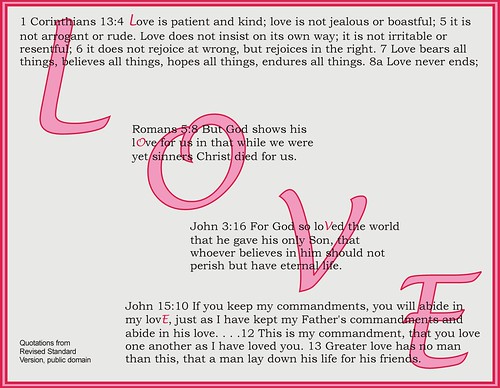
You may be able to see larger versions of this poster from my Flickr photostream -- use the photo as a link. No password or membership is required to see Flickr photos.
I thank my wife for advice on this poster, and it is dedicate to her. She wished that I had used a different translation, but I wanted one in public domain, and the RSV seemed best. Her problem was with 1 Corinthians 13:7, which, in the RSV, says "believes all things." Some versions have "trusts" here, instead, and I think that that conveys the meaning better. I believe that the idea is that we trust God's love, no matter what.
As you probably know, there is more than one word for love in the Greek. (See Wikipedia article on The Four Loves, by C. S. Lewis.)
Thank you, God, for Your great love, which I don't deserve.
Sunday, February 13, 2011
prayers in the Bible: Paul in 2 Thessalonians 1
2 Thessalonians 1:11 To this end we also pray always for you, that our God may count you worthy of your calling, and fulfill every desire of goodness and work of faith, with power; 1:12 that the name of our Lord Jesus may be glorified in you, and you in him, according to the grace of our God and the Lord Jesus Christ. (WEB)
Here is a simple, yet profound prayer. It is that God would count us worthy of our calling! How simple. How profound. May it be so in my own life.
This is part of a series on prayers in the Bible. The previous post in the series is here.
Thanks for reading.
Here is a simple, yet profound prayer. It is that God would count us worthy of our calling! How simple. How profound. May it be so in my own life.
This is part of a series on prayers in the Bible. The previous post in the series is here.
Thanks for reading.
Subscribe to:
Posts (Atom)