License

I have written an e-book, Does the Bible Really Say That?, which is free to anyone. To download that book, in several formats, go here.
Creative Commons License
The posts in this blog are licensed under a Creative Commons Attribution-NonCommercial-ShareAlike 3.0 Unported License. You can copy and use this material, as long as you aren't making money from it. If you give me credit, thanks. If not, OK.

Tuesday, August 21, 2012

Job, Harry Potter and misery

If there is a God, and He is even close to all-powerful, why is there suffering? (If there is a god who isn't even close to being all-powerful, he, she, or it is not God.)

That's a very good question, and theologians and philosophers have been asking it, and trying to answer, for a long time. But it's pretty clear that none of the answers are fully satisfactory to everybody. This attempt won't be, either. (I have dealt with the topic before, here, and here, among other places.)

C. S. Lewis had two good answers. One of them was in his non-fictional book, The Problem of Pain. Here it is in one sentence: "Try to exclude the possibility of suffering which the order of nature and the existence of free-wills involve, and you will find that you have excluded life itself." The other, simpler, better answer is in his splendid novel, Till We Have Faces. The four-sentence answer there is "I know now, Lord, why you utter no answer. You are yourself the answer. Before your face questions die away. What other answer would suffice?" To me, a belief in an after-life is also an answer, but I won't say more about that here. I doubt if it's a full answer for almost anyone.

I'm sure that not everyone is satisfied with either of the answers given by Lewis. The question remains, for many.

One of the books of the Bible, Job, is about suffering. God, although sovereign, allowed Satan, the adversary, to take Job's possessions, his children, and his good health. (Satan said that, if he was allowed to do so, Job would lose his faith in God.) Job didn't like all this loss, and complained about what he didn't like for a few chapters. Other people, well-meaning, tried to tell Job that all this was his fault -- he must have done something bad. His wife told him to stop believing in God. Job refused to believe that his troubles were his fault, and he refused to stop believing in the goodness of God. But he still had a question. Why did this happen to me? In the end, God appeared to Job, and, basically, said, "Who are you to question me?" Job said, basically, "I'm sorry, you are right. Forgive me. I'll shut up." Then God restored his possessions, and he had more children. God told those who had questioned Job's righteousness to ask Job to pray for them. Satan doesn't make an appearance, after the very first part, but presumably he was seriously disappointed by Job's reaction. In many ways, the answer given Job is the same as the answer given in The Problem of Pain.

I don't know, for sure, if Job was a real character. He probably was, but I suppose that the book could be a long parable. I don't think it matters, for our purposes. The question remains -- why is there suffering, if there is a powerful and loving God?

I presume that you know enough about the Harry Potter books, by J. K. Rowling, that what I am about to say makes sense. If not, you  should read them, or at least the Wikipedia summary. (Here's one place where I have written about the books previously.)

Is J. K. Rowling a terrible person? After all, she wrote about a character, Harry Potter, who had to undergo a great deal of suffering. His parents died while he was still very small, he had to live with relatives, the Dursley's, who took advantage of him, and restricted him terribly. He went through all sorts of ordeals. Some of his best friends died. He felt that he and his two closest friends had to leave his wizard training at Hogwarts, and wander in the woods for an extended period of time, during which the three of them suffered the misery of disagreeing with one another, and doubting each other's motives. Harry's mentor, Dumbledore, died. Harry himself offered to die to save the good wizards.

Would people read these seven books, and watch the movies based on them, if Harry hadn't had to suffer? I don't think so. A life without conflict, without occasional misery, seems dull and uninteresting. (How much good news do you see on TV, or read in the newspaper, compared to scandals, natural disasters, wars, crimes, stupidity by various politicians, and other awful things? Not very much. The news organizations couldn't sell good news. We wouldn't buy it, or watch or read it.)

Rowling, to write a novel which speaks to us (or at least to some of us) included suffering, of various kinds. True, it wasn't all about suffering. In the end, Harry marries his sweetheart, and has children. He is at least on nodding terms with Draco Malfoy, who was once his bitter enemy. Voldemort and his followers are defeated. But I submit that Rowling, who had almost absolute power over the content of her books, including the plot, was not a bad person because she put many of her characters through terrible suffering. And she didn't put in characters, like Voldemort, who had, except possibly before the books start, no good characteristics, because she was not in control of what she wrote. She was.

Similarly, God is not a bad person, nor impotent, because there is misery in the world.

I know. The Harry Potter books are fiction. My life (I think) is real. So is yours. No analogy is perfect, and this one certainly isn't. But I think it helped me to write this post. Besides, I'm not so sure that the life of characters in a novel, in relationship to the author, doesn't resemble the relationship between our lives and the Creator.

Thanks for reading.


How to make your browser safer

Gizmo's Freeware has done it again. They have published a fine article on how to make your browser safer.

The article includes separate instructions for all common browsers. I highly recommend that you read it, and take at least some of the precautions suggested.


Monday, August 20, 2012

The world was fresh and young: Howard Pyle


Upon that quest, Sir Percival and Sir Ewaine rode together for the sake of companionship. And they made agreement to travel together in that wise until the fortunes of adventure should separate them.
So they rode side by side in very pleasant companionship, taking the way that chance led them, yet everywhere seeking for news of Sir Launcelot, of whom they could find no word of any sort.
In those days the world was very fresh and young, so that it was great pleasure to journey in that wise, for anon they two rode beneath blue skies and anon through gentle showers, anon up hill and anon down dale, anon through countryside, anon through town, anon through forest and anon through wold. Yea; in those days, when the world was young, all things of life were so gay and joyous that it was little wonder that good knights like those twain took delight in being abroad in that wise, for so they might breathe more freely, out in the wider expanses of God's world, and so the spirit within them might expand to a greater joy of life than would be possible in court or in lady's bower. - Howard Pyle, The Story of Sir Launcelot and His Companions, public domain. (Originally published in 1907)

Pyle was an illustrator, primarily of children's books -- this one was meant to be one. I first read it, and its three companion volumes, from my elementary school library, more than six decades ago. Pyle was considered to be an excellent artist, as well as a teacher of other well-known artists -- see the Wikipedia article on him. His most important pupil was probably N. C. Wyeth. The article says that Pyle's pirate book is largely responsible for the way current popular culture (such as the Pirates of the Caribbean series) shows pirates.

His idea of the world being somehow better during the time of King Arthur is interesting, and attractive, and it was probably one of the attractions of his series on Camelot, but I'm not sure that it is valid. The book which is the source of the quotation, and other books by Pyle, are available free from Project Gutenberg.

Thanks for reading.

Sunday, August 19, 2012

Prayer and Trouble, Part 6, by E. M. Bounds

Prayer in the time of trouble brings comfort, help, hope, and blessings, which, while not removing the trouble, enable the saint the better to bear it and to submit to the will of God. Prayer opens the eyes to see God’s hand in trouble. Prayer does not interpret God’s providences, but it does justify them and recognise God in them. Prayer enables us to see wise ends in trouble. Prayer in trouble drives us away from unbelief, saves us from doubt, and delivers from all vain and foolish questionings because of our painful experiences. Let us not lose sight of the tribute paid to Job when all his troubles came to the culminating point: “In all this Job sinned not, nor charged God foolishly.”

Alas! for vain, ignorant men, without faith in God and knowing nothing of God’s disciplinary processes in dealing with men, who charge God foolishly when troubles come, and who are tempted to “curse God.” How silly and vain are the complainings, the murmurings and the rebellion of men in the time of trouble! What need to read again the story of the Children of Israel in the wilderness! And how useless is all our fretting, our worrying over trouble, as if such unhappy doings on our part could change things! “And which of you with taking thought, can add to his stature one cubit?” How much wiser, how much better, how much easier to bear life’s troubles when we take everything to God in prayer? From The Essentials of Prayer, by E. M. Bounds.

Although E. M. Bounds died in 1913, this book was first published in 1925, by an admirer of the author's life. Bounds was known for praying from four until seven each morning.

This post is one of a series, taken from The Essentials of Prayer, by Bounds. Found through the Christian Classics Ethereal Library, here. The Essentials of Prayer is in the public domain. The previous post in the entire series on the book is here. Thanks for reading. Read this book, and, more importantly, practice, prayer.

Thursday, August 16, 2012

Heartless, by Anne Elisabeth Stengl

Heartless (Tales of Goldstone Wood), by Anne Elisabeth Stengl, is a fantasy book, with swords, magic, and dragons. (See here for my musings on why sword and sorcery fiction is popular). It won the Christy award for Best First Novel in 2011. I haven't read the other winners, and I'm not sure if a fantasy novel has won this particular Christy Award previously, but the award was well deserved.

Stengl does not have a Wikipedia article on her, and Heartless doesn't, either. Here is the Amazon page for the author, and she has a blog.

I'll try to give away as little as possible of the plot, but will muse on various aspects of the novel. The plot is complex.

First, I confess that I have read two novels, by the same author, published after Heartless, in her series, Tales of Goldstone Wood. The second one, Veiled Rose, mostly takes place before the events in Heartless. There are some allusions to these events in Heartless, indicating that the author didn't just write a second novel based on the first one -- the first one foreshadows the second, and she already had largely it in mind when writing the first. (There is supposed to be a fourth novel, to be released later this year.)

Second, there is no doubt in my mind that this qualifies as a Christian novel, by almost any standard. I don't say this because it mentions Christ, or God, or the Bible, or salvation. It doesn't. In fact, the theology of the characters is nearly non-existent. They don't worship together, and they don't pray on a regular basis. I hope to post later, giving more detail on why I say that the book is Christian. My guess is that the fact that there is no direct "preaching" in the book might make it more attractive to non-Christians.

There is a Christ-figure, not in the sense that he dies to pay for the sins of others, at least not within the events of this book, but in the sense that he comes from another realm -- fairyland -- with the purpose of taking a bride for himself.

There are, as I said, dragons. Stengl's dragons live a very long time. They can appear as dragons, huge lizards with wings and fiery breath, or as human, or at least human-like, beings. They can talk, and are intelligent. They love treasure. They are almost entirely evil. No dragon is a main character, but a few of them appear in the book, and they are important in it.

The theme of the book is trust. Una, a princess coming into adulthood, and who is one of the main characters, trusts the wrong person for much of the story, but finally comes to trust the right one. In fact, she trusts him enough to let him kill her, as a dragon, so that she may live as a human. The episode reminded me of the experience of Eustace Scrubb, transformed from a dragon to a human by Aslan, in The Voyage of the Dawn Treader, by C. S. Lewis, but Stengl's depiction is more gripping, and, as I said, coming to that point is, in large part, what the book is about.

This is a fine book, and compares well with good fantasy from mainstream publishers. I confess that I have read Heartless twice in less than two months, and I am glad that I did.

I have read both the hardback book and the Kindle edition. Bethany House, the publisher, is to be commended for the latter. Not only are there color ornaments, and the like, and not many typos, but you can go to page numbers in the book, if you need to.

The book could have used a map, but there isn't one, in either edition.

Thanks for reading. Read Heartless.

Death and natural selection: compatible with the Bible?

In a series posted by the BioLogos Forum, the question of whether death, which is often thought to be a central part of how natural selection works, is considered. A Southern Baptist theologian doubts that such a mechanism is consistent with scripture, and with the goodness of God. A christian biologist responds, indicating that it is.

The biologist puts forth a couple of important ideas: biologists have a more complex view of the role of death and natural selection than Darwin (and most modern non-biologists) have, and some important theologians, before Darwin's theory was ever proposed, believed that non-human death could have occurred before the fall.

Here's the last post in the series, which provides links to the other three. (Look to the right of the photo of a church.)

Wednesday, August 15, 2012

Sunspots 379

Things I have recently spotted that may be of interest to someone else:

Science: Wired reports on a study that shows that social connectedness as a teenager is much more important than academic achievement in adult happiness.

Sports: Syndicated columnist George F. Will says that football has gotten too big and too dangerous for the players.

The Arts: Rebecca Luella Miller, of Speculative Faith, tells us why fantasy is so appealing to so-called young adults.

Politics: (or something) National Public Radio reports that a book on Thomas Jefferson, by David Barton, has been pulled from their offerings, because of errors of fact.

Computing: Fox News reports that the bad guys use suddenly popular searches (related to some scandal, for example) as a way to mess up our computers.

Christianity: From the BioLogos Foundation, a brief summary of the history of how Darwin was received by Christians, in his own time. By no means all Christians were hostile. (Some were.)

Image source (public domain)

Monday, August 13, 2012

National Public Radio on David Barton's view of US history

National Public Radio has done some fact-checking about claims made by David Barton, whose view of history is so congenial to the right wing. He has made numerous false claims, according to NPR's research. Other authorities have also questioned his scholarship.

The truth speaks for itself. It doesn't need to be defended with inaccuracies or distortions, and such are generally counter-productive.

Update, August 14: Evangelical scholars have also criticized Barton's methods and conclusions. See here.

Thanks for reading.


Sunday, August 12, 2012

Prayer and Trouble, Part 5, by E. M. Bounds

There is a distinct note of comfort in the Gospel for the praying saints of the Lord, and He is a wise scribe in Divine things who knows how to minister this comfort to the brokenhearted and sad ones of earth. Jesus Himself said to His sad disciples, “I will not leave you comfortless.”

All the foregoing has been said that we may rightly appreciate the relationship of prayer to trouble. In the time of trouble, where does prayer come in? The Psalmist tells us: “Call upon me in the day of trouble; I will deliver thee, and thou shalt glorify me.” Prayer is the most appropriate thing for a soul to do in the “time of trouble.” Prayer recognises God in the day of trouble. “It is the Lord; let him do what seemeth him good.” [1 Samuel 3:18] Prayer sees God’s hand in trouble, and prays about it. Nothing more truly shows us our helplessness than when trouble comes. It brings the strong man low, it discloses our weakness, it brings a  sense of helplessness. Blessed is he who knows how to turn to God in “the time of trouble.” If trouble is of  the Lord, then the most natural thing to do is to carry the trouble to the Lord, and seek grace and patience and submission. It is the time to inquire in the trouble, “Lord, what wilt thou have me to do?” How natural and reasonable for the soul, oppressed, broken, and bruised, to bow low at the footstool of mercy and seek the face of God? Where could a soul in trouble more likely find solace than in the closet?
Alas! trouble does not always drive men to God in prayer. Sad is the case of him who, when trouble bends his spirit down and grieves his heart, yet knows not whence the trouble comes nor knows how to pray about it. Blessed is the man who is driven by trouble to his knees in prayer! - From The Essentials of Prayer, by E. M. Bounds.

Although E. M. Bounds died in 1913, this book was first published in 1925, by an admirer of the author's life. Bounds was known for praying from four until seven each morning.

This post is one of a series, taken from The Essentials of Prayer, by Bounds. Found through the Christian Classics Ethereal Library, here. The Essentials of Prayer is in the public domain. The previous post in the entire series on the book is here. Thanks for reading. Read this book, and, more importantly, practice, prayer.

Saturday, August 11, 2012

Evidence for being a Christian: What the Bible says

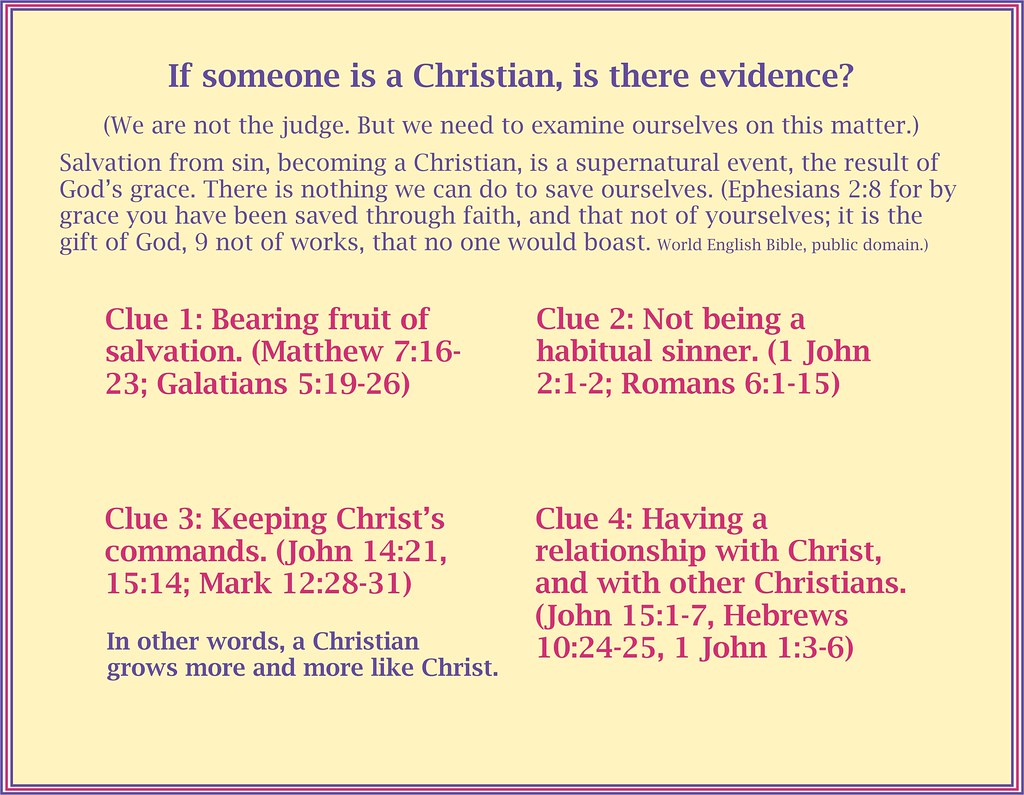
Evidence for Being a Christian
(The graphic above is a link to a larger version, which you are free to use for non-commercial purposes.)


Who is saved?

We cannot save ourselves, and the church cannot save us.
Salvation from sin is a supernatural event, the result of God’s grace. We can ask forgiveness for sin, and accept Christ’s atoning sacrifice, and the power of the resurrection. We need to do these things. But salvation is God’s work in us. (Ephesians 2:8 for by grace you have been saved through faith, and that not of yourselves; it is the gift of God, 9 not of works, that no one would boast. (Scripture quotations from the World English Bible, public domain)

Furthermore, raising our hands, saying a prayer, kneeling at a mourner’s bench, shaking a preacher’s hand, testifying to being saved, being baptized, having our names on a church roll do not and cannot save us, in and of themselves. (There is nothing wrong with these acts, or similar ones, and most converts ought to do most or all of them, especially baptism, but they don’t save us.) In other words, no one is saved because she thinks she is, or because he joined the church 15 years ago. If she or he is saved, it is because of God’s forgiveness. Whether we are saved or not is ultimately a question that only God can really answer. I once heard a Southern Baptist pastor say that about 50% of the people on the rolls of his church weren’t really saved. Why did he say that? Because, although they had participated in one or more of the acts listed above, they showed no evidence of salvation. (Southern Baptists are by no means alone in this!)

A person who is saved bears fruit of salvation 
Matthew 13:18 “Hear, then, the parable of the farmer. 19 When anyone hears the word of the Kingdom, and doesn’t understand it, the evil one comes, and snatches away that which has been sown in his heart. This is what was sown by the roadside. 20 What was sown on the rocky places, this is he who hears the word, and immediately with joy receives it; 21 yet he has no root in himself, but endures for a while. When oppression or persecution arises because of the word, immediately he stumbles. 22 What was sown among the thorns, this is he who hears the word, but the cares of this age and the deceitfulness of riches choke the word, and he becomes unfruitful. 23 What was sown on the good ground, this is he who hears the word, and understands it, who most certainly bears fruit, and produces, some one hundred times as much, some sixty, and some thirty.”

Matthew 7:16 By their fruits you will know them. Do you gather grapes from thorns, or figs from thistles? 17 Even so, every good tree produces good fruit; but the corrupt tree produces evil fruit. 18 A good tree can’t produce evil fruit, neither can a corrupt tree produce good fruit. 19 Every tree that doesn’t grow good fruit is cut down, and thrown into the fire. 20 Therefore by their fruits you will know them. 21 Not everyone who says to me, ‘Lord, Lord,’ will enter into the Kingdom of Heaven; but he who does the will of my Father who is in heaven. 22 Many will tell me in that day, ‘Lord, Lord, didn’t we prophesy in your name, in your name cast out demons, and in your name do many mighty works?’ 23 Then I will tell them, ‘I never knew you. Depart from me, you who work iniquity.’

John 15:1 “I am the true vine, and my Father is the farmer. 2 Every branch in me that doesn’t bear fruit, he takes away. Every branch that bears fruit, he prunes, that it may bear more fruit. 3 You are already pruned clean because of the word which I have spoken to you. 4 Remain in me, and I in you. As the branch can’t bear fruit by itself, unless it remains in the vine, so neither can you, unless you remain in me. 5 I am the vine. You are the branches. He who remains in me, and I in him, the same bears much fruit, for apart from me you can do nothing. 6 If a man doesn’t remain in me, he is thrown out as a branch, and is withered; and they gather them, throw them into the fire, and they are burned. 7 If you remain in me, and my words remain in you, you will ask whatever you desire, and it will be done for you.

Jesus does not explain what “fruit” is. But He calls it “good fruit,” and says that we must remain in Him in order to produce it. The fruit is probably two related things: influencing people to be converted, and the Fruits of the Spirit, described in Galatians 5, which also describes bad fruit:

Galatians 5:19 Now the deeds of the flesh are obvious, which are: adultery, sexual immorality, uncleanness, lustfulness, 20 idolatry, sorcery, hatred, strife, jealousies, outbursts of anger, rivalries, divisions, heresies, 21 envy, murders, drunkenness, orgies, and things like these; of which I forewarn you, even as I also forewarned you, that those who practice such things will not inherit the Kingdom of God.
22 But the fruit of the Spirit is love, joy, peace, patience, kindness, goodness, faith, 23 gentleness, and self-control. Against such things there is no law. 24 Those who belong to Christ have crucified the flesh with its passions and lusts. 25 If we live by the Spirit, let’s also walk by the Spirit. 26 Let’s not become conceited, provoking one another, and envying one another.

A person who is saved is not a habitual sinner.
(Note: To some people, sin is anything short of perfection – to them, honest mistakes, and memory lapses, are sin. However, I am using a more restrictive definition, from the Free Dictionary: 1. A transgression of a religious or moral law, especially when deliberate.  
2. Theology
a. Deliberate disobedience to the known will of God. b. A condition of estrangement from God resulting from such disobedience.
We should remember that there are sins of omission – things that we should do, but don’t – as well as sins of commission. See James 4:17 and Matthew 25:40-25.
Newly saved people don't instantly become mature Christians. The Holy Spirit works to develop us. Even mature Christians may newly realize some sin as He reveals it to them. Psalm 86:11a Teach me your way, Yahweh.)

1 John 2:1 My little children, I write these things to you so that you may not sin. If anyone sins, we have a Counselor with the Father, Jesus Christ, the righteous. 2 And he is the atoning sacrifice for our sins, and not for ours only, but also for the whole world.

Romans 6:1 What shall we say then? Shall we continue in sin, that grace may abound? 2 May it never be! We who died to sin, how could we live in it any longer? 3 Or don’t you know that all we who were baptized into Christ Jesus were baptized into his death? 4 We were buried therefore with him through baptism to death, that just as Christ was raised from the dead through the glory of the Father, so we also might walk in newness of life. 5 For if we have become united with him in the likeness of his death, we will also be part of his resurrection; 6 knowing this, that our old man was crucified with him, that the body of sin might be done away with, so that we would no longer be in bondage to sin. 7 For he who has died has been freed from sin. 8 But if we died with Christ, we believe that we will also live with him; 9 knowing that Christ, being raised from the dead, dies no more. Death no more has dominion over him! 10 For the death that he died, he died to sin one time; but the life that he lives, he lives to God. 11 Thus consider yourselves also to be dead to sin, but alive to God in Christ Jesus our Lord. 12 Therefore don’t let sin reign in your mortal body, that you should obey it in its lusts. 13 Also, do not present your members to sin as instruments of unrighteousness, but present yourselves to God, as alive from the dead, and your members as instruments of righteousness to God. 14 For sin will not have dominion over you. For you are not under law, but under grace. 15 What then? Shall we sin, because we are not under law, but under grace? May it never be!

A person who is saved follows Christ’s commandments.
John 14:21 One who has my commandments, and keeps them, that person is one who loves me. One who loves me will be loved by my Father, and I will love him, and will reveal myself to him.”
23 Jesus answered him, “If a man loves me, he will keep my word. My Father will love him, and we will come to him, and make our home with him. 24 He who doesn’t love me doesn’t keep my words.

John 15:14  You are my friends, if you do whatever I command you.

1 John 1:3 This is how we know that we know him: if we keep his commandments. 4 One who says, “I know him,” and doesn’t keep his commandments, is a liar, and the truth isn’t in him. 5 But whoever keeps his word, God’s love has most certainly been perfected in him. This is how we know that we are in him: 6 he who says he remains in him ought himself also to walk just like he walked.

Matthew 7:24 “Everyone therefore who hears these words of mine, and does them, I will liken him to a wise man, who built his house on a rock. 25 The rain came down, the floods came, and the winds blew, and beat on that house; and it didn’t fall, for it was founded on the rock. 26 Everyone who hears these words of mine, and doesn’t do them will be like a foolish man, who built his house on the sand. 27 The rain came down, the floods came, and the winds blew, and beat on that house; and it fell—and great was its fall.”

What are Christ’s commandments?
Many of them are found in the Sermon on the Mount (Matthew 5-7). Some of the commands in that Sermon are to keep our motives pure – don’t even want to commit adultery or murder; be reconciled to others, and forgive them; turn the other cheek; love even your enemies; don’t draw attention to your good deeds; don’t be anxious about worldly possessions; judge yourselves before judging others; beware of false prophets. He also told us to live the summary of the Old Testament Law:

Matthew 22:37 Jesus said to him, “‘You shall love the Lord your God with all your heart, with all your soul, and with all your mind.’ 38 This is the first and great commandment. 39 A second likewise is this, ‘You shall love your neighbor as yourself.’ 40 The whole law and the prophets depend on these two commandments.”

In Mark 12:14-19, Jesus commanded His listeners to honor the government, including paying taxes. We should remember that this was an occupying government, and its head was a Roman pagan emperor.

There are other commands, but one more is found in the last words of Matthew’s gospel: Matthew 28:19 Go, and make disciples of all nations, baptizing them in the name of the Father and of the Son and of the Holy Spirit, 20 teaching them to observe all things that I commanded you. Behold, I am with you always, even to the end of the age.” Amen.

A person who is saved continues in a relationship with Christ, and seeks the fellowship of other Christians. 
John 15:1-7 (quoted above) uses the phrase “remain in me” or equivalent, seven times.

John 17:20 Not for these only do I pray, but for those also who believe in me through their word, 21 that they may all be one; even as you, Father, are in me, and I in you, that they also may be one in us; that the world may believe that you sent me. 22 The glory which you have given me, I have given to them; that they may be one, even as we are one; 23 I in them, and you in me, that they may be perfected into one; that the world may know that you sent me, and loved them, even as you loved me.

Hebrews 10:24 Let us consider how to provoke one another to love and good works, 25 not forsaking our own assembling together, as the custom of some is, but exhorting one another; and so much the more, as you see the Day approaching.

There are about 20 occurrences of groups of Christians being together in Acts. (See here.) Sometimes they met to worship, sometimes as a prayer meeting, sometimes to consider policy or doctrine. It was Paul’s practice to establish churches wherever he went as a missionary. Christ refers to seven churches in Revelation.

To summarize the evidences given above for being a Christian, a Christian becomes more and more like Christ. The Holy Spirit works in the life of a believer to bring these things about.

My conclusion is that as long as we remain in good relationship with God, we will keep Christ’s commandments, our lives will bear fruit, and we will not lose our salvation. Perhaps I ought to stop there, but the original question still remains. There are at least two views of the answer, both with Biblical support, but the question, and its answers, are trivial beside the more important question – am I saved now? Unfortunately, some people, who don't follow Christ's commandments, who do not have a relationship with Christ, who are persistent and unrepentant sinners, and whose lives show the wrong kind of fruit, are deluded by Satan into thinking that they are saved when they are not.

Thanks for reading!

Added October 26, 2012: You may want to see this post, on the warning passages in the book of Hebrews.

Added June 9, 2015: Neither the chart, nor the above discussion, consider baptism as evidence that one is a Christian. In Acts, baptism was perhaps the most important sign of being converted. Jesus commanded the church to baptize new believers. It's important! But what the chart and discussion are really about is ongoing evidence, up-to-date evidence. Baptism, for most believers, is a one-time event. The four evidences above are about our continuing life in Christ.

Friday, August 10, 2012

"Darwin's Finches" were studied by a Christian

As a retired biology teacher, I knew about the finches of the Galapagos Islands. I also knew that, although they have often been put forth as good evidence for Darwin's theory of speciation by natural selection, Darwin, himself, didn't know much about them (although he did visit the Galapagos Islands while on his voyage with the Beagle.) And I knew that the world's expert on these amazing birds was a man named David Lack. I read his book, Darwin's Finches.

A recent essay from the Biologos Foundation points out something that I didn't know, but is well documented. That is that Lack became a Christian fairly early in his scientific career, and remained one throughout the rest of his life. Furthermore, his faith was known to contemporary scientists. The essay quotes Ernst Mayr, himself a towering figure in the science of evolution, and also perhaps the most important historian of biology of modern times, testifying to Lack's faith. (It is not clear that Mayr, himself, was a Christian. He may have been. He was also an important philosopher of biology.)

The essay indicates that Lack did not find his Christian beliefs and his evolutionary science to be in conflict.

Thanks for reading.

Wednesday, August 08, 2012

Sunspots 378

Things I have recently spotted that may be of interest to someone else:
Science:  Wired reports that scientists attached a small camera to a cormorant, and recorded video from a 150-foot dive.

Wired also reports that the melting of the Greenland ice sheet may not be as big a disaster as we thought.

Computing: Gizmo's freeware has a detailed article on how to tell if your Windows computer is infected. It also has another on how to clean an infected computer. (It's easier to prevent than cure!)

Christianity: (or Hinduism) A blog post about ministering to women who have been involved in the Hindu practice of devadasi, temple prostitution, in India. I don't know how widespread this practice is. Here's the Wikipedia article on the practice.

Image source (public domain)

Monday, August 06, 2012

Life on Mars? So what?

Congratulations to NASA on landing the Curiosity on Mars.

Suppose life is discovered on Mars? I see nothing in the Bible that would rule out that possibility, or that predicts it, and no threat to my faith, whether life is discovered on Mars (or anywhere else but Earth) or not.

Some additional musings:

It is impossible to absolutely prove that there has never been (or, for that matter is not now) life on Mars. It can always be argued that the Curiosity, and any additional exploratory apparatuses or people, have not looked everywhere, under every circumstance. There could be life deep within Mars, or only under rocks in a few places that have been overlooked, or the life might not have been Carbon-based, so the wrong procedure was used to find it. However, I think that we may decide that there is reasonable doubt that life now exists, or ever has existed, on Mars, at some point, if there is no evidence for it.

Who cares if there is life on Mars? Well, curious people ought to care, just to find out. Also, it is possible that, if Martian life forms are found, we might be able to study them, and learn something of value, such as a cure for cancer, or how to establish life on the moon. The discovery of the Americas by Europeans is not an exact parallel, of course, but that discovery certainly changed life in Europe (and the Americas!), in ways that would have been impossible to predict. Do I anticipate important benefits to humans, if life is discovered on Mars? No, but it can't be ruled out.

If there is reasonable doubt that life has ever existed on Mars, then we will probably be more inclined to go there ourselves. The argument that we have messed up the biology of earth, and, therefore, shouldn't be allowed to mess up the biology of Mars, will be weak, or non-existent. Why should we go to Mars? Because it is there, as someone said about why we should climb Mt. Everest, however strong or weak that argument is. It is possible that there may be commercial and scientific value from various phenomena, geological, meteorological, or astronomical, discovered going to Mars.

We certainly have enough to do on earth. Poverty, disease and sin are a long way from being eliminated. But perhaps, as the pictures of the earth from the moon changed our way of thinking about ourselves, probably for the good, looking at earth from another planet, with an atmosphere, might also change our way of thinking about ourselves, for the good, enough and more to offset the expense and effort of going to Mars. But don't hold your breath.

Thanks for reading. I have previously mused about the possibility of religious activity among living things on other planets.

Sunday, August 05, 2012

Prayer and Trouble, Part 4, by E. M. Bounds

Three words practically the same in the processes of Divine discipline are found, temptation, trial and trouble, and yet there is a difference between them. Temptation is really a solicitation to evil arising from the devil or born in the carnal nature of man. Trial is testing. It is that which proves us, tests us, and makes us stronger and better when we submit to the trial and work together with God in it “My brethren, count it all joy when ye fall into divers temptations; knowing this, that the trying of your faith worketh patience.” [James 1:2-3]

Peter speaks along the same line:
“Wherein ye greatly rejoice, now for a season, if need be, ye are in heaviness through manifold temptations; that the trial of your faith being much more precious than that of gold that perisheth, though it be tried with fire, might be found unto praise, and honor and glory at the appearing of Jesus Christ.” [1 Peter 1:6-7]
The third word is trouble itself, which covers all the painful, sorrowing, and grievous events of life. And yet temptations and trials might really become troubles. So that all evil days in life might well be classed under the head of the “time of trouble.” And such days of trouble are the lot of all men. Enough to know that trouble, no matter from what source it comes; becomes in God’s hand His own agent to accomplish His gracious work concerning those who submit patiently to Him, who recognise Him in prayer, and who work together
with God.

Let us settle down at once to the idea that trouble arises not by chance, and neither occurs by what men call accident. “Although affliction cometh not forth of the dust, neither doth trouble spring out of the ground, yet man is born unto trouble as the sparks fly upward.” [Job 5:6-7] Trouble naturally belongs to God’s moral government, and is one of His invaluable agents in governing the world.

When we realise this, we can the better understand much that is recorded in the Scriptures, and can have a clearer conception of God’s dealings with His ancient Israel. In God’s dealings with them, we find what is called a history of Divine Providence, and providence always embraces trouble. No one can understand the story of Joseph and his old father Jacob unless he takes into the account trouble and its varied offices. - From The Essentials of Prayer, by E. M. Bounds.

Although E. M. Bounds died in 1913, this book was first published in 1925, by an admirer of the author's life. Bounds was known for praying from four until seven each morning.

This post is one of a series, taken from The Essentials of Prayer, by Bounds. Found through the Christian Classics Ethereal Library, here. The Essentials of Prayer is in the public domain. The previous post in the entire series on the book is here. Thanks for reading. Read this book, and, more importantly, practice, prayer.

Saturday, August 04, 2012

Why do we have stock markets?

Wired has a most interesting piece, mostly about why stock traders want to trade at as close to light speed as possible, and how that's being accomplished, but the article also raises a fundamental question, and gives a disquieting answer:

"High-frequency trading raises an existential question for capitalism, one that most traders try to avoid confronting: Why do we have stock markets? . . . Trading increasingly is an end in itself, operating at a remove from the goods-and-services-producing part of the economy and taking a growing share of GDP . . ."

I'm not an economist, but I'd suggest a small tax on each stock/commodity/futures/whatever transaction.

Definitely worth a read.

Thursday, August 02, 2012

A Young-earth creationist on the debate (among Christians) about origins

Todd Wood is a good scientist, and a young-earth creationist. He is a young-earth creationist not because he thinks science supports that view, but because he thinks the Bible should be interpreted in that way. Others, of course disagree. He (along with a so-called evolutionary creationist) was recently profiled in a Christianity Today article.

Wood has posted his reaction to the article. The most important, and unfortunate, thing that he said was this: "A lot of folks may be too far gone to participate in fruitful discussion." In other words, a lot of Christians haven't been acting, or thinking, like Christians should, whatever their views on origins, and have become bitter toward those with other views, and close-minded about their own.

I'm afraid he's right, and I hope I'm not one of those "folks." I don't think Wood is.

Thanks for reading. Read Wood.

Wednesday, August 01, 2012

Sunspots 377

Things I have recently spotted that may be of interest to someone else:

Science:  Wired reports on giant fossilized sperm -- from water fleas.

Sports: Wired on the massive anti-drug use efforts at the Olympics.

Computing: Gizmo's Freeware tells us that you can use Skype to let someone in another location see your computer's desktop. This may help in solving computer problems.

Christianity: Ken Schenck has been posting on interpreting the Bible. In a recent post in his series, he wrote: "For example, we have no reason to believe that the Parable of the Prodigal Son or the Parable of the Good Samaritan ever actually happened.  They are parables, not historical stories. Yet they are as true as any history book."

Image source (public domain)

Monday, July 30, 2012

Some quotations on fear

Genesis 3:9 Yahweh God called to the man, and said to him, “Where are you?”
10 The man said, “I heard your voice in the garden, and I was afraid, because I was naked; and I hid myself.” (All Bible quotations from the World English Bible, public domain)

As it was, she was surprised into looking into the Beast's face.
The contrasts she found there were too great: wisdom and despair, power and weakness, man and animal. These made him far more terrible than any hungry lion, any half-tamed hydra, any angry sorcerer, terrible as something that should not exist is terrible, because to recognize that it does exist shakes that faith in the foundations of the natural world which human beings must have to bear the burden of their rationality. Robin McKinley, Rose Daughter. New York: Ace, 1998, p. 87. ("she" is Beauty.)

1 Peter 3:13 Now who is he who will harm you, if you become imitators of that which is good? 14 But even if you should suffer for righteousness’ sake, you are blessed. “Don’t fear what they fear, neither be troubled.”


I was in the chapel over the burial-vault of my race.  I called aloud:  "If any of the dead are moving here, let
them take pity upon me, for I, alas! am still alive; and let some dead woman comfort me, for I am a stranger in the land of the dead, and see no light."  A warm kiss alighted on my lips through the dark.  And I said, "The dead kiss well; I will not be afraid."  And a great hand was reached out of the dark, and grasped mine for a moment, mightily and tenderly.  I said to myself:  "The veil between, though very dark, is very thin." (George MacDonald, Phantastes, public domain)


GHOST, n. The outward and visible sign of an inward fear.

. . . Accounting for the uncommon behavior of ghosts, Heine mentions somebody's ingenious theory to the effect that they are as much afraid of us as we of them. Not quite, if I may judge from such tables of comparative speed as I am able to compile from memories of my own experience.
There is one insuperable obstacle to a belief in ghosts. A ghost never comes naked: he appears either in a winding-sheet or "in his habit as he lived." To believe in him, then, is to believe that not only have the dead the power to make themselves visible after there is nothing left of them, but that the same power inheres in textile fabrics. Supposing the products of the loom to have this ability, what object would they have in exercising it? And why does not the apparition of a suit of clothes sometimes walk abroad without a ghost in it? These be riddles of significance. They reach away down and get a convulsive grip on the very tap-root of this flourishing faith. (Ambrose Bierce, The Devil's Dictionary, public domain)


LONGEVITY, n. Uncommon extension of the fear of death. (The Devil's Dictionary)

My first religion was pure Paganism, which among sincere men is more shortly described as extreme fear. Then there succeeded a state of mind which is quite real, but for which no proper name has ever been found. The ancients called it Stoicism, and I think it must be what some German lunatics mean (if they mean anything) when they talk about Pessimism. It was an empty and open acceptance of the thing that happens—as if one had got beyond the value of it. And then, curiously enough, came a very strong contrary feeling—that things mattered very much indeed, and yet that they were something more than tragic. It was a feeling, not that life was unimportant, but that life was much too important ever to be anything but life. I hope that this was Christianity. At any rate, it occurred at the moment when we went crash into the omnibus. (G. K. Chesterton, Tremendous Trifles, public domain)

Revelation 6:15 The kings of the earth, the princes, the commanding officers, the rich, the strong, and every slave and free person, hid themselves in the caves and in the rocks of the mountains. 16 They told the mountains and the rocks, “Fall on us, and hide us from the face of him who sits on the throne, and from the wrath of the Lamb, 17 for the great day of his wrath has come; and who is able to stand?” 

Thanks for reading.

Sunday, July 29, 2012

Prayer and Trouble, Part 3, by E. M. Bounds

Trouble belongs to the disciplinary part of the moral government of God. This is a life of probation, where the human race is on probation. It is a season of trial. Trouble is not penal in its nature. It belongs to what the Scriptures call “chastening.” “Whom the Lord loveth he chasteneth, and scourgeth every son whom he receiveth.” [Hebrews 12:6] Speaking accurately, punishment does not belong to this life. Punishment for sin will take place in the next world. God’s dealings with people in this world are of the nature of discipline. They are corrective processes in His plans concerning man. It is because of this that prayer comes in when trouble arises. Prayer belongs to the discipline of life.

As trouble is not sinful in itself, neither is it the evidence of sin. Good and bad alike experience trouble. As the rain falls alike on the just and unjust, so drouth likewise comes to the righteous and the wicked. Trouble is no evidence whatever of the Divine displeasure. Scripture instances without number disprove any such idea. Job is a case in point, where God bore explicit testimony to his deep piety, and yet God permitted Satan to afflict him beyond any other man for wise and beneficent purposes. Trouble has no power in itself to interfere with the relations of a saint to God. “Who shall separate us from the love of Christ? Shall tribulation, or distress, or persecution, or famine, or nakedness, or peril, or sword?” [Romans 8:35] - From The Essentials of Prayer, by E. M. Bounds.

Although E. M. Bounds died in 1913, this book was first published in 1925, by an admirer of the author's life. Bounds was known for praying from four until seven each morning.

This post is one of a series, taken from The Essentials of Prayer, by Bounds. Found through the Christian Classics Ethereal Library, here. The Essentials of Prayer is in the public domain. The previous post in the entire series on the book is here. Thanks for reading. Read this book, and, more importantly, practice, prayer.

Friday, July 27, 2012

The Amazing Spiderman - comic book science

My wife and I recently saw The Amazing Spiderman. (Wikipedia article here, official website here.)

The film stars Andrew Garfield as high school nerd Peter Parker, whose parents died in an accident, apparently soon after they left young Peter Parker to live with his aunt and uncle. (Well-played by Sally Field and Martin Sheen, with some good lines, especially for Sheen.) Emma Stone plays Gwen Stacy, his high school classmate, who becomes his best friend. Garfield and Stone are both a little old for high school, but why not? I think they both did a good job as actors.

I don't wish to give away the plot, but will mention a few aspects of the film.

Parker/Spiderman is portrayed as on the side of good -- he wants to fight criminals. But his morals are not always perfect. In a glaring example, he takes an identification badge for a special science internship, which belongs to another student, from a table. When the other student arrives, he is forcibly escorted from the building. Parker shows no remorse, and pays no penalty. Presumably, his action might have cost the other boy a college scholarship. I was reminded of incidents in the Harry Potter books, where Harry, Hermione and Ron often break all sorts of rules, because they think they have to, to do what they want. Sometimes what they are doing is to help them defeat Voldemort. Sometimes it's just to have fun, or to get something they want.

The science in the film is comic book science -- impossible things, like regenerating a limb in a matter of minutes, take place. This is not surprising, since the movie is based on comic books. But we should be careful of comic book science.

I know, no one with any sense is going to consciously judge the scientific enterprise by what they read in comic books, or see in movies based on them. But, still, our mythology becomes part of us, whether we realize it or not, and whether or not it makes sense. Some aspects of comic book science are partly true, but mostly not so. The first is that a single scientist can produce a significant breakthrough in any field of science in a relatively short period. Most significant discoveries are made by teams, or made in more than one place at the same time. The second is that lots of beakers, retorts, tubing, and the like are needed to produce scientific breakthroughs. Sometimes, in some fields. But not in astronomy, or in much of ecology, for example. Third is the myth of the mad scientist. There are some scientists who have done some bad things, or want to do them, but scientists are no more likely to want to deliberately release evil upon humankind than, say, park rangers or kindergarten teachers. Most scientists are simply trying to do their job as best they can, and when ethical issues come up, I don't think they are more (or less) likely to make mistakes than anybody else.

Perhaps we should have more movies about mad bankers, or mad real estate tycoons.

One more aspect. There is a large tower, home of Osco, a bioengineering company, in the middle of Manhattan. Much of the action takes place there. According to the Wikipedia article, the director, Marc Webb, thought of this tower as a modern-day Tower of Babel.

Thanks for reading!

Thursday, July 26, 2012

Ursula K. Le Guin interview

Wired has published an interview with Ursula K. Le Guin, arguably the most important writer of fantastic literature in the last six decades. (She's still writing, at 82 years of age.)

See here for one of my previous posts on Le Guin. Thanks for reading. Read Le Guin. Please.

Wednesday, July 25, 2012

Sunspots 376

Things I have recently spotted that may be of interest to someone else:

Humor:  (sort of) In case you wondered, 15th century bras, and other underwear, have been discovered.

Science:  Articles from the BioLogos Foundation on "Naming 'the God Particle'," and "What is the Higgs Boson?"

The Arts: (and science) Wired has an article on photos of insects, mostly leaf-cutter ants, by an artist.

Image source (public domain)

Tuesday, July 24, 2012

Is there evidence of conversion?

Is there evidence of conversion? I believe so. It's not up to me to judge, and the person I need to be most concerned about is me, not someone else, but here's some of what the Bible says on the subject:

A person who is saved bears fruit of salvation.

Matthew 13:18 “Hear, then, the parable of the farmer. 19 When anyone hears the word of the Kingdom, and doesn’t understand it, the evil one comes, and snatches away that which has been sown in his heart. This is what was sown by the roadside. 20 What was sown on the rocky places, this is he who hears the word, and immediately with joy receives it; 21 yet he has no root in himself, but endures for a while. When oppression or persecution arises because of the word, immediately he stumbles. 22 What was sown among the thorns, this is he who hears the word, but the cares of this age and the deceitfulness of riches choke the word, and he becomes unfruitful. 23 What was sown on the good ground, this is he who hears the word, and understands it, who most certainly bears fruit, and produces, some one hundred times as much, some sixty, and some thirty.” (Scripture quotations from the World English Bible, public domain)

Matthew 7:16 By their fruits you will know them. Do you gather grapes from thorns, or figs from thistles? 17 Even so, every good tree produces good fruit; but the corrupt tree produces evil fruit. 18 A good tree can’t produce evil fruit, neither can a corrupt tree produce good fruit. 19 Every tree that doesn’t grow good fruit is cut down, and thrown into the fire. 20 Therefore by their fruits you will know them. 21 Not everyone who says to me, ‘Lord, Lord,’ will enter into the Kingdom of Heaven; but he who does the will of my Father who is in heaven. 22 Many will tell me in that day, ‘Lord, Lord, didn’t we prophesy in your name, in your name cast out demons, and in your name do many mighty works?’ 23 Then I will tell them, ‘I never knew you. Depart from me, you who work iniquity.’

John 15:1 “I am the true vine, and my Father is the farmer. 2 Every branch in me that doesn’t bear fruit, he takes away. Every branch that bears fruit, he prunes, that it may bear more fruit. 3 You are already pruned clean because of the word which I have spoken to you. 4 Remain in me, and I in you. As the branch can’t bear fruit by itself, unless it remains in the vine, so neither can you, unless you remain in me. 5 I am the vine. You are the branches. He who remains in me, and I in him, the same bears much fruit, for apart from me you can do nothing. 6 If a man doesn’t remain in me, he is thrown out as a branch, and is withered; and they gather them, throw them into the fire, and they are burned. 7 If you remain in me, and my words remain in you, you will ask whatever you desire, and it will be done for you.

Jesus does not explain what “fruit” is. But He calls it “good fruit,” and says that we must remain in Him in order to produce it. The fruit is probably two related things: influencing people to be converted, and the Fruits of the Spirit, described in Galatians 5, which also describes bad fruit:

Galatians 5:19 Now the deeds of the flesh are obvious, which are: adultery, sexual immorality, uncleanness, lustfulness, 20 idolatry, sorcery, hatred, strife, jealousies, outbursts of anger, rivalries, divisions, heresies, 21 envy, murders, drunkenness, orgies, and things like these; of which I forewarn you, even as I also forewarned you, that those who practice such things will not inherit the Kingdom of God.

22 But the fruit of the Spirit is love, joy, peace, patience, kindness, goodness, faith, 23 gentleness, and self-control. Against such things there is no law. 24 Those who belong to Christ have crucified the flesh with its passions and lusts. 25 If we live by the Spirit, let’s also walk by the Spirit. 26 Let’s not become conceited, provoking one another, and envying one another.

A person who is saved is not a habitual sinner.

(Note: To some people, sin is anything short of perfection – to them, honest mistakes, and memory lapses, are sin. However, I am using a more restrictive definition, from the Free Dictionary:

1. A transgression of a religious or moral law, especially when deliberate.
2. Theology
a. Deliberate disobedience to the known will of God.
b. A condition of estrangement from God resulting from such disobedience.

We should remember that there are sins of omission – things that we should do, but don’t – as well as sins of commission. See James 4:17 and Matthew 25:40-25.)

1 John 1:1 My little children, I write these things to you so that you may not sin. If anyone sins, we have a Counselor with the Father, Jesus Christ, the righteous. 2 And he is the atoning sacrifice for our sins, and not for ours only, but also for the whole world.

Romans 6:1 What shall we say then? Shall we continue in sin, that grace may abound? 2 May it never be! We who died to sin, how could we live in it any longer? 3 Or don’t you know that all we who were baptized into Christ Jesus were baptized into his death? 4 We were buried therefore with him through baptism to death, that just as Christ was raised from the dead through the glory of the Father, so we also might walk in newness of life. 5 For if we have become united with him in the likeness of his death, we will also be part of his resurrection; 6 knowing this, that our old man was crucified with him, that the body of sin might be done away with, so that we would no longer be in bondage to sin. 7 For he who has died has been freed from sin. 8 But if we died with Christ, we believe that we will also live with him; 9 knowing that Christ, being raised from the dead, dies no more. Death no more has dominion over him! 10 For the death that he died, he died to sin one time; but the life that he lives, he lives to God. 11 Thus consider yourselves also to be dead to sin, but alive to God in Christ Jesus our Lord.

12 Therefore don’t let sin reign in your mortal body, that you should obey it in its lusts. 13 Also, do not present your members to sin as instruments of unrighteousness, but present yourselves to God, as alive from the dead, and your members as instruments of righteousness to God. 14 For sin will not have dominion over you. For you are not under law, but under grace. 15 What then? Shall we sin, because we are not under law, but under grace? May it never be!

A person who is saved follows Christ’s commandments.

John 14:21 One who has my commandments, and keeps them, that person is one who loves me. One who loves me will be loved by my Father, and I will love him, and will reveal myself to him.”

23 Jesus answered him, “If a man loves me, he will keep my word. My Father will love him, and we will come to him, and make our home with him. 24 He who doesn’t love me doesn’t keep my words.

John 17:15 I pray not that you would take them from the world, but that you would keep them from the evil one. 16 They are not of the world even as I am not of the world. 17 Sanctify them in your truth. Your word is truth. 18 As you sent me into the world, even so I have sent them into the world.

1 John 2:3 This is how we know that we know him: if we keep his commandments. 4 One who says, “I know him,” and doesn’t keep his commandments, is a liar, and the truth isn’t in him. 5 But whoever keeps his word, God’s love has most certainly been perfected in him. This is how we know that we are in him: 6 he who says he remains in him ought himself also to walk just like he walked.

Matthew 7:24 “Everyone therefore who hears these words of mine, and does them, I will liken him to a wise man, who built his house on a rock. 25 The rain came down, the floods came, and the winds blew, and beat on that house; and it didn’t fall, for it was founded on the rock. 26 Everyone who hears these words of mine, and doesn’t do them will be like a foolish man, who built his house on the sand. 27 The rain came down, the floods came, and the winds blew, and beat on that house; and it fell—and great was its fall.”


For more on what Christ's commandments are, see here.

A person who is saved continues in a relationship with Christ, and seeks the fellowship of other Christians.

John 15:1-7 (quoted above) uses the phrase “remain in me” or equivalent, seven times.

John 17:20 Not for these only do I pray, but for those also who believe in me through their word, 21 that they may all be one; even as you, Father, are in me, and I in you, that they also may be one in us; that the world may believe that you sent me. 22 The glory which you have given me, I have given to them; that they may be one, even as we are one; 23 I in them, and you in me, that they may be perfected into one; that the world may know that you sent me, and loved them, even as you loved me.

Hebrews 10:24 Let us consider how to provoke one another to love and good works, 25 not forsaking our own assembling together, as the custom of some is, but exhorting one another; and so much the more, as you see the Day approaching.

There are about 20 occurrences of groups of Christians being together in Acts. Sometimes they met to worship, sometimes as a prayer meeting, sometimes to consider policy or doctrine. It was Paul’s practice to establish churches wherever he went as a missionary. Christ speaks to seven churches, not individuals, in Revelation.

To summarize the evidences given above for being a Christian, a Christian becomes more and more like Christ. The Holy Spirit works in the life of a believer to bring these things about.


Thanks for reading!

August 19, 2012: This document, slightly modified, was re-posted, with a graphic at the beginning, a few days later, here.

Monday, July 23, 2012

Christ's commands -- what are they?

What are Christ’s commandments?

There are a lot of them, and I'm not going to list them all, but this post is an attempt to present some of the most important ones.

Many of Christ's commandments to us are found in the Sermon on the Mount (Matthew 5-7), which includes commands to let our light shine; keep our motives pure – don’t even want to commit adultery or murder; be reconciled to others, and forgive them, especially before you try to worship; turn the other cheek – that is, don't retaliate when others do evil to you; don't pledge that you will do something, just do it; love even your enemies; don’t draw attention to your good deeds; don’t be anxious about worldly possessions; judge yourselves before judging others; beware of false prophets; treat other people as you would like to be treated yourself.

He also told us to live the summary of the Old Testament Law: Matthew 22:37 Jesus said to him, “‘You shall love the Lord your God with all your heart, with all your soul, and with all your mind.’ 38 This is the first and great commandment. 39 A second likewise is this, ‘You shall love your neighbor as yourself.’ 40 The whole law and the prophets depend on these two commandments.” (Bible quotations are from the World English Bible, which is public domain.)
In Mark 12:14-19, Jesus commanded His listeners to honor the government, including paying taxes. We should remember that this was an occupying government, and its head was a Roman pagan emperor.

There are other commands, but one more is found in the last words of Matthew’s gospel: Matthew 28:19 Go, and make disciples of all nations, baptizing them in the name of the Father and of the Son and of the Holy Spirit, 20 teaching them to observe all things that I commanded you. Behold, I am with you always, even to the end of the age.” Amen.

*   *   *   *
I updated this by adding a couple of items that I had forgotten, and by rewording, on August 25, 2012. See also a post on Jesus and the Ten Commandments.

Sunday, July 22, 2012

Prayer and Trouble, Part 2, by E. M. Bounds

What an infinite variety there is in the troubles of life! How diversified the experiences of men in the school of trouble! No two people have the same troubles under like environments. God deals with no two of His children in the same way. And as God varies His treatment of His children, so trouble is varied. God does not repeat Himself. He does not run in a rut. He has not one pattern for every child. Each trouble is proportioned to each child. Each one is dealt with according to his own peculiar case.
Trouble is God’s servant, doing His will unless He is defeated in the execution of that will. Trouble is under the control of Almighty God, and is one of His most efficient agents in fulfilling His purposes and in perfecting His saints. God’s hand is in every trouble which breaks into the lives of men. Not that He directly and arbitrarily orders every unpleasant experience of life. Not that He is personally responsible for every painful and afflicting thing which comes into the lives of His people. But no trouble is ever turned loose in this world
and comes into the life of saint or sinner, but comes with Divine permission, and is allowed to exist and do its painful work with God’s hand in it or on it, carrying out His gracious designs of redemption.

All things are under Divine control. Trouble is neither above God nor beyond His control. It is not something in life independent of God. No matter from what source it springs nor whence it arises, God is sufficiently wise and able to lay His hand upon it without assuming responsibility for its origin, and work it into His plans and purposes concerning the highest welfare of His saints. This is the explanation of that gracious statement in Romans, so often quoted, but the depth of whose meaning has rarely been sounded, “And we know that all things work together for good to them that love God.” [Romans 8:28] - From The Essentials of Prayer, by E. M. Bounds.

Although E. M. Bounds died in 1913, this book was first published in 1925, by an admirer of the author's life. Bounds was known for praying from four until seven each morning.

This post is one of a series, taken from The Essentials of Prayer, by Bounds. Found through the Christian Classics Ethereal Library, here. The Essentials of Prayer is in the public domain. The previous post in the entire series on the book is here. Thanks for reading. Read this book, and, more importantly, practice, prayer.

Wednesday, July 18, 2012

iGoogle is going away: alternatives that may work

iGoogle has been our home page for perhaps 5 years -- the default web page shown when a browser cranks up. It may be yours, too. Favorite links, an appointment calendar, weather in places all over the country, top news stories, schedules for movies showing locally, and more. What's not to like?

Google tells me that iGoogle will not be available after November 1, 2013.

What are the alternatives? One is to just use my browser.

But there are more full-featured possibilities. Here are some that I found, with a little searching. I haven't tried any of them yet, so I'll just list them, with no annotation:

Netvibes

AllMyFaves

Protopage

MyYahoo!

MyHomeMSN

uStart

I hope one of them will work as well as iGoogle has.

Thanks for reading.

*  *  *  *  *
As of January 10, 2013, I have tried some of the above, but am now running FVD Speed Dial, which lets me set up a screen full of icons that I make, from the web site's web page. I have set my FVD page up to open automatically whenever I open a new tab. My FVD Speed Dial page can be synchronized across computers. The program is free, and works with both Firefox and Google Chrome.

Sunspots 375

Things I have recently spotted that may be of interest to someone else:

Science:  Wired reports that long-entrenched thinking among biologists, that female animals select males with showy characteristics, is not entirely correct.

Sci-Tech Daily reports that cancer cells can produce up to five daughter cells, not the usual two, when they divide.

Computing: From Gizmo's Freeware, a Firefox add-on which lets you draw, or type, on a web page while accessing that page with Firefox. (I confess -- I haven't tried it.)

Fox News reports on the first photo ever posted to the World Wide Web.

National Public Radio tells us that senior citizens are using computers much more than they did a few years ago.

Christianity: 

Image source (public domain)

Tuesday, July 17, 2012

This blog is available through twitterfeed

This blog is now available through twitterfeed, as "Sun and Shield blog." Someone asked for this. I hope it works.

Sunday, July 15, 2012

Prayer and Trouble, part 1, by E. M. Bounds

Trouble and prayer are closely related to each other. Prayer is of great value to trouble. Trouble often drives men to God in prayer, while prayer is but the voice of men in trouble. There is great value in prayer in the time of trouble. Prayer often delivers out of trouble, and still oftener gives strength to bear trouble, ministers comfort in trouble, and begets patience in the midst of trouble. Wise is he in the day of trouble who knows his true source of strength and who fails not to pray.

Trouble belongs to the present state of man on earth. “Man that is born of a woman is of few days and full of trouble.” Trouble is common to man. There is no exception in any age or clime or station. Rich and poor alike, the learned and the ignorant, one and all are partakers of this sad and painful inheritance of the fall of man. “There hath no temptation taken you but such as is common to man.” The “day of trouble” dawns on every one at some time in his life. “The evil days come and the years draw nigh” when the heart feels its heavy pressure.

That is an entirely false view of life and shows supreme ignorance that expects nothing but sunshine and looks only for ease, pleasure and flowers. It is this class who are so sadly disappointed and surprised when trouble breaks into their lives. These are the ones who know not God, who know nothing of His disciplinary dealings with His people and who are prayerless.

From The Essentials of Prayer, by E. M. Bounds.

Although E. M. Bounds died in 1913, this book was first published in 1925, by an admirer of the author's life. Bounds was known for praying from four until seven each morning.

This post is one of a series, taken from The Essentials of Prayer, by Bounds. Found through the Christian Classics Ethereal Library, here. The Essentials of Prayer is in the public domain. The previous post in the entire series on the book is here. Thanks for reading. Read this book, and, more importantly, practice, prayer.

Wednesday, July 11, 2012

Sunspots 374

Things I have recently spotted that may be of interest to someone else:

Humor: (or something) Fox News on why Taco Bell flew lunch in to a small town in Alaska.


Computing: Gizmo's Freeware has a page on free video editors.

Christianity: (Sort of) A definition of religion, in a review of books on the evolution of religion, more or less, in The American Interest: “system of symbols which, when enacted by human beings, establishes powerful, pervasive, and long-lasting moods and motivations that make sense in terms of an idea of a general order of existence.” The quotation is from one of the books reviewed, authored by Robert Bellah.
 
Image source (public domain)

Sunday, July 08, 2012

Prayer, Praise and Thanksgiving, by E. M. Bounds: Conclusion

God does much for us in answer to prayer, but we need from Him many gifts, and for them we are to make special prayer. According to our special needs, so must our praying be. We are to be special and particular and bring to the knowledge of God by prayer, supplication and thanksgiving, our particular requests, the things we need, the things we greatly desire. And with it all, accompanying all these requests, there must be thanksgiving.

It is indeed a pleasing thought that what we are called upon to do on earth, to praise and give thanks, the angels in heaven and the redeemed disembodied spirits of the saints are doing also. It is still further pleasing to contemplate the glorious hope that what God wants us to do on earth, we will be engaged in doing throughout an unending eternity. Praise and thanksgiving will be our blessed employment while we remain in heaven. Nor will we ever grow weary of this pleasing task.

From The Essentials of Prayer, by E. M. Bounds.

Although E. M. Bounds died in 1913, this book was first published in 1925, by an admirer of the author's life. Bounds was known for praying from four until seven each morning.

This post is one of a series, taken from The Essentials of Prayer, by Bounds. Found through the Christian Classics Ethereal Library, here. The Essentials of Prayer is in the public domain. The previous post in the entire series on the book is here. Thanks for reading. Read this book, and, more importantly, practice, prayer.

Saturday, July 07, 2012

Christianity Today article on Todd Wood and Darrel Falk

Christianity Today has published an article on Darrel Falk, an evolutionary creationist who is part of the BioLogos Foundation, and on Todd Wood, a young-earth creationist from Bryan College. I don't know either of them personally, but I have read quite a bit of their writing, and they are good representatives of their views. In my view, the article is fair to both Christian scientists.

Friday, July 06, 2012

The Higgs boson -- what it is, etc.

I'm not a nuclear physicist, but this week's landmark discovery (apparently) of the Higgs boson deserves some mention by me. So does the work of the many scientists and other workers who made this event possible.

Here's an article by Reuters, explaining what the Higgs boson/field is all about. Here's another article from Reuters, about the announcement of the discovery. Here's an article from the Christian Science Monitor, including a photo of Peter Higgs, and a 3 minute 27 video explaining the particle/field. And, of course, there's a Wikipedia article.

Physicists cannot explain why there is a universe at all, or why it has the properties we have found. There is nothing in this discovery that eliminates or rules out the activity of God. As Colossians 1 puts it, "in him all things hold together." ("Him" is Christ.)

Thanks for reading. It's more than the Higgs field that holds the universe (and you and me) together.

Wednesday, July 04, 2012

Sunspots 373

Things I have recently spotted that may be of interest to someone else:
 
Science: (or medicine) Some surgeons in training are using clementines (the fruit -- a relative of oranges and tangerines) to practice surgery on, says National Public Radio. It's not as crazy as it sounds.

The Arts: Wired reports that you can have your DNA, or the results of testing on your DNA, turned into a work of art.

Computing: Google is offering a free power searching short course, with six fifty minute classes, beginning in a few days. If you (or I) complete the course, we get a certificate.

National Public Radio reports that Orbitz, the hotel room web site, shows Apple users more expensive options than those logging on with other devices. Other reports document the same phenomenon, from other on-line retailers.

Christianity: Ken Schenck has written a fine article on the four fold sense of scripture.

Image source (public domain)