License

I have written an e-book, Does the Bible Really Say That?, which is free to anyone. To download that book, in several formats, go here.
Creative Commons License
The posts in this blog are licensed under a Creative Commons Attribution-NonCommercial-ShareAlike 3.0 Unported License. You can copy and use this material, as long as you aren't making money from it. If you give me credit, thanks. If not, OK.
Showing posts with label history. Show all posts

Tuesday, November 28, 2023

No Abraham, no Moses: Major events in history, according to Answers in Genesis

Answers in Genesis (AiG) tells us that the Bible is "a history book that reveals the major events of history that are foundational to the Bible’s important messages."

In the web page referenced in the previous paragraph, which is credited to Ken Ham and Stacia McKeever, AiG sets forth seven major events in the history of the world, each one beginning with a C. These are Creation, Corruption (the Fall), Catastrophe (the Flood), Confusion (The Tower of Babel), all of which are in the first 11 chapters of Genesis, and Christ, the Cross, and Consummation, from the remainder of the Bible.

Condensing the Bible into seven, or even more, events is a challenge, and it's not surprising that AiG has left out some major events and individuals. But what have they left out?

Abraham is left out. Abraham is mentioned about 230 times in the Bible, with about 70 of these in the New Testament. These include Galatians 3:6-8, and other important references to Abraham's faith. 

Moses is another omission. Moses is mentioned about 780 times in the Bible, of which about 70 are in the New Testament. These include leading the Israelites through the Red Sea and the Jordan River, governing them for decades, receiving the Ten Commandments and other laws, and speaking to God face to face.

There are other events and people left out of the "important messages," such as Job, David, Ruth, Esther, Isaiah and all of the other prophets. The Psalms are not exactly an event, but they are important even today, often used, and quoted often in the New Testament. There is additional wisdom literature in the Bible. Psalms, Jeremiah and Ezekiel make up about 15% of the Bible.

Acts and the Epistles, which make up much of the New Testament, describe the formation and beliefs of the early church, and are foundational for most of the beliefs of the church of today. They are left out of AiG's list.

On the other hand, the story of the Tower of Babel (Genesis 11) is included in the 7 C's list, in spite of the fact that it isn't referred to anywhere else in the Bible. There are important Bible scholars who do not believe that there actually was such a tower. Bible scholars also question other statements on the 7 C's page, such as that there was a world-wide flood, or that dinosaurs were rescued on the Ark.

AiG is to be commended for pointing us to the importance of the Bible, but emphasizes their interpretation of one book of the Bible,  Genesis, too much. (Genesis is less than 6% of the Bible.)

Thanks for reading.

Wednesday, June 14, 2023

Sunspots 938

Things I have recently spotted that may be of interest to others*:


Computing: Gizmodo reports that a TikTok official may have lied to the US Congress (which is a crime), when he said that TikTok doesn't send user data to China.

Gizmodo on how artificial intelligence can do bad things.

NPR on detecting Artificial Intelligence creations from real ones.

Environment: The National Weather Service has released a video of major air pollution in New York City, mostly from fires in Canada.

History: (and Politics) A Conversation writer describes situations somewhat like the race to become President, with a Vice President running against a previous President.

Another Conversation writer discusses Cleopatra and the rulers (at least some were female) of Nubia.

Humor: (or something) Gizmodo reports that Ikea has developed a couch that folds up for a one-person carry, weighs about 22 pounds, and doesn't require screws, etc., to put together.

Politics: A Conversation writer sets us straight on the Espionage Act.

Science: An exhaustive study, reported in Nature, finds that people all over the world believe that there is a continuing moral decline. But the study reports that this decline is merely perceived, not actual.

A fascinating article in Science Alert discusses how parasites may alter the behavior of their hosts.

Sci-Tech Daily reports that curly hair may have helped early humans to survive.

A Conversation writer tells us all sorts of things about glass.

*I try not to include items that require a password or fee to view.

Thanks for reading.

Monday, January 24, 2022

Answers in Genesis's 7 C's of History, revisited

The graphic above is from Answers in Genesis (AiG) on-line materials. It represents a 4th C, confusion. I believe getting permission for its use is not needed, as I am using a little bit of their post in criticism of AiG.

In a previous post, I commented on the 7 C's of History, a structure by AiG, used to organize human history. The post notes that nearly half of the Bible is not covered by any of these 7 supposedly main points -- Abraham, Moses, nearly all prophecy, the Psalms, and more of the Bible, in Genesis 12 through Malachi are not mentioned.

It is also true that their 4th point, "Confusion," the story of the Tower of Babel, occurs in only one chapter of the Bible, Genesis 11. So far as I can discover, that story is not referred to at all, anywhere else in scripture.

This is remarkable. A supposedly Bible-based organization leaves out large parts of the Bible, including some pretty important ones, and puts in one story that is not referred to in the New Testament at all, and is found in only one chapter of the Old Testament. Bible-based? Sort of.

Thanks for reading.

Saturday, November 27, 2021

Is Genesis 1-11 history, or myth? Comparing the sequence of events in Genesis 1 and Genesis 2

First, what is a myth? The Project Gutenberg eText of Webster's 1913 dictionary says this:
1. A story of great but unknown age which originally embodied a belief regarding some fact or phenomenon of experience, and in which often the forces of nature and of the soul are personified; an ancient legend of a god, a hero, the origin of a race, etc.; a wonder story of prehistoric origin; a popular fable which is, or has been, received as historical.

2. A person or thing existing only in imagination, or whose actual existence is not verifiable.

And what is history? The Project Gutenberg eText of Webster's 1913 dictionary says this:

1. A learning or knowing by inquiry; the knowledge of facts and events, so obtained; hence, a formal statement of such information; a narrative; a description; a written record; as, the history of a patient's case; the history of a legislative bill.

2. A systematic, written account of events, particularly of those affecting a nation, institution, science, or art, and usually connected with a philosophical explanation of their causes; a true story, as distinguished from a romance; -- distinguished also from annals, which relate simply the facts and events of each year, in strict chronological order; from biography, which is the record of an individual's life; and from memoir, which is history composed from personal experience, observation, and memory.

Some Bible scholars claim that Genesis 1-11 is history. If I understand them, they mean that this text relates real events which happened in sequence as they are read in that text. Other Bible scholars claim that the same passage is myth. If I understand them, these scholars mean that this text is true, in the sense that we are to learn from it, and that it tells us about God, but that it does not necessarily portray real events, nor events in the sequence in which they actually happened.

One author who thinks Genesis 1-11 is myth is Joel Edmund Anderson. Here's an excerpt from one of his blog posts:
Saying Genesis 1-11 is myth doesn’t denigrate it. “Myth” doesn’t mean “untruth.” It is a specific genre of ancient writing that was used to describe a culture’s worldview regarding what that culture believed about (a) the gods/God, (b) the nature of human beings, and (c) the nature of the created order. It wasn’t trying to convey historical facts. It was trying to articulate that “worldview lens” through which that culture could interpret their world.

Anderson has written many other blog posts on these topics. So have others. (Here's another of Anderson's posts, pertinent to the topic of the post you are reading.)

What should we learn from Genesis 1-2? I am not God, so cannot be certain of what He wanted us to grasp, but the things that we were meant to learn probably included, first and foremost, that there is only one real God, powerful and wise enough to make the world as it is. Very possibly, mentioning the sun and the moon as appearing on the fourth day, rather than the first day, and without specifically naming them, shows us, and the ancient Hebrews, that we shouldn't worship the sun and the moon. We are also probably meant to learn that God is responsible for beauty, diversity and order in the world, and that humans have special responsibilities -- we are, in some senses, god-like.

Let's now look at Genesis 1 and Genesis 2:


(This graphic gets tangled up with other parts of the blog, on some platforms. The graphic is still there, as a separate file. Feel free to use the graphic, with no attribution needed.)

There are significant differences in the sequence of events in Genesis 1 vs. Genesis 2. Claims that these two chapters both set forth, in sequence, the events of the creation, are not supported by a plain reading of Genesis 1 and 2. There are various ways of explaining the differences between the Genesis 1 sequence, and the Genesis 2 sequence, and perhaps some of them are valid, but the idea that there is a plain reading of these two chapters, setting forth events in sequence, is not supported.
 
This post shows that Answer in Genesis, the most prominent Young-Earth Creationist organization, doesn't believe that there is, or was, a firmament. I guess that that means that the verse about the creation and existence of that firmament can't be history, as history is defined above. (Paragraph added June 17, 2022.)

Thanks for reading!


Wednesday, July 07, 2021

Sunspots 840

Things I have recently spotted that may be of interest to others*:


The Arts: Some Gizmodo writers reflect on what the earliest human music was like.

Environment: (And politics) Gizmodo on right-wing outrage at suggestions that climate change may lead to problems, such as the condo collapse in Florida.

Gizmodo reports on (sort of) sunscreen for roads, which apparently cuts down on heat and pollution.

Finance: Relevant reports that we may soon see advertisements in our dreams.

The graphic used in these posts is from NASA, hence, it is free to use like this.

*I try not to include items that require a password or fee to view.

Thanks for reading.

Tuesday, February 11, 2020

Ken Ham/Answers in Genesis ignores much of the Bible: revising Ham's 7 C's

Answers in Genesis has posted a way of looking at history, by Ken Ham and Stacia McKeever. They hang human history on 7 C's, as follows:
Creation
Corruption
Catastrophe
Confusion
Christ
Cross
Consummation

In their discussion, each of these C's has scripture describing that particular event, or stage.

Others have noted -- I can't remember who -- that since Confusion is about the story of the Tower of Babel, which is in Genesis 11, and the next stage is Christ, their scheme leaves out almost the entirety of the Old Testament.

No Abraham, no plagues of Egypt, no Moses, no Exodus, no Mount Sinai, no Ten Commandments, no Tabernacle, no system of celebration and sacrifices, no prophets, no wisdom literature, no Psalms, no David, no Solomon, no Temple, and much more -- you get the idea. More than half the Bible left out!

Bible scholars are by no means unanimous on the dates and geographic extent of events in Genesis, but by the reckoning of Answers in Genesis, the Tower of Babel (Confusion) was in 2242 BC. (Or 2246 BC.) Thus, about 2240 years of the history of life on earth are ignored in the 7 C scheme. Answers in Genesis says that creation took place in 4004 BC. So their scheme leaves out about 37% of what they believe to have been earth's history, and more than half of the times, and most of the events, covered by the Bible. Amazing, for a Bible-based organization.

I propose, for those who want a C scheme, an 8th C -- Covenant, between Confusion and Christ, and that the scripture associated with this be taken from Genesis 12 through Malachi. Captivity would also fit in.

There is, no doubt, some value in the 7 C's scheme, even if one doesn't agree with the dates put forth by Answers in Genesis, or their ideas on the geographic extent of the Flood. But there's a lot of God's revelation left out.

On January 25, 2022, I added this:
Not only does the 7 C's scheme leave out some important scriptures and people, but it includes a minor story, that of the tower of Babel. That story occurs in only one chapter of Genesis, and, so far as I can determine, is not referred to anywhere else in the Bible.

Thanks for reading! (The title was revised on May 31, 2022)

Wednesday, September 13, 2017

Sunspots 643


Things I have recently spotted that may be of interest to someone else:


Christianity: Christianity Today points out that (in spite of Article VI of the US Constitution) there now seem to be religious tests for public office.


Computing: A Scientific American commentary argues that e-mail should go back to being text-only, for the sake of cyber-safety.

Food: Relevant tells us that there is now a new kind of chocolate -- and it's pink.

History: Listverse tell us some facts about hurricanes, including how the naming system has changed.

Humor: (and health) Relevant reports that the tooth fairy refused to accept a tooth, because the child had not taken proper care of the tooth -- too much sugar, etc.

Scientific American has an article entitled "The Rise of the Recliner as a Male Social Space." Really.
 

Politics: FiveThirtyEight analyzes the changing religious affiliation (or lack of one) of voters for both political parties, and finds that both parties will have to change to continue to attract voters.

National Public Radio looks at Steve Bannon's view of US history, and finds it to be rather inaccurate.


Science: Nature reports that humans are evolving toward living longer.

Scientific American tells us how global climate change is making severe hurricanes more likely.

And Scientific American also reports that fireflies are in danger of going extinct in China, and why.


Image source (public domain)

Wednesday, June 28, 2017

Sunspots 632


Things I have recently spotted that may be of interest to someone else:


Christianity: Relevant and Sojourners report that many evangelical organizations are calling for prison and sentencing reform -- there are too many people in prison for too long, and too many of them are African-American. Attorney General Sessions, on the other hand, seems to want to put as many people behind bars as possible, for as long as possible.

An article in Christianity Today argues that most evangelical Christians have either mostly ignored social injustices, or ignored Biblical principles about sex and family matters.


Computing: The Wikipedia is has competition various right-wing on-line encyclopedias, according to Wired.

(sort of) National Public Radio reports that a man has been fined $120,000,000 for placing millions of robocalls, including some to emergency numbers and hospitals.

Education: "Why teachers suck."

History: Listverse discusses 10 things about our history that most of us get wrong.

Politics: Sojourners reports that a broad coalition of Christians is expressing united opposition to the President's budget, and to the House's health-care bill, and warning against what they believe to be coming in the Senate version of this bill. Their chief complaint is that help for the poor would be cut drastically. (Note - budgets submitted by Presidents rarely, if ever, are approved without significant changes.)

Relevant says that it's time for the church to address gun violence.

National Public Radio reports on a survey, which indicates that more than 80% of Americans believe people with mental illness should not be allowed to have guns; background checks should be done for private sales and gun shows; and guns should not be sold to people on no-fly or terror watch lists.

Science: The Anchorage Daily News reports on how killer whales are interfering with fishermen, apparently communicating with each other, and teaching their young in interference techniques.

National Public Radio reports on why different bird species have eggs with different shapes.


Image source (public domain)

Wednesday, March 01, 2017

Sunspots 615

Things I have recently spotted that may be of interest to someone else:


Christianity: A Relevant writer says that we're called to serve immigrants, legal or illegal.


Health: (Sort of) Listverse has 10 descriptions, from people who died, or thought they would, on what it's like to die.

History: A report on the report of the finding and salvaging of the Hunley, the first submarine to bring down an enemy ship in war. The Hunley sunk in the Charleston, SC, harbor.

Listverse on why the Germans voted the Nazis into power.

Politics: Authorities in so-called Red States are working to eliminate the effects of climate change, but they don't call it that, according to Scientific American.

Science: Scientific American reports on the discovery of 7 planets, around a star that's "only" 40 light-years away, which planets may be suitable for life.

Scientific American also explains the mechanism of the poison that apparently was used to assassinate the half-brother of the North Korean leader.

Bees (not honeybees) have been shown to learn how to do a task by watching another bee do it, according to Nature.

Sports: (Not really) A Relevant writer says it's time for Sports Illustrated to stop publishing the annual swimsuit issue.

(And history) Listverse on 10 sporting events that influenced subsequent events strongly.

Image source (public domain)

Wednesday, December 07, 2016

Sunspots 603

Things I have recently spotted that may be of interest to someone else:


The Arts: Relevant reports on some amazing sculpture made from paper.

Christianity: A Relevant article says that the idea that we have a hole in our heart that only God can fill is dangerous.

Relevant also examines the idea of the "war on Christmas."

BioLogos analyzes the theology of Dr. Strange.


Computing: Gizmo's Freeware tells us how to download the Microsoft Solitaire Collection for iOs and Android devices.

Gizmo's Freeware also lists the top 50 games for Windows, released in the last 10 years. Most of these are also available for other platforms.

Education: National Public Radio reports on the benefits of bilingual education.

History: Listverse tells us about 10 diseases that had a profound effect on history.

Humor: A video of 11,000 dominoes falling.


Politics: (and other things) Benjamin L. Corey says that fake news isn't the problem -- it's that people believe fake news, because they want to.

National Public Radio reports that the military has been discharging thousands of veterans who suffer from various emotional an cognitive disorders, resulting from combat, in such a way that they can't receive all the benefits of those honorably discharged. And tried to cover this up.

Science: National Public Radio also reports on the question of what birds hear when they listen to bird songs.


Image source (public domain)

Sunday, March 20, 2016

Excerpts from Orthodoxy, by G. K. Chesterton, 65

I take in order the next instance offered: the idea that Christianity belongs to the Dark Ages. Here I did not satisfy myself with reading modern generalizations; I read a little history. And in history I found that Christianity, so far from belonging to the Dark Ages, was the one path across the Dark Ages that was not dark. It was a shining bridge connecting two shining civilizations. If any one says that the faith arose in ignorance and savagery the answer is simple: it didn’t. It arose in the Mediterranean civilization in the full summer of the Roman Empire. The world was swarming with skeptics, and pantheism was as plain as the sun, when Constantine nailed the cross to the mast. It is perfectly true that afterwards the ship sank; but it is far more extraordinary that the ship came up again: repainted and glittering, with the cross still at the top. This is the amazing thing the religion did: it turned a sunken ship into a submarine. The ark lived under the load of waters; after being buried under the debris of dynasties and clans, we arose and remembered Rome. If our faith had been a mere fad of the fading empire, fad would have followed fad in the twilight, and if the civilization ever re-emerged (and many such have never re-emerged) it would have been under some new barbaric flag. But the Christian Church was the last life of the old society and was also the first life of the new. She took the people who were forgetting how to make an arch and she taught them to invent the Gothic arch. In a word, the most absurd thing that could be said of the Church is the thing we have all heard said of it. How can we say that the Church wishes to bring us back into the Dark Ages? The Church was the only thing that ever brought us out of them.

I came back to the same conclusion: the sceptic was quite right to go by the facts, only he had not looked at the facts. The sceptic is too credulous; he believes in newspapers or even in encyclopedias. Again the three questions left me with three very antagonistic questions. The average sceptic wanted to know how I explained the namby-pamby note in the Gospel, the connection of the creed with medieval darkness and the political impracticability of the Celtic Christians. But I wanted to ask, and to ask with an earnestness amounting to urgency, “What is this incomparable energy which appears first in one walking the earth like a living judgment and this energy which can die with a dying civilization and yet force it to a resurrection from the dead; this energy which last of all can inflame a bankrupt peasantry with so fixed a faith in justice that they get what they ask, while others go empty away; so that the most helpless island of the Empire can actually help itself?” There is an answer: it is an answer to say that the energy is truly from outside the world; that it is psychic, or at least one of the results of a real psychical disturbance. The highest gratitude and respect are due to the great human civilizations such as the old Egyptian or the existing Chinese. Nevertheless it is no injustice for them to say that only modern Europe has exhibited incessantly a power of self-renewal recurring often at the shortest intervals and descending to the smallest facts of building or costume. All other societies die finally and with dignity. We die daily. We are always being born again with almost indecent obstetrics. It is hardly an exaggeration to say that there is in historic Christendom a sort of unnatural life: it could be explained as a supernatural life. It could be explained as an awful galvanic life working in what would have been a corpse. For our civilization ought to have died, by all parallels, by all sociological probability, in the Ragnorak of the end of Rome. That is the weird inspiration of our estate: you and I have no business to be here at all. We are all revenants; all living Christians are dead pagans walking about. Just as Europe was about to be gathered in silence to Assyria and Babylon, something entered into its body. And Europe has had a strange life—it is not too much to say that it has had the jumps—ever since.


Orthodoxy, by G. K. Chesterton, is in the public domain, and available from Project Gutenberg. The previous post in this series is here. Thanks for reading! Read Chesterton.

*  *  *  *  *

Note, April 7, 2016. It has come to my attention that this post has been viewed over 800 times. I have no idea of the reason for this popularity, but am grateful for it.

Wednesday, September 30, 2015

Sunspots 540

Things I have recently spotted that may be of interest to someone else:


Christianity: Benjamin L. Corey on how we should think about the people who wash our cars, check us out in Walmart, stand in line in front of us at McDonalds, etc. Revolutionary!

(and Sports) ESPN reports that two of the most successful quarterbacks in the NFL have sparred over the question of whether God cares about who wins, as opposed to God not caring much about who wins, but caring about the individual players.

Relevant has a post on whether Christians should use politically correct speech, or not. The article actually gives a definition of such speech, which is helpful.


Computing: Gizmo's Freeware reports on a freeware program for rotating video files.

Gizmo also tells you how to check (and change) your privacy settings for Microsoft and Google.

Education: (Or politics, or history) Insidegov has ranked US presidents by their net worth, in comparable dollar values.

Politics: (sort of) The New York Times reports on how the US government is exploring some inexpensive tweaks in how people interact with it, that don't cost much, can save taxpayer money, and can make government more effective.

National Public Radio examines recent proposals to simplify the tax code by having fewer brackets, and finds that that won't simplify much.

Science: Relevant links to a seven-minute video showing, dramatically, how the solar system's objects are really far apart.

Wired tells us that we are surrounded by a cloud of bacteria, that come off our skin, and out of us when we fart.

Audubon tells us why hawks keep hummingbirds safe.


Image source (public domain)

Wednesday, June 11, 2014

Sunspots 474

Things I have recently spotted that may be of interest to someone else:

Christianity: The Huffington Post has an article telling us that we may be using "I've been blessed" entirely too much.
Computing: (or something) One of my photos was used by a Fox News web page, without my permission. Hardly a shock, and it could have been some other web site (and has been, sometimes.) Here's the original photo. They didn't spell my name correctly, but that happens a lot. Oh, well.
Education: (Or history, or politics) Robert Krulwich posts on people who had a parent, or grandparent, who remembered things from over a century ago -- human wormholes. Interesting.

Politics: (Sort of) National Public Radio reports on the death of the last of the Navajo Code Talkers, who used their own language to communicate secrets for the US military, in World War II. Navajo is so complex, and was so obscure to the Japanese, that they were unable to decipher the communications of the Code Talkers.
Science: Fox News reports on evidence that the moon and the earth have always been separate, but collided a long time ago.
The New York Times on a new procedure -- testing for all the DNA in a diseased person's body, and checking that DNA against all known disease-causing organisms, including parasites.
National Public Radio reports that spiders tune their webs, much like violinists tune their violins, although not for the same reasons.

 
Image source (public domain)

Thursday, January 02, 2014

Thomas Aquinas and God's use of natural selection in creation

In two recent posts in the BioLogos Forum, a Roman Catholic theologian claims that Thomas Aquinas, considered the most important theologian of history, by that church, understood that God used natural selection in the creation of the variety of living things.

The posts are here and here.

The posts consider, and refute, one of the most frequent objections to the use of evolutionary processes, the loss of life necessary in natural selection.

The closing statement is "To sum up, why did God choose to create via an evolutionary process rather than via special creation? Because it better reveals his glory and his power. Because it reveals better that he is God."

Thanks for reading.


Monday, September 17, 2012

The My America series

Some time ago, I read My Brother's Keeper: Virginia's Diary, by Mary Pope Osborne, and The Journal of C.J. Jackson: a Dust Bowl Migrant by William Durbin, and found them excellent. They are part of the My America and My Name is America series, a series of books about, and for young teens. Based on the two I read, the books are fictitious diaries about various troubled times in our history, from the viewpoints of various types of young people. I found them to be good reading, and, as far as I can tell, they are true to the facts. The Dust Bowl volume includes photos, and a map of the Southwest, featuring US highway 66.

Thanks for reading.

Monday, August 13, 2012

National Public Radio on David Barton's view of US history

National Public Radio has done some fact-checking about claims made by David Barton, whose view of history is so congenial to the right wing. He has made numerous false claims, according to NPR's research. Other authorities have also questioned his scholarship.

The truth speaks for itself. It doesn't need to be defended with inaccuracies or distortions, and such are generally counter-productive.

Update, August 14: Evangelical scholars have also criticized Barton's methods and conclusions. See here.

Thanks for reading.


Friday, November 19, 2010

Christian Responses to Hitler: Obeying Civil Authority

I am not an expert on history. But I am a Sunday School teacher. This week's Sunday School lesson, in our church, includes Paul's statements, to the Romans, about what sort of attitude they should have towards government. I quote Romans 13:1-7, from the WEB, which is public domain:
13:1 Let every soul be in subjection to the higher authorities, for there is no authority except from God, and those who exist are ordained by God. 2 Therefore he who resists the authority, withstands the ordinance of God; and those who withstand will receive to themselves judgment. 3 For rulers are not a terror to the good work, but to the evil. Do you desire to have no fear of the authority? Do that which is good, and you will have praise from the same, 4 for he is a servant of God to you for good. But if you do that which is evil, be afraid, for he doesn’t bear the sword in vain; for he is a servant of God, an avenger for wrath to him who does evil. 5 Therefore you need to be in subjection, not only because of the wrath, but also for conscience’ sake. 6 For this reason you also pay taxes, for they are servants of God’s service, attending continually on this very thing. 7 Give therefore to everyone what you owe: taxes to whom taxes are due; customs to whom customs; respect to whom respect; honor to whom honor.

My wife, who is in my class, asked me how this related to Hitler. That's a good question. This is my attempt to answer that. The quotation above seems to be saying that Hitler, for one, was ordained by God, and shouldn't have been resisted, at least not by Christians in Germany. In the first place, this principle, namely to submit to authority, was not absolute, even for Paul. In Acts 16, Paul refused to leave prison until the rulers had come personally to apologize to him. (They had arrested him in violation of his rights as a Roman citizen.) With this act, he resisted the order to have him released quietly. Why did Paul say this? We don't know. It is possible that he was acting in his own behalf, and wanted to get back at the authorities because they had violated his rights. It is also possible that he wanted to show, for the sake of the new Christians (the jailer and his household had been converted and baptized) that Christianity was respectable, or that Christ was above earthly authority. We don't know.

In Acts 23, Paul reprimanded the high priest:
23:1 Paul, looking steadfastly at the council, said, “Brothers, I have lived before God in all good conscience until this day.” 2 The high priest, Ananias, commanded those who stood by him to strike him on the mouth. 3 Then Paul said to him, “God will strike you, you whitewashed wall! Do you sit to judge me according to the law, and command me to be struck contrary to the law?” 4 Those who stood by said, “Do you malign God’s high priest?” 5 Paul said, “I didn’t know, brothers, that he was high priest. For it is written, ‘You shall not speak evil of a ruler of your people.’” [The Old Testament reference is to Exodus 22:28]
The NIV Study Bible has a text note on verse 5, suggesting that it is possible that Paul's eyesight was poor, and he couldn't tell that it was the high priest, or that someone else was presiding, sitting in the place of the high priest, or that Paul was being sarcastic, or that he refused to recognized the high priest's authority. It seems to me that there is another possibility, and one that also could have occurred in Acts 16. That is that Paul might have sinned -- he wasn't supposed to react to the authorities as he did. In that case, he would have had to confess and repent of his actions. The Bible doesn't indicate the reasons for Paul's actions in either case.

So what was going on here? Does the New Testament contradict itself? I don't think so.

First, I believe that there is a Biblical principle, which is that we should respect and obey those in authority. But that principle is not as important as other moral principles in the Bible, for example the Ten Commandments. Nor is it above the two great commandments from the Old Testament, which Jesus re-affirmed in the New Testament, in Mark 12:28-34, and Matthew 22:34-40. Nor is it above the Golden Rule, "Do unto others as you would have them do unto you." (Matthew 7:12)

Second, God's authority is over any human authority. If a human authority commands me to do something I shouldn't, for example to commit murder, or to deny Christ as Lord, I should refuse. As Peter said, "We must obey God rather than men." (Acts 5:29)

These two points are different aspects of the same thing.

However, we usually aren't asked, by human authorities, to do something that violates a higher Biblical principle, or that puts human authority above God's. We should prayerfully consider, before refusing to obey a human authority. We should be careful that we aren't wanting to disobey because it would be to our own selfish advantage to do so (for example by cheating on our taxes). We should also be careful that we don't assume, for no good reason, that a political position we don't like is opposed to God's desires.

Third, violent resistance seems to be always, or nearly always, contrary to God's plan for Christians.

So what about Hitler? The rule of Hitler, and the Nazis, seems to have produced situations where Christians had legitimate reasons for refusing to obey civil authority.

Although there is disagreement about Hitler's religious views, mostly because Hitler made statements that seem to be contradictory, it seems likely that Hitler, and the Nazis, wanted to destroy Christianity entirely. Holocaust deniers to the contrary, Hitler and the Nazis did try, and nearly succeeded, in eliminating all the Jews from Germany, and other countries that they conquered. There were Christians, and others, who resisted this. Corrie ten Boom, with other members of her family, deceived the Germans who occupied the Netherlands, in various ways, such as by obtaining ration cards by fraudulent means. They did not carry out violent protest. In this way, they, and other citizens of the Netherlands, were able to get many Jews out of the country. Anne Frank and her family were also kept hidden, and helped, by non-Jewish citizens of the Netherlands, which was against the edicts of the occupying Nazis. Oskar Schindler, and many other people, also helped the Jews, in defiance of Nazi demands. As far as I know, Schindler was not a Christian.

Not all Christians, or those who claimed to be Christians, were opposed to the Nazis. There was a group, known as German Christians, who supported Hitler. This source claims that one reason for this support was that these Christians were opposed to homosexual practices, and to communism, and the Nazis, were, too. Homosexuals and communists (and other groups) were persecuted, and executed, by the Nazis.

There was also a Confessing Church, which was primarily opposed to the theological claims of Nazism, rather than to the Holocaust. The theological claims should have been opposed. Here is one such outrageous claim: "Dr. Zoellner ... has tried to tell me that Christianity consists in faith in Christ as the Son of God. That makes me laugh ... Christianity is not dependent upon the Apostle's Creed .... [but] is represented by the Party .... the German people are now called ... by the Führer to a real Christianity .... The Führer is the herald of a new revelation." (See here. Zoellner was a leader of the Confessing Church.) Karl Barth was also one of its leaders. (Here is an article on Barth's thought, during the early days of the Nazi regime.)

Another leader of the Confessing Church was Dietrich Bonhoeffer. Bonhoeffer is the author of several works, translated into English, including The Cost of Discipleship and Ethics, both of them probably among the dozen or so most influential works on Christianity written during the previous century. Bonhoeffer came to believe that active resistance against Hitler was called for. He joined a group that planned to assassinate Hitler. This group did not succeed, and Bonhoeffer was executed, before he reached his 40th birthday. Bonhoeffer realized that he was acting in a way that seemed contrary to his faith, but said that he felt he had to act as he did, and trust God's grace for forgiveness. (See the Wikipedia article on Bonhoeffer for more.)

The Nazi treatment of the Confessing Church, and the error of the German Christians, are instructive. One lesson is that the Church should always keep the State at arms length. In the U.S., there is a danger that conservative churches will become arms of the Republicans, or the Tea Party, and that liberal churches may become arms of the Democrats. Both of these tendencies must and should be opposed. The state, or a political movement, may seem to have goals compatible with a church, but becoming too close together seems to always mean that the church, not the state, compromises its core principles and beliefs. No political party, and few, if any, political movements, have been fully compatible with Christianity.

More on Politics. Ken Schenck, Religion professor at Indiana Wesleyan University, has posted a compilation of Bible verses about social justice.

I have previously mused on the source of political authority in the U. S.

I have posted on what the New Testament says about what Christian attitudes toward government should be.

Summary: We should honor the state, and civil authority, except in extreme circumstances. But we must always put God's moral demands first. For example, we should obey traffic laws, except in emergencies. Poor planning, such as not starting out early enough, does not constitute an emergency.

Thanks for reading.

Monday, April 05, 2010

Are the ideas of the past always wrong? Chronological snobbery

I was reading a book about C. S. Lewis and Tolkien, and came across a discussion of an idea that was common to these two literary giants. That idea is that, just because an idea was held in the past, that, by itself, does not mean that it was false. In fact, it may still be valid, but have been discarded, like the fashions in apparel or hair styles of 40 years ago. The Wikipedia article on Chronological Snobbery gives a quotation from Lewis. In it, he says that we should ask if an idea was ever shown to be wrong, or did it just fade away?

We live too much in the present, and assume that all our ideas are fresh and new, until they quickly fade, into our past.

Read Lewis, and don't practice Chronological Snobbery.

Thursday, June 18, 2009

Christ Church, Philadelphia

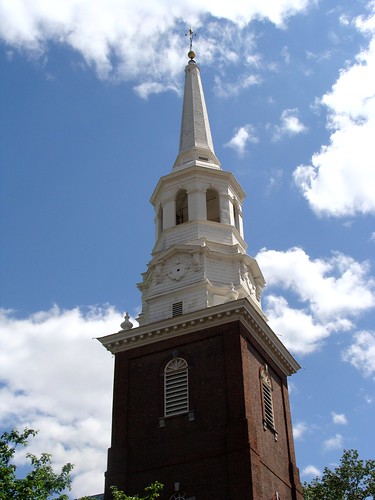
Christ Church, steeple

The photo above shows the steeple of Christ Church, Philadelphia, Pennsylvania, USA, arguably the most important church in the history of the US. The congregation, originally part of the Anglican Church, which became a congregation in 1695, built their first building on this site in 1696. From 1727-1744, a new building, the one shown, was constructed around the first one. The steeple you see contains building materials from the first church, which was torn down when it was possible to use the larger building for worship.

Fifteen signers of the Declaration of Independence attended this church, including Benjamin Franklin. Betsy Ross and George Washington also attended the church. There is a chandelier hanging from the ceiling of the church, with candles. We were told, when we visited the place, that the chandelier was lit for the wedding of Sarah Franklin, Benjamin Franklin's daughter, and that it was lit in May, 2009, for a current wedding. An active congregation meets in the building.

In 1785, the Episcopal church began in this building. We were told that the first African-American pastor of a major denomination was ordained to the ministry in this church.


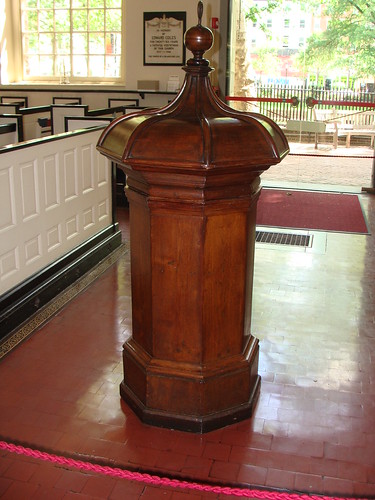
The beautiful object above is the baptismal font of Christ Church. (You can see the rope, to keep tourists from touching it, in the foreground.) We were told that it is about 600 years old, and was sent from England in the early years of the church, for "as long as needed," when the church was still an Anglican one. William Penn, the founder of Pennsylvania, was baptized in the font as a baby, in England. (Penn was not an Episcopalian in later life, but a Quaker. He was born in 1644.)

We enjoyed our travel to, and in, the Philadelphia area last month.