In a previous excerpt, Knapp stated
that there are four features of "impressions" from God. These are
Scriptural; Right (consistent with good morals); Providential (in
harmony with God's will); and Reasonable. He continues:
While the above tests are sufficient and final, the following facts are also worthy of notice in this connection.
(a). Divine impressions are persuasive. God does not drive, but leads His children. Impressions from other sources are loud, clamorous, feverish, and seek to drown the Spirit's voice.
(b). Impressions from above always give sufficient time to the honest seeker to test their genuineness. Those from below are in a hurry, and fearing detection, clamor for immediate decisions.
While it is true, when duty is clearly known, that "The king's business requireth haste," yet when it is not clearly known it is just as true that "He that believeth shall not make haste."
A friend of mine recently was cheated out of quite a large sum of money, because he yielded to a loud and hasty impression to lend it to a person who proved to be a scamp. Had he have waited, prayed, considered and tested the matter, he would have been saved a costly lesson.
(c). Impressions from above welcome the light. Those from below shrink back from it. The first love to be catechised; the second are afraid of tests, and don't like to be questioned. Adam and Eve, when following those from above, were possessed of innocent and holy boldness, and delighted in the divine presence; afterwards they instinctively sought to hide from God's searching eye.
Impressions from above, when followed, are attended by a sweet peace and the consciousness that they are right; those from below, by perplexity and the feeling that something is wrong. The first brings rest. The second robs of it.
Impressions from above appeal to our higher spiritual instincts; those from below often to our passions, prejudices, fancies, infatuations and selfish inclinations.
Those from above make us feel, "I ought to do so," and if obeyed there comes a sweet and permanent delight in putting the "ought" in practice. Those from below lack this feature, and though if followed bring gratification, it is but temporary. A serpent hides in every rose they bring, and soon is felt its fatal sting.
Impressions from below are destitute of spiritual heat. Satan can counterfeit the light of truth, but not the ardent glow of holy love. Hence impressions from him bring spiritual chill and discomfort instead of warmth and satisfaction.
Impressions from above ripen into convictions.
Those from below never do. They may crystallize into desires, or imaginations, or opinions, but never become convictions. The first make men like the Apostles after Pentecost so that they "can not but speak" and pray and act. The latter will apologize for expressing itself, and is swept away before the former like leaves before, a gale. It is a part of the mission of the Holy Spirit to fill us with such convictions that we will be like the "mountains round about Jerusalem," mighty and immovable.
The conditions which must be met in order to rightfully apply these tests will be noticed in a succeeding chapter.
Excerpted from Impressions, by Martin Wells Knapp. Original publication date, 1892. Public domain. My source is here. The previous post in the series is here.

Musings on science, the Bible, and fantastic literature (and sometimes basketball and other stuff).
God speaks to us through the Bible and the findings of science, and we should listen to both types of revelation.
The title is from Psalm 84:11.
The Wikipedia is usually a pretty good reference. I mostly use the World English Bible (WEB), because it is public domain. I am grateful.
License
I have written an e-book, Does the Bible Really Say That?, which is free to anyone. To download that book, in several formats, go here.

The posts in this blog are licensed under a Creative Commons Attribution-NonCommercial-ShareAlike 3.0 Unported License. You can copy and use this material, as long as you aren't making money from it. If you give me credit, thanks. If not, OK.
The posts in this blog are licensed under a Creative Commons Attribution-NonCommercial-ShareAlike 3.0 Unported License. You can copy and use this material, as long as you aren't making money from it. If you give me credit, thanks. If not, OK.
Sunday, December 11, 2016


Wednesday, December 07, 2016
Sunspots 603
Things I have recently spotted that may
be of interest to someone else:

The Arts: Relevant reports on some amazing sculpture made from paper.
Christianity: A Relevant article says that the idea that we have a hole in our heart that only God can fill is dangerous.
Relevant also examines the idea of the "war on Christmas."
BioLogos analyzes the theology of Dr. Strange.
Computing: Gizmo's Freeware tells us how to download the Microsoft Solitaire Collection for iOs and Android devices.
Gizmo's Freeware also lists the top 50 games for Windows, released in the last 10 years. Most of these are also available for other platforms.
Education: National Public Radio reports on the benefits of bilingual education.
History: Listverse tells us about 10 diseases that had a profound effect on history.
Humor: A video of 11,000 dominoes falling.
Politics: (and other things) Benjamin L. Corey says that fake news isn't the problem -- it's that people believe fake news, because they want to.
National Public Radio reports that the military has been discharging thousands of veterans who suffer from various emotional an cognitive disorders, resulting from combat, in such a way that they can't receive all the benefits of those honorably discharged. And tried to cover this up.
Science: National Public Radio also reports on the question of what birds hear when they listen to bird songs.
Image source (public domain)
The Arts: Relevant reports on some amazing sculpture made from paper.
Christianity: A Relevant article says that the idea that we have a hole in our heart that only God can fill is dangerous.
Relevant also examines the idea of the "war on Christmas."
BioLogos analyzes the theology of Dr. Strange.
Computing: Gizmo's Freeware tells us how to download the Microsoft Solitaire Collection for iOs and Android devices.
Gizmo's Freeware also lists the top 50 games for Windows, released in the last 10 years. Most of these are also available for other platforms.
Education: National Public Radio reports on the benefits of bilingual education.
History: Listverse tells us about 10 diseases that had a profound effect on history.
Humor: A video of 11,000 dominoes falling.
Politics: (and other things) Benjamin L. Corey says that fake news isn't the problem -- it's that people believe fake news, because they want to.
National Public Radio reports that the military has been discharging thousands of veterans who suffer from various emotional an cognitive disorders, resulting from combat, in such a way that they can't receive all the benefits of those honorably discharged. And tried to cover this up.
Science: National Public Radio also reports on the question of what birds hear when they listen to bird songs.
Image source (public domain)
Sunday, December 04, 2016
Impressions, by Martin Wells Knapp, 25
In a previous excerpt, Knapp stated
that there are four features of "impressions" from God. These are
Scriptural; Right (consistent with good morals); Providential (in
harmony with God's will); and Reasonable. He continues with more on the 4th of these:
4. Reasonable. Impressions from above are always in harmony with a spiritually enlightened judgment. God has given us reasoning powers for a purpose, and He respects them, appeals to them, and all of His leadings are in unison with them. He will bring up all the facts in the case in such a way as to convince that His leadings are all in harmony with sanctified common sense. Indeed, when the first three tests above mentioned are met, reason can but accept the conclusions which they bring.
I have a friend who was frightened from receiving the baptism of the Holy Spirit, because Satan kept suggesting to her that if she did she would have to do absurd and unreasonable things. He "impressed" her that she ought to go and preach at a political meeting, talk religion to every one she met on the street and everywhere, and do kindred unreasonable things. He made her believe that these impressions came from God instead of him, and thus fearfully perplexed her. Satan took the fact that we are to do good "as we have Opportunity," and with it sought to compel her to force opportunities. An appeal to this test would have defeated him. God never requires an unreasonable thing. He invites us to "reason" with Him, and appeals to our judgments that His service is a "reasonable service."
God deals with us as with rational beings, and it is a consequence of that recognition of our rationality that He does not require us to act upon sudden suggestions or impressions, even if the come from Himself without our first subjecting them to the scrutiny of reason.
"Try all things," wrote John Wesley, "by the written Word, and let all bow down before it. You are in danger of enthusiasm [fanaticism] every hour, if you depart ever so little from Scripture; yea, or from the plain literal meaning of any text taken in connection with the context. And so you are if you despise or lightly esteem reason, knowledge, or human learning, every one of which is an excellent gift of God, and may serve the noblest purposes."
The Holy Spirit is our divinely appointed guide. We are to be led by Him. He speaks directly to our hearts and also through the four mediums mentioned. He never contradicts Himself. So there is always perfect harmony between His inward impressions and these four voices.
No impression should be acted on as from above which does not clearly meet these tests.
God never asks us to act on uncertainties.
To do so is a spiritual crime. "He that doubteth is damned if he eat," and this principle prescribes the doing of anything concerning the rightfulness of which there is doubt.
Impressions from above always meet all four of the above tests, and every impression which is doubtful should be rigidly and prayerfully tried by each.
If Scriptural, right, providential and reasonable, they may be taken as God's voice, and followed as confidently as the angel brought to earth the tidings of our Savior's birth. Otherwise impressions should be firmly rejected ere they lead into folly, fanaticism and final ruin.
Excerpted from Impressions, by Martin Wells Knapp. Original publication date, 1892. Public domain. My source is here. The previous post in the series is here.
4. Reasonable. Impressions from above are always in harmony with a spiritually enlightened judgment. God has given us reasoning powers for a purpose, and He respects them, appeals to them, and all of His leadings are in unison with them. He will bring up all the facts in the case in such a way as to convince that His leadings are all in harmony with sanctified common sense. Indeed, when the first three tests above mentioned are met, reason can but accept the conclusions which they bring.
I have a friend who was frightened from receiving the baptism of the Holy Spirit, because Satan kept suggesting to her that if she did she would have to do absurd and unreasonable things. He "impressed" her that she ought to go and preach at a political meeting, talk religion to every one she met on the street and everywhere, and do kindred unreasonable things. He made her believe that these impressions came from God instead of him, and thus fearfully perplexed her. Satan took the fact that we are to do good "as we have Opportunity," and with it sought to compel her to force opportunities. An appeal to this test would have defeated him. God never requires an unreasonable thing. He invites us to "reason" with Him, and appeals to our judgments that His service is a "reasonable service."
God deals with us as with rational beings, and it is a consequence of that recognition of our rationality that He does not require us to act upon sudden suggestions or impressions, even if the come from Himself without our first subjecting them to the scrutiny of reason.
"Try all things," wrote John Wesley, "by the written Word, and let all bow down before it. You are in danger of enthusiasm [fanaticism] every hour, if you depart ever so little from Scripture; yea, or from the plain literal meaning of any text taken in connection with the context. And so you are if you despise or lightly esteem reason, knowledge, or human learning, every one of which is an excellent gift of God, and may serve the noblest purposes."
The Holy Spirit is our divinely appointed guide. We are to be led by Him. He speaks directly to our hearts and also through the four mediums mentioned. He never contradicts Himself. So there is always perfect harmony between His inward impressions and these four voices.
No impression should be acted on as from above which does not clearly meet these tests.
God never asks us to act on uncertainties.
To do so is a spiritual crime. "He that doubteth is damned if he eat," and this principle prescribes the doing of anything concerning the rightfulness of which there is doubt.
Impressions from above always meet all four of the above tests, and every impression which is doubtful should be rigidly and prayerfully tried by each.
If Scriptural, right, providential and reasonable, they may be taken as God's voice, and followed as confidently as the angel brought to earth the tidings of our Savior's birth. Otherwise impressions should be firmly rejected ere they lead into folly, fanaticism and final ruin.
Excerpted from Impressions, by Martin Wells Knapp. Original publication date, 1892. Public domain. My source is here. The previous post in the series is here.
Wednesday, November 30, 2016
Sunspots 602
Things I have recently spotted that may be of interest to someone else:

Christianity: I've probably mentioned this before, but it deserves repeating. Relevant has a post on the Good Samaritan and refugees.
Food: The History Blog reports that turkeys were domesticated in North America at least 1500 years ago.
Health: Relevant reports that the U. S. abortion rate is the lowest it's been since 1971,
History: Listverse tells us about 10 ancient female warriors, and their exploits. Deborah and Yael (Judges 4) are not mentioned.
Listverse also discusses 10 ancient languages, which you may have never heard of.
Politics: (or something) Relevant reports that the UN says that there are 25,000,000 orphans in Africa.
Science: National Public Radio points out that humans did not invent agriculture.
Image source (public domain)
Sunday, November 27, 2016
Impressions, by Martin Wells Knapp, 24
In the previous excerpt, Knapp states that there are four features of "impressions" from God. These are Scriptural; Right (consistent with good morals); Providential (in harmony with God's will); and Reasonable. He continues:
1. Scriptural. Impressions from above are always in harmony with the teachings of the Word. Other impressions may wrest isolated passages to their support, but God's guidance is in harmony with the whole blessed Book. It never leads a person to do contrary to its teachings or to influence others to such a course. On every doubtful point the question, "What does the Bible teach?" should lead to search until that knowledge is gained, and then it should be acted upon. While it is a book of general principles, it also covers almost every practical point that ever occurs in human life.
Multitudes of impressions from below die of fright at their own images when they are compelled to look in the mirror of God's Word. The Sword of the Spirit which is the Word of God, will pierce the thickest armor in which Satan can mail his deceptive suggestions. Then let every doubtful impression first of all be rigidly examined under the focalized light of all that the Scripture teaches in regard to it.
Jesus himself thus appealed to the Word when tempted by Satan, and victorious are all His followers who walk in His steps.
In regard to every doubtful impression ask: "Is it Scriptural?" If it is not, then it should be transported as a felon to eternal exile in the Siberia of doomed impressions.
2. Right. God speaks through the voice of man's moral convictions. The rule of right and wrong in moral matters is universal. Even cannibals know that it is wrong to steal and lie and kill, "which show the work of the law written in their own hearts."
Impressions which are from God are always right. They may be contrary to our feelings, our prejudices and our natural inclinations, but they are always right. They will stand all tests, and their rightfulness soon becomes a conviction which can not be shaken.
The voices of Scripture and of right always agree, but many who have not all the light of Scripture are convinced by the voice of this monitor within which way the path of duty lies. This voice brands as from below any impression which would lead to a wrong act.
Millions of impressions, if compelled to answer the simple question: "Are you right?" will blush and hesitate and squirm, and finally in confusion retire.
3. Providential. God often speaks to His children through His providences. "In examining the Scriptures upon this matter," writes Dr. G. D. Watson, "we find that the peculiar sphere of the Father's leading is providence; the peculiar sphere of Christ's guidance is the written Word, and the peculiar sphere of the Spirit's guidance is direct conviction and illumination upon the heart and spiritual senses.
"The providence of God touches at every point our physical being and wants, and appeals to our common sense. The Logos, the Word of God takes hold of our immortal nature and appeals to our faith; the Holy Spirit operates immediately on our heart and mind, giving us such impellings and restrainings, such premonitions or drawings as compose the living, practical filling up of the outline of guidance."
The open door of providential opportunity awaits every person who follows impressions from above.
"I will go before thee," declares Jehovah, to all who follow Him, "and make the crooked places straight; I will break in pieces the gates of brass, and cut in sunder the bars of iron." Impressions from above find "crooked places" divinely straightened, gates of brass divinely broken, and bars of iron divinely sundered.
The providential openings which thus ever welcome those divinely led are marvelous. God never impresses a Noah to build an ark, or a Solomon a temple, but that means, material and men await their appropriating faith. He never impresses a Philip to go preach to an individual, but that he prepares the person for Philip's preaching. He never says to an imprisoned Peter "Arise up quickly," but that Peter will find chains providentially broken, and gates providentially burst.
The Peters that are mourning because they can not, on account of providential interpositions, do what they claim God is impressing them to, are not being influenced by impressions from above. This third door to the secret chamber of certainty, in regard to being divinely led, always flies open as by magic before the face of him whom God is guiding.
God never prompts to do impossibilities, therefore His leadings can always be followed. He who is impressed to do something which in the nature of the case he can not do, may be sure that the leading is from some other source than above. If the way will not open for us to put our impressions in practice, and providential indications are all to the contrary, it is well to bury them. They may die hard, but death should be their doom.
Excerpted from Impressions, by Martin Wells Knapp. Original publication date, 1892. Public domain. My source is here. The previous post in the series is here.
1. Scriptural. Impressions from above are always in harmony with the teachings of the Word. Other impressions may wrest isolated passages to their support, but God's guidance is in harmony with the whole blessed Book. It never leads a person to do contrary to its teachings or to influence others to such a course. On every doubtful point the question, "What does the Bible teach?" should lead to search until that knowledge is gained, and then it should be acted upon. While it is a book of general principles, it also covers almost every practical point that ever occurs in human life.
Multitudes of impressions from below die of fright at their own images when they are compelled to look in the mirror of God's Word. The Sword of the Spirit which is the Word of God, will pierce the thickest armor in which Satan can mail his deceptive suggestions. Then let every doubtful impression first of all be rigidly examined under the focalized light of all that the Scripture teaches in regard to it.
Jesus himself thus appealed to the Word when tempted by Satan, and victorious are all His followers who walk in His steps.
In regard to every doubtful impression ask: "Is it Scriptural?" If it is not, then it should be transported as a felon to eternal exile in the Siberia of doomed impressions.
2. Right. God speaks through the voice of man's moral convictions. The rule of right and wrong in moral matters is universal. Even cannibals know that it is wrong to steal and lie and kill, "which show the work of the law written in their own hearts."
Impressions which are from God are always right. They may be contrary to our feelings, our prejudices and our natural inclinations, but they are always right. They will stand all tests, and their rightfulness soon becomes a conviction which can not be shaken.
The voices of Scripture and of right always agree, but many who have not all the light of Scripture are convinced by the voice of this monitor within which way the path of duty lies. This voice brands as from below any impression which would lead to a wrong act.
Millions of impressions, if compelled to answer the simple question: "Are you right?" will blush and hesitate and squirm, and finally in confusion retire.
3. Providential. God often speaks to His children through His providences. "In examining the Scriptures upon this matter," writes Dr. G. D. Watson, "we find that the peculiar sphere of the Father's leading is providence; the peculiar sphere of Christ's guidance is the written Word, and the peculiar sphere of the Spirit's guidance is direct conviction and illumination upon the heart and spiritual senses.
"The providence of God touches at every point our physical being and wants, and appeals to our common sense. The Logos, the Word of God takes hold of our immortal nature and appeals to our faith; the Holy Spirit operates immediately on our heart and mind, giving us such impellings and restrainings, such premonitions or drawings as compose the living, practical filling up of the outline of guidance."
The open door of providential opportunity awaits every person who follows impressions from above.
"I will go before thee," declares Jehovah, to all who follow Him, "and make the crooked places straight; I will break in pieces the gates of brass, and cut in sunder the bars of iron." Impressions from above find "crooked places" divinely straightened, gates of brass divinely broken, and bars of iron divinely sundered.
The providential openings which thus ever welcome those divinely led are marvelous. God never impresses a Noah to build an ark, or a Solomon a temple, but that means, material and men await their appropriating faith. He never impresses a Philip to go preach to an individual, but that he prepares the person for Philip's preaching. He never says to an imprisoned Peter "Arise up quickly," but that Peter will find chains providentially broken, and gates providentially burst.
The Peters that are mourning because they can not, on account of providential interpositions, do what they claim God is impressing them to, are not being influenced by impressions from above. This third door to the secret chamber of certainty, in regard to being divinely led, always flies open as by magic before the face of him whom God is guiding.
God never prompts to do impossibilities, therefore His leadings can always be followed. He who is impressed to do something which in the nature of the case he can not do, may be sure that the leading is from some other source than above. If the way will not open for us to put our impressions in practice, and providential indications are all to the contrary, it is well to bury them. They may die hard, but death should be their doom.
Excerpted from Impressions, by Martin Wells Knapp. Original publication date, 1892. Public domain. My source is here. The previous post in the series is here.
Wednesday, November 23, 2016
Sunspots 601
Things I have recently spotted that may
be of interest to someone else:

Christianity: Relevant tells us five things we need to know about prayer.
(and History) National Public Radio reports on how Martin Luther went viral (in 1517!).
A Relevant article favors sexual abstinence before marriage, but points out that this doesn't mean that a couple will have "great sex" on their wedding night.
Food: National Public Radio reports on a truffle auction. Would you believe 6 figures for a truffle?
History: ListVerse on why many of us think things are really bad (for example, that our children are less safe than in the past) and why we shouldn't think so.
ListVerse also discusses the craziest (and most violent and fraudulent) Presidential election in U. S. History. It wasn't the one in 2016.
Humor: National Public Radio reports (in verse!) on sculptures created by Dr. Seuss.
Politics: The Oxford Dictionary has made "post-truth" (!) the word of the year. Relevant and Sojourners react to that choice.
Science: Scientific American tells us why skaters don't get dizzy when they spin.
Scientific American also has photos of Ceres, a dwarf planet. Here's the Wikipedia article on Ceres.
Image source (public domain)
Christianity: Relevant tells us five things we need to know about prayer.
(and History) National Public Radio reports on how Martin Luther went viral (in 1517!).
A Relevant article favors sexual abstinence before marriage, but points out that this doesn't mean that a couple will have "great sex" on their wedding night.
Food: National Public Radio reports on a truffle auction. Would you believe 6 figures for a truffle?
History: ListVerse on why many of us think things are really bad (for example, that our children are less safe than in the past) and why we shouldn't think so.
ListVerse also discusses the craziest (and most violent and fraudulent) Presidential election in U. S. History. It wasn't the one in 2016.
Humor: National Public Radio reports (in verse!) on sculptures created by Dr. Seuss.
Politics: The Oxford Dictionary has made "post-truth" (!) the word of the year. Relevant and Sojourners react to that choice.
Science: Scientific American tells us why skaters don't get dizzy when they spin.
Scientific American also has photos of Ceres, a dwarf planet. Here's the Wikipedia article on Ceres.
Image source (public domain)
Sunday, November 20, 2016
Impressions, by Martin Wells Knapp, 23
CHAPTER V
IMPRESSIONS -- HOW TO TEST THEM
Prove all things; hold fast that which is good." -- 1 Thes. 5: 21.
"To the law and the testimony if they speak not according to this Word, it is because there is no truth in them." -- Isaiah 8:20.
God has made such ample provision for the guidance of His children that they may be just as sure that they are led by Him as that they are saved.
In order to do this it is needful to apply to every doubtful impression certain detecting tests. To do this sometimes requires keen spiritual sight, yet is a privilege which the least of God's children may enjoy. "His sheep hear His voice" and "follow Him," and we would not be commanded to "try the Spirits whether they are of God," if there was no danger from them, or if we were powerless to distinguish them. All impressions which are from above bear the four following distinguishing features. They are:
1. Scriptural. In harmony with God's will as revealed in His Word.
2. Right. In harmony with God's will as revealed in man's moral nature.
3. Providential. In harmony with God's will as revealed in His providential dealings.
4. Reasonable. In harmony with God's will as revealed to a spiritually enlightened judgment.
Many impressions are so evidently of God that they need no testing, but all that are any ways doubtful should be summoned before this infallible court of final appeal.
Every impression from above has upon it the Divine Stamp: S. R. P. R.
Excerpted from Impressions, by Martin Wells Knapp. Original publication date, 1892. Public domain. My source is here. The previous post in the series is here.
IMPRESSIONS -- HOW TO TEST THEM
Prove all things; hold fast that which is good." -- 1 Thes. 5: 21.
"To the law and the testimony if they speak not according to this Word, it is because there is no truth in them." -- Isaiah 8:20.
God has made such ample provision for the guidance of His children that they may be just as sure that they are led by Him as that they are saved.
In order to do this it is needful to apply to every doubtful impression certain detecting tests. To do this sometimes requires keen spiritual sight, yet is a privilege which the least of God's children may enjoy. "His sheep hear His voice" and "follow Him," and we would not be commanded to "try the Spirits whether they are of God," if there was no danger from them, or if we were powerless to distinguish them. All impressions which are from above bear the four following distinguishing features. They are:
1. Scriptural. In harmony with God's will as revealed in His Word.
2. Right. In harmony with God's will as revealed in man's moral nature.
3. Providential. In harmony with God's will as revealed in His providential dealings.
4. Reasonable. In harmony with God's will as revealed to a spiritually enlightened judgment.
Many impressions are so evidently of God that they need no testing, but all that are any ways doubtful should be summoned before this infallible court of final appeal.
Every impression from above has upon it the Divine Stamp: S. R. P. R.
Excerpted from Impressions, by Martin Wells Knapp. Original publication date, 1892. Public domain. My source is here. The previous post in the series is here.
Thursday, November 17, 2016
Pride is a more important sin than homosexual activity or abortion
Pride versus homosexual activity and abortion.
There are approximately 50 condemnations of pride in the Bible, depending on what counts as a passage. I arbitrarily counted multiple occurrences in the same chapter as one occurrence, which probably made for an underestimate the number of occurrences. I did a search in the on-line English Standard Version, for both "pride" and "proud." See the end of this post for the results from the Old Testament.
In the New Testament, the word used is usually, or always, hyperēphania, or typhoō. There are about 5 occurrences in the NT:
Mark 7:20 ... He said, “That which proceeds out of the man, that defiles the man. 21 For from within, out of the hearts of men, proceed evil thoughts, adulteries, sexual sins, murders, thefts, 22 covetings, wickedness, deceit, lustful desires, an evil eye, blasphemy, pride, and foolishness. 23 All these evil things come from within, and defile the man.”
Luke 1:50 His mercy is for generations of generations on those who fear him.
51 He has shown strength with his arm.
He has scattered the proud in the imagination of their hearts.
James 4:6 But he gives more grace. Therefore it says, “God resists the proud, but gives grace to the humble. ... (quoting Proverbs 3:34)
1 Peter 5:5 Likewise, you younger ones, be subject to the elder. Yes, all of you clothe yourselves with humility, to subject yourselves to one another; for “God resists the proud, but gives grace to the humble.” (Again, quoting Proverbs 3:34. In the World English Bible, that is "Surely he mocks the mockers,
but he gives grace to the humble." Note that verse from Proverbs was not counted above.)
1 John 2:15 Don’t love the world or the things that are in the world. If anyone loves the world, the Father’s love isn’t in him. 16 For all that is in the world, the lust of the flesh, the lust of the eyes, and the pride of life, isn’t the Father’s, but is the world’s.
I excluded some verses from these search that were translated as "conceit" or arrogance" in the World English Bible. I also didn't include justifiable pride, such as Paul's pride in some of the churches.
OK, so what?
There are, thus, about 50 negative references to pride in the Bible. Some of the most evil characters in the Bible, starting with Satan, himself, were guilty of it.
There are only about 9 Biblical condemnations of homosexual activity. In the case of Sodom, which is one of these, homosexuality may not have been their most important sin. (See the first paragraph of this post for scriptural basis for the previous sentence.) Homosexual behavior is not the most important sin, or even most important sexual sin. (See the Ten Commandments for evidence of these assertions.) There is no Biblical evidence that Jesus ever mentioned homosexual behavior.
There is no completely unambiguous condemnation of abortion in the Bible. See here for more on abortion.
This is not to say that homosexual activity or abortion are approved by God. I don't think either one is. But why aren't the Christians I mostly associate with up in arms about pride, rather than about abortion and homosexuality? Here are some possible answers:
1) Homosexual activity is mostly unambiguous. Abortion is almost entirely unambiguous. You know if you have engaged in homosexual activity, or had an abortion, and it is often possible for other people to know this, too. Pride, on the other hand, is less easy to spot.
2) We are more inclined to condemn other people for things that we know we haven't done. Most of us have been sinfully proud at some point. For example, I need to be careful not to be proud that I thought about the comparison in this blog post, when other people didn't. Most Christians haven't had an abortion, or engaged in homosexual activity.
3) Abortion ends a human life, or prevents it from starting. Pride usually doesn't do either of these, therefore it would seem to be less serious. (Wars fought because of national pride, or because of pride on the part of a political leader, or general, do end human lives, lots of them.)
4) There are organizations dedicated to stamping out homosexual behavior, or abortion, or both. As far as I know, there are no organizations dedicated to stamping out pride. (I'm not, of course, referring to so-called "gay pride" events. Some Christians, and others, are against such.) Perhaps that's a symptom of answers 1-3, but it also means that it's less likely that the ordinary Christian will be interested in taking up an anti-pride crusade. There are political candidates who base some of their appeal on being against homosexual behavior, or against abortion. So far as I'm aware, there has never been a political candidate who ran against pride. On the contrary, all too many politicians seem to be as guilty of that sin as I am, maybe more so.
Old Testament search results:
Leviticus 26:19
2 Chronicles 26:16
2 Chronicles 32:25
Job 35:12
Job 40:11-12
Psalm 10:4
Psalm 31:18, 23
Psalm 59:12
Psalm 73:6
Psalm 94:2
Psalm 123:4
Proverbs 8:13
Proverbs 11:2
Proverbs 15:25
Proverbs 16:18-19
Proverbs 21:4, 24
Proverbs 29:23
Ecclesiastes 7:8
Isaiah 2:11-12, 17
Isaiah 9:9
Isaiah 13:11
Isaiah 16:6
Isaiah 23:9
Isaiah 25:11
Isaiah 28:1, 3
Jeremiah 13:9, 17
Jeremiah 48:29
Jeremiah 48:16
Jeremiah 50:31-32
Ezekiel 7:10, 20, 24
Ezekiel 16:49, 56
Ezekiel 24:21
Ezekiel 28:2, 5, 17
Ezekiel 30:6, 18
Ezekiel 31:10
Ezekiel 32:12
Ezekiel 33:28
Daniel 4:37
Hosea 5:5
Hosea 7:10
Amos 6:8
Amos 8:7
Obadiah 3
Zephaniah 2:10
Zechariah 9:6
Zechariah 10:11
In the Old Testament, the Hebrew word is usually (possibly always) ga'own.
Thanks for reading! Don't be proud. I hope that I'm not, either.
There are approximately 50 condemnations of pride in the Bible, depending on what counts as a passage. I arbitrarily counted multiple occurrences in the same chapter as one occurrence, which probably made for an underestimate the number of occurrences. I did a search in the on-line English Standard Version, for both "pride" and "proud." See the end of this post for the results from the Old Testament.
In the New Testament, the word used is usually, or always, hyperēphania, or typhoō. There are about 5 occurrences in the NT:
Mark 7:20 ... He said, “That which proceeds out of the man, that defiles the man. 21 For from within, out of the hearts of men, proceed evil thoughts, adulteries, sexual sins, murders, thefts, 22 covetings, wickedness, deceit, lustful desires, an evil eye, blasphemy, pride, and foolishness. 23 All these evil things come from within, and defile the man.”
Luke 1:50 His mercy is for generations of generations on those who fear him.
51 He has shown strength with his arm.
He has scattered the proud in the imagination of their hearts.
James 4:6 But he gives more grace. Therefore it says, “God resists the proud, but gives grace to the humble. ... (quoting Proverbs 3:34)
1 Peter 5:5 Likewise, you younger ones, be subject to the elder. Yes, all of you clothe yourselves with humility, to subject yourselves to one another; for “God resists the proud, but gives grace to the humble.” (Again, quoting Proverbs 3:34. In the World English Bible, that is "Surely he mocks the mockers,
but he gives grace to the humble." Note that verse from Proverbs was not counted above.)
1 John 2:15 Don’t love the world or the things that are in the world. If anyone loves the world, the Father’s love isn’t in him. 16 For all that is in the world, the lust of the flesh, the lust of the eyes, and the pride of life, isn’t the Father’s, but is the world’s.
I excluded some verses from these search that were translated as "conceit" or arrogance" in the World English Bible. I also didn't include justifiable pride, such as Paul's pride in some of the churches.
OK, so what?
There are, thus, about 50 negative references to pride in the Bible. Some of the most evil characters in the Bible, starting with Satan, himself, were guilty of it.
There are only about 9 Biblical condemnations of homosexual activity. In the case of Sodom, which is one of these, homosexuality may not have been their most important sin. (See the first paragraph of this post for scriptural basis for the previous sentence.) Homosexual behavior is not the most important sin, or even most important sexual sin. (See the Ten Commandments for evidence of these assertions.) There is no Biblical evidence that Jesus ever mentioned homosexual behavior.
There is no completely unambiguous condemnation of abortion in the Bible. See here for more on abortion.
This is not to say that homosexual activity or abortion are approved by God. I don't think either one is. But why aren't the Christians I mostly associate with up in arms about pride, rather than about abortion and homosexuality? Here are some possible answers:
1) Homosexual activity is mostly unambiguous. Abortion is almost entirely unambiguous. You know if you have engaged in homosexual activity, or had an abortion, and it is often possible for other people to know this, too. Pride, on the other hand, is less easy to spot.
2) We are more inclined to condemn other people for things that we know we haven't done. Most of us have been sinfully proud at some point. For example, I need to be careful not to be proud that I thought about the comparison in this blog post, when other people didn't. Most Christians haven't had an abortion, or engaged in homosexual activity.
3) Abortion ends a human life, or prevents it from starting. Pride usually doesn't do either of these, therefore it would seem to be less serious. (Wars fought because of national pride, or because of pride on the part of a political leader, or general, do end human lives, lots of them.)
4) There are organizations dedicated to stamping out homosexual behavior, or abortion, or both. As far as I know, there are no organizations dedicated to stamping out pride. (I'm not, of course, referring to so-called "gay pride" events. Some Christians, and others, are against such.) Perhaps that's a symptom of answers 1-3, but it also means that it's less likely that the ordinary Christian will be interested in taking up an anti-pride crusade. There are political candidates who base some of their appeal on being against homosexual behavior, or against abortion. So far as I'm aware, there has never been a political candidate who ran against pride. On the contrary, all too many politicians seem to be as guilty of that sin as I am, maybe more so.
Old Testament search results:
Leviticus 26:19
2 Chronicles 26:16
2 Chronicles 32:25
Job 35:12
Job 40:11-12
Psalm 10:4
Psalm 31:18, 23
Psalm 59:12
Psalm 73:6
Psalm 94:2
Psalm 123:4
Proverbs 8:13
Proverbs 11:2
Proverbs 15:25
Proverbs 16:18-19
Proverbs 21:4, 24
Proverbs 29:23
Ecclesiastes 7:8
Isaiah 2:11-12, 17
Isaiah 9:9
Isaiah 13:11
Isaiah 16:6
Isaiah 23:9
Isaiah 25:11
Isaiah 28:1, 3
Jeremiah 13:9, 17
Jeremiah 48:29
Jeremiah 48:16
Jeremiah 50:31-32
Ezekiel 7:10, 20, 24
Ezekiel 16:49, 56
Ezekiel 24:21
Ezekiel 28:2, 5, 17
Ezekiel 30:6, 18
Ezekiel 31:10
Ezekiel 32:12
Ezekiel 33:28
Daniel 4:37
Hosea 5:5
Hosea 7:10
Amos 6:8
Amos 8:7
Obadiah 3
Zephaniah 2:10
Zechariah 9:6
Zechariah 10:11
In the Old Testament, the Hebrew word is usually (possibly always) ga'own.
Thanks for reading! Don't be proud. I hope that I'm not, either.
Wednesday, November 16, 2016
Sunspots 600
Things I have recently spotted that may
be of interest to someone else:

Christianity: (sort of) Scientific American (!) on how to be a better forgiver.
Relevant on how social media are shaping our lives, in ways you may not have considered.
Listverse reminds us of 10 (actually more) people in the Bible who were important, but are not named.
Computing: You probably don't want to know how I keep up with several RSS feeds, such as those from Relevant, Christianity Today, Scientific American, BioLogos, and several blogs by individuals, but I'll tell you. I use Feedly. Gizmo's Freeware (I follow its posts through Feedly) suggests a number of RSS aggregators, including Feedly, all free. Perhaps one of these would help you.
Finance: (or something) Scientific American on how deadlines actually help people to get things done.
Food: Scientific American also reports that some insects that are eaten commonly (in some cultures, anyway) are better sources of iron in the diet than beef.
History: From the American Museum of Natural History, a video showing the growth of the human population through time, especially the last two millennia.
Listverse tells us 10 things that you didn't know about toilet paper.
Politics: Relevant says that there were lots of fake news stories related to the recent political campaigns, on Facebook. Mark Zuckerberg, CEO of Facebook, says that he doesn't think they influenced the election much, if at all. I saw some fake news, but figured the Facebook Friends who re-posted the items weren't interested in being told that the Mexican legislature really hasn't agreed to pay for Mr. Trump's wall, or that someone in the FBI wasn't shot to death over the e-mail leaks. As I understand it, such fake news makes money from being seen, and the more bizarre the claim, the more likely that people will look at the page.
Science: Listverse discusses 10 amazing facts (they said "eye-popping facts") about human vision.
Scientific American points out eight worrisome trends in the world's climate.
Image source (public domain)
Christianity: (sort of) Scientific American (!) on how to be a better forgiver.
Relevant on how social media are shaping our lives, in ways you may not have considered.
Listverse reminds us of 10 (actually more) people in the Bible who were important, but are not named.
Computing: You probably don't want to know how I keep up with several RSS feeds, such as those from Relevant, Christianity Today, Scientific American, BioLogos, and several blogs by individuals, but I'll tell you. I use Feedly. Gizmo's Freeware (I follow its posts through Feedly) suggests a number of RSS aggregators, including Feedly, all free. Perhaps one of these would help you.
Finance: (or something) Scientific American on how deadlines actually help people to get things done.
Food: Scientific American also reports that some insects that are eaten commonly (in some cultures, anyway) are better sources of iron in the diet than beef.
History: From the American Museum of Natural History, a video showing the growth of the human population through time, especially the last two millennia.
Listverse tells us 10 things that you didn't know about toilet paper.
Politics: Relevant says that there were lots of fake news stories related to the recent political campaigns, on Facebook. Mark Zuckerberg, CEO of Facebook, says that he doesn't think they influenced the election much, if at all. I saw some fake news, but figured the Facebook Friends who re-posted the items weren't interested in being told that the Mexican legislature really hasn't agreed to pay for Mr. Trump's wall, or that someone in the FBI wasn't shot to death over the e-mail leaks. As I understand it, such fake news makes money from being seen, and the more bizarre the claim, the more likely that people will look at the page.
Science: Listverse discusses 10 amazing facts (they said "eye-popping facts") about human vision.
Scientific American points out eight worrisome trends in the world's climate.
Image source (public domain)
Tuesday, November 15, 2016
Is it OK to pray that my team (or my candidate) will win?
Is it OK to pray that my team will win, or that my candidate will win a political office, or a job, or an Oscar, etc.?
Well, God knows our hearts, and if that sort of outcome is one of our top desires, then we might as well pray it, because He knows. But perhaps praying of that sort isn't wise, and perhaps we should have more God-centered top desires.
The outcome we desire may not be the one that God wants.
Here are some possibilities:
1) Perhaps God calculates which team is most deserving -- has practiced harder, prepared more thoroughly -- and awards a win to that team. Only God could do that. Does He? Who could know that? Would it be necessary for God to award the victory? Most of the time, the more deserving team would have won without divine intervention. Maybe the team that hasn't practiced and prepared so well has better players, and God counts that as most deserving.
2) I doubt very much that God adds up the number, length, and fervency of the prayers for team A, and the same for team B, and makes sure that the team with most prayer behind it wins. Only God could do that, but I really doubt that He does so. Prayer in the New Testament, and throughout the history of the church, shows little or no hint of that sort of prayer.
3) Perhaps God doesn't really care who wins.
4) God may have some particular outcome(s) in mind that we know nothing about. For example, a player might be injured, and, as a result, cease being an athlete, and enter some sort of Christian service. A player on the winning team may glorify God in a public way, influencing others, because of a win. Or a player (or coach) may be humbled as the result of a loss, and repent of some sin. I guess it's possible for a player, or a coach, or a fan, to tell God that she will obey Him if He lets her team win. I doubt that this would work, though. God surely could use the outcome of a game to subtly, or strongly, influence fans, players, coaches and referees for good, in many different ways we can't imagine, tailored to each of the individuals involved. We aren't likely to see such influence, unless we are personally involved.
Situation 4), that God uses events, including contests, to influence many people in various ways, for their good, and His glory, seems most likely, to me. And it seems to me that I shouldn't spend a lot, or any time, praying for a particular winner in athletic contests, and perhaps not even in political ones. (I ought to be praying that God's purposes, whatever they are -- we usually don't know all of them -- will be advanced, by my candidate, or the other one.)
I think it's OK to play for the safety of the players and coaches, and the audience, and that participants and fans won't be tempted to sin (for example by hating the opposition, or the referees, or being proud if their side wins) because of an athletic event. And the most important prayer, for an athletic contest, must be to pray that God will be glorified through it.
The same sort of actions by God could, I guess, be true of political contests. And dare I mention war? God did intervene in various ways in military contests in the Old Testament, sometimes, it seems, more interested in making some combatant the winner, or sometimes more interested in letting one side -- often the sinful Israelites -- be defeated. Perhaps God still intervenes in battles and wars in the 21st Century. Battles and wars usually must be more important than, say, the World Series.
Thanks for reading. Feel free to comment.
Well, God knows our hearts, and if that sort of outcome is one of our top desires, then we might as well pray it, because He knows. But perhaps praying of that sort isn't wise, and perhaps we should have more God-centered top desires.
The outcome we desire may not be the one that God wants.
Here are some possibilities:
1) Perhaps God calculates which team is most deserving -- has practiced harder, prepared more thoroughly -- and awards a win to that team. Only God could do that. Does He? Who could know that? Would it be necessary for God to award the victory? Most of the time, the more deserving team would have won without divine intervention. Maybe the team that hasn't practiced and prepared so well has better players, and God counts that as most deserving.
2) I doubt very much that God adds up the number, length, and fervency of the prayers for team A, and the same for team B, and makes sure that the team with most prayer behind it wins. Only God could do that, but I really doubt that He does so. Prayer in the New Testament, and throughout the history of the church, shows little or no hint of that sort of prayer.
3) Perhaps God doesn't really care who wins.
4) God may have some particular outcome(s) in mind that we know nothing about. For example, a player might be injured, and, as a result, cease being an athlete, and enter some sort of Christian service. A player on the winning team may glorify God in a public way, influencing others, because of a win. Or a player (or coach) may be humbled as the result of a loss, and repent of some sin. I guess it's possible for a player, or a coach, or a fan, to tell God that she will obey Him if He lets her team win. I doubt that this would work, though. God surely could use the outcome of a game to subtly, or strongly, influence fans, players, coaches and referees for good, in many different ways we can't imagine, tailored to each of the individuals involved. We aren't likely to see such influence, unless we are personally involved.
Situation 4), that God uses events, including contests, to influence many people in various ways, for their good, and His glory, seems most likely, to me. And it seems to me that I shouldn't spend a lot, or any time, praying for a particular winner in athletic contests, and perhaps not even in political ones. (I ought to be praying that God's purposes, whatever they are -- we usually don't know all of them -- will be advanced, by my candidate, or the other one.)
I think it's OK to play for the safety of the players and coaches, and the audience, and that participants and fans won't be tempted to sin (for example by hating the opposition, or the referees, or being proud if their side wins) because of an athletic event. And the most important prayer, for an athletic contest, must be to pray that God will be glorified through it.
The same sort of actions by God could, I guess, be true of political contests. And dare I mention war? God did intervene in various ways in military contests in the Old Testament, sometimes, it seems, more interested in making some combatant the winner, or sometimes more interested in letting one side -- often the sinful Israelites -- be defeated. Perhaps God still intervenes in battles and wars in the 21st Century. Battles and wars usually must be more important than, say, the World Series.
Thanks for reading. Feel free to comment.
Sunday, November 13, 2016
Impressions, by Martin Wells Knapp, 22
[Concluding Chapter IV, "Impressions from Below -- Results of Following Them"]
Despair. When Satan succeeds in deceiving a soul to do or not do, as the case may be, he often sweeps down on it like a cyclone, and accuses it of committing the "unpardonable sin." He quotes Hebrews 10:26,27, in regard to "willful sin" and its penalty; also 2d Peter 2:20,21, about the "latter end being worse with them than the beginning," and Hebrews 6: 46, about it being "impossible" for some "if they shall fall away to renew them again to repentance," and kindred passages. He blindfolds the eyes of his victims to the bountiful provision of pardon to the penitent, and with vehemence and persistence brings such Scripture as the above to their minds. Unless they fly to the blood and claim victory in Jesus, they become the victims of Giant Despair.
All the fearful results that follow a refusal to be guided by God are too terrible to tell.
The most vivid portrayal of them, perhaps, that can be found, is in the wilderness wanderings of the children of Israel after they refused to be led into the promised land. The reader is referred to our book, Out of Egypt into Canaan, Chapter VII, where these events are particularly noticed, and also to the chapter on "Jonahs" in Revival Kindlings. May we each so resist "impressions from below," and be so fully "led of the Spirit," that we will never have personally the experiences to which this chapter points, but may continually abide in the sunshine of His smile, in whose "presence is fullness of joy," and at whose "right hand there are pleasures for evermore."
Excerpted from Impressions, by Martin Wells Knapp. Original publication date, 1892. Public domain. My source is here. The previous post in the series is here.
Despair. When Satan succeeds in deceiving a soul to do or not do, as the case may be, he often sweeps down on it like a cyclone, and accuses it of committing the "unpardonable sin." He quotes Hebrews 10:26,27, in regard to "willful sin" and its penalty; also 2d Peter 2:20,21, about the "latter end being worse with them than the beginning," and Hebrews 6: 46, about it being "impossible" for some "if they shall fall away to renew them again to repentance," and kindred passages. He blindfolds the eyes of his victims to the bountiful provision of pardon to the penitent, and with vehemence and persistence brings such Scripture as the above to their minds. Unless they fly to the blood and claim victory in Jesus, they become the victims of Giant Despair.
All the fearful results that follow a refusal to be guided by God are too terrible to tell.
The most vivid portrayal of them, perhaps, that can be found, is in the wilderness wanderings of the children of Israel after they refused to be led into the promised land. The reader is referred to our book, Out of Egypt into Canaan, Chapter VII, where these events are particularly noticed, and also to the chapter on "Jonahs" in Revival Kindlings. May we each so resist "impressions from below," and be so fully "led of the Spirit," that we will never have personally the experiences to which this chapter points, but may continually abide in the sunshine of His smile, in whose "presence is fullness of joy," and at whose "right hand there are pleasures for evermore."
Excerpted from Impressions, by Martin Wells Knapp. Original publication date, 1892. Public domain. My source is here. The previous post in the series is here.
Wednesday, November 09, 2016
Sunspots 599
Things I have recently spotted that may
be of interest to someone else:

Christianity: Relevant says that the U. S. is not now, or soon won't be, a Christian nation, and suggests how to react to this.
Relevant also has a post on reasons why we don't actually have a quiet time, even though we know we should.
Listverse gives us 10 common misconceptions about the separation of church and state.
From the National Association of Evangelicals, brief statements on "Biotechnology and Bioethics," "Sanctity of Life," and "Bioethics and Stem Cell Research." (These are not new, one going back to 2005, but they seem to be current."
Billy Graham turned 98 a few days ago. Christianity Today (which Graham founded) looks back over his life, which was characterized by "chastity, integrity, sincerity, ambition, humility, and, above all, hope."
Humor: (or something) The BBC reports on giant natural snowballs in Siberia.
Politics: The Presidential election is supposed to be over by now. But the New York Times examines the effectiveness, or not, of fact-checking.
Science: A graphic, showing all of the rivers, and their tributaries, in the 48 US states.
Scientific American reports that one-celled organisms that act like both plants and animals are much more important to ocean life than we had known.
Scientific American also reports on the reason why first-born children make more money than later children.
Image source (public domain)
Christianity: Relevant says that the U. S. is not now, or soon won't be, a Christian nation, and suggests how to react to this.
Relevant also has a post on reasons why we don't actually have a quiet time, even though we know we should.
Listverse gives us 10 common misconceptions about the separation of church and state.
From the National Association of Evangelicals, brief statements on "Biotechnology and Bioethics," "Sanctity of Life," and "Bioethics and Stem Cell Research." (These are not new, one going back to 2005, but they seem to be current."
Billy Graham turned 98 a few days ago. Christianity Today (which Graham founded) looks back over his life, which was characterized by "chastity, integrity, sincerity, ambition, humility, and, above all, hope."
Humor: (or something) The BBC reports on giant natural snowballs in Siberia.
Politics: The Presidential election is supposed to be over by now. But the New York Times examines the effectiveness, or not, of fact-checking.
Science: A graphic, showing all of the rivers, and their tributaries, in the 48 US states.
Scientific American reports that one-celled organisms that act like both plants and animals are much more important to ocean life than we had known.
Scientific American also reports on the reason why first-born children make more money than later children.
Image source (public domain)
Monday, November 07, 2016
God's Sovereignty, the US Presidential election, and more important matters
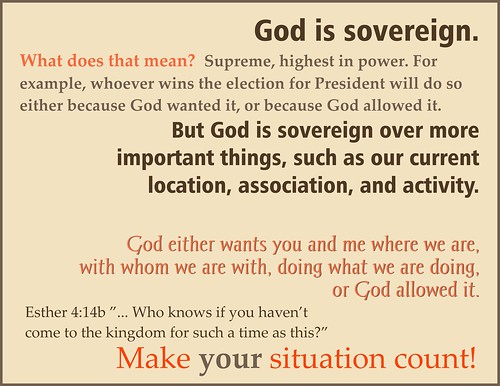
The poster above was created to remind me that God is sovereign -- things are as they are either because God wanted them that way, or because He allowed them. That's true whether Mrs. Clinton or Mr. Trump, or someone else, wins the Presidential election that is supposed to end a too-long campaign season tomorrow. It's true no matter who wins the US Senate, or any other offices, local and state-wide. It's true no matter how various referendums may turn out.
From the Project Gutenberg 1913 Webster's Dictionary, public domain, the following definition: "...The quality or state of being sovereign, or of being a sovereign; the exercise of, or right to exercise, supreme power; dominion; sway; supremacy; independence ..."
For me, the bottom line is not about the election, or who will win the Super Bowl, or any of millions of other things that I cannot influence at all, or cannot influence very much (I did vote). The important question is "what am I doing, in service to God and others, with the situation I am in?" See Esther 4:14b, which says "Who knows if you haven't come to the kingdom for such a time as this?" (World English Bible, public domain)
I posted this to my Flickr photostream (The poster above is a link to a larger version, there) yesterday. A fellow user commented, to the effect that "Didn't God give us free will?" A good question.
I believe He did. I don't consider myself adequate to explain free will, but at least part of the reason many Christians believe that there is such a thing is that John 3:16 says that whosoever will may believe in Him. Another reason is that our intuition tells us that we have free choice, at least in some matters. But, as the Wikipedia article on "Free will" puts it, "The notions of free will and predestination are heavily debated among Christians." I believe in both free will and God's sovereignty.
For more on God's sovereignty, see here. This excellent post points out seven scriptural references that indicate God's sovereignty. It does not include any reference to Psalm 104, which indicates that God controls the supplies of the needs of the natural world. No doubt there are other passages that could have been included.
Thanks for reading. Do what you can, in your situation.
Sunday, November 06, 2016
Impressions, by Martin Wells Knapp, 21
[Continuing Chapter IV, Impressions from Below -- Results of Following Them]
Disappointment. Most of failures in business doubtless come because God's guidance is not sought and followed. Failures in religious work may result from the same cause. Revival meetings which are projected for the sake of personal aggrandizement, or simply through sectarian zeal and rivalry, are doomed for this reason. I knew of a minister who held a series of meetings in a certain place chiefly to keep out another denomination. He was not led by God, and his efforts ended in disappointment. God will have His children learn to let Him lead, and if the lesson costs them a thousand disappointments it is better than that it should go unlearned.
Salvation Hindered. Neglect to follow where and when the Spirit leads, often greatly hinders the work of salvation.
Undue Hurry. Such persons forget that "If the Holy Spirit inspires anything, He always gives time to consult upon it with God." Impetuous, and hurried by the pressure of self or Satanic influence, they rush pell-mell in ways that are far more hurried than wise, and miss the guidance of the still small voice that would have brought certainty and satisfaction.
Formality. It is to be feared that some, like the Jews who rejected Jesus, influenced by their pride, preconceived notions and prejudices, have turned a deaf ear to divine guidance and quenched the Spirit; and, like them, kept up a mere formal worship, totally destitute of the life and power of heart piety. Substituting formality for Christianity, their condition is sad, and is one of the prevalent and pitiable results which flows from following "impressions from below."
Fanaticism. There is much more danger today of people perishing amid the icebergs of formality than in the wildfire of fanaticism. Both should be avoided. All fanaticism, from primitive times to the present, has come from discarding proper tests and following "impressions from below." This is one of the perils which threatens spiritual people, just as a fast express train is more likely to leap the track than a slow train. God's trains, however, never need to leap over the chasm of fanaticism, and never will if they follow His instructions.
Excerpted from Impressions, by Martin Wells Knapp. Original publication date, 1892. Public domain. My source is here. The previous post in the series is here.
Disappointment. Most of failures in business doubtless come because God's guidance is not sought and followed. Failures in religious work may result from the same cause. Revival meetings which are projected for the sake of personal aggrandizement, or simply through sectarian zeal and rivalry, are doomed for this reason. I knew of a minister who held a series of meetings in a certain place chiefly to keep out another denomination. He was not led by God, and his efforts ended in disappointment. God will have His children learn to let Him lead, and if the lesson costs them a thousand disappointments it is better than that it should go unlearned.
Salvation Hindered. Neglect to follow where and when the Spirit leads, often greatly hinders the work of salvation.
Undue Hurry. Such persons forget that "If the Holy Spirit inspires anything, He always gives time to consult upon it with God." Impetuous, and hurried by the pressure of self or Satanic influence, they rush pell-mell in ways that are far more hurried than wise, and miss the guidance of the still small voice that would have brought certainty and satisfaction.
Formality. It is to be feared that some, like the Jews who rejected Jesus, influenced by their pride, preconceived notions and prejudices, have turned a deaf ear to divine guidance and quenched the Spirit; and, like them, kept up a mere formal worship, totally destitute of the life and power of heart piety. Substituting formality for Christianity, their condition is sad, and is one of the prevalent and pitiable results which flows from following "impressions from below."
Fanaticism. There is much more danger today of people perishing amid the icebergs of formality than in the wildfire of fanaticism. Both should be avoided. All fanaticism, from primitive times to the present, has come from discarding proper tests and following "impressions from below." This is one of the perils which threatens spiritual people, just as a fast express train is more likely to leap the track than a slow train. God's trains, however, never need to leap over the chasm of fanaticism, and never will if they follow His instructions.
Excerpted from Impressions, by Martin Wells Knapp. Original publication date, 1892. Public domain. My source is here. The previous post in the series is here.
Wednesday, November 02, 2016
Sunspots 598
Things I have recently spotted that may be of interest to someone else:

The Arts: Rebecca Luella Miller, of Speculative Faith, believes that Christians have vacated certain types of media, and, that being the case, it's no wonder that these media seem to be anti-Christian.
Christianity: From the Huffington Post, 12 questions that all Christians, including me, should be asking themselves. (The post is in the framework of asking these questions of Mr. Trump, but the questions are pertinent for all of us.)
Computing: Gizmo's Freeware points to a utility for Windows that will tell you your WiFi password, if you've forgotten it. It will also name your connection for you, if you have forgotten that.
Food: Listverse gives us 10 interesting facts about chewing gum. (I know -- chewing gum isn't actually a food.)
Health: The New York Times reports on access to healthcare in the US. We just don't have the best healthcare in the world, no matter what politicians of both parties may say.
Scientific American reports that blue light, such as is emitted from the screens of various information appliances, prohibits sleep hormones from working effectively. The article mentions a couple of programs that may help to adjust the light emitted by your device(s). I've installed one of these on my tablet.
Humor: (or something) Scientific American reports that telling lies gets easier, the more you do it, and there are neurological changes in the brain that lying causes.
Politics: FiveThirtyEight lists 20 times that Donald Trump has threatened to sue someone, or actually has sued them, during his Presidential campaign. The post also points out that Trump has been sued 17 times during the same period.
Benjamin L. Corey reminds us that Roe v. Wade was decided by a 7-2 vote in the U. S. Supreme Court, and that 5 of those 7 were appointed by Republican Presidents. For more on the Supreme Court and abortion, see here.
From a Patheos blogger, "I'm Pro-Life, And I Don't Care About the Supreme Court."
From Sojourners: "Read This Before You Cast a 'Supreme Court' Vote."
Image source (public domain)
Sunday, October 30, 2016
Impressions, by Martin Wells Knapp, 20
CHAPTER IV
IMPRESSIONS FROM BELOW -- RESULTS OF FOLLOWING THEM
"But they rebelled and vexed His Holy Spirit; therefore He was turned to be their enemy, and He fought against them." -- Isaiah 63:10.
When people act on every sudden and strong or repeated impression, instead of "pondering their paths" and submitting to the tests which will determine their character, sad results follow. The following are some of them:
Perplexity. Many have been perplexed and bewildered and driven to the very verge of insanity in this way.
The devil comes with a suggestion. He clothes it in robes of light so that it appears to be the truth. He persistently pushes it. If resisted, he claims that those who do so are resisting the Spirit If they yield to it, he then tears off his "robe of light" and laughs at their deception. He says, "no harm," when he seeks to allure astray, and afterwards accuses with fierce fury, a foretaste of the taunts with which he will tantalize the lost throughout eternity.
A student was tempted to leave school and engage in revival work. The proposal came unexpectedly, and he was pushed to a decision. He loved that work, and without reflection agreed to go. But this decision filled him with dissatisfaction, and as he prayed about it the Spirit took the providences connected with his coming to school and remaining there, and showed him that God's leadings still were schoolward, and as he was released from his hasty promise his perplexity vanished, and the sunshine of God's favor again beamed upon him.
Unwise Action. Every act that is not in harmony with God's will is unwise. He who acts hurriedly upon impulses is frequently betrayed into such action.
Excerpted from Impressions, by Martin Wells Knapp. Original publication date, 1892. Public domain. My source is here. The previous post in the series is here.
IMPRESSIONS FROM BELOW -- RESULTS OF FOLLOWING THEM
"But they rebelled and vexed His Holy Spirit; therefore He was turned to be their enemy, and He fought against them." -- Isaiah 63:10.
When people act on every sudden and strong or repeated impression, instead of "pondering their paths" and submitting to the tests which will determine their character, sad results follow. The following are some of them:
Perplexity. Many have been perplexed and bewildered and driven to the very verge of insanity in this way.
The devil comes with a suggestion. He clothes it in robes of light so that it appears to be the truth. He persistently pushes it. If resisted, he claims that those who do so are resisting the Spirit If they yield to it, he then tears off his "robe of light" and laughs at their deception. He says, "no harm," when he seeks to allure astray, and afterwards accuses with fierce fury, a foretaste of the taunts with which he will tantalize the lost throughout eternity.
A student was tempted to leave school and engage in revival work. The proposal came unexpectedly, and he was pushed to a decision. He loved that work, and without reflection agreed to go. But this decision filled him with dissatisfaction, and as he prayed about it the Spirit took the providences connected with his coming to school and remaining there, and showed him that God's leadings still were schoolward, and as he was released from his hasty promise his perplexity vanished, and the sunshine of God's favor again beamed upon him.
Unwise Action. Every act that is not in harmony with God's will is unwise. He who acts hurriedly upon impulses is frequently betrayed into such action.
Excerpted from Impressions, by Martin Wells Knapp. Original publication date, 1892. Public domain. My source is here. The previous post in the series is here.
Wednesday, October 26, 2016
Sunspots 597
Things I have recently spotted that may
be of interest to someone else:

Christianity: Lifeway Research has set forth four questions that indicate whether someone is an evangelical.
Computing: Gizmo's freeware has updated its annotated list of free games for Windows machines. (Some of these have Ios and Android versions.)
Finance: The New York Times discusses Walmart's higher wages, and, perhaps, treating workers better, and the effects of these changes on the bottom line.
Food: Relevant says that newly developed sweet potatoes may prevent blindness in many people. (The potatoes have not been genetically modified.)
Health: Scientific American says that weight loss surgery also alters the brain.
Gizmo's Freeware points us to a hearing test that requires just a computer and headphones.
History: Listverse on clowns that terrified people in the past.
Politics: Charles Krauthammer, no one's idea of a left-winger, claims that the election of Mr. Trump would be very dangerous, and tells why.
Image source (public domain)
Christianity: Lifeway Research has set forth four questions that indicate whether someone is an evangelical.
Computing: Gizmo's freeware has updated its annotated list of free games for Windows machines. (Some of these have Ios and Android versions.)
Finance: The New York Times discusses Walmart's higher wages, and, perhaps, treating workers better, and the effects of these changes on the bottom line.
Food: Relevant says that newly developed sweet potatoes may prevent blindness in many people. (The potatoes have not been genetically modified.)
Health: Scientific American says that weight loss surgery also alters the brain.
Gizmo's Freeware points us to a hearing test that requires just a computer and headphones.
History: Listverse on clowns that terrified people in the past.
Politics: Charles Krauthammer, no one's idea of a left-winger, claims that the election of Mr. Trump would be very dangerous, and tells why.
Image source (public domain)
Sunday, October 23, 2016
Impressions, by Martin Wells Knapp, 19
[Knapp continues his discussion of "Impressions from Below:"]
10. The Opinions of Other People. There is a sense in which "in a multitude of counselors there is safety," but more frequently there is confusion. He who seeks counsel from others more than from God will soon find discordant human voices drowning the inner voice, and know the truthfulness of the declaration that "cursed is the man who trusteth in man and maketh flesh his arm." God often leads His children contrary to the counsels of their best friends, to teach them to rely on Him. So the voices of even our best friends, much less the decisions of Madam Grundy, can not be substituted for the tests which will be named. Satan or self will sometimes originate a very strong impression in the mind of Bro. Impulse and Bro. Self-Confidence, and make them believe it is of the Lord. It may relate to the action of Bro. Tender Conscience. With the solemnity and dogmatic certainty of an infallible oracle, they inform him of the revelation which they claim to have gotten of God, implying that they doubt his decision, and, perhaps, piety, if he does not accept their message as divine. I have known persons to bring and urge such messages, when to follow them would be to violate conscience, common sense and the clearest teachings of the Word.
11. Signs. As Satan can easily counterfeit them as he did with Moses in Egypt, it is evident that they would be an unsafe standard by which to try impressions. It is perilous to depend upon them. Yet the whole Simple family frequently do it. If they have an impression that one of their family is not to live long, and a bird flies into the room, or a looking-glass is broken, they are alarmed. They think it a sure sign of further mortality if a grave caves in or it rains upon the coffin on its way to its last long home. They are sure it is a bad sign to begin a job on Friday, and are governed by many similar superstitions It is also believed that some people who don't like to be classed with the Simple family are affected by such signs to a greater degree than they are free to confess.
12. Chance Happenings. Another trick of the adversary to get people to avoid rightful tests of impressions, is to prevail upon them to submit them to some chance happening. Bro. and Sister Truth Seeker have often been led astray in this way. They are impressed to do a certain thing, and decide that if the sun rises clear they will do it, if cloudy, not. If a certain chance event occurs they will take an impression to be of God; if it does not occur, not of Him. It might fittingly be called "religious gambling." It is a sort of "toss penny" arrangement which finds no sanction since the Holy Ghost fell at Pentecost. That good people have sometimes resorted to it simply proves their infirmity. It was before Pentecost that the Apostles "cast lots" in electing a successor of Judas. Had they waited until after, they doubtless would have taken a different course, and been saved the mortification of choosing a man who never was heard of afterwards, and of forestalling the Spirit, who put Paul in the place of Judas.
Its use drives to wrong conclusions, dwarfs the reason, fosters ignorance, offers incense to chance, perplexes the conscience, pleases Satan and grieves the Holy Ghost. These, and other similar devices, are often used by "the world, the flesh and the devil," to accomplish their designs. The deception practiced is often so subtle as to escape detection only from those who have learned to try them by divine tests. While Satan is allowed great latitude in his efforts to deceive, yet he can go no further than God permits.
It would not be surprising if there are ways revealed whereby all his counterfeit coin can be detected, and God's voice always be clearly and unmistakably known.
Given a God with whom all things are possible, a Savior whose mission is to "destroy the works of the devil," and who has promised His children "power over all the power of the enemy," and such a provision may be confidently looked for.
Excerpted from Impressions, by Martin Wells Knapp. Original publication date, 1892. Public domain. My source is here. The previous post in the series is here.
10. The Opinions of Other People. There is a sense in which "in a multitude of counselors there is safety," but more frequently there is confusion. He who seeks counsel from others more than from God will soon find discordant human voices drowning the inner voice, and know the truthfulness of the declaration that "cursed is the man who trusteth in man and maketh flesh his arm." God often leads His children contrary to the counsels of their best friends, to teach them to rely on Him. So the voices of even our best friends, much less the decisions of Madam Grundy, can not be substituted for the tests which will be named. Satan or self will sometimes originate a very strong impression in the mind of Bro. Impulse and Bro. Self-Confidence, and make them believe it is of the Lord. It may relate to the action of Bro. Tender Conscience. With the solemnity and dogmatic certainty of an infallible oracle, they inform him of the revelation which they claim to have gotten of God, implying that they doubt his decision, and, perhaps, piety, if he does not accept their message as divine. I have known persons to bring and urge such messages, when to follow them would be to violate conscience, common sense and the clearest teachings of the Word.
11. Signs. As Satan can easily counterfeit them as he did with Moses in Egypt, it is evident that they would be an unsafe standard by which to try impressions. It is perilous to depend upon them. Yet the whole Simple family frequently do it. If they have an impression that one of their family is not to live long, and a bird flies into the room, or a looking-glass is broken, they are alarmed. They think it a sure sign of further mortality if a grave caves in or it rains upon the coffin on its way to its last long home. They are sure it is a bad sign to begin a job on Friday, and are governed by many similar superstitions It is also believed that some people who don't like to be classed with the Simple family are affected by such signs to a greater degree than they are free to confess.
12. Chance Happenings. Another trick of the adversary to get people to avoid rightful tests of impressions, is to prevail upon them to submit them to some chance happening. Bro. and Sister Truth Seeker have often been led astray in this way. They are impressed to do a certain thing, and decide that if the sun rises clear they will do it, if cloudy, not. If a certain chance event occurs they will take an impression to be of God; if it does not occur, not of Him. It might fittingly be called "religious gambling." It is a sort of "toss penny" arrangement which finds no sanction since the Holy Ghost fell at Pentecost. That good people have sometimes resorted to it simply proves their infirmity. It was before Pentecost that the Apostles "cast lots" in electing a successor of Judas. Had they waited until after, they doubtless would have taken a different course, and been saved the mortification of choosing a man who never was heard of afterwards, and of forestalling the Spirit, who put Paul in the place of Judas.
Its use drives to wrong conclusions, dwarfs the reason, fosters ignorance, offers incense to chance, perplexes the conscience, pleases Satan and grieves the Holy Ghost. These, and other similar devices, are often used by "the world, the flesh and the devil," to accomplish their designs. The deception practiced is often so subtle as to escape detection only from those who have learned to try them by divine tests. While Satan is allowed great latitude in his efforts to deceive, yet he can go no further than God permits.
It would not be surprising if there are ways revealed whereby all his counterfeit coin can be detected, and God's voice always be clearly and unmistakably known.
Given a God with whom all things are possible, a Savior whose mission is to "destroy the works of the devil," and who has promised His children "power over all the power of the enemy," and such a provision may be confidently looked for.
Excerpted from Impressions, by Martin Wells Knapp. Original publication date, 1892. Public domain. My source is here. The previous post in the series is here.
Wednesday, October 19, 2016
Sunspots 596
Things I have recently spotted that may
be of interest to someone else:

Christianity: Stephen Burnett continues a series about "Christian White Magic," here and here.
Relevant reports that a missionary in Russia has been arrested and fined for holding a religious service in his home, and inviting others to attend.
A Relevant commentator says that Christianity is not just a relationship -- it's a religion.
Finance: Relevant reports that the Mall of America will be closed on Thanksgiving Day.
Health: (and food) A doctor tells why he eats dropped food off of his kitchen floor, even if it's been there more than five seconds.
History: Listverse sets the record straight on Pocohantas. She had a very hard life.
Humor: A Christianity Today contributor prays for certain characteristics of a possible future husband.
Literature: Morgan Busse, Christian writer of fantastic literature, asks "What if Only One Person Reads my Books?"
Politics: The New York Times reports on a study of the political leanings of doctors, and there are several interesting results. Surgeons, for example, are nearly three times more likely to be Republican than infectious disease specialists. Also, doctors in higher-paying specialties are more likely to be Republican.
Science: Scientific American reports that silkworms, fed mulberry leaves sprayed with solutions of certain artificial materials, produce silk which is stronger than normal silk, and such silk can conduct electricity.
Oh, oh. Scientific American reports that the Food and Drug Administration, important scientific journals, and universities exert considerable control over how news from these bodies is reported. One example -- Fox News is not invited to FDA press conferences. The reason for this is not clear.
And Scientific American says that ISIS gets quite a bit of money from agriculture.
Listverse grosses us out with photos and descriptions of the 10 creepiest fungi.
FiveThirtyEight tells us that rocks don't just sit there.
Image source (public domain)
Christianity: Stephen Burnett continues a series about "Christian White Magic," here and here.
Relevant reports that a missionary in Russia has been arrested and fined for holding a religious service in his home, and inviting others to attend.
A Relevant commentator says that Christianity is not just a relationship -- it's a religion.
Finance: Relevant reports that the Mall of America will be closed on Thanksgiving Day.
Health: (and food) A doctor tells why he eats dropped food off of his kitchen floor, even if it's been there more than five seconds.
History: Listverse sets the record straight on Pocohantas. She had a very hard life.
Humor: A Christianity Today contributor prays for certain characteristics of a possible future husband.
Literature: Morgan Busse, Christian writer of fantastic literature, asks "What if Only One Person Reads my Books?"
Politics: The New York Times reports on a study of the political leanings of doctors, and there are several interesting results. Surgeons, for example, are nearly three times more likely to be Republican than infectious disease specialists. Also, doctors in higher-paying specialties are more likely to be Republican.
Science: Scientific American reports that silkworms, fed mulberry leaves sprayed with solutions of certain artificial materials, produce silk which is stronger than normal silk, and such silk can conduct electricity.
Oh, oh. Scientific American reports that the Food and Drug Administration, important scientific journals, and universities exert considerable control over how news from these bodies is reported. One example -- Fox News is not invited to FDA press conferences. The reason for this is not clear.
And Scientific American says that ISIS gets quite a bit of money from agriculture.
Listverse grosses us out with photos and descriptions of the 10 creepiest fungi.
FiveThirtyEight tells us that rocks don't just sit there.
Image source (public domain)
Sunday, October 16, 2016
Impressions, by Martin Wells Knapp, 18
[Knapp continues his discussion of "Impressions from Below:"]
7. Passion. Many have attributed impressions to come from God which were born of no other parentage than their own rebellions passions. Saul of Tarsus, beneath the sway of this power, "breathing out slaughter" against the followers of Jesus, tells us that he verily thought he was doing God service. It is sometimes miscalled "righteous indignation," but loses none of the lion-like in its nature by the lamb-skin in which it thus is robed. Beware of its decision. Impulse and passion often prove a Niagara which drowns the voice of duty, and sweeps thousands of victims over the falls of irretrievable loss.
8. Prejudices and Preconceived Notions. These by their hue and cry attempt to deafen the ear to every voice which does not agree with them. Peter, though fully sanctified, had to be taken aside and given a special object lesson before he could distinguish, above the din of these two voices the Spirit's call to preach the gospel to the Gentiles. These two arbiters always interpret impressions according to their own views, and it is folly to appeal to them. Yet they are misleading millions. I have known their victims to be shocked at new and successful measures which the Holy Ghost would suggest in revival work, simply because these two censors were offended.
9. The Flesh. The voices of the body often clamor for excessive and unlawful gratification. Any impression which gives them license is popular with them. They are all ambitious to sit upon the throne of the soul and control its decisions, and must be "kept under," or instead of the "fruits of the Spirit," there will be the "lusts of the flesh," a harvest of thistles.
From Impressions, by Martin Wells Knapp. Original publication date, 1892. Public domain. My source is here. The previous post in the series is here.
7. Passion. Many have attributed impressions to come from God which were born of no other parentage than their own rebellions passions. Saul of Tarsus, beneath the sway of this power, "breathing out slaughter" against the followers of Jesus, tells us that he verily thought he was doing God service. It is sometimes miscalled "righteous indignation," but loses none of the lion-like in its nature by the lamb-skin in which it thus is robed. Beware of its decision. Impulse and passion often prove a Niagara which drowns the voice of duty, and sweeps thousands of victims over the falls of irretrievable loss.
8. Prejudices and Preconceived Notions. These by their hue and cry attempt to deafen the ear to every voice which does not agree with them. Peter, though fully sanctified, had to be taken aside and given a special object lesson before he could distinguish, above the din of these two voices the Spirit's call to preach the gospel to the Gentiles. These two arbiters always interpret impressions according to their own views, and it is folly to appeal to them. Yet they are misleading millions. I have known their victims to be shocked at new and successful measures which the Holy Ghost would suggest in revival work, simply because these two censors were offended.
9. The Flesh. The voices of the body often clamor for excessive and unlawful gratification. Any impression which gives them license is popular with them. They are all ambitious to sit upon the throne of the soul and control its decisions, and must be "kept under," or instead of the "fruits of the Spirit," there will be the "lusts of the flesh," a harvest of thistles.
From Impressions, by Martin Wells Knapp. Original publication date, 1892. Public domain. My source is here. The previous post in the series is here.
Wednesday, October 12, 2016
Sunspots 595
 Things I have recently spotted that may
be of interest to someone else:
Things I have recently spotted that may
be of interest to someone else: Christianity: First Things reports on a study of beliefs among evangelicals, and finds that all too many such believe that their own interpretation of the Bible is the final authority, as opposed to the interpretation of the church at large.
Computing: Gizmo's Freeware reminds us that it's a good idea to run the free Malicious Software Removal Tool regularly on Windows computers, and tells us how to do it. I just did, and it took less than 5 minutes and didn't find anything, thank God!
Newsweek claims that neither of the major candidates for President knows as much about computers and the Internet as he or she should, considering the importance of this topic.
Finance: FiveThirtyEight asks what is wrong (if anything) with insider trading?
Health: Scientific American has a brief report on the likelihood that the types of microbes in breast tissue may increase, or decrease, the likelihood of breast cancer.
Humor: (or something) Listverse tells us about 10 things you can legally do, if you are in the right country. (Sample -- marry a dog.)
(actually, 10 bizarre accidents that have recently killed people.
the reverse of humor.) Listverse reports on
Politics: (and computing) Newsweek reports that the Bush Administration "lost" 22 million e-mails during President Bush's tenure in office, including during the time of the decision to go to war, under some under highly suspicious circumstances, used a private server (belonging to the Republican National Committee!) and stonewalled Congress on what was in those e-mails, and what happened to them. This by no means excuses Mrs. Clinton's mistake (or whatever you want to call it), but what the Bush White House did may have been just as bad, or much worse.
Leonard Pitts muses about the death (by a gunshot) of a 6-year-old boy, who lived less than an hour from me, and points out that we get all worked up over deaths caused by foreign terrorists (there have been "only" 71, since 9/1/2001) and hardly even notice over 30,000 deaths a year, all too many of them innocent children, killed by guns wielded by citizens.
Christianity Today blasts both Presidential candidates, but also blasts all too many evangelicals who have supported Mr. Trump. "What Trump is, everyone has known and has been able to see for decades, let alone the last few months."
Science: National Public Radio tells us that video chats are good for small children's development.
Image source (public domain)
Sunday, October 09, 2016
Impressions, by Martin Wells Knapp, 17
[Knapp continues his descriptions of impressions from below.]
5. Infatuation. Under the magic charms of this enchantress all voices but her own are but faintly heard or altogether hushed. Her victims are restive under any restraint that crosses her whims, and frequently at her impetuous behests do violence to sacred vows and teachings of the Word divine.
The still small voice of duty is no more their delight, but the wine she offers intoxicates with pleasure. Too late they learn that beneath its sparkling surface there lurks disappointment, chagrin and frequently disgrace and even death. Satan may make people think that the voice of their infatuation is the voice of the Holy Ghost
Under its seductive sway it is said that three young men went in succession to their spiritual adviser, and each claimed that he was strongly "impressed of God," that he should marry a certain, attractive woman of wealth. An individual felt sure that God had revealed to him that he should a woman who was already the promised wife of another person. Another Christian man broke a long engagement and married the object of his infatuation. The woman whom he thus had wronged soon after died, and the lightnings of God's judgments have ever since been leaping upon the wrongdoer.
Attachments thus are frequently fostered which lead to alienations, law suits, neighborhood and church divisions, sundered family circles, and sometimes suicide and murder. Similar instances to the above abound on every side. The ruin wrought by bad people and the ridiculous antics cut by some good people under the influence of this enchantress, show that it is foolish and often fatal to follow her decisions. To appeal to her is as unwise as it would be to put a giddy girl upon the judge's bench. Delighted is the devil when he can delude to heed her siren voice instead of appealing to tests divine.
6. Impulse. Under this influence impressions which are very strong are acted upon in haste to be repented of at leisure. God never hurries people to do doubtful things. The devil does. Thus influenced, impulsive Peter drew his sword and made it needful for Jesus to perform the miracle of healing a sundered ear. Modern Peters by similar acts are constantly making miracles necessary to counteract the harm they thus have done. "He that believeth shall not make haste," applies to all action concerning the righteousness of which the child of God has any doubt.
From Impressions, by Martin Wells Knapp. Original publication date, 1892. Public domain. My source is here. The previous post in the series is here.
5. Infatuation. Under the magic charms of this enchantress all voices but her own are but faintly heard or altogether hushed. Her victims are restive under any restraint that crosses her whims, and frequently at her impetuous behests do violence to sacred vows and teachings of the Word divine.
The still small voice of duty is no more their delight, but the wine she offers intoxicates with pleasure. Too late they learn that beneath its sparkling surface there lurks disappointment, chagrin and frequently disgrace and even death. Satan may make people think that the voice of their infatuation is the voice of the Holy Ghost
Under its seductive sway it is said that three young men went in succession to their spiritual adviser, and each claimed that he was strongly "impressed of God," that he should marry a certain, attractive woman of wealth. An individual felt sure that God had revealed to him that he should a woman who was already the promised wife of another person. Another Christian man broke a long engagement and married the object of his infatuation. The woman whom he thus had wronged soon after died, and the lightnings of God's judgments have ever since been leaping upon the wrongdoer.
Attachments thus are frequently fostered which lead to alienations, law suits, neighborhood and church divisions, sundered family circles, and sometimes suicide and murder. Similar instances to the above abound on every side. The ruin wrought by bad people and the ridiculous antics cut by some good people under the influence of this enchantress, show that it is foolish and often fatal to follow her decisions. To appeal to her is as unwise as it would be to put a giddy girl upon the judge's bench. Delighted is the devil when he can delude to heed her siren voice instead of appealing to tests divine.
6. Impulse. Under this influence impressions which are very strong are acted upon in haste to be repented of at leisure. God never hurries people to do doubtful things. The devil does. Thus influenced, impulsive Peter drew his sword and made it needful for Jesus to perform the miracle of healing a sundered ear. Modern Peters by similar acts are constantly making miracles necessary to counteract the harm they thus have done. "He that believeth shall not make haste," applies to all action concerning the righteousness of which the child of God has any doubt.
From Impressions, by Martin Wells Knapp. Original publication date, 1892. Public domain. My source is here. The previous post in the series is here.
Wednesday, October 05, 2016
Sunspots 594
Things I have recently spotted that may
be of interest to someone else:

Christianity: Benjamin L. Corey claims that the US is not hostile toward Christianity, but hostile toward Christians who try to bully others into certain kinds of behavior.
Computing: Several companies in the information sector are working together with public representatives to develop ethics guidelines for artificial intelligence, according to reports by National Public Radio and other sources.
Gizmo's Freeware has posted an updated and annotated list of the best free apps, including, for example, substitutes for Word and Excel, and games, and many more.
Finance: Scientific American reports that Congress, with a bill backed by members of both parties (!) will probably pass legislation that helps prevent people who have lost property in a flood from continuing to receive federally backed insurance payments when they re-build in the same place. The worst case mentioned is a home that has had 34 damage claims in 32 years, whose owner has been paid about ten times the property's value over that time period.
Food: Cup noodles are 45 years old. NPR reports on their history and culture (and also on Ramen noodles).
Health: National Public Radio reports on the value of walking for health, especially in older people.
History: Listverse presents 10 amazing stories of survival in the Arctic.
Humor: (or not) The Conversation on why some of us think clowns are creepy.
Real humor: An amazing rope trick video.
Politics: NPR reports on the question of whether fact checks matter.
Science: NPR reports that an environmentally cleaner car may actually cost less.
Scientific American reports that 8-month-old babies are able to understand more than we might expect, and to use communication with adults.
Image source (public domain)
Christianity: Benjamin L. Corey claims that the US is not hostile toward Christianity, but hostile toward Christians who try to bully others into certain kinds of behavior.
Computing: Several companies in the information sector are working together with public representatives to develop ethics guidelines for artificial intelligence, according to reports by National Public Radio and other sources.
Gizmo's Freeware has posted an updated and annotated list of the best free apps, including, for example, substitutes for Word and Excel, and games, and many more.
Finance: Scientific American reports that Congress, with a bill backed by members of both parties (!) will probably pass legislation that helps prevent people who have lost property in a flood from continuing to receive federally backed insurance payments when they re-build in the same place. The worst case mentioned is a home that has had 34 damage claims in 32 years, whose owner has been paid about ten times the property's value over that time period.
Food: Cup noodles are 45 years old. NPR reports on their history and culture (and also on Ramen noodles).
Health: National Public Radio reports on the value of walking for health, especially in older people.
History: Listverse presents 10 amazing stories of survival in the Arctic.
Humor: (or not) The Conversation on why some of us think clowns are creepy.
Real humor: An amazing rope trick video.
Politics: NPR reports on the question of whether fact checks matter.
Science: NPR reports that an environmentally cleaner car may actually cost less.
Scientific American reports that 8-month-old babies are able to understand more than we might expect, and to use communication with adults.
Image source (public domain)
Sunday, October 02, 2016
Impressions, by Martin Wells Knapp, 16
Frightful ... are the mistakes and disasters which have come from being led by untried impressions. To keep from the discriminating light of the detecting proof tests which God has provided, Satan has devised many ingenious and deceptive expedients. As the rightful judges never will render a decision in his favor, but always detect the slightest error, he makes a desperate effort to prevail upon persons to appeal to other judges whom he can bribe to decide as he wishes. If possible, he will push people to act upon doubtful impressions without trying them at all; but if they will "try the spirits, whether they be of God," then he insists that they shall be tried before a court of his dictation. The following are among the judges which he recommends, and which have betrayed multitudes:
1. Feelings. People who are duped by this judge follow their feelings instead of their convictions. Impressions which harmonize with their feelings are fondled, and other impressions are given a cold reception. If their feelings are crossed they raise such a cry as to drown the whisperings of the still small voice within, and then seek their selfish gratification. They sometimes do very unscriptural things because they "feel like it," and for the same reason avoid the cross and the self-denial which it imposes. They mistake the voice of their own feelings for a message from above, and following the decisions of this judge, they are betrayed into wrong action. Well did Wesley exhort his followers to "trample under foot the enthusiastic doctrine that we are to do good only when we feel like it." He who tests his convictions by his feelings, instead of God's judges, is as foolish as a man who would take his case out of a wise and righteous court and put it in the power of a crying child.
2. Imagination. Fancy is often quick to seize an impression, paint it and make it appear as real and beautiful as a blooming rose. The Christian, of course, renounces all imaginations that are known to be wrong; but in order to divert from the work and the life-plan which God has marked out, imagination will often paint another work and point to another plan which some wrong impression has suggested, and thus seek to lead from the path where duty calls.
A person sometimes has an impression that he ought to have a certain desirable appointment [to a position]. In fact, a number often feel "strongly impressed" that they should have the same place. Then they imagine themselves there, and when the appointments are made and their fancy bubble bursts they weep like children because the voice of their imaginations did not prove to be the voice of God. Sometimes imagination takes foreboding of evil and makes it seem as real as fact, and goads to worry over what never comes.
Every "imagination" that does not stand the tests above mentioned should be "cast down." He who substitutes it instead of them will find himself in as sad a plight as the student who might seek to make a paint-brush light his room instead of turning on the gas. The burden of Jeremiah's message against God's people was that they followed "their own imaginations" instead of heeding the voice divine.
Who is there that has not sometimes had a "strong impression" that an absent friend was sick, or in danger, or dying, and afterwards found that it was all imagination?
The devil is called the "Tormentor," and he loves to tantalize by this or any other means.
"Beware," wrote Wesley, "of a heated imagination. . . . . Some charge their own imaginations on the will of God, and that not written but impressed on their hearts. If these impressions be received as a rule of action instead of the written Word, I know nothing so wicked or absurd but that we may fall into, and that without remedy."
3. Chance Texts. The habit of turning to some chance text and hinging action upon that, has prevailed with some. This is as if a physician should prescribe for his patient by opening his books at random and writing out the first [prescription] which catches his eye! Or as if a lawyer would open a book of legal lore and give his client the chance counsel which he thus might find! Is spiritual indolence or ignorance less pardonable than medical or legal?
The come-outer is impressed that he should leave the church. He urges the divinity of his impression by taking as a test the first text which meets his eye as he opens the Bible. It chances to be, "Come out from among them and be ye separate." With this text Satan blinds his eyes to the whole teaching of Scripture in regard to the organized church, and on it he drifts down the stream of "come-outism," over the falls of final fanaticism.
Another person is impressed that women ought not to do public work. He opens his Bible, and by chance his eye catches, "Let the women learn in silence." The whole question is settled in an instant! And so easily, too! And thus wresting this Scripture from its proper place, he peacefully pillows his head upon it, and lies down on the railroad track of the facts of Scripture, right and sense in the matter, and is crushed by the wheels of truth as it steams with triumph on its destined way. "Search the Scriptures," not "fool" with them, is the divine command.
4. Dreams. God has spoken to men by dreams, but this is not His usual way. There is, under the spirit's dispensation, no Scripture warrant for depending upon them for guidance. Jeremiah called them "chaff" when compared to the revealed Word. He who substitutes the chaff of dreams for the wheat of Bible truth will soon become a spiritual starveling. Many people have allowed themselves to be alarmed because previous impressions were strengthened by dreams which were merely born of bad digestion. The Bible speaks of "false dreams" and "filthy dreamers," and complains of those who caused the people to forget God by "their dreams which they told every man to his neighbor."
A certain person received me very coldly where I was once engaged in revival work because of a striking dream he had had of an evangelist which he thought referred to me. Before the meeting closed he changed his mind, and thought it must have meant some other person.
A Christian lady of whom I knew, after losing her husband, dreamed that a relative came to her home and brought a man, and said to her, "I have brought you this man for your husband." The dream made a very deep impression, and the features of the promised husband were vividly fixed in her mind. She actually expected the fulfillment of the dream, but looked for it in vain to the day of her death.
All impressions made by dreams which do not meet the approval of the rightful tests should be allowed to vanish. To follow them may prove as fatal as for an engineer, because of "a strong impression made by a dream," to run his train without orders from headquarters. In either case fearful wreckage may be the result.
Mr. Wesley wisely warns: "Do not hastily ascribe things to God. Do not easily suppose dreams, voices, impressions, visions, or revelations to be from God. They may be from Him. They may be from nature. They may be from the devil. Therefore believe not every spirit, but 'try the spirits whether they be from God."'
From Impressions, by Martin Wells Knapp. Original publication date, 1892. Public domain. My source is here. The previous post in the series is here.
1. Feelings. People who are duped by this judge follow their feelings instead of their convictions. Impressions which harmonize with their feelings are fondled, and other impressions are given a cold reception. If their feelings are crossed they raise such a cry as to drown the whisperings of the still small voice within, and then seek their selfish gratification. They sometimes do very unscriptural things because they "feel like it," and for the same reason avoid the cross and the self-denial which it imposes. They mistake the voice of their own feelings for a message from above, and following the decisions of this judge, they are betrayed into wrong action. Well did Wesley exhort his followers to "trample under foot the enthusiastic doctrine that we are to do good only when we feel like it." He who tests his convictions by his feelings, instead of God's judges, is as foolish as a man who would take his case out of a wise and righteous court and put it in the power of a crying child.
2. Imagination. Fancy is often quick to seize an impression, paint it and make it appear as real and beautiful as a blooming rose. The Christian, of course, renounces all imaginations that are known to be wrong; but in order to divert from the work and the life-plan which God has marked out, imagination will often paint another work and point to another plan which some wrong impression has suggested, and thus seek to lead from the path where duty calls.
A person sometimes has an impression that he ought to have a certain desirable appointment [to a position]. In fact, a number often feel "strongly impressed" that they should have the same place. Then they imagine themselves there, and when the appointments are made and their fancy bubble bursts they weep like children because the voice of their imaginations did not prove to be the voice of God. Sometimes imagination takes foreboding of evil and makes it seem as real as fact, and goads to worry over what never comes.
Every "imagination" that does not stand the tests above mentioned should be "cast down." He who substitutes it instead of them will find himself in as sad a plight as the student who might seek to make a paint-brush light his room instead of turning on the gas. The burden of Jeremiah's message against God's people was that they followed "their own imaginations" instead of heeding the voice divine.
Who is there that has not sometimes had a "strong impression" that an absent friend was sick, or in danger, or dying, and afterwards found that it was all imagination?
The devil is called the "Tormentor," and he loves to tantalize by this or any other means.
"Beware," wrote Wesley, "of a heated imagination. . . . . Some charge their own imaginations on the will of God, and that not written but impressed on their hearts. If these impressions be received as a rule of action instead of the written Word, I know nothing so wicked or absurd but that we may fall into, and that without remedy."
3. Chance Texts. The habit of turning to some chance text and hinging action upon that, has prevailed with some. This is as if a physician should prescribe for his patient by opening his books at random and writing out the first [prescription] which catches his eye! Or as if a lawyer would open a book of legal lore and give his client the chance counsel which he thus might find! Is spiritual indolence or ignorance less pardonable than medical or legal?
The come-outer is impressed that he should leave the church. He urges the divinity of his impression by taking as a test the first text which meets his eye as he opens the Bible. It chances to be, "Come out from among them and be ye separate." With this text Satan blinds his eyes to the whole teaching of Scripture in regard to the organized church, and on it he drifts down the stream of "come-outism," over the falls of final fanaticism.
Another person is impressed that women ought not to do public work. He opens his Bible, and by chance his eye catches, "Let the women learn in silence." The whole question is settled in an instant! And so easily, too! And thus wresting this Scripture from its proper place, he peacefully pillows his head upon it, and lies down on the railroad track of the facts of Scripture, right and sense in the matter, and is crushed by the wheels of truth as it steams with triumph on its destined way. "Search the Scriptures," not "fool" with them, is the divine command.
4. Dreams. God has spoken to men by dreams, but this is not His usual way. There is, under the spirit's dispensation, no Scripture warrant for depending upon them for guidance. Jeremiah called them "chaff" when compared to the revealed Word. He who substitutes the chaff of dreams for the wheat of Bible truth will soon become a spiritual starveling. Many people have allowed themselves to be alarmed because previous impressions were strengthened by dreams which were merely born of bad digestion. The Bible speaks of "false dreams" and "filthy dreamers," and complains of those who caused the people to forget God by "their dreams which they told every man to his neighbor."
A certain person received me very coldly where I was once engaged in revival work because of a striking dream he had had of an evangelist which he thought referred to me. Before the meeting closed he changed his mind, and thought it must have meant some other person.
A Christian lady of whom I knew, after losing her husband, dreamed that a relative came to her home and brought a man, and said to her, "I have brought you this man for your husband." The dream made a very deep impression, and the features of the promised husband were vividly fixed in her mind. She actually expected the fulfillment of the dream, but looked for it in vain to the day of her death.
All impressions made by dreams which do not meet the approval of the rightful tests should be allowed to vanish. To follow them may prove as fatal as for an engineer, because of "a strong impression made by a dream," to run his train without orders from headquarters. In either case fearful wreckage may be the result.
Mr. Wesley wisely warns: "Do not hastily ascribe things to God. Do not easily suppose dreams, voices, impressions, visions, or revelations to be from God. They may be from Him. They may be from nature. They may be from the devil. Therefore believe not every spirit, but 'try the spirits whether they be from God."'
From Impressions, by Martin Wells Knapp. Original publication date, 1892. Public domain. My source is here. The previous post in the series is here.
Subscribe to:
Posts (Atom)