I have been doing my bit to fill cyberspace, with this blog, for over two years, for which set of privileges I thank God.
I frequently wonder just what I am going to post. Sometimes the timing isn't right. Sometimes I haven't had, or taken, time to polish up some topic. A few times, I just haven't posted, for various reasons. No doubt there are numerous occasions when you, my hypothetical reader, and I, would have been better off if I hadn't posted at all, but never mind.
Inspiration (or something less) often comes from what I see on someone else's blog, or on some other web page. Today is one of those times.
I subscribe to Claw of the Conciliator, which covers, like this one, a multitude of things, occasionally including fantastic literature, which is why I subscribe. The title comes from a book by Gene Wolfe. (See here for my one post -- so far -- on this great author of fantastic literature.) Wolfe's term, Conciliator, was not chosen by accident. Wolfe, who has won numerous awards from mainstream organizations concerned with excellence in fantastic literature, is a Christian. One of the aspects of his fiction is the extensive vocabulary he employs. One word, that I supposed he made up, which occurs in the book indicated, is fuligin, which means "so black that you can't really see it." It turns out that he hadn't made it up. I don't know where he got it.
A recent post on the Claw of the Conciliator blog, to my wonder and amazement, points to a web page, which consists of an article by Gene Wolfe (published with permission) on how he discovered Tolkien's writing, (here's my web page on Tolkien) and quotes a letter from Tolkien (an even greater writer of fantastic literature, also a Christian) to Wolfe. Wolfe had written Tolkien, characteristically, asking where his terms, orc and warg, had come from. Tolkien wrote back, and explains. Tolkien, in this case, at least, like Wolfe, did not make up these words, or did not make them up from nothing. He was a student of languages, and used words from ancient tongues as roots for some of his words. (He also made up his own languages, but that's another story.)
Thanks, Elliot, for the tip. Thank you, hypothetical reader, for reading!

Musings on science, the Bible, and fantastic literature (and sometimes basketball and other stuff).
God speaks to us through the Bible and the findings of science, and we should listen to both types of revelation.
The title is from Psalm 84:11.
The Wikipedia is usually a pretty good reference. I mostly use the World English Bible (WEB), because it is public domain. I am grateful.
License
I have written an e-book, Does the Bible Really Say That?, which is free to anyone. To download that book, in several formats, go here.

The posts in this blog are licensed under a Creative Commons Attribution-NonCommercial-ShareAlike 3.0 Unported License. You can copy and use this material, as long as you aren't making money from it. If you give me credit, thanks. If not, OK.
The posts in this blog are licensed under a Creative Commons Attribution-NonCommercial-ShareAlike 3.0 Unported License. You can copy and use this material, as long as you aren't making money from it. If you give me credit, thanks. If not, OK.
Tuesday, January 30, 2007


Monday, January 29, 2007
Trinity Episcopal Church, Abbeville, SC
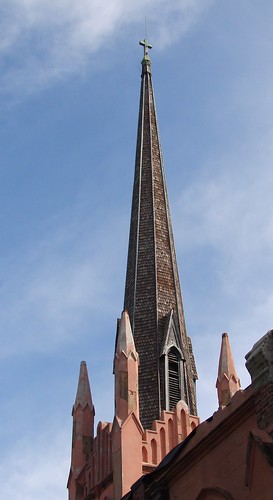
We recently took a day trip through some of upstate South Carolina, including Abbeville and Laurens, SC., and other places.
This is a photo of the steeple of Trinity Episcopal Church, in Abbeville, South Carolina, USA, which, according to the link in the previous sentence, was both the birthplace and the deathbed of the Confederacy, the Southern side of the U. S. Civil war. The church was built in 1859. The congregation originated in 1842. A sign in front of the building says that the confederate army wanted to use the metal of the church's bell for weapons.
Unfortunately, the church seems to be neglected. There was a bulletin about a service, over a month old, in a sign at the front. If you look carefully, you can see some loose shingles, or something, in the steeple. There were patches of discoloration/decay all over the walls. (I believe you can get to the Flickr page for this photo, if you click on the photo itself. There's an "all sizes" link just above the photo on that page, and you can click on that, and select a larger size to see more detail.) It's too bad that this building needs repair and care. The Bible says that the church is God's people, not buildings, but buildings are still important in worship.
A Flickr member says that there was a committee to renovate the church, but nothing seems to have come of that, yet, anyway.
Although not necessary, steeples are common on top of Christian houses of worship. I believe the reason is that architects have thought of them as symbolizing pointing toward heaven. This one has a cross, which is the most common Christian symbol, on top of the steeple.
Thanks for reading.
Sunday, January 28, 2007
Diary of an Old Soul, Jan 28 - Feb 3
28. I was like Peter when he began to sink.
To thee a new prayer therefore I have got--
That, when Death comes in earnest to my door,
Thou wouldst thyself go, when the latch doth clink,
And lead him to my room, up to my cot;
Then hold thy child's hand, hold and leave him not,
Till Death has done with him for evermore.
29. Till Death has done with him?--Ah, leave me then!
And Death has done with me, oh, nevermore!
He comes--and goes--to leave me in thy arms,
Nearer thy heart, oh, nearer than before!
To lay thy child, naked, new-born again
Of mother earth, crept free through many harms,
Upon thy bosom--still to the very core.
30. Come to me, Lord: I will not speculate how,
Nor think at which door I would have thee appear,
Nor put off calling till my floors be swept,
But cry, "Come, Lord, come any way, come now."
Doors, windows, I throw wide; my head I bow,
And sit like some one who so long has slept
That he knows nothing till his life draw near.
31. O Lord, I have been talking to the people;
Thought's wheels have round me whirled a fiery zone,
And the recoil of my words' airy ripple
My heart unheedful has puffed up and blown.
Therefore I cast myself before thee prone:
Lay cool hands on my burning brain, and press
From my weak heart the swelling emptiness.
FEBRUARY. 1. I to myself have neither power nor worth,
Patience nor love, nor anything right good;
My soul is a poor land, plenteous in dearth--
Here blades of grass, there a small herb for food--
A nothing that would be something if it could;
But if obedience, Lord, in me do grow,
I shall one day be better than I know.
2. The worst power of an evil mood is this--
It makes the bastard self seem in the right,
Self, self the end, the goal of human bliss.
But if the Christ-self in us be the might
Of saving God, why should I spend my force
With a dark thing to reason of the light--
Not push it rough aside, and hold obedient course?
3. Back still it comes to this: there was a man
Who said, "I am the truth, the life, the way:"--
Shall I pass on, or shall I stop and hear?--
"Come to the Father but by me none can:"
What then is this?--am I not also one
Of those who live in fatherless dismay?
I stand, I look, I listen, I draw near.
The above is excerpted from George MacDonald's A Book of Strife in the Form of The Diary of an Old Soul (Public Domain, 1880). For further information see this post. These are the entries for/from January 28th through February 3rd.
To thee a new prayer therefore I have got--
That, when Death comes in earnest to my door,
Thou wouldst thyself go, when the latch doth clink,
And lead him to my room, up to my cot;
Then hold thy child's hand, hold and leave him not,
Till Death has done with him for evermore.
29. Till Death has done with him?--Ah, leave me then!
And Death has done with me, oh, nevermore!
He comes--and goes--to leave me in thy arms,
Nearer thy heart, oh, nearer than before!
To lay thy child, naked, new-born again
Of mother earth, crept free through many harms,
Upon thy bosom--still to the very core.
30. Come to me, Lord: I will not speculate how,
Nor think at which door I would have thee appear,
Nor put off calling till my floors be swept,
But cry, "Come, Lord, come any way, come now."
Doors, windows, I throw wide; my head I bow,
And sit like some one who so long has slept
That he knows nothing till his life draw near.
31. O Lord, I have been talking to the people;
Thought's wheels have round me whirled a fiery zone,
And the recoil of my words' airy ripple
My heart unheedful has puffed up and blown.
Therefore I cast myself before thee prone:
Lay cool hands on my burning brain, and press
From my weak heart the swelling emptiness.
FEBRUARY. 1. I to myself have neither power nor worth,
Patience nor love, nor anything right good;
My soul is a poor land, plenteous in dearth--
Here blades of grass, there a small herb for food--
A nothing that would be something if it could;
But if obedience, Lord, in me do grow,
I shall one day be better than I know.
2. The worst power of an evil mood is this--
It makes the bastard self seem in the right,
Self, self the end, the goal of human bliss.
But if the Christ-self in us be the might
Of saving God, why should I spend my force
With a dark thing to reason of the light--
Not push it rough aside, and hold obedient course?
3. Back still it comes to this: there was a man
Who said, "I am the truth, the life, the way:"--
Shall I pass on, or shall I stop and hear?--
"Come to the Father but by me none can:"
What then is this?--am I not also one
Of those who live in fatherless dismay?
I stand, I look, I listen, I draw near.
The above is excerpted from George MacDonald's A Book of Strife in the Form of The Diary of an Old Soul (Public Domain, 1880). For further information see this post. These are the entries for/from January 28th through February 3rd.
Saturday, January 27, 2007
Ben Witherington on Barack Obama
Ben Witherington, a conservative Christian scholar (see also here) has, says his web page, ". . . been seen on the History Channel, NBC, ABC, CBS, CNN, The Discovery Channel, A&E, and the PAX Network."
Witherington has weighed in on the claims that Barack Obama, Democratic candidate for President, is a closet Muslim, with the implication that he may even be a terrorist, I guess. (If you are interested in seeing the charges raised against Obama, see my previous post.)
Basically, he says that Obama should be given the benefit of the doubt, and thinks that some right-wing and/or Christian organizations have been on a witch-hunt over this. Those of us who claim the name of Christ should be ashamed of such behavior. His blog post (see first link in the previous paragraph) indicates that Witherington has been on the Fox TV network, too.
Witherington has more to say, all good, as far as I am concerned, and he responds to a number of comments.
I didn't intend to get back into politics so soon, but a commenter guided me to Witherington's post, and I changed my mind.
Thanks for reading.
Witherington has weighed in on the claims that Barack Obama, Democratic candidate for President, is a closet Muslim, with the implication that he may even be a terrorist, I guess. (If you are interested in seeing the charges raised against Obama, see my previous post.)
Basically, he says that Obama should be given the benefit of the doubt, and thinks that some right-wing and/or Christian organizations have been on a witch-hunt over this. Those of us who claim the name of Christ should be ashamed of such behavior. His blog post (see first link in the previous paragraph) indicates that Witherington has been on the Fox TV network, too.
Witherington has more to say, all good, as far as I am concerned, and he responds to a number of comments.
I didn't intend to get back into politics so soon, but a commenter guided me to Witherington's post, and I changed my mind.
Thanks for reading.
Friday, January 26, 2007
Women in the Old Testament, 3: Athaliah
At a recent midweek service, my pastor asked who we thought was the wickedest woman in the Bible. There were several responses, including Jezebel, Herodias, and Potiphar's wife. I was a little surprised to hear Eve mentioned as a candidate. I suggested Athaliah. I hadn't researched her lately, but decided to do so, and post on her. I have previously posted about some good, or at least neutral, women from the Old Testament. I don't have anything good to report about Athaliah.
What was so bad?
Athaliah's story is found in 2 Kings 8 - 11. 8:16 tells us that her husband was King Jehoram of Judah, the Southern Kingdom. 8:18 says that she was Ahab's daughter, and, presumably, also Jezebel's. Not a great ancestry, but people have overcome their ancestry. Did she? No. Verse 8:26 names her for the first time, and says that she was also the granddaughter of King Omri. So, she had an idolatrous father, mother and grandfather. What did she do?
What she did was to kill all her grandsons, when her son died, so that she could take the throne for herself. 2 Kings 11:1 describes this killing. One of her grandsons escaped, because his aunt Jehosheba (aka Jehoshabeath) hid six-year-old Joash (aka Jehoash) from his grandmother. Eventually, Jehoiada, the High Priest, brought young Joash forward as king, and had the wicked Athaliah killed.
The story is also told in 2 Chronicles 22-23.
Destroying your own grandsons, to further your own ambition, strikes me as about as evil a thing as one can do. I can't imagine any grandmother I know doing that, and it's hard to imagine any grandmother I don't know doing it, either.
I don't know who the wickedest woman in the Bible was, but Athaliah is a candidate, I guess.
Here's part 1, and here's part 2 of this series. These are both more general than this one. Here are three specific posts on such women, one a post on five sisters, one on Abishag, and one on Tamar.
Thanks for reading.
What was so bad?
Athaliah's story is found in 2 Kings 8 - 11. 8:16 tells us that her husband was King Jehoram of Judah, the Southern Kingdom. 8:18 says that she was Ahab's daughter, and, presumably, also Jezebel's. Not a great ancestry, but people have overcome their ancestry. Did she? No. Verse 8:26 names her for the first time, and says that she was also the granddaughter of King Omri. So, she had an idolatrous father, mother and grandfather. What did she do?
What she did was to kill all her grandsons, when her son died, so that she could take the throne for herself. 2 Kings 11:1 describes this killing. One of her grandsons escaped, because his aunt Jehosheba (aka Jehoshabeath) hid six-year-old Joash (aka Jehoash) from his grandmother. Eventually, Jehoiada, the High Priest, brought young Joash forward as king, and had the wicked Athaliah killed.
The story is also told in 2 Chronicles 22-23.
Destroying your own grandsons, to further your own ambition, strikes me as about as evil a thing as one can do. I can't imagine any grandmother I know doing that, and it's hard to imagine any grandmother I don't know doing it, either.
I don't know who the wickedest woman in the Bible was, but Athaliah is a candidate, I guess.
Here's part 1, and here's part 2 of this series. These are both more general than this one. Here are three specific posts on such women, one a post on five sisters, one on Abishag, and one on Tamar.
Thanks for reading.
Thursday, January 25, 2007
Wired answers (sort of) the big questions
Wired has posted a number of mostly scientific big questions (samples: "Why do we sleep?" "What happens to information in a black hole?" "Why can't we predict the weather?") and attempts at answers. I was pleased by the tentative nature of the answers, and the selection of questions is good. The responses are by various experts. No doubt experts who disagree strongly with the responses could be found.
Here's the last part of Greg Easterbrook's answer to "Where did life come from?"
Did God or some other higher being create life? Did it begin on another world, to be transported later to ours? Until such time as a wholly natural origin of life is found, these questions have power. We’re improbable, we’re here, and we have no idea why. Or how.
Well, I have an answer, found in Genesis 1, John 1:1-5, Colossians 1:15-20, and elsewhere in the Bible. But, as Hebrews 11:3 suggests, it's not a scientific answer. It's an answer of faith. Easterbrook's scientific answer is great. (This seems to be a page that allows some changes by users, so I can't be sure that it will stay the same. The quotations were what I found on January 24.)
I liked Kevin Kelly's answer to the last question, which is "Why do we still have big questions?" Here's part of what he said:
The paradox of science is that every answer breeds at least two new questions. More answers mean even more questions, expanding not only what we know but also what we don’t know. Every new tool for looking farther or deeper or smaller allows us to spy into our ignorance. Future technologies such as artificial intelligence, controlled fusion, and quantum computing (to name a few on the near horizon) will change the world - that means the biggest questions have yet to be asked.
Thanks for reading.
Here's the last part of Greg Easterbrook's answer to "Where did life come from?"
Did God or some other higher being create life? Did it begin on another world, to be transported later to ours? Until such time as a wholly natural origin of life is found, these questions have power. We’re improbable, we’re here, and we have no idea why. Or how.
Well, I have an answer, found in Genesis 1, John 1:1-5, Colossians 1:15-20, and elsewhere in the Bible. But, as Hebrews 11:3 suggests, it's not a scientific answer. It's an answer of faith. Easterbrook's scientific answer is great. (This seems to be a page that allows some changes by users, so I can't be sure that it will stay the same. The quotations were what I found on January 24.)
I liked Kevin Kelly's answer to the last question, which is "Why do we still have big questions?" Here's part of what he said:
The paradox of science is that every answer breeds at least two new questions. More answers mean even more questions, expanding not only what we know but also what we don’t know. Every new tool for looking farther or deeper or smaller allows us to spy into our ignorance. Future technologies such as artificial intelligence, controlled fusion, and quantum computing (to name a few on the near horizon) will change the world - that means the biggest questions have yet to be asked.
Thanks for reading.
Wednesday, January 24, 2007
Sunspots 92

Things I have recently spotted that may be of interest to someone else:
Humor: This one is partly science, but take your time. Don't go there yet. It's Procrastination Central, by a social scientist.
Science: Fish, including some pretty small ones, make sounds.
Some supposedly "pure" white people have been found to have black ancestry.
Politics: A one-time feminist argues for chastity in non-married women. (This is in the Times of London, not some religious periodical.)
A good post on Christianity and pacifism. (It's a complicated subject, folks)
Sports: For the first time, a National Football (US football, that is) League coach in the Super Bowl will be black. In fact, both of them will be. I don't believe a National Basketball Association league championship coach has ever been black. Last year, one of the coaches in the championship was black. At least once, the winning team had a black General Manager. Both the NFL and NBA have mostly black players, but it has taken some time for this to percolate up to management and coaching in these team sports. I don't follow baseball, soccer (everybody else's football) or hockey as closely.
Computing: The Firefox browser can be set to open more than one home page.
Christianity: Heard on a broadcast by Ravi Zacharias, Jan 21st: "Christ didn't come to make bad people good, He came to make dead people alive."
This week's Christian Carnival is here. (For information on locating these Carnivals, see here.)
When I don't tell where I found an item above, I either found it directly, or was probably pointed to it by the Librarian's Internet Index, SciTech Daily, or Arts and Letters Daily. All of these sources are great.
Thanks for reading! Keep clicking away.
Image source (public domain)
Monday, January 22, 2007
Barack Obama, Muslim?
Two good people -- Christians, church-goers, people I want praying for me -- have forwarded me an e-mail message which claims that Barack Hussein Obama, Democratic candidate for President of the U. S., is a Muslim in disguise, with the underlying implication that no Muslim is fit to be President. This message, and others I've heard about, but not received, even imply that any one named Hussein, or with a name that close to Osama, must be a terrorist.
I have checked this with the usually reliable Urban Legends Reference pages, (the previous link quotes one version of the e-mail) and they conclude that this message is, at best, a serious distortion. (Added Jan 24, 2006: CNN has investigated the charge that Obama attended a radical Muslim school in Indonesia, and found it to be false.)
People who run for office should be evaluated on their fitness for the office, their character, and their stands on the issues. Their religious beliefs make up part of their character, to be sure.
I remember the election season of 2006 with dread. We do watch TV some, and network TV was full of ads (That's hardly news -- that's the purpose of network TV). Way too many of the ads were political. They made wild claims about what their candidates had done for us while in office, which is bad enough, but more often made outrageous claims about why opposing candidates were not fit for office. In many cases, if the implications of these claims were true, the opponent should have been in jail. Generally, there was no way suggested to check either sort of claim, and the TV news, nor the newspapers, usually gave much help, either.
We have, so far, a black man with some Muslim background, a woman, a man with Hispanic ancestry, a Mormon, and many others running for President of the U. S. (We also have a man whose last name is very close to "brownbag," and another with an Italian name. Isn't the mafia an Italian organization?) I am sure that all of these have some qualifications that would make them good Presidents. I am also sure that they all have some weaknesses in their qualifications, and that none of them would be a perfect President, if elected. Mr. Obama, and the Mormon, Mitt Romney, for instance, don't seem to have any significant experience in foreign relations. (George W. Bush didn't have a lot, either, when he became President.) It is possible that there are dangers in electing a Mormon as President. (There were fears that John F. Kennedy, the first Catholic President, would somehow transform the White House into a branch of the Vatican, when he ran for President. It didn't happen.)
It is said that Obama joined a Christian church a number of years ago because he knew that it would enhance his chances of election to office. Well, maybe. If so, he wouldn't be the first person who has exploited religious affiliation to political advantage. (For example, Richard M. Nixon used religious conservatives to his advantage. It is doubtful if he was, at heart, one of them.)
The real problem, it seems to me, is that many people, including good people, are prejudiced against anyone who is not "like them," because of their race, or their name, or their religious background, and will vote accordingly. Others are prejudiced against having any woman in the office of President. (We currently have females who are two and three heartbeats from the Presidency, should something happen to Mr. Bush and Mr. Cheney.) I probably have some unacknowledged prejudices myself. I shouldn't. I should be voting on a person's qualifications for an office, including their character and their positions on the issues, regardless of sex, ancestry, or religion. That includes Mr. Obama. He sounds good, so far. He says that he wants to bring us together. I hope somebody does.
While we're talking about politics, let's don't forget that I am running for President of the U. S. I have one plank in my platform.
Thanks for reading.
* * * *
Added, Jan 27, 2007. A commenter below suggested a post by Ben Witherington on the same subject. Mr. Witherington is a noted conservative Christian commentator, and, indeed, had some important things to say about the attack on Mr. Obama, and on other things. Here is a link to his post.
I have checked this with the usually reliable Urban Legends Reference pages, (the previous link quotes one version of the e-mail) and they conclude that this message is, at best, a serious distortion. (Added Jan 24, 2006: CNN has investigated the charge that Obama attended a radical Muslim school in Indonesia, and found it to be false.)
People who run for office should be evaluated on their fitness for the office, their character, and their stands on the issues. Their religious beliefs make up part of their character, to be sure.
I remember the election season of 2006 with dread. We do watch TV some, and network TV was full of ads (That's hardly news -- that's the purpose of network TV). Way too many of the ads were political. They made wild claims about what their candidates had done for us while in office, which is bad enough, but more often made outrageous claims about why opposing candidates were not fit for office. In many cases, if the implications of these claims were true, the opponent should have been in jail. Generally, there was no way suggested to check either sort of claim, and the TV news, nor the newspapers, usually gave much help, either.
We have, so far, a black man with some Muslim background, a woman, a man with Hispanic ancestry, a Mormon, and many others running for President of the U. S. (We also have a man whose last name is very close to "brownbag," and another with an Italian name. Isn't the mafia an Italian organization?) I am sure that all of these have some qualifications that would make them good Presidents. I am also sure that they all have some weaknesses in their qualifications, and that none of them would be a perfect President, if elected. Mr. Obama, and the Mormon, Mitt Romney, for instance, don't seem to have any significant experience in foreign relations. (George W. Bush didn't have a lot, either, when he became President.) It is possible that there are dangers in electing a Mormon as President. (There were fears that John F. Kennedy, the first Catholic President, would somehow transform the White House into a branch of the Vatican, when he ran for President. It didn't happen.)
It is said that Obama joined a Christian church a number of years ago because he knew that it would enhance his chances of election to office. Well, maybe. If so, he wouldn't be the first person who has exploited religious affiliation to political advantage. (For example, Richard M. Nixon used religious conservatives to his advantage. It is doubtful if he was, at heart, one of them.)
The real problem, it seems to me, is that many people, including good people, are prejudiced against anyone who is not "like them," because of their race, or their name, or their religious background, and will vote accordingly. Others are prejudiced against having any woman in the office of President. (We currently have females who are two and three heartbeats from the Presidency, should something happen to Mr. Bush and Mr. Cheney.) I probably have some unacknowledged prejudices myself. I shouldn't. I should be voting on a person's qualifications for an office, including their character and their positions on the issues, regardless of sex, ancestry, or religion. That includes Mr. Obama. He sounds good, so far. He says that he wants to bring us together. I hope somebody does.
While we're talking about politics, let's don't forget that I am running for President of the U. S. I have one plank in my platform.
Thanks for reading.
* * * *
Added, Jan 27, 2007. A commenter below suggested a post by Ben Witherington on the same subject. Mr. Witherington is a noted conservative Christian commentator, and, indeed, had some important things to say about the attack on Mr. Obama, and on other things. Here is a link to his post.
Sunday, January 21, 2007
Diary of an Old Soul, Jan 21 - 27
21. Thou in my heart hast planted, gardener divine,
A scion of the tree of life: it grows;
But not in every wind or weather it blows;
The leaves fall sometimes from the baby tree,
And the life-power seems melting into pine;
Yet still the sap keeps struggling to the shine,
And the unseen root clings cramplike unto thee.
22. Do thou, my God, my spirit's weather control;
And as I do not gloom though the day be dun,
Let me not gloom when earth-born vapours roll
Across the infinite zenith of my soul.
Should sudden brain-frost through the heart's summer run,
Cold, weary, joyless, waste of air and sun,
Thou art my south, my summer-wind, my all, my one.
23. O Life, why dost thou close me up in death?
O Health, why make me inhabit heaviness?--
I ask, yet know: the sum of this distress,
Pang-haunted body, sore-dismayed mind,
Is but the egg that rounds the winged faith;
When that its path into the air shall find,
My heart will follow, high above cold, rain, and wind.
24. I can no more than lift my weary eyes;
Therefore I lift my weary eyes--no more.
But my eyes pull my heart, and that, before
'Tis well awake, knocks where the conscience lies;
Conscience runs quick to the spirit's hidden door:
Straightway, from every sky-ward window, cries
Up to the Father's listening ears arise.
25. Not in my fancy now I search to find thee;
Not in its loftiest forms would shape or bind thee;
I cry to one whom I can never know,
Filling me with an infinite overflow;
Not to a shape that dwells within my heart,
Clothed in perfections love and truth assigned thee,
But to the God thou knowest that thou art.
26. Not, Lord, because I have done well or ill;
Not that my mind looks up to thee clear-eyed;
Not that it struggles in fast cerements tied;
Not that I need thee daily sorer still;
Not that I wretched, wander from thy will;
Not now for any cause to thee I cry,
But this, that thou art thou, and here am I.
27. Yestereve, Death came, and knocked at my thin door.
I from my window looked: the thing I saw,
The shape uncouth, I had not seen before.
I was disturbed--with fear, in sooth, not awe;
Whereof ashamed, I instantly did rouse
My will to seek thee--only to fear the more:
Alas! I could not find thee in the house.
The above is excerpted from George MacDonald's A Book of Strife in the Form of The Diary of an Old Soul (Public Domain, 1880). For further information see this post. These are the entries for/from January 21st through 27th.
A scion of the tree of life: it grows;
But not in every wind or weather it blows;
The leaves fall sometimes from the baby tree,
And the life-power seems melting into pine;
Yet still the sap keeps struggling to the shine,
And the unseen root clings cramplike unto thee.
22. Do thou, my God, my spirit's weather control;
And as I do not gloom though the day be dun,
Let me not gloom when earth-born vapours roll
Across the infinite zenith of my soul.
Should sudden brain-frost through the heart's summer run,
Cold, weary, joyless, waste of air and sun,
Thou art my south, my summer-wind, my all, my one.
23. O Life, why dost thou close me up in death?
O Health, why make me inhabit heaviness?--
I ask, yet know: the sum of this distress,
Pang-haunted body, sore-dismayed mind,
Is but the egg that rounds the winged faith;
When that its path into the air shall find,
My heart will follow, high above cold, rain, and wind.
24. I can no more than lift my weary eyes;
Therefore I lift my weary eyes--no more.
But my eyes pull my heart, and that, before
'Tis well awake, knocks where the conscience lies;
Conscience runs quick to the spirit's hidden door:
Straightway, from every sky-ward window, cries
Up to the Father's listening ears arise.
25. Not in my fancy now I search to find thee;
Not in its loftiest forms would shape or bind thee;
I cry to one whom I can never know,
Filling me with an infinite overflow;
Not to a shape that dwells within my heart,
Clothed in perfections love and truth assigned thee,
But to the God thou knowest that thou art.
26. Not, Lord, because I have done well or ill;
Not that my mind looks up to thee clear-eyed;
Not that it struggles in fast cerements tied;
Not that I need thee daily sorer still;
Not that I wretched, wander from thy will;
Not now for any cause to thee I cry,
But this, that thou art thou, and here am I.
27. Yestereve, Death came, and knocked at my thin door.
I from my window looked: the thing I saw,
The shape uncouth, I had not seen before.
I was disturbed--with fear, in sooth, not awe;
Whereof ashamed, I instantly did rouse
My will to seek thee--only to fear the more:
Alas! I could not find thee in the house.
The above is excerpted from George MacDonald's A Book of Strife in the Form of The Diary of an Old Soul (Public Domain, 1880). For further information see this post. These are the entries for/from January 21st through 27th.
Friday, January 19, 2007
Islamic anti-science philosophy?
I am not an expert in the subject of this post, which is the result of an hour or so of searching and reading in the Internet. The subject is important, and was an eye-opener to me.
Steven Weinberg, author and Nobel Prize-winning physicist, supports the atheism of Richard Dawkins, except that Dawkins' attacks on Christianity are misplaced, he says -- he really should be attacking Islam, because Christians don't usually act as if they really believe what they say they do. (If they did, they would be making more of an effort to convert him, he writes.) Weinberg says that, in the twelfth century A. D., an Islamic philosopher named Abu Hamid al-Ghazali (there are variations on the name -- Weinberg used Ghazzali) did away with the foundation of science under Islam (which had, a few centuries earlier, been the center of developing science) by saying that there could be no laws of nature, because these would tie the hands of the deity. See here for al-Ghazali's website.
* * * *
Added Jan 30th, 2007. See the comment below by Jeremy Pierce, which casts grave doubt on Weinberg's main thesis.
* * * *
Weinberg seems to be correct about one thing, namely that al-Ghazali was an important philosopher. (The Wikipedia article on him says that his influence has been compared to that of Thomas Aquinas in Christianity.) He is also mostly, or entirely, correct about another idea, namely that al-Ghazali attacked the very foundations of science (although he really seemed to have broader aim, at philosophy, or even more fundamentally, at reason itself). Here's what the al-Ghazali web site says about his The Incoherence of the Philosophers (this book has other names):
The so-called necessity of causality is, says al-Ghazali, simply based on the mere fact that an event A has so far occurred concomitantly with an event B. There is no guarantee of the continuation of that relationship in the future, since the connection of A and B lacks logical necessity. In fact, according to Ash‘arite atomistic occasionalism, the direct cause of both A and B is God; God simply creates A when he creates B. Thus theoretically he can change his custom (sunna, ‘ada) at any moment, and resurrect the dead: in fact, this is 'a second creation'.
This web site goes on to affirm what Weinberg stated about al-Ghazali.
This article, in Perspectives on Science and Christian Faith, presents a more complex picture of al-Ghazali.
The history of the development of science is a complicated subject, and opinions vary. However, it is possible to argue that Christianity has been, at least at some times, and in some ways, friendly to the development of science. (So was Islam.) To me, belief in a God of order and pattern is crucial to the development of science, although perhaps that is a simplistic view. If I really believed that there was no meaning in the universe, no fundamental laws, why try to uncover them? For example, Isaac Newton, although he would probably be classified as belonging to a Christian cult today, believed that science was an enterprise that, by showing what God had done, glorified God. Although the roots of Western Science pre-date Christianity, it grew and matured among civilizations that were, at least nominally, Christian, and I don't think that was an accident.
It seems likely that al-Ghazali really did undercut science for Muslims. If so, he did them a great disservice.
I will not go into the coherence of Weinberg and Dawkins, or that of the late Francis Crick (who is mentioned favorably by Weinberg) except to say that they have denied what I believe to be the source of the laws of nature.
This post is not meant as an attack on Islam.
I write as a Christian, and too much of what Weinberg says about the lack of certitude in Christians rings true.
Thanks for reading.
Steven Weinberg, author and Nobel Prize-winning physicist, supports the atheism of Richard Dawkins, except that Dawkins' attacks on Christianity are misplaced, he says -- he really should be attacking Islam, because Christians don't usually act as if they really believe what they say they do. (If they did, they would be making more of an effort to convert him, he writes.) Weinberg says that, in the twelfth century A. D., an Islamic philosopher named Abu Hamid al-Ghazali (there are variations on the name -- Weinberg used Ghazzali) did away with the foundation of science under Islam (which had, a few centuries earlier, been the center of developing science) by saying that there could be no laws of nature, because these would tie the hands of the deity. See here for al-Ghazali's website.
* * * *
Added Jan 30th, 2007. See the comment below by Jeremy Pierce, which casts grave doubt on Weinberg's main thesis.
* * * *
Weinberg seems to be correct about one thing, namely that al-Ghazali was an important philosopher. (The Wikipedia article on him says that his influence has been compared to that of Thomas Aquinas in Christianity.) He is also mostly, or entirely, correct about another idea, namely that al-Ghazali attacked the very foundations of science (although he really seemed to have broader aim, at philosophy, or even more fundamentally, at reason itself). Here's what the al-Ghazali web site says about his The Incoherence of the Philosophers (this book has other names):
The so-called necessity of causality is, says al-Ghazali, simply based on the mere fact that an event A has so far occurred concomitantly with an event B. There is no guarantee of the continuation of that relationship in the future, since the connection of A and B lacks logical necessity. In fact, according to Ash‘arite atomistic occasionalism, the direct cause of both A and B is God; God simply creates A when he creates B. Thus theoretically he can change his custom (sunna, ‘ada) at any moment, and resurrect the dead: in fact, this is 'a second creation'.
This web site goes on to affirm what Weinberg stated about al-Ghazali.
This article, in Perspectives on Science and Christian Faith, presents a more complex picture of al-Ghazali.
The history of the development of science is a complicated subject, and opinions vary. However, it is possible to argue that Christianity has been, at least at some times, and in some ways, friendly to the development of science. (So was Islam.) To me, belief in a God of order and pattern is crucial to the development of science, although perhaps that is a simplistic view. If I really believed that there was no meaning in the universe, no fundamental laws, why try to uncover them? For example, Isaac Newton, although he would probably be classified as belonging to a Christian cult today, believed that science was an enterprise that, by showing what God had done, glorified God. Although the roots of Western Science pre-date Christianity, it grew and matured among civilizations that were, at least nominally, Christian, and I don't think that was an accident.
It seems likely that al-Ghazali really did undercut science for Muslims. If so, he did them a great disservice.
I will not go into the coherence of Weinberg and Dawkins, or that of the late Francis Crick (who is mentioned favorably by Weinberg) except to say that they have denied what I believe to be the source of the laws of nature.
This post is not meant as an attack on Islam.
I write as a Christian, and too much of what Weinberg says about the lack of certitude in Christians rings true.
Thanks for reading.
Thursday, January 18, 2007
Women in the Old Testament, 2
Over a year ago, I posted on Jacob's family, in Genesis, and women's importance. I pointed out that Genesis says that 66 persons went with Jacob to Egypt, and names them, but there are almost no women in the list. Women almost certainly went, but just weren't included in the count. This morning, in my devotional reading, I found this verse, also about Jacob:
Genesis 37:35 All his sons and all his daughters rose up to comfort him, but he refused to be comforted and said, “No, I shall go down to Sheol to my son, mourning.” Thus his father wept for him. (ESV)
This is in the story of Joseph, after his brothers had sold him into slavery, and deceived their father, making Jacob believe that he was dead.
As far as I know, only one daughter, Dinah, is mentioned in Genesis by name, but this verse indicates that there must have been at least a few more of them. It is possible that all of these daughters married, and stayed behind when Jacob and his family went to Egypt, but I doubt this, for two reasons. Dinah was raped, and therefore probably not as desirable as a wife, so perhaps she didn't marry. One or more of Jacob's other daughters may not have married, either. Except for the Dinah story, there is no indication in Genesis that Jacob became related to anyone by a daughter's marriage, and that exception was temporary. Benjamin was fairly young when the family went to Egypt, and it is possible that he had half-sisters of about his own age. Since the daughters comforted Jacob, they may have still lived in the household, either unmarried, or with their husbands, and this means that it seems at least possible that some of them were still with the household when the family moved to Egypt.
As Carol Hill and others have pointed out, not only were women's roles different in the times of the patriarchs than they are in 21st century North America, but numbers in Genesis were used differently than we might use them.
Thanks for reading.
Genesis 37:35 All his sons and all his daughters rose up to comfort him, but he refused to be comforted and said, “No, I shall go down to Sheol to my son, mourning.” Thus his father wept for him. (ESV)
This is in the story of Joseph, after his brothers had sold him into slavery, and deceived their father, making Jacob believe that he was dead.
As far as I know, only one daughter, Dinah, is mentioned in Genesis by name, but this verse indicates that there must have been at least a few more of them. It is possible that all of these daughters married, and stayed behind when Jacob and his family went to Egypt, but I doubt this, for two reasons. Dinah was raped, and therefore probably not as desirable as a wife, so perhaps she didn't marry. One or more of Jacob's other daughters may not have married, either. Except for the Dinah story, there is no indication in Genesis that Jacob became related to anyone by a daughter's marriage, and that exception was temporary. Benjamin was fairly young when the family went to Egypt, and it is possible that he had half-sisters of about his own age. Since the daughters comforted Jacob, they may have still lived in the household, either unmarried, or with their husbands, and this means that it seems at least possible that some of them were still with the household when the family moved to Egypt.
As Carol Hill and others have pointed out, not only were women's roles different in the times of the patriarchs than they are in 21st century North America, but numbers in Genesis were used differently than we might use them.
Thanks for reading.
Wednesday, January 17, 2007
Sunspots 91

Things I have recently spotted that may be of interest to someone else:
Science:
Surprise! Men are distracted, and tend to make bad decisions, in the presence of an attractive female.
People who use two languages daily are considerably less likely to develop dementia.
A group of scientists has made a list of the 100 most endangered species of animals, based on their rarity and apparent genetic uniqueness.
Politics, or maybe Science:
The White House has published "Advancing Stem Cell Science Without Destroying Human Life." This report has been called "ridiculous" by Arthur Caplan, the most visible bioethicist of our time.
Computing:
At least some of Internet Telephony Magazine is freely available.
Literature:
E. Stephen Burnett on the treatment of the church in fantastic literature.
Christianity:
Catez argues that ". . . words such as 'justification,' 'propitiation,' 'sanctification,' 'flesh,' 'predestination', and 'repentance' are not specially theological, but ordinary English words." She doesn't say so, but, as evidence, one of the great short stories of fantastic literature was " 'Repent, Harlequin!' Said the Ticktockman."
Francis Collins, head of the US Human Genome Project, in Christianity Today, on how God used evolution.
Bonnie, from Intellectuelle, has a short, but solid piece on helping others grieve, and says that some of us aren't doing as much of it as we should, for the sake of others, and ourselves.
This week's Christian Carnival is here. (For information on locating these Carnivals, see here.)
When I don't tell where I found an item above, I either found it directly, or was probably pointed to it by the Librarian's Internet Index, SciTech Daily, or Arts and Letters Daily. All of these sources are great.
Thanks for reading! Keep clicking away.
Tuesday, January 16, 2007
Why do animals have heads?
In previous posts, I mused about why there is sex, and why living things have cells. See the latter post for some discussion of what "Why?" means. Here, I mean "What is the function?" or "What good does it do them?"
A head is a structure, at one end of an animal, that has a concentration of important organs. It contains the brain, some sense organs, and a mouth. In some organisms, such as ourselves, a head is usually clearly defined from the neck. In other organisms, like fish, it isn't. In the Arthropoda, which include insects and spiders, heads are often even more clearly distinct from the rest of the body than they are in vertebrates, like humans or elephants. Many kinds of animals, but not all, have heads. The Echinodermata (starfish and their relatives), the sponges, and other types of animals do not have heads. But the vertebrates, and the Arthropods, which are the types of animals we are most likely to see, do.
Having a lot of sense organs in one place, especially in a place at the front of your body, the part that goes into any new area first, is useful. Being able to see, hear, and smell what you are about to get into before you get there can help you change your mind about where you are going to go, or about how to act when you get there. Having these senses in the head accomplishes that. But why the head? Wouldn't it be even better to have, for example, eyes, nose and ears on our hands? That way we could look, smell, and hear around corners, or behind and in front of us at the same time. The answer appears to be rapid communication. It takes some time for a message to get from the sense organs to the brain. The further away they are, the slower is the reaction. So having sight, smell, and hearing (and also taste, balance, and some of the touch sensors) in the head means quicker reaction time, which may make the difference between life and death. (It is also true that hardly any other organism has structures like the hands, which are flexible, and can go anywhere -- most vertebrates use their "hands" to walk on.)
Another thing the head can do, at least in vertebrates, is to provide protection for the brain. The skull helps with that. It also protects the sense organs and the mouth, but the brain is especially well protected. If the brain, and the skull, were located anywhere except at an end of the body, there would probably be serious interference with digestion and other functions.
I'm glad I have a head, and I hope I use it for God's glory. Thanks for reading.
A head is a structure, at one end of an animal, that has a concentration of important organs. It contains the brain, some sense organs, and a mouth. In some organisms, such as ourselves, a head is usually clearly defined from the neck. In other organisms, like fish, it isn't. In the Arthropoda, which include insects and spiders, heads are often even more clearly distinct from the rest of the body than they are in vertebrates, like humans or elephants. Many kinds of animals, but not all, have heads. The Echinodermata (starfish and their relatives), the sponges, and other types of animals do not have heads. But the vertebrates, and the Arthropods, which are the types of animals we are most likely to see, do.
Having a lot of sense organs in one place, especially in a place at the front of your body, the part that goes into any new area first, is useful. Being able to see, hear, and smell what you are about to get into before you get there can help you change your mind about where you are going to go, or about how to act when you get there. Having these senses in the head accomplishes that. But why the head? Wouldn't it be even better to have, for example, eyes, nose and ears on our hands? That way we could look, smell, and hear around corners, or behind and in front of us at the same time. The answer appears to be rapid communication. It takes some time for a message to get from the sense organs to the brain. The further away they are, the slower is the reaction. So having sight, smell, and hearing (and also taste, balance, and some of the touch sensors) in the head means quicker reaction time, which may make the difference between life and death. (It is also true that hardly any other organism has structures like the hands, which are flexible, and can go anywhere -- most vertebrates use their "hands" to walk on.)
Another thing the head can do, at least in vertebrates, is to provide protection for the brain. The skull helps with that. It also protects the sense organs and the mouth, but the brain is especially well protected. If the brain, and the skull, were located anywhere except at an end of the body, there would probably be serious interference with digestion and other functions.
I'm glad I have a head, and I hope I use it for God's glory. Thanks for reading.
Monday, January 15, 2007
Play in the Bible
Carl Zimmer, an important science writer, recently wrote about the function and origin of play in animals, in Forbes. Since play is rather widely distributed in vertebrates, it must confer some positive benefits. (The article says that reptiles don't play. It doesn't mention fish, but I am not aware of any play behavior in such animals. Many birds and mammals play.) Zimmer supposes that play helps social animals to bond with each other, enables them to sharpen their skills, and to learn about the environment around them. The same is true of humans. A human child, and probably a human adult, who has no time to play, or lives in an environment that doesn't allow it, is seriously handicapped.
So what is play? Zimmer doesn't define it. The Wikipedia article admits that defining play is difficult. The Free Dictionary has many definitions for play, as both a verb and a noun. Let's say that you and I know what it is, and I won't try to define it carefully, either. Play is something like "an amusing diversion, especially for or by children."
I checked the Bible. Most of the occurrences of the word "play" in the ESV, at any rate, do not match the definition above. Several uses are about performing on a musical instrument, and the most common use is some variation of "play the harlot," in Old Testament prophecies about Israel's disloyalty to God.
There are a few times when the Bible uses play, referring to children, and a couple of the references are to animals playing.
In Job 41, God, speaking to Job, refers to children playing, as if it is natural. In Matthew 11:16-17, Jesus refers to children as having playmates. Isaiah's description of the Peaceable Kingdom includes the idea of children playing. Zechariah's vision of the new, restored Jerusalem also mentions children playing. God seems to think that play is natural, and presumably beneficial. Heaven may include play, depending on what aspect of the future Isaiah and Zechariah were describing.
Here is one of the references to animal play:
Psalm 104:25 Here is the sea, great and wide,
which teems with creatures innumerable,
living things both small and great.
26 There go the ships,
and Leviathan, which you formed to play in it.
(There is an alternate reading of verse 26, but it doesn't change the meaning of play. I don't know what animal Leviathan is, or was, and I don't think anyone else knows for certain, either.)
Here's the other:
Job 40:20, describing the place where Behemoth can be found, says:
20 For the mountains yield food for him
where all the wild beasts play.
(I don't know what Behemoth is, or was, either, but it seems clear that it is some sort of animal.)
I suspect that Zimmer is correct (He isn't the first to have had this idea, of course) that animal play bestows some advantage on the animals. My guess is that God invented the idea of play, as well as inventing laughter, and joy. I can't prove this. C. S. Lewis, among others, supposes, in The Screwtape Letters, that these things are the inventions of God. I think he was right. I think some play is good for us. (Too much isn't, at least for adults.) God must have meant children and animals to play, and, I think, he also meant for adults to amuse themselves and others.
My wife often says of me, even when I am doing something really serious, like writing this blog, that I am "playing at" the computer. Perhaps you are playing at one too, right now. Thanks for playing here. I guess I am bonding, at least a little. Perhaps I'm learning skills, too. Whether or not I am, it can be fun. Thank you, God!
* * * *
Added August 3, 2013: In reading this post, I noted that I didn't refer to the courtship behavior (actual or figurative, or both) described in the Song of Solomon, aka Song of Songs, as a sort of playing. Perhaps it's just as well that I didn't!
Thanks for reading.
So what is play? Zimmer doesn't define it. The Wikipedia article admits that defining play is difficult. The Free Dictionary has many definitions for play, as both a verb and a noun. Let's say that you and I know what it is, and I won't try to define it carefully, either. Play is something like "an amusing diversion, especially for or by children."
I checked the Bible. Most of the occurrences of the word "play" in the ESV, at any rate, do not match the definition above. Several uses are about performing on a musical instrument, and the most common use is some variation of "play the harlot," in Old Testament prophecies about Israel's disloyalty to God.
There are a few times when the Bible uses play, referring to children, and a couple of the references are to animals playing.
In Job 41, God, speaking to Job, refers to children playing, as if it is natural. In Matthew 11:16-17, Jesus refers to children as having playmates. Isaiah's description of the Peaceable Kingdom includes the idea of children playing. Zechariah's vision of the new, restored Jerusalem also mentions children playing. God seems to think that play is natural, and presumably beneficial. Heaven may include play, depending on what aspect of the future Isaiah and Zechariah were describing.
Here is one of the references to animal play:
Psalm 104:25 Here is the sea, great and wide,
which teems with creatures innumerable,
living things both small and great.
26 There go the ships,
and Leviathan, which you formed to play in it.
(There is an alternate reading of verse 26, but it doesn't change the meaning of play. I don't know what animal Leviathan is, or was, and I don't think anyone else knows for certain, either.)
Here's the other:
Job 40:20, describing the place where Behemoth can be found, says:
20 For the mountains yield food for him
where all the wild beasts play.
(I don't know what Behemoth is, or was, either, but it seems clear that it is some sort of animal.)
I suspect that Zimmer is correct (He isn't the first to have had this idea, of course) that animal play bestows some advantage on the animals. My guess is that God invented the idea of play, as well as inventing laughter, and joy. I can't prove this. C. S. Lewis, among others, supposes, in The Screwtape Letters, that these things are the inventions of God. I think he was right. I think some play is good for us. (Too much isn't, at least for adults.) God must have meant children and animals to play, and, I think, he also meant for adults to amuse themselves and others.
My wife often says of me, even when I am doing something really serious, like writing this blog, that I am "playing at" the computer. Perhaps you are playing at one too, right now. Thanks for playing here. I guess I am bonding, at least a little. Perhaps I'm learning skills, too. Whether or not I am, it can be fun. Thank you, God!
* * * *
Added August 3, 2013: In reading this post, I noted that I didn't refer to the courtship behavior (actual or figurative, or both) described in the Song of Solomon, aka Song of Songs, as a sort of playing. Perhaps it's just as well that I didn't!
Thanks for reading.
Sunday, January 14, 2007
Diary of an Old Soul, Jan 14 - 20
14. Sometimes, hard-trying, it seems I cannot pray--
For doubt, and pain, and anger, and all strife.
Yet some poor half-fledged prayer-bird from the nest
May fall, flit, fly, perch--crouch in the bowery breast
Of the large, nation-healing tree of life;--
Moveless there sit through all the burning day,
And on my heart at night a fresh leaf cooling lay.
15. My harvest withers. Health, my means to live--
All things seem rushing straight into the dark.
But the dark still is God. I would not give
The smallest silver-piece to turn the rush
Backward or sideways. Am I not a spark
Of him who is the light?--Fair hope doth flush
My east.--Divine success--Oh, hush and hark!
16. Thy will be done. I yield up everything.
"The life is more than meat"--then more than health;
"The body more than raiment"--then than wealth;
The hairs I made not, thou art numbering.
Thou art my life--I the brook, thou the spring.
Because thine eyes are open, I can see;
Because thou art thyself, 'tis therefore I am me.
17. No sickness can come near to blast my health;
My life depends not upon any meat;
My bread comes not from any human tilth;
No wings will grow upon my changeless wealth;
Wrong cannot touch it, violence or deceit;
Thou art my life, my health, my bank, my barn--
And from all other gods thou plain dost warn.
18. Care thou for mine whom I must leave behind;
Care that they know who 'tis for them takes care;
Thy present patience help them still to bear;
Lord, keep them clearing, growing, heart and mind;
In one thy oneness us together bind;
Last earthly prayer with which to thee I cling--
Grant that, save love, we owe not anything.
19. 'Tis well, for unembodied thought a live,
True house to build--of stubble, wood, nor hay;
So, like bees round the flower by which they thrive,
My thoughts are busy with the informing truth,
And as I build, I feed, and grow in youth--
Hoping to stand fresh, clean, and strong, and gay,
When up the east comes dawning His great day.
20. Thy will is truth--'tis therefore fate, the strong.
Would that my will did sweep full swing with thine!
Then harmony with every spheric song,
And conscious power, would give sureness divine.
Who thinks to thread thy great laws' onward throng,
Is as a fly that creeps his foolish way
Athwart an engine's wheels in smooth resistless play.
The above is excerpted from George MacDonald's A Book of Strife in the Form of The Diary of an Old Soul (Public Domain, 1880). For further information see this post. These are the entries for/from January 14th through 20th.
For doubt, and pain, and anger, and all strife.
Yet some poor half-fledged prayer-bird from the nest
May fall, flit, fly, perch--crouch in the bowery breast
Of the large, nation-healing tree of life;--
Moveless there sit through all the burning day,
And on my heart at night a fresh leaf cooling lay.
15. My harvest withers. Health, my means to live--
All things seem rushing straight into the dark.
But the dark still is God. I would not give
The smallest silver-piece to turn the rush
Backward or sideways. Am I not a spark
Of him who is the light?--Fair hope doth flush
My east.--Divine success--Oh, hush and hark!
16. Thy will be done. I yield up everything.
"The life is more than meat"--then more than health;
"The body more than raiment"--then than wealth;
The hairs I made not, thou art numbering.
Thou art my life--I the brook, thou the spring.
Because thine eyes are open, I can see;
Because thou art thyself, 'tis therefore I am me.
17. No sickness can come near to blast my health;
My life depends not upon any meat;
My bread comes not from any human tilth;
No wings will grow upon my changeless wealth;
Wrong cannot touch it, violence or deceit;
Thou art my life, my health, my bank, my barn--
And from all other gods thou plain dost warn.
18. Care thou for mine whom I must leave behind;
Care that they know who 'tis for them takes care;
Thy present patience help them still to bear;
Lord, keep them clearing, growing, heart and mind;
In one thy oneness us together bind;
Last earthly prayer with which to thee I cling--
Grant that, save love, we owe not anything.
19. 'Tis well, for unembodied thought a live,
True house to build--of stubble, wood, nor hay;
So, like bees round the flower by which they thrive,
My thoughts are busy with the informing truth,
And as I build, I feed, and grow in youth--
Hoping to stand fresh, clean, and strong, and gay,
When up the east comes dawning His great day.
20. Thy will is truth--'tis therefore fate, the strong.
Would that my will did sweep full swing with thine!
Then harmony with every spheric song,
And conscious power, would give sureness divine.
Who thinks to thread thy great laws' onward throng,
Is as a fly that creeps his foolish way
Athwart an engine's wheels in smooth resistless play.
The above is excerpted from George MacDonald's A Book of Strife in the Form of The Diary of an Old Soul (Public Domain, 1880). For further information see this post. These are the entries for/from January 14th through 20th.
Saturday, January 13, 2007
Theodicy, or the problem of evil/pain
Henry has begun posting on Theodicy. His first post on the subject refers favorably to a long article, "Christian Theodicy in Light of Genesis and Modern Science," by William Dembski. Henry, as he says, is not much of a Dembski fan, which makes his approval of this article more impressive.
The Dembski article weighs in at 52 pages, so don't hold your breath until I post about it. I may, or may not, but I wanted to mention it.
The problem of theodicy is a serious challenge to believers. (The Wikipedia article on the subject gives 9 different views on the subject.) One aspect of this is that different views of origins differ in how they deal with decay and death in non-human organisms. Henry, and, apparently, Dembski, are well worth reading as they consider this subject.
Thanks for reading!
The Dembski article weighs in at 52 pages, so don't hold your breath until I post about it. I may, or may not, but I wanted to mention it.
The problem of theodicy is a serious challenge to believers. (The Wikipedia article on the subject gives 9 different views on the subject.) One aspect of this is that different views of origins differ in how they deal with decay and death in non-human organisms. Henry, and, apparently, Dembski, are well worth reading as they consider this subject.
Thanks for reading!
Friday, January 12, 2007
Comet McNaught visible tonight in Northern hemisphere
A fellow blogger saw me at a basketball game, and told me that Comet McNaught is now about as bright an object as there is, except for the sun and the moon.
A newspaper article says that tonight is the last night it can be seen in the Northern hemisphere, West to Southwest, about 5 degrees above the horizon. Go to a place with a flat surface, so trees, buildings, or hills don't block it. I haven't seen this comet yet. I hope I get to.
The Wikipedia has an up-to-date article on this phenomenon.
Thanks for reading.
A newspaper article says that tonight is the last night it can be seen in the Northern hemisphere, West to Southwest, about 5 degrees above the horizon. Go to a place with a flat surface, so trees, buildings, or hills don't block it. I haven't seen this comet yet. I hope I get to.
The Wikipedia has an up-to-date article on this phenomenon.
Thanks for reading.
Thursday, January 11, 2007
Successes in the use of embryonic stem cells
As far as I am aware, there have been no successful treatments of a human medical condition with human embryonic stem cells so far. This is not surprising, given the complexity of nucleated human cells, and the recent discovery of embryonic stem cells (1998). Some advocates of human embryonic stem cell research have made some exaggerated claims, or at least claims that, so far, can not be backed up with clinical results, about the benefits of using such cells. Some opponents of human embryonic stem cell research have done the opposite, and would have us believe that there is no potential for medical good possible from these cells that can't be obtained in other ways. The truth probably lies somewhere in between.
This post does not deal with the ethical, moral, and legal issues involved in research on human embryonic stem cells, except to say that such issues exist, and are important enough that some people have argued that no such research should ever be done.
There have been some treatments of conditions in rats, using human embryonic stem cells. ("Human" is not a typo in the previous sentence.)
One of these is reported here. Rats with Parkinson's disease-like symptoms were treated with cells derived from human embryonic stem cells, and showed considerable improvement. However, they also developed tumors. Clearly, whatever the ethics of using such cells, this treatment isn't ready to be used in humans at this point.
Another study is reported here. Rats with spinal cord injuries were treated with cells derived from human embryonic stem cells. A group which was treated within a week after the injury showed improvement. A group of rats which was treated ten months after the injury did not.
It is possible that other successes have been reported, and, most likely, other successes will be, perhaps successes in humans, not just with human embryonic stem cells.
See here for a post on a technique that may bypass most or all of the ethical issues involved.
See here for an editorial in First Things on the subject. (Summary: no human successes yet.)
Thanks for reading.
This post does not deal with the ethical, moral, and legal issues involved in research on human embryonic stem cells, except to say that such issues exist, and are important enough that some people have argued that no such research should ever be done.
There have been some treatments of conditions in rats, using human embryonic stem cells. ("Human" is not a typo in the previous sentence.)
One of these is reported here. Rats with Parkinson's disease-like symptoms were treated with cells derived from human embryonic stem cells, and showed considerable improvement. However, they also developed tumors. Clearly, whatever the ethics of using such cells, this treatment isn't ready to be used in humans at this point.
Another study is reported here. Rats with spinal cord injuries were treated with cells derived from human embryonic stem cells. A group which was treated within a week after the injury showed improvement. A group of rats which was treated ten months after the injury did not.
It is possible that other successes have been reported, and, most likely, other successes will be, perhaps successes in humans, not just with human embryonic stem cells.
See here for a post on a technique that may bypass most or all of the ethical issues involved.
See here for an editorial in First Things on the subject. (Summary: no human successes yet.)
Thanks for reading.
Wednesday, January 10, 2007
Sunspots 90

Things I have recently spotted that may be of interest to someone else:
Humor:
Have you read Toby Appel's Guide to the Orchestra? (Sample: "Trumpet players are the scum of the earth. I'll admit, though, they do look good when they're all cleaned up.")
Science:
The brightest supernova ever recorded has fueled the interest in these objects, and what causes them.
The largest dinosaur ever found in Europe has been recently discovered.
Science, on scientific breakthroughs in 2006.
Literature:
Merriam-Webster has recently accepted 100 new words, including mouse potato and sandwich generation.
Christianity:
This week's Christian Carnival is here. (For information on locating these Carnivals, see here.)
When I don't tell where I found an item above, I either found it directly, or was probably pointed to it by the Librarian's Internet Index, SciTech Daily, or Arts and Letters Daily. All of these sources are great.
Thanks for reading! Keep clicking away.
Image source (public domain)
Tuesday, January 09, 2007
Musing about Gene Wolfe
Gene Wolfe is a craftsman of fantastic literature. He has won numerous awards, critical acclaim, and his books and stories apparently sell well. I'm currently reading his The Wizard, and would like to post on some of my thoughts, with some help from web sources.
1) Wolfe uses Christian symbolism and Christian ideas. His work is not overtly evangelical, or blatantly Christian, but the world view shows through. (See, for example, this article, which argues that the main character of the four books of the New Sun is a Christ-figure, for evidence.) The Wikipedia article on him says that his writing is strongly influenced by his Catholic faith. I agree.
2) Wolfe seems to be interested in large size. His New Sun series had, as peripheral characters, Baldanders, a giant who grows to an enormous size, and one or more undines, large beings who look like huge humans, but live in water. (The idea of a giant named Baldanders, he says, came from a similar character by Jorge Luis Borges.) In an interview, Wolfe mentions fifty foot sizes, and indicates that he realizes that merely expanding a human to, say eight times normal size would not work -- fundamental structural changes would be necessary. (Wolfe was trained as an engineer.) The series also has several Exultants, an ethnic group, or a cult, or both, which are taller than normal humans, but probably less than three meters tall.
In Wolfe's The Knight, and The Wizard, which are not part of the New Sun series, there are also giants, a whole race, or maybe more than one, of them. In these books, he draws on Norse mythology, which included giants several times the size of humans.
3) Wolfe uses unusual words. In an interview, he says that he didn't make up any of them. This was a surprise to me. I thought he had. He has found some interesting words, and used them well.
4) At least some of Wolfe's main characters fall in love in a hurry. In The Knight, Sir Able doesn't spend much time with Disiri, but she is the love of his life. In the Long Sun books, Patera Silk falls in love with Hyacinth on short acquaintance, and she is the love of his life.
In closing, I note that two of the very best authors of fantastic literature in English, Wolfe and Connie Willis, are Christians, or at least sympathetic to Christianity. There are probably more such.
Thanks for reading these random thoughts.
1) Wolfe uses Christian symbolism and Christian ideas. His work is not overtly evangelical, or blatantly Christian, but the world view shows through. (See, for example, this article, which argues that the main character of the four books of the New Sun is a Christ-figure, for evidence.) The Wikipedia article on him says that his writing is strongly influenced by his Catholic faith. I agree.
2) Wolfe seems to be interested in large size. His New Sun series had, as peripheral characters, Baldanders, a giant who grows to an enormous size, and one or more undines, large beings who look like huge humans, but live in water. (The idea of a giant named Baldanders, he says, came from a similar character by Jorge Luis Borges.) In an interview, Wolfe mentions fifty foot sizes, and indicates that he realizes that merely expanding a human to, say eight times normal size would not work -- fundamental structural changes would be necessary. (Wolfe was trained as an engineer.) The series also has several Exultants, an ethnic group, or a cult, or both, which are taller than normal humans, but probably less than three meters tall.
In Wolfe's The Knight, and The Wizard, which are not part of the New Sun series, there are also giants, a whole race, or maybe more than one, of them. In these books, he draws on Norse mythology, which included giants several times the size of humans.
3) Wolfe uses unusual words. In an interview, he says that he didn't make up any of them. This was a surprise to me. I thought he had. He has found some interesting words, and used them well.
4) At least some of Wolfe's main characters fall in love in a hurry. In The Knight, Sir Able doesn't spend much time with Disiri, but she is the love of his life. In the Long Sun books, Patera Silk falls in love with Hyacinth on short acquaintance, and she is the love of his life.
In closing, I note that two of the very best authors of fantastic literature in English, Wolfe and Connie Willis, are Christians, or at least sympathetic to Christianity. There are probably more such.
Thanks for reading these random thoughts.
Subscribe to:
Posts (Atom)