License

I have written an e-book, Does the Bible Really Say That?, which is free to anyone. To download that book, in several formats, go here.
Creative Commons License
The posts in this blog are licensed under a Creative Commons Attribution-NonCommercial-ShareAlike 3.0 Unported License. You can copy and use this material, as long as you aren't making money from it. If you give me credit, thanks. If not, OK.

Wednesday, September 30, 2009

Sunspots 230

Things I have recently spotted that may be of interest to someone else:


Humor:
Jan tells us why women go to the bathroom/restroom/lavatory/head/whatever with each other

Science:
Wired reports that some scientists think we have been looking for extraterrestrial life that's too much like life here on earth.

Slate, on why Iran needs so many centrifuges to do whatever it's doing with nuclear material.

Christianity:
He Lives is not sure that God is omni-anything, except omniholy.


Image source (public domain)

Tuesday, September 29, 2009

Sorry, NCIS: Los Angeles

We taped the first episode of the new CBS series, NCIS: Los Angeles, last Tuesday. (This program is a spin-off from the long-running NCIS, and an episode of that program introduced most of the characters during the previous TV season.)

In case anybody cares, there is a real NCIS.

We don't plan to visit the new program again.

The old NCIS has six main characters, two female. (A few years ago, there were three main female characters.) The new program, according to the TV Guide Fall Preview issue, and to our viewing of the first episode, seems to have just two main characters, both male. There are a lot less potential relationships between the characters. NCIS has all sorts of interactions among the six, as well as with minor recurring characters, such as Ducky's mother, Jimmy Palmer, the assistant medical examiner, or Tobias, from the FBI. Almost none of these relationships are romantic. They are relationships of friendship, of rivalry, between subordiates and a boss, or mentoring relationships. The old NCIS features a lot of, well, investigation. Granted, it was only partly believable. McGee can break into any computer system on the planet, Abby is an expert in forensic chemistry, and apparently all other types of forensic science. Gibbs, DiNozzo, Ziva and McGee do a lot of investigation of crime scenes. Ducky examines corpses, finding all sorts of clues. But it is investigation, and we often learned something from watching, and we listen to people think. The new program seems to major on car chases and exchanges of gunfire.

The old NCIS is set in the District of Columbia, or near it. (There are Naval bases in that area.) The new is set in Los Angeles. Why Los Angeles? There is no major Navy or Marine presence there. If it has to be in the West, why not Puget Sound, or or the San Diego area, which are the major locations of the Navy and Marines in the West? We don't understand, except that Los Angeles has more glamor, if not much of the Navy or Marines.

We have gotten used to various quirks of the old NCIS, such as Abby's warm emotions, and her tattoos, Gibbs' handcrafting of a boat, and ineptness at high technology, DiNozzo's many courtships and stealing of other people's food, Ziva's struggles with English idioms, and her abilities as a hand-to-hand fighter, Ducky's one-way conversations with dead bodies, and monologues on all sorts of experiences that he has had, and the occasional head slap from one character to another, usually from Gibbs. Perhaps there will be as many quirks in the new series, but it will have to go some to equal the old. There are also frequent moral dilemmas in the old series. Perhaps there will be some in the new one, but we don't plan to give it a chance. We don't think watching gunfire and car chases, and lots of gee-whiz technology, equal watching human interactions, emotions, and thought processes. Sorry, NCIS: Los Angeles. I'll stick with plain vanilla NCIS.

Well, that's my first review of a TV program -- actually two programs in one. One good entertainment. One not so good.

Thanks for reading.

Monday, September 28, 2009

The Last Safe Place on Earth, by Richard Peck

Richard Peck is an award-winning author, mostly writing for young people (which means that I can understand what he writes). My wife and I have enjoyed his A Year Down Yonder (Which won the Newbery award), A Long Way from Chicago, and The Teacher's Funeral: A Comedy in Three Parts. These books are humorous, and about life in the early twentieth century, in rural America. They are coming-of-age novels, too. So I checked out The Last Safe Place on Earth, expecting the same. Wrong!

No date is given for this book, but the telephone and autos are taken for granted as part of life, and computers, and cell phones, aren't, so it must have been meant for the 1960s through the 1980s. The Diary of a Young Girl, by Anne Frank, which was published in English in 1952, and Fahrenheit 451, published in 1953, by Ray Bradbury, are important class assignments. The setting is apparently a suburban community. Todd, a tenth-grader, is the protagonist, and the entire story is told from his point of view.

Todd's family consists of his sister Diana, his little sister, Marnie, and his parents. Diana isn't his biological sister, but his cousin. Her parents were killed in an auto wreck when she was small. She is also a tenth grader. Marnie is in elementary school. The family has moved to this community to escape crime and other problems they were experiencing elsewhere. Diana, Todd, and his parents are good to each other, and clearly love each other, but they are in lots of activities. Their lives are scheduled pretty thoroughly. So they get Laurel, also a tenth-grader, recommended by others, and apparently posing no reasons for worry, not even a boyfriend, to babysit Marnie. Todd finds that he is strongly attracted to Laurel.

So what is Peck getting at? In a word, intolerance.

It turns out that Laurel, and her family, are fundamentalist Christians. Laurel has a lot of time with Marnie, in the afternoons, before the parents and older children get home from their activities. Todd is awakened one night by Marnie, in the bathroom. She has tried to flush her Halloween witch costume down. The reason is that Laurel has told her that witches and ghosts are real, and evil. Marnie's mother tells Laurel that her services aren't wanted anymore.

There are other examples of intolerance, not involving fundamentalist Christians. High school kids are naturally pretty intolerant, although they usually don't think so, and Peck captures that. But he also has Laurel's church oppose Frank's book, apparently because it shows Jews in a favorable light.

There is plenty of food for thought for me here. How should I treat Halloween? Is it a harmless part of our culture, or a celebration of the devil's work? Do I really listen to ideas that are foreign to me, or do I just ignore them? How aggressively do I try to evangelize others? Are people who don't believe in Christ as I do really lost eternally?

Unfortunately, Peck seems a little intolerant himself. Laurel's family, and the other families in her church, are shown as all having serious problems, which they hide, even from themselves. (Laurel's father has gone elsewhere, perhaps to look for work, perhaps for other reasons. Laurel's young teen brother hot-wires cars and wrecks them.) Fundamentalists aren't the only people, Christian or not, who pretend that they have it all together when they don't, and, on the other hand, many of them have exemplary family lives, and Peck should know that. If he does, he's not letting on.

Todd's family is appealing. They have disagreements, and face problems, but work things out. They can drop their scheduled lives to help each other, and even to help one of Todd's friends, and Laurel, herself, when she has nowhere to turn.

Peck is a good writer. This book is more than just a good read, however. There's a message, and that message is one that needs to be received with great care.

Sunday, September 27, 2009

Blessings on the righteous in the Old Testament: musings

Psalm 1 and Jeremiah 17:5-8 say about the same thing, namely that those who trust in God will flourish like a tree planted by a stream, while those who don't are cursed. Here's the passage from Jeremiah:

Thus says the Lord:
“Cursed is the man who trusts in man
and makes flesh his strength, [1]
whose heart turns away from the Lord.
He is like a shrub in the desert,
and shall not see any good come.
He shall dwell in the parched places of the wilderness,
in an uninhabited salt land.
“Blessed is the man who trusts in the Lord,
whose trust is the Lord.
He is like a tree planted by water,
that sends out its roots by the stream,
and does not fear when heat comes,
for its leaves remain green,
and is not anxious in the year of drought,
for it does not cease to bear fruit.” (All scripture quotation and links are ESV, which allows such use, if properly credited. Emphasis added for reasons explained below.)

I confess that I have trouble with one aspect of this, namely that it sounds a little like the prosperity gospel, a popular, but, I believe, sadly misguided belief (perhaps even heresy is appropriate) that Christians are supposed to be well off financially and health-wise.


Why don't I (and many smarter people) think that Christians are promised good finances and good health? Well, for one thing, Christ, the founder of Christianity, is said to have had few material possessions, nor to have sought them. In Matthew 8:20, he said that he had no building that He could claim as His house. When He sent out the Twelve, he told them not to take anything but the bare necessities with them. It is possible that the soldiers, beneath the cross, gambled for the only clothing He had.


Another reason that I don't believe this is that almost all Christians born before the Twentieth Century have died, and many of them must have died of sicknesses of various kinds.


The Bible, in Hebrews 11, describes those Old Testament characters who were our examples in faith. Here's what verses 35-38 say:
35 Women received back their dead by resurrection. Some were tortured, refusing to accept release, so that they might rise again to a better life. 36 Others suffered mocking and flogging, and even chains and imprisonment. 37 They were stoned, they were sawn in two, they were killed with the sword. They went about in skins of sheep and goats, destitute, afflicted, mistreated— 38 of whom the world was not worthy—wandering about in deserts and mountains, and in dens and caves of the earth.

That doesn't sound like prosperity, in the usual sense, to me.


I think that perhaps what Psalm 1 and Jeremiah 17 are talking about is relationship with God, not prosperity. I have emphasized six words which speak of water for the blessed, and lack of water for the cursed. In John 4, Jesus promised the Samaritan woman living water. In John 7, He said:
37b “If anyone thirsts, let him come to me and drink. 38 Whoever believes in me, as the Scripture has said, ‘Out of his heart will flow rivers of living water.’” 39 Now this he said about the Spirit, whom those who believed in him were to receive, for as yet the Spirit had not been given, because Jesus was not yet glorified.

John here explains "living water," and he explains it as an indwelling presence. I believe that the prosperity, the health, that God promises His followers is that we have a relationship with the God of the Universe, which ought to be enough prosperity for anyone.


Thanks for reading.

*  *  *  *  *


I mistakenly let this one get published before I meant to, so I deleted it and re-published for this date. superrustyfly commented on it, for which I thank him. That comment is reproduced below, as part of the post, not as a comment:


superrustyfly (http://superrustyfly.wordpress.com/) has left a new comment on your post "Blessings on the righteous in the Old Testament: m...":

I noticed this and recounted in my mind that the Psalms and Proverbs and other wisdom books tend to speak in generalities what it comes to what people should and should not do, and the blessings and curses that may befall them. As far as prosperity gospel, they need to exegete their scriptures better and at least recognize that Christianity is match with carrying a cross.

Just a little two cents to add.

Saturday, September 26, 2009

Kudzu

kudzu leaves

Kudzu has been discovered growing in Canada, according to the Toronto Globe and Mail. As you can see from the photo above, kudzu is a vining plant. It happens to be a member of the pea, or Fabaceae family of flowering plants. That means that it has structures in the roots, nodules, which Nitrogen-fixing bacteria can live in. These bacteria take Nitrogen out of the air in the soil, and begin the process of making it available to the kudzu plant, and, thence, to anything that will eat that plant. Nitrogen is found in proteins, and in DNA and RNA, and elsewhere. Living things absolutely must have it in order to exist.

Which brings up a question. How many signs of insect damage (or damage from plant-eating vertebrates, for that matter) do you see in the photo? The answer is none. In spite of kudzu's remarkably rapid growth -- the vines can grow up to a foot a day in good weather -- and that it is a source of protein, it is not eaten readily by many animals. Goats will eat it. I once tried to feed some captive mice some kudzu leaves. Apparently they would gladly have starved to death rather than eating the stuff, so I relented, and put them back on a more normal diet.

Why won't the animals of the Southeastern part of North America, where kudzu grows, eat the plant? Most likely, the answer is that kudzu is not native to that area. It is native to Japan, and parts of China. Presumably, in these areas there are various kinds of insects, and other animals, that eat it. But not in the Southeastern US. When kudzu was brought here, to stop erosion, the animals that eat it were left behind. As a result, kudzu grows almost unchecked. But it is checked. How? by frost. The first common green plant to perish when the weather gets cooler seems to be kudzu. The last plant to start growing in the summer is kudzu. It covers many a hill or field during the time between the first autumn freeze, and the last freeze of the next Spring.

This photo:

Kudzu, gray,  with woodchuck holes

Shows how kudzu is anything but green in the winter.

It is not good stewardship to bring non-native living things into an area. They often tend to mess up ths organisms that are already there.

Orson Scott Card's Ender books

Orson Scott Card is one of the giants of present-day fantastic literature. The Wikipedia article on him says that he is the only author to ever win both the Nebula and the Hugo Awards in the same year, two years in a row.
I believe that I have read all but one of the books by Card that are set in the so-called Enderverse. There are, so far, four books in the Ender series, and four in the Shadow series, and, also several short stories. I wish to do four things in this post. (Ender is a nickname given to Andrew Wiggin, the central character of the Enderverse, by his sister, when both of them were young. It also can take the meaning of "one who ends something.")

First, I often post about religious aspects of fantastic literature. (See here for the most important such post, which links to several others.) Card is a Mormon. I am far from an expert on Mormonism. As I understand it, its adherents place considerable value on the family unit. That comes through in Card's books. They are as much books about family dynamics and relationships as they are about novel ideas and far planets. There are at least four families of importance in the Ender books, with Ender, his sister and his brother being one such. Both Ender and his sister also become part of another significant family.

There are religions in some of the Ender books. In Speaker for the Dead, the humans on the planet Lusitania are from Brazil, and they practice a form of Catholicism. There are hints of the practice of some oriental religions in the books.

There are ideas about the relationship between matter, or body, and spirit, which are prominent. They may come from Mormonism, or Card, like many another writer before him, may have just made them up. These ideas are part of a helpful Wikipedia article on "Concepts in the Ender's Game series." See the sections on Philote and Philotic Web. The article, and Card, present these ideas as physics -- The Way Things Are, not as religion per se, but, like real physics, they have religious implications. In this case, the implications are related to the nature of the soul, and its immortality.

Second, I wish to commend Card for what has been called the Hierarchy of Exclusion, introduced in Speaker for the Dead, and used in his later novels. What is a hierarchy of exclusion? It is a classification of intelligent beings, based on how well we understand them, or could understand them. The terms, which Card mostly took from Swedish, are useful in fantastic literature, much like Ursula Le Guin's invention of the concept of an ansible is. I don't know if anyone but Card has used them in fiction. Ansible has been used by more than Le Guin. Both Card's terms, and Le Guin's, may someday become a reality. Some stage from Card's Hierarchy should be immediately applicable if we encounter another species somewhere. One of the books, Xenocide, has a title which comes from one possible way of dealing with another species -- Ender, himself, unwittingly was almost a Xenocide -- he nearly wiped out another intelligent species.

In C. S. Lewis's Out of the Silent Planet, there are three intelligent non-human species on Malacandra -- Mars. All of them could be called ramen, in relation to humans. They, and the humans, are capable of communication and co-existence.

Third, I wish to comment briefly on Card's biology. Card creates sub-creations with bizarre means of reproduction, or, perhaps better put, means of establishing a new generation. One such is the diggers, of his Homecoming Saga. (The link does not explain this biology, and I'm not going to try, either.)

In the Ender books, there are two other important species, the buggers, or Formics and the piggies, or Pequininos. The buggers are something like intelligent wasps, bees or ants, with a queen, and sterile workers. The species is propagated from colony to colony by queen producing queen. (I don't recall a "male" bugger mentioned in the books.) The piggies are even more un-human in their propagation. When a piggie dies, or is sacrificed, and properly prepared, that creature becomes a tree. There are, actually, two kinds of trees, mother-trees and father-trees, and new piggies begin their existence in the mother-trees. As I said, Card can be bizarre.

Card also uses a so-called virus, the Descolada virus, which is of extra-terrestrial origin, quasi-intelligent, and able to make fundamental changes in the biology of the species it infects. It can infect humans. Card doesn't explain how a microscopic parasite can have enough information, or information processing ability, to be even quasi-intelligent. Another example of strange biology.

Fourth, a little about Children of the Mind, the fourth book in the Ender series.

Ender is, by now, about 3,000 years old, earth time. He is, physiologically, a mature adult. He has done so much near-light-speed travel that he finds himself millenia from the time of his origin. His sister, Valentine, has done much the same thing, much of it with Ender. Both of them have married. Valentine has children of her own, and Ender has married into an  intelligent, and deeply dysfunctional family of Lusitanians. Their brother, Peter, who was, in his time, a vicious bully, then the wise leader of the human planets, is long dead. Jane, a conscious being who lives, as it were, in the unused processing time of the computers used by humans on many planets, is a key character. She is capable of moving containers large enough to hold several humans at a time to other planets, with no time elapsed. Jane's processing power is so great that she uses Ender's mind to construct a new Valentine, with a personality like that Ender remembers from his youth, and a new Peter, again a young man. Ender finally dies, and Peter takes on his personality and memories. With various members of Ender's and Valentine's families, and with the help of piggies and their trees, and the hive queen, Lusitania foils an attempt, by all the other planets with humans, to destroy it entirely. The new Peter, and his wife, and Jane, now in a human body, are left to continue their lives.

In some ways, the Ender books resemble the Hyperion series, by Dan Simmons, also an award winner, where intelligent entities live in the unused computer processing capacity of the computers run by humans, and it is possible for computers to bring about instantaneous travel between planets.

There are moral questions in the book. How to treat other species is one. How to deal honestly with family problems, and forgive, is another. There is, I would say, much more conversation than action, although there is a lot of action, domestic, interplanetary, scientific.

Orson Scott Card has a splendid imagination. He deserved his awards. Thanks for reading.

Friday, September 25, 2009

Was Psalm 51 performed in public?

Psalm 51 sets forth David's confession of sin, related to his actions concerning Bathsheba. He committed adultery with her, with or without her consent, and ordered that her husband, a good soldier, be placed so that he would be killed in battle. Thus he also committed murder, by proxy. He also tried to cover up his adultery, so that the husband, Uriah, would think that he was the father of Bathsheba's child. In spite of all these sins against Uriah, David recognized, in Psalm 51:4, that only one sin really mattered:

4a Against you, you only, have I sinned
and done what is evil in your sight,

After reading this for decades, it suddenly occurred to me that Psalm 51 may have been a confession made publicly. The Bible doesn't say that it was, but apparently most of the Psalms were designed to be sung in public worship by the Israelites, and the heading of the Psalm, in the ESV, begins with "To the choirmaster," indicating that perhaps David expected that the Psalm would be performed as part of the worship of Israel. It is unlikely, with the palace servants (and perhaps some jealous wives), the prophet Nathan, and Joab, head of David's army, knowing the facts of the case, that David's actions could have been a secret. More likely they were public gossip. I understand that we can't know this for sure. The story may have been known only to David, Bathsheba, Joab and Nathan. David may have written Psalm 51 as his private confession to God, and some later writer saw to it that the public heard and read it, after David's death. But it's interesting to think about.

The application, of course, is that whether or not our sins are public knowledge, we need to confess them. No matter who else might have been hurt, God is the first person we should seek forgiveness from.

Thanks for reading.

Thursday, September 24, 2009

Matter, by Iain Banks

Matter, by Iain M. Banks, was published in 2008.

Apparently, Banks is an important writer, but this is the first time I have read his work. The book is long (593 pages, including a glossary, and some appendixes, which I found useful).

As a reviewer said, the book seems to be about the construction and operation of shell worlds (artificial worlds with several levels, which may be inhabited by different types of intelligent beings) and the interactions between many intelligent species, or about warfare in a civilization with perhaps World War II technology, until well past the halfway point, when a reader realizes that it's about something else, entirely, and that the first part was a long introduction.

I won't give away the plot. You can check the first link, above, if you want to read about that, or you can read another review, here.

Let me muse about a few things.

The title comes, I believe, from a discussion between two beings, one apparently a far-future descent of humans, one not, on p. 348. The human asks the non-human about wars. Why must they be carried out in matter, rather than in simulation? The non-human replies ". . . where would be the fun in just playing a game?" (New York: Orbit Books, 2008).

The setting is far in the future, and the whole galaxy (perhaps more than one galaxy) seems to be inhabited.

One assumption that Banks makes, and a lot of other writers also seem to, is that members of non-human intelligent races would all think alike. We don't. Why should the Klingons? Or the Oct, one of the species in Matter?

One of the issues in Matter has to do with the relationship between species at different levels of technological development. How much interference should be used? How much guidance? These may, some day, become real issues.

There are gods in Matter, who are actually highly developed species, apparently immortal, or nearly so. They aren't omniscient or omnipotent.

On technological progress:

"The type of progress you guys are used to doesn't scale into this sort of civilisational level; societies progress until they Sublime --god-like retirement, if you will -- and then others start again, finding their own way up the tech-face. But it is a tech-face, not a tech-ladder; there are a lot of routes to the top and any two civs who've achieved this summit might well have discovered quite different abilities en route. Ways of keeping technology viable over long periods of time are known to have existed aeons ago, and just because something's ancient doesn't mean it's inferior." (540)

Banks doesn't seem to acknowledge the real Author, either in his worldview, or explicitly, but he has written a book on a grand scale. I enjoyed it.

I have posted on the possibility of intelligent life on other worlds.

Thank you so much for reading!

Wednesday, September 23, 2009

Sunspots 229

Things I have recently spotted that may be of interest to someone else:


Science:
Wired tells us that a 48 pound trout has been caught. Is this fish a record? Well, maybe not. It was from genetically engineered stock.

Carl Zimmer, in Discover, on the neuroanatomy of sexual desire.

Wired reports that the ancestors of Tyrannosaurus rex may have been about your size, or mine.

Christianity:
From Threads from Henry's Web: "God can teach me through my stupidity, my carelessness, or my stubbornness. But if I become convinced that I have nothing to learn, that I have nailed down all the details, learning will stop."

From He Lives: ". . . there is no secular or humanist model of free will." (italics in original)


Image source (public domain)

Tuesday, September 22, 2009

A little about Intelligent Design astronomy

The He Lives blog is written by a physicist. Like me, he has some problems with one of the central ideas of the Intelligent Design (ID) movement, namely that it is possible to prove God's design scientifically.

In response to a post on his blog, a commenter asked him about ID astronomy. What would it be like?

He Lives made an insight-filled response. Among other things, he said that there should be the following difference between a Christian astronomer and a naturalist (atheist):

Atheistic Scientist: Isn't nature beautiful?
Theistic Scientist: Isn't creation beautiful?

Then, He Lives went further. Our blogger pointed out, quite correctly, that there have been a number of astronomers, some of them important, who were Christians, and statements like the second one above were accepted as routine, at least coming from Christians. But, because of the activity of the ID movement, most of the scientific establishment is no longer able to accept statements like the second one, because they see them as suggesting that astronomy proves God's existence.

Well, astronomy does prove God's existence, and so does genetics, and physical chemistry, but only to the committed believer. As Hebrews 11:3 puts it: "
By faith we understand that the universe was created by the word of God, so that what is seen was not made out of things that are visible." (emphasis added) For another post on that verse, see here.

Thanks for reading.

Monday, September 21, 2009

Cautions on interpreting what the Bible says about end times


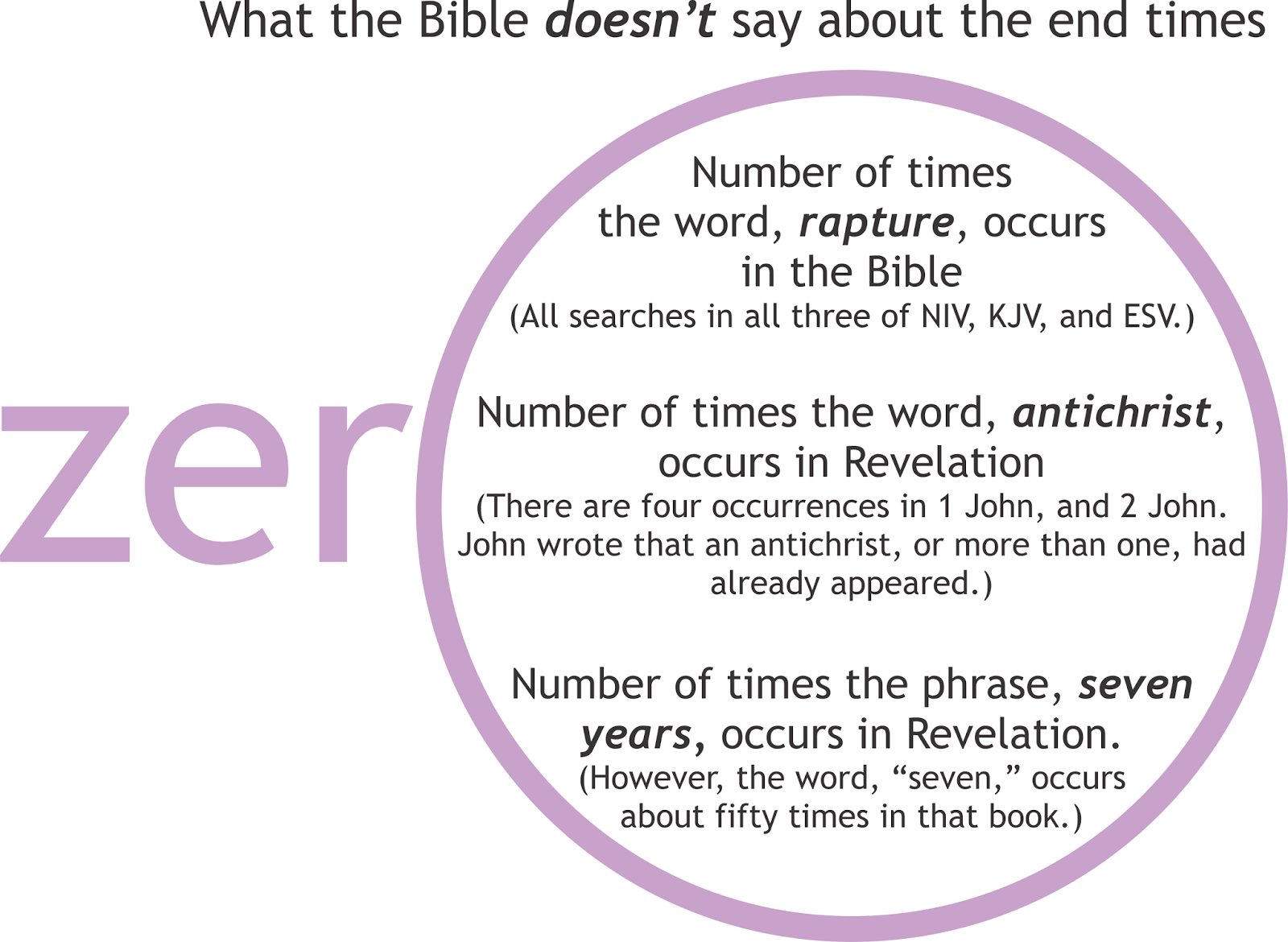
I believe that you can get a larger version of the graphic below, by right-clicking on it. You may feel free to use the graphic, as long as you do not use it for any commercial purpose -- it must remain free for all to use.

I don't have a lot of answers on end times. Some people seem to have answers, and they may be right. The above graphic illustrates reasons for caution. The Bible is not as clear about the end times as some people seem to believe that it is.

"Rapture" is not a word used in the Bible. The presentation of the idea of a rapture, a sudden removal of Christians from the world, that is most familiar to me is based on 1 Thessalonians 4:17. However, as you may learn from the comments on this post, below, that familiar presentation is probably mistaken, and a misinterpretation of scripture. (This paragraph was amended on September 28, 2009)

There are other reasons for caution. The Bible says this:
Matthew 24:36 “But concerning that day and hour no one knows, not even the angels of heaven, nor the Son, but the Father only. (All scripture from the ESV. See here for information on the ESV policy on on-line usage.)
and
Matthew 24:44 Therefore you also must be ready, for the Son of Man is coming at an hour you do not expect.

A serious warning, widely ignored, occurs in Revelation: 22:18 I warn everyone who hears the words of the prophecy of this book: if anyone adds to them, God will add to him the plagues described in this book, 19 and if anyone takes away from the words of the book of this prophecy, God will take away his share in the tree of life and in the holy city, which are described in this book.


Connie Willis, an author of fantastic literature, put it this way, probably a little too cynically, and, perhaps, even violating the warning above -- but she has a point -- in a short story:
The radio evangelists made it sound like the story of the Second Coming was a single narrative, but it was actually a hodgepodge of isolated scriptures -- Matthew 24 and sections of Isaiah and Daniel, verses out of Second Thessalonians and Joel, stray ravings from Revelation and Jeremiah, all thrown together by the evangelists as if the authors were writing at the same time. If they were even writing about the same thing. Connie Willis, "Epiphany," pp. 653-700, in The Winds of Marble Arch and Other Stories -- Burton, MI: Subterranean Press, 2007 -- p. 671. For similar thoughts, from an expert in Biblical interpretation, see here. (The expert doesn't call Revelation "ravings.") The expert, Kenneth Schenck, of Indiana Wesleyan University, is referring to the Dispensationalist view of end times, in particular the idea that there will be a seven year tribulation, and he points out that that view has, at best, very weak support in the Bible.
 
Thanks for reading. The Bible is clear on one idea about the end times: He is returning! We don't know when.

*    *    *    *    *

Added August 3, 2011: Here is a post, by me, on the first four prophecies mentioned by Matthew as being fulfilled by the coming, and early life, of Christ, and how difficult it must have been for those who first heard these prophecies, or even spoke and wrote them, to understand them as being about what actually happened.

Since these prophecies were difficult to interpret -- in some cases, impossible to interpret correctly until after the prediction came about -- why should we expect easy interpretations of prophecies about end times?

Added March 13, 2010:

David Heddle, of the He Lives blog, has recently posted on a particular word that occurs sometimes in prophecy, namely soon, and also this generation. He points out that some who claim to be interpreting the Bible very literally ignore, for example, part of the very first verse of Revelation, which says that Jesus told John that He was going to show him what would happen soon. Heddle doesn't seem to have a solution to how to deal with soon. I don't either. But, as I said in the title, it's best to be cautious, very cautious, about interpreting end times. Some people aren't very careful.

Added September 18, 2010:
Heddle has also posted on Armageddon, making a case for the idea that the Battle of Armageddon has already occurred.

Sunday, September 20, 2009

Strength in the New Testament

The New Testament mentions strength, and related words, a few times. I used the ESV search facility to find some of these (other versions may differ somewhat, and I may not have searched for all variants).

Here are some of the references, with remarks.

In Mark 12:28-30, Jesus told a questioner that the most important commandment was to love God with all your strength. Strength, then, must have to do, at least in this case, with resolve, will, determination, and the like.

In Luke 21:34-36, He warns the disciples about what is to come, and tells them to pray for strength, so strength, lest there be any doubt, can be divinely augmented. We should probably all pray for strength.

In Romans 1:11-12, Paul told the Romans that he wished he could impart a spiritual gift to them, to strengthen them. Spiritual gifts, then, apparently can add to the strength of a body of believers, and/or to individuals.

In Romans 4, Paul describes the faith of Abraham. He says, among other things, that ". . . he grew strong in his faith as he gave glory to God" (verse 20, last part).

In 1 Corinthians 16:13-14, Paul writes: "Be watchful, stand firm in the faith, act like men, be strong. 14 Let all that you do be done in love." I would judge that strength without the sort of love described in 1 Corinthians 13 isn't really the kind of strength that God wants us to have.

In 2 Corinthians 12:10, Paul says that he is strong when he is weak, one of the many paradoxes in the Bible. Most likely he was exalting the strength of God, which works when ours can't and doesn't. The author of Hebrews, in Hebrews 11:32-34, lists some of the heroes of faith, who were also made strong when they were weak in themselves.

Ephesians 6:10 and 1 Peter 4:10-11 also tell us that our strength must come from the Lord.

In 2 Timothy 2:1-3, Paul tells Timothy that he must be strengthened through Christ's grace.

And, finally, so does Phillipians 4:12-13, where Paul says, in verse 13: "I can do all things through him who strengthens me."

Be strong in Him!

Thanks for reading.

Friday, September 18, 2009

Why we really make decisions the way we do

John Stuart Mill had this (and a lot more) to say:

So long as opinion is strongly rooted in the feelings, it gains rather than loses instability by having a preponderating weight of argument against it. For if it were accepted as a result of argument, the refutation of the argument might shake the solidity of the conviction; but when it rests solely on feeling, worse it fares in argumentative contest, the more persuaded adherents are that their feeling must have some deeper ground, which the arguments do not reach; and while the feeling remains, it is always throwing up fresh intrenchments of argument to repair any breach made in the old. John Stuart Mill, The Subjection of Women, 1869, Chapter 1, 2nd paragraph. (Public Domain)

So what we argue for is mostly based on how we feel, not the validity of the position. Old news, but sobering.

Thanks for reading.

Thursday, September 17, 2009

The Morality of Richard Dawkins

I have read In Defence of the Soul, by Keith Ward. He argues that a completely materialistic view of life makes no sense, and points out that some of those who have argued for such a view are inconsistent:
When the destroyers of the soul have done their work, they usually turn back from the moral consequences of their theories, and end with a rather lame and totally unconvincing attempt to reinstate a modified version of traditional morality. We have seen this in Jacques Monod, in Erich Fromm and Karl Marx in slightly different ways. A particularly clear example can be found on the last page of Richard Dawkins' very entertaining book, The Selfish Gene. Having argued for 214 pages that human life is totally governed by the genes, 'unconscious, blind, replicators', he now says, in the last sentence or two, 'It is possible that yet another unique quality of man is a capacity for genuine disinterested, true altruism. I hope so, but I am not going to argue the case one way or another . . .' This is suitably tentative, but his last sentence reads: 'We, alone on earth, can rebel against the tyranny of the selfish replicators.'* The questions this raises are obvious. How can rational, responsible, altruistic, purposive, conscious conduct be accounted for on such a materialist theory? Why should he hope that altruism is possible, unless he really does have a basic sense of moral obligation? And isn't it odd to see morality as a rebellion against our true natures, instead of as a fulfilment of their potentialities? Keith Ward, In Defence of the Soul. Oxford, UK: Oneworld Publications, 1998. p. 161.
*cites Dawkins, The Selfish Gene (Oxford University Press, 1976) p. 215.

Thanks for reading.

Wednesday, September 16, 2009

Sunspots 228

Things I have recently spotted that may be of interest to someone else:


Science:
It looks like the USA is not sending anyone to the moon in the forseeable future.

Wired tells us that gecko tails, when detached from the lizard, exhibit some complex behavior. There's a video.

Wired also reports on the likely use of robots as aids in surgery .

Christianity:
Ken Schenck on the history of ordination in the church.


Image source (public domain)

Tuesday, September 15, 2009

More than one universe? Robert Mann's take.

As you may be aware, there are physicists who believe that there are multiple universes. They believe, for example, that the universe I am in somehow spawns two different ones, depending on whether or not I decide to pick up a pen or not -- it one, I did, in the other, I didn't. The Wikipedia article on the subject says that the concept goes back at least to the 19th century. Even though it is hard to imagine any possible experimental proof for this idea, it has a following. Some authors of fantastic literature have produced sub-creations, based on the concept. One such was Philip Pullman.

In the latest issue of Perspectives on Science and Christian Faith -- which is not yet available on-line -- Robert B. Mann discusses "The Puzzle of Existence," considering the interesting question of why some things exist, and some things don't. It is hard, for example, to believe that there couldn't have been more species of butterflies than there are and have been, or that the only possible asteroids were those that we have known about, or that our parents could not have had other children than us.

One reason that some things don't exist is that the laws of physics, or the properties of chemistry and biology, don't allow it. Water, in its solid form, does not float in the air. Rose plants won't grow on the planet Mercury (or on a diet of only the element Mercury). But there must be other reasons for nonexistence, for entities like the possibilities mentioned in the previous paragraph. Either God wanted only some types of butterflies, or chance determined who got born, or God uses what we call chance to determine that certain things will exist, and some not.

Mann closes by challenging the multiple universe idea. He points out that, if all possible universes exist, that would seem to make it possible for a universe with a fallen earth, but no redemption, to exist, which seems totally incompatible with God's love, omnipresence, and omnipotence. Interesting ideas.

Thanks for reading.

Monday, September 14, 2009

Norman Borlaug, Nobel prize winning botanist, dies

Norman Borlaug, architect of the Green Revolution, has passed away, at age 95.

The categories for the Nobel Prizes were mostly determined by the will of Alfred Nobel. A number of geneticists, such as Watson and Crick, have won or shared in the Nobel Prize for Physiology or Medicine, but there is no prize in genetics. There is no prize in zoology, or botany. A few zoologists have won the Prize in Physiology or Medicine. Borlaug, a botanist, made scientific and agricultural contributions of such importance that he won the Nobel Peace Prize in 1970.

What did Borlaug do? What is the Green Revolution? Put simply, Borlaug worked, for many years, on improving crop yields in third world countries. Much of his work was in the field in those countries. There is a chart included in the Wikipedia article on the man that dramatically shows the effect of the work of Borlaug and his colleagues. Wheat yields in Mexico, according to the chart, increased by more than four-fold since 1950. Borlaug's techniques involved increased fertilizer and other agricultural techniques which had not been used very much in third world countries, and breeding crops that could take advantage of these techniques. It seems clear that Borlaug's work kept many people, probably many millions, from starvation.

Borlaug's work has not been without controversy. Critics have claimed that Borlaug's techniques have worked to the advantage of agribusiness companies, made third world farmers too dependent on seed that they may not always be able to afford, and harmed the environment. There is some truth in all these claims, but Borlaug believed that producing more food was more important. He has also put forward the Borlaug Hypothesis, which states that improving crop yields makes deforestation less likely. He has stated that population growth is one of the important reasons why people don't have enough food.

Science is sometimes accused of being too divorced from people's real needs. Maybe so. What, if any, is the practical value of string theory? But discoveries that, at first, seem only interesting to specialists, or irrelevant to human physical or economic needs, often turn out to be of immense practical use. One example is Mendel's work in studying how some characteristics of peas were inherited. I doubt if Mendel, or Mendel's contemporaries, had any idea that his discoveries would make tremendous advances in agriculture and medicine possible. Without Mendel, no Borlaug. Science is also a way of learning about God. Psalm 19:1-4 and Romans 1:20 tell us that how nature works is one of the ways God is revealed to us.

I'm not sure Borlaug's work has helped us to know God better, but it has helped lots of people stay alive, so that they have a chance of learning about Him. We should be grateful for his work.

Thanks for reading.

Sunday, September 13, 2009

Some thoughts on church choirs

The entire range of human experiences is present in a church choir, including but not restricted to jealousy, revenge, horror, pride, incompetence (the tenors have never been on the right note in the entire history of church choirs, and the basses have never been on the right page), wrath, lust, and existential despair. Connie Willis, "An Introduction to This Book, or 'These Are a Few of My Favorite Things,'" in The Winds of Marble Arch and Other Stories -- Burton, MI: Subterranean Press, 2007 -- p. 14.

2 Chronicles 20:21 And when he had taken counsel with the people, he appointed those who were to sing to the Lord and praise him in holy attire, as they went before the army, and say,
“Give thanks to the Lord,
for his steadfast love endures forever.”
22 And when they began to sing and praise, the Lord set an ambush against the men of Ammon, Moab, and Mount Seir, who had come against Judah, so that they were routed. (ESV, as are all quotations from the Bible in this post. "he" was king Jehoshaphat. This may be the only time in history when a choir defeated an army. Of course, it was God who actually did it.)
2 Chronicles 29:27 Then Hezekiah commanded that the burnt offering be offered on the altar. And when the burnt offering began, the song to the Lord began also, and the trumpets, accompanied by the instruments of David king of Israel. 28 The whole assembly worshiped, and the singers sang, and the trumpeters sounded. All this continued until the burnt offering was finished. 29 When the offering was finished, the king and all who were present with him bowed themselves and worshiped. 30 And Hezekiah the king and the officials commanded the Levites to sing praises to the Lord with the words of David and of Asaph the seer. And they sang praises with gladness, and they bowed down and worshiped.
Colossians 3:14 And above all these put on love, which binds everything together in perfect harmony. 15 And let the peace of Christ rule in your hearts, to which indeed you were called in one body. And be thankful. 16 Let the word of Christ dwell in you richly, teaching and admonishing one another in all wisdom, singing psalms and hymns and spiritual songs, with thankfulness in your hearts to God.
Revelation 5:And when he had taken the scroll, the four living creatures and the twenty-four elders fell down before the Lamb, each holding a harp, and golden bowls full of incense, which are the prayers of the saints. And they sang a new song, saying,
“Worthy are you to take the scroll
and to open its seals,
for you were slain, and by your blood you ransomed people for God
from every tribe and language and people and nation,
10 and you have made them a kingdom and priests to our God,
and they shall reign on the earth.”
Sing on!

Saturday, September 12, 2009

Michael Jordan, David Robinson, John Stockton

Michael Jordan, David Robinson, and John Stockton were recently inducted into the National Basketball Association's Hall of Fame, and rightly so.

Jordan first gained national prominence as a member of the University of North Carolina Tar Heel men's team, in the early 80s. That team won the NCAA National Championship in 1982. The Wikipedia article on Jordan says that he led the team. That could be argued. (See here for a report on that team.) James Worthy and Sam Perkins were on that team. So were Matt Doherty and Jimmy Black. My recollection - I saw many of the team's games, including the championship game - is that Worthy was more the star than Jordan. This is borne out by Worthy's choice as most outstanding player of the 1982 NCAA tournament, and the fact that he was the first player chosen in the NBA draft. But it's a team game. They were all fine players.

Here's a CBS article on Jordan's induction speech. He said some wise things, mostly that he admonished the basketball world to stop looking for him. As he said, "You didn't find me." Jordan has had some bumps in his life. He hasn't been a hero in every way. But he was a great player, perhaps even the best ever. He could shoot, he could play defense. But his finest attribute, in his glory years in the NBA, was that he made other players better.


Robinson was a gentleman, through and through, and, I believe, he still is. He has been married only once, and he and his wife have given millions to charity. I have heard it said that Robinson is a Christian. He went to the US Naval Academy, and served two years in the Navy before entering the NBA.

Stockton, who, like Jordan and Robinson, was a member of the "Dream Team" of mostly NBA players that won the Olympic Gold medal in 1982, was said to be an invisible man in Barcelona, where the Olympics were held. For one thing, he is white, when fans were (rightly) expecting NBA stars to be mostly black. For another, he is only a little over six feet tall, and weighed less than 190 pounds during his career. Stockton is the NBA's all-time leader in career steals and assists. He was also a good shot.

Stockton and Robinson played for only one NBA team each during their entire careers, Utah and San Antonio, respectively. Jordan almost did, with Chicago. He probably played longer than he should have, and was less than world-class during his career with the Washington, DC, team. Jordan won championships with the Bulls, Robinson won one with the Spurs. Stockton's Jazz never won a championship, although they came close.

All three of these men deserve their honor. I am glad that I got to see them play on TV many times.

God gives some people ability. Some of us develop that, and some of us don't. Stockton, Jordan, and Robinson had God-given ability. They developed it. They all worked hard, and played and practiced when they'd probably rather have been doing something else.

Thanks for reading.

Friday, September 11, 2009

Musings on an anniversary

Today is a September eleventh. I am very sorry for what happened. Real people died, and real people who didn't die had their lives shattered -- loved ones gone, in a few cases jobs gone, nightmares endured for the rest of their lives. But, as always, we didn't react as wisely as we should have. I didn't, either.

When thousands of US residents die one by one, in gang warfare in our streets, in highway accidents, without proper medical care, we don't pay a lot of attention. When hundreds or thousands die at once, we do. Is that wise?

Our elected and appointed officials felt that they had to "do something." One thing has been to beef up airport security. Are we better off because of this? Maybe. Maybe not. Critics of airport security say that we are now very good at keeping small sharp objects off planes, but that it no longer matters, because of changes to how the cockpit is protected. And maintenance personnel could do things to blow up planes, and we don't check them.

Another thing that our leaders felt that they had to do -- a lot of us we wanted them to -- was to punish someone badly. They picked Iraq. Perhaps the world is better off for this, perhaps not. Some people think that Iraq is likely to turn into a bloodbath between Kurds, Sunnis, and Shiites. Some think that the Shiite part of it is going to become a satellite of Iran. Even if Iraq becomes a stable democracy, where freedom of religion (including for Christians) is allowed, it's not there yet. Osama bin Laden has yet to be caught. Iraq has been a breeding ground for new terrorists. We've lost lives, and taken them. There has been massive corruption and graft. We didn't plan for an occupation very well. Our troops lacked armor at first, and they often haven't been given the medical and psychological care that they need. We have sometimes been exposed as horribly immoral. We've spent vast amounts of our money, without (until recently) even putting the expense into the budget.

God says that vengeance belongs to Him. I should let Him take care of revenge on someone who harms me, if He chooses to. It's not my business. Does that apply to governments, especially governments which, like ours, are not theocracies? Perhaps not. But God is still the final authority.

I close with good news. Christ came to end all suffering and death. Whatever evil is now in the world, it will all be ended.

Thanks for reading.