License

I have written an e-book, Does the Bible Really Say That?, which is free to anyone. To download that book, in several formats, go here.
Creative Commons License
The posts in this blog are licensed under a Creative Commons Attribution-NonCommercial-ShareAlike 3.0 Unported License. You can copy and use this material, as long as you aren't making money from it. If you give me credit, thanks. If not, OK.
Showing posts with label Glory. Show all posts

Sunday, March 12, 2023

With Christ in the School of Prayer, by Andrew Murray, excerpt 169

This post continues a series of excerpts from With Christ in the School of Prayer, by Andrew Murray. I do this, not because I'm a powerful prayer warrior, but because I'm not. Murray was. I thank the Christian Classics Ethereal Library for making this public domain work available. To see their post of the book, go here. His book is based on Mark 11:22-24. The previous post in this series is here. As usual in this blog, long quotations are in this color. Murray's book is based on Mark 11:22-24.

And do Thou, the God of glory, the Father of glory, my God and my Father, accept the desire of a child who has seen that Thy glory is indeed alone worth living for. O Lord! Show me Thy glory. Let it overshadow me. Let it fill the temple of my heart. Let me dwell in it as revealed in Christ. And do Thou Thyself fulfil in me Thine own good pleasure, that Thy child should find his glory in seeking the glory of his Father. Amen.

Sunday, September 08, 2019

The Art of Divine Contentment: An Exposition of Philippians 4:11 by Thomas Watson. Excerpt 92

Watson, near the close of his book, sets forth some rules for being contented:

Rule 17. Meditate much on the glory which shall be revealed. There are great things laid up in heaven. Though it be sad for the present yet let us be content in that it shortly will be better; it is but a while and we shall be with Christ, bathing ourselves in the fountain of love; we shall never complain of wants and injuries any more; our cross may be heavy, but one sight of Christ will make us forget all our former sorrows. There are two things that should give contentment.
1. That God will make us able to bear our troubles. (1 Cor. 10. 13) God, saith Chrysostom, doth like a lutanist, who will not let the strings of his lute be too slack lest it spoil the music of prayer and repentance? nor yet too much adversity, “lest the spirit fail before me; and the souls that I have made.” (Is. 57. 16)
2. When we have suffered a while, we shall be perfected in glory; the cross shall be our ladder by which we shall climb up to heaven. Be then content, and then the scene will alter; God will ere long turn out water into wine; the hope of this is enough to drive away all distempers from the heart. Blessed be God, it will be better: “we have no continuing city here,” therefore our afflictions cannot continue. A wise man looks still to the end; “The end of the just man is peace.” (Ps. 37. 37) Methinks the smoothness of the end should make amends for the ruggedness of the way. O eternity, eternity! Think often of the kingdom prepared. David was advanced from the field to the throne: first he held his shepherd’s staff, and shortly after the royal sceptre. God’s people may be put to hard services here: but God hath chosen them to be kings, to sit upon the throne with the Lord Jesus. This being weighed in the balance of faith, would be an excellent means to bring the heart to contentment.

Thomas Watson lived from 1620-1686, in England. He wrote several books which survive. This blog, thank God, has posted excerpts from hisThe Art of Divine Contentment: An Exposition of Philippians 4:11, over a number of weeks, on Sundays.

My source for the text is here, and I thank the Christian Classics Ethereal Library for making this text (and many others) available. The previous excerpt is here.

Sunday, October 21, 2018

The Art of Divine Contentment: An Exposition of Philippians 4:11 by Thomas Watson. Excerpt 49

Watson continues discussing how the evils of affliction may work for good:

Sixthly, These evils of affliction are for good, as they bring with them certificates of God’s love, and are evidences of his special favour. Affliction is the saint’s livery; it is a badge and cognizance of honour: that the God of glory should look upon a worm, and take so much notice of him, as to afflict him rather than lose him, is an high act of favour. God’s rod is a sceptre of dignity, Job calls God’s afflicting of us, his magnifying of us. (Job 7. 17) Some men’s prosperity hath been their shame, when others afflictions have been their crown.

Seventhly, These afflictions work for our good, because they work for us a far exceeding weight of glory. (2 Cor. 4. 17) That which works for my glory in heaven, works for my good. We do not read in Scripture that any man’s honour or riches do work for him a weight of glory, but afflictions do; and shall a man be discontented at that which works for his glory?
The heavier the weight of affliction, the heavier the weight of glory; not that our sufferings do merit glory, (as the papists do wickedly gloss,) but though they are not the cause of our crown, yet they are the way to it; and God makes us, as he did our captain, “perfect through sufferings.” (He. 2. 10) And shall not all this make us contented with our condition? O I beseech you, look not upon the evil of affliction, but the good! Afflictions in Scripture are called “visitations.” (Job 7. 18) The word in the Hebrew, to visit, is taken in a good sense, as well as a bad: God’s afflictions are but friendly visits. Behold here God’s rod, like Aaron’s rod blossoming; and Jonathan’s rod, it hath honey at the end of it. Poverty shall starve out our sins; the sickness of the body cures a sin-sick soul; O then, instead of murmuring and being discontented, bless the Lord! Hadst thou not met with such a rub in the way, thou mightest have gone to hell and never stopped.


Thomas Watson lived from 1620-1686, in England. He wrote several books which survive. This blog, God willing, will post excerpts from his The Art of Divine Contentment: An Exposition of Philippians 4:11, over a number of weeks, on Sundays.

My source for the text is here, and I thank the Christian Classics Ethereal Library for making this text (and many others) available. The previous excerpt is here.
  
Philippians 4:11 Not that I speak because of lack, for I have learned in whatever state I am, to be content in it. (World English Bible, public domain.)
      

Monday, December 04, 2017

The magnificence of Christ, creator and sustainer

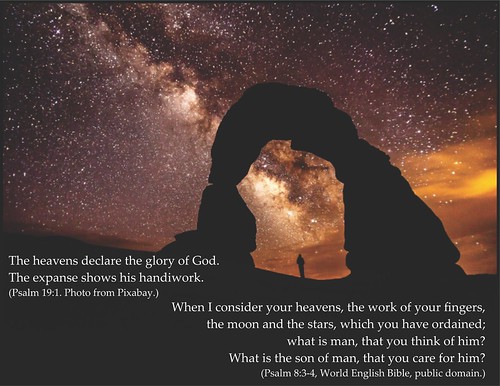
God revealed through the Milky Way


God the Son was important in the creation, and in sustaining that which He created!

John 1:1 In the beginning was the Word, and the Word was with God, and the Word was God. 2 The same was in the beginning with God. 3 All things were made through him. Without him, nothing was made that has been made. 10 He was in the world, and the world was made through him, and the world didn’t recognize him. 12a But as many as received him, to them he gave the right to become God’s children . . .

Colossians 1:14 in whom we have our redemption, the forgiveness of our sins. 15 He is the image of the invisible God, the firstborn of all creation. 16 For by him all things were created in the heavens and on the earth, visible things and invisible things, whether thrones or dominions or principalities or powers. All things have been created through him and for him. 17 He is before all things, and in him all things are held together.

Hebrews 1:3 His Son is the radiance of his glory, the very image of his substance, and upholding all things by the word of his power, who, when he had by himself purified us of our sins, sat down on the right hand of the Majesty on high ...

(Although the passages above indicate that God the Son was the most important agent in the creation, there are scriptural indications that God the Father and God the Holy Spirit were also involved.)

Perhaps you and I don't fully appreciate the magnificence of creation, and, therefore, we may not fully appreciate the magnificence of Christ.

Creation shows that God the son loves diversity. There are about 400,000 species of beetles, and probably at least a million yet to be discovered. (Psalm 104:24 Yahweh, how many are your works! In wisdom, you have made them all. The earth is full of your riches. 25 There is the sea, great and wide, in which are innumerable living things, both small and large animals.)

Creation is unimaginably large. “Recent estimates of the number of galaxies in the observable universe range from 200 billion [(2×10 to the 11th power) to 2 trillion (2×10 to the 12th power)] or more, … containing more stars than all the grains of sand on planet Earth.” (Wikipedia) And that’s only the observable universe.

Creation shows the power of God the Son. Most of the energy on earth comes from the sun. In the sun, Hydrogen nuclei bombard each other at several million degrees, and turn into Helium nuclei, releasing energy by e =m c-squared. The sun is about 93 million miles away. Since it is emitted in all directions, the vast majority of the sun’s emitted energy goes off into space, never hitting the earth, or any other body in the Solar System. But it’s warm enough for life on earth, and light enough for photosynthesis, just from the tiny fraction of the sun’s emitted energy that strikes it. We can scarcely imagine the power of the sun, and it’s a fairly small star.

Creation shows that God the Son likes beauty. He didn’t have to make the universe so that rainbows, or fall foliage, or butterflies, or eclipses, exist. But He did. Using scientific tools, such as microscopes and telescopes, we have found that there is amazing beauty, even in things we can’t get to, or can’t see with the naked eye.


The Creation is sustained by God the Son. How? By laws, like gravity, and created properties, such as that water can exist in three different forms at reasonably normal temperatures. The laws of gravity ensure, for example, that the planets continue to orbit the sun. The properties of water make rain possible, among many other things. God also sustains by processes, like erosion, plate tectonics, and natural selection. We can’t be sure if God is intimately involved in making every raindrop, or lets nature take its course to make each one, but He could make each and every one carefully and magnificently. 

God the Son can, and, at least sometimes, does, change the “normal” course of nature. We call that a miracle.


God, the Son’s, creation is beyond our imagination! He created time and space! God created matter and energy! God created the four fundamental forces, (also called the four interactions) – gravity, the electromagnetic force, the strong force and the weak force. God created the entire electromagnetic spectrum: light, radio waves, wi-fi, microwaves, X-rays, and more. God created the universe with appropriate physical properties for the existence of life

We should not forget that, even though He was largely responsible for the creation of the entire universe, He came to earth. Not as a baby, but as an embryo, a being with just a few cells, and hardly any connection to the world outside his mother’s womb. Then, of course, He became a fetus, and, after about nine months, a baby. Still helpless, dependent, and, presumably, severely limited in His ability to communicate.

And we should not forget what St. Paul said about the Creator and Sustainer of the universe:
5 Have this in your mind, which was also in Christ Jesus, 6 who, existing in the form of God, didn’t consider equality with God a thing to be grasped, 7 but emptied himself, taking the form of a servant, being made in the likeness of men. 8 And being found in human form, he humbled himself, becoming obedient to the point of death, yes, the death of the cross. 9 Therefore God also highly exalted him, and gave to him the name which is above every name, 10 that at the name of Jesus every knee should bow, of those in heaven, those on earth, and those under the earth, 11 and that every tongue should confess that Jesus Christ is Lord, to the glory of God the Father. (From Philippians 2)

Thanks for reading! To God be the glory!

Thursday, May 14, 2015

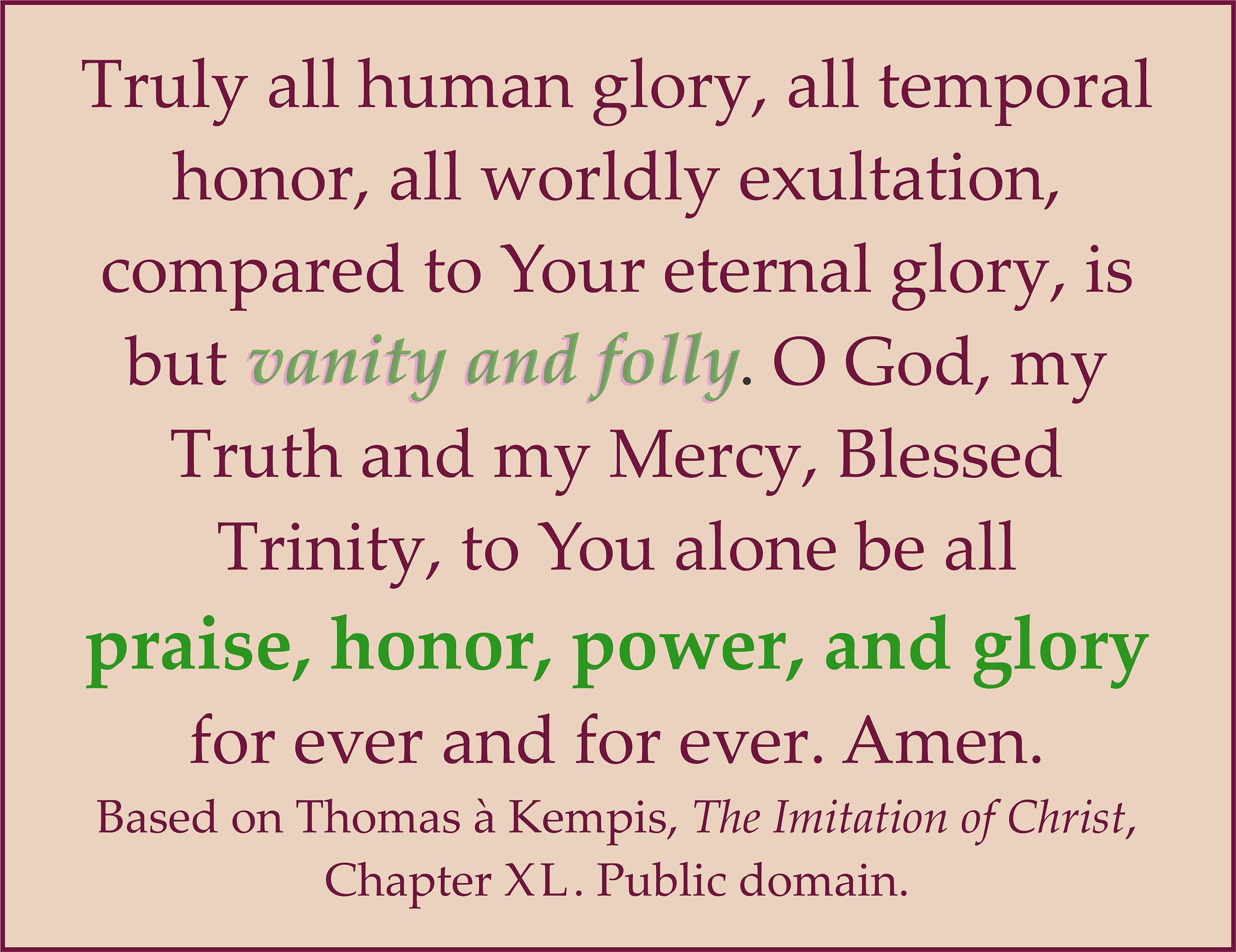
Poster on giving God glory, based on The Imitation of Christ

Imitation of Christ, on glory 

Based on The Imitation of Christ, a work by Thomas à Kempis, 15th century, hence public domain.

"Truly all human glory, all temporal honor, all worldly exultation, compared to Your eternal glory, is but vanity and folly. O God, my Truth and my Mercy, Blessed Trinity, to You alone be all praise, honor, power, and glory for ever and for ever. Amen." Indeed.

Thanks for looking. I used Coolors to generate the color scheme used in this poster.

Sunday, August 15, 2010

Give glory or not?

1 Samuel 5:4 And they said, “What is the guilt offering that we shall return to him?” They answered, “Five golden tumors and five golden mice, according to the number of the lords of the Philistines, for the same plague was on all of you and on your lords. 5 So you must make images of your tumors and images of your mice that ravage the land, and give glory to the God of Israel. Perhaps he will lighten his hand from off you and your gods and your land.
 
This was when the Israelites had taken the Ark of the Covenant into battle, and lost the battle, and the ark. All wasn't well for the Philistines, however. God sent them various troubles. The theology of the Philistines may not have been correct, but they knew that God was powerful (he had, among other things, removed the head of one of their idols without human help) and that they needed to do something to stop the plague and cancers (?) that he had sent to them. So they did their best to give Him glory.

Jesus had another take on the topic of glory, two in fact, in this passage:
John 5:41 I do not receive glory from people. 42 But I know that you do not have the love of God within you. 43 I have come in my Father's name, and you do not receive me. If another comes in his own name, you will receive him. 44 How can you believe, when you receive glory from one another and do not seek the glory that comes from the only God?

This should not be taken as an admonition not to glorify God. Jesus was speaking to bad people. He didn't want their glory. He wants ours. Romans 15:7 says "Therefore welcome one another as Christ has welcomed you, for the glory of God." 1 Corinthians 10:31 has this admonition from Paul: "So, whether you eat or drink, or whatever you do, do all to the glory of God." There are several other verses in the New Testament indicating that, whether Christ receives glory from us or not, we should give it, and, in a sense are, ourselves, part of that glory. (2 Corinthians 8:23 As for Titus, he is my partner and fellow worker for your benefit. And as for our brothers, they are messengers of the churches, the glory of Christ.)
I am reading the Bible through in a year, and was struck by the first two passages above, from the May 9th and May 8th readings (This post got stuck in my drafts for quite a while!). All quotations are from the ESV. (emphasis added)


Thanks for reading!

Tuesday, January 27, 2009

Happy Birthday, Mozart

W. Amadeus Mozart was born on this date in 1756.

Here's a video of a boy's choir singing the Gloria from one of his masses. Glory to God, indeed!

Tuesday, May 08, 2007

Science and glory

I believe that the Bible teaches that one of the ways God has revealed Himself to us is through the natural world. (Psalm 19, Romans 1:20) I believe that we, fallen beings that we are, can and do make mistakes in our interpretation of this, and His other revelations, but that, nonetheless, they are all, including nature, legitimate.

The Bible says that "It is the glory of God to conceal a thing; But the glory of kings is to search out a matter. Proverbs 25:2 (ASV)" The ESV has very similar language, and so do all other versions of the Bible that I have seen.

Many people have seen God's glory in various displays of natural beauty and majesty, from the microscopic to the telescopic. If His glory is seen in nature, (Psalm 19:1) then studying nature should increase our appreciation of His glory.

Proverbs 25:2 seems to be telling us that not only is God's glory seen in nature, but that we can get glory (although we aren't kings) by seeking out the ways and secrets of the natural world, in other words, by being scientists. It isn't the only way, of course, but it's a legitimate way to get glory for ourselves, and, more importantly, to increase our appreciation of God's glory.

Thanks for reading.