Musings on science, the Bible, and fantastic literature (and sometimes basketball and other stuff).
God speaks to us through the Bible and the findings of science, and we should listen to both types of revelation.
The title is from Psalm 84:11.
The Wikipedia is usually a pretty good reference. I mostly use the World English Bible (WEB), because it is public domain. I am grateful.
License
The posts in this blog are licensed under a Creative Commons Attribution-NonCommercial-ShareAlike 3.0 Unported License. You can copy and use this material, as long as you aren't making money from it. If you give me credit, thanks. If not, OK.
Tuesday, November 08, 2022
The earth is fixed in place?
Sunday, August 07, 2022
With Christ in the School of Prayer, by Andrew Murray, excerpt 138
This post continues a series of excerpts from With Christ in the School of Prayer, by Andrew Murray. I thank the Christian Classics Ethereal Library for making this public domain work available. To see their post of the book, go here. His book is based on Mark 11:22-24. The previous post in this series is here. As usual in this blog, long quotations are in this color. Murray's book is based on Mark 11:22-24.
The Father accepts the will, the sacrifice is well-pleasing; the Holy Spirit will seal us within with the consciousness, we are living for God and His glory.
And then what quiet peace and power there will be in our prayers, as we know ourselves through His grace, in perfect harmony with Him who says to us, when He promises to do what we ask: ‘That the Father may be glorified in the Son.’ With our whole being consciously yielded to the inspiration of the Word and Spirit, our desires will be no longer ours but His; their chief end the glory of God. With increasing liberty we shall be able in prayer to say: Father! Thou knowest, we ask it only for Thy glory. And the condition of prayer-answers, instead of being as a mountain we cannot climb, will only give us the greater confidence that we shall be heard, because we have seen that prayer has no higher beauty or blessedness than this, that it glorifies the Father. And the precious privilege of prayer will become doubly precious because it brings us into perfect unison with the Beloved Son in the wonderful partnership He proposes: ‘You ask, and I do, that the Father may be glorified in the Son.’ precious because it brings us into perfect unison with the Beloved Son in the wonderful partnership He proposes: ‘You ask, and I do, that the Father may be glorified in the Son.’
‘LORD, TEACH US TO PRAY.Monday, December 04, 2017
The magnificence of Christ, creator and sustainer

God the Son was important in the creation, and in sustaining that which He created!
John 1:1 In the beginning was the Word, and the Word was with God, and the Word was God. 2 The same was in the beginning with God. 3 All things were made through him. Without him, nothing was made that has been made. 10 He was in the world, and the world was made through him, and the world didn’t recognize him. 12a But as many as received him, to them he gave the right to become God’s children . . .
Colossians 1:14 in whom we have our redemption, the forgiveness of our sins. 15 He is the image of the invisible God, the firstborn of all creation. 16 For by him all things were created in the heavens and on the earth, visible things and invisible things, whether thrones or dominions or principalities or powers. All things have been created through him and for him. 17 He is before all things, and in him all things are held together.
Hebrews 1:3 His Son is the radiance of his glory, the very image of his substance, and upholding all things by the word of his power, who, when he had by himself purified us of our sins, sat down on the right hand of the Majesty on high ...
(Although the passages above indicate that God the Son was the most important agent in the creation, there are scriptural indications that God the Father and God the Holy Spirit were also involved.)
Perhaps you and I don't fully appreciate the magnificence of creation, and, therefore, we may not fully appreciate the magnificence of Christ.
Creation shows that God the son loves diversity. There are about 400,000 species of beetles, and probably at least a million yet to be discovered. (Psalm 104:24 Yahweh, how many are your works! In wisdom, you have made them all. The earth is full of your riches. 25 There is the sea, great and wide, in which are innumerable living things, both small and large animals.)
Creation is unimaginably large. “Recent estimates of the number of galaxies in the observable universe range from 200 billion [(2×10 to the 11th power) to 2 trillion (2×10 to the 12th power)] or more, … containing more stars than all the grains of sand on planet Earth.” (Wikipedia) And that’s only the observable universe.
Creation shows the power of God the Son. Most of the energy on earth comes from the sun. In the sun, Hydrogen nuclei bombard each other at several million degrees, and turn into Helium nuclei, releasing energy by e =m c-squared. The sun is about 93 million miles away. Since it is emitted in all directions, the vast majority of the sun’s emitted energy goes off into space, never hitting the earth, or any other body in the Solar System. But it’s warm enough for life on earth, and light enough for photosynthesis, just from the tiny fraction of the sun’s emitted energy that strikes it. We can scarcely imagine the power of the sun, and it’s a fairly small star.
Creation shows that God the Son likes beauty. He didn’t have to make the universe so that rainbows, or fall foliage, or butterflies, or eclipses, exist. But He did. Using scientific tools, such as microscopes and telescopes, we have found that there is amazing beauty, even in things we can’t get to, or can’t see with the naked eye.
God, the Son’s, creation is beyond our imagination! He created time and space! God created matter and energy! God created the four fundamental forces, (also called the four interactions) – gravity, the electromagnetic force, the strong force and the weak force. God created the entire electromagnetic spectrum: light, radio waves, wi-fi, microwaves, X-rays, and more. God created the universe with appropriate physical properties for the existence of life
We should not forget that, even though He was largely responsible for the creation of the entire universe, He came to earth. Not as a baby, but as an embryo, a being with just a few cells, and hardly any connection to the world outside his mother’s womb. Then, of course, He became a fetus, and, after about nine months, a baby. Still helpless, dependent, and, presumably, severely limited in His ability to communicate.
And we should not forget what St. Paul said about the Creator and Sustainer of the universe:
5 Have this in your mind, which was also in Christ Jesus, 6 who, existing in the form of God, didn’t consider equality with God a thing to be grasped, 7 but emptied himself, taking the form of a servant, being made in the likeness of men. 8 And being found in human form, he humbled himself, becoming obedient to the point of death, yes, the death of the cross. 9 Therefore God also highly exalted him, and gave to him the name which is above every name, 10 that at the name of Jesus every knee should bow, of those in heaven, those on earth, and those under the earth, 11 and that every tongue should confess that Jesus Christ is Lord, to the glory of God the Father. (From Philippians 2)
Thanks for reading! To God be the glory!
Tuesday, November 15, 2016
Is it OK to pray that my team (or my candidate) will win?
Well, God knows our hearts, and if that sort of outcome is one of our top desires, then we might as well pray it, because He knows. But perhaps praying of that sort isn't wise, and perhaps we should have more God-centered top desires.
The outcome we desire may not be the one that God wants.
Here are some possibilities:
1) Perhaps God calculates which team is most deserving -- has practiced harder, prepared more thoroughly -- and awards a win to that team. Only God could do that. Does He? Who could know that? Would it be necessary for God to award the victory? Most of the time, the more deserving team would have won without divine intervention. Maybe the team that hasn't practiced and prepared so well has better players, and God counts that as most deserving.
2) I doubt very much that God adds up the number, length, and fervency of the prayers for team A, and the same for team B, and makes sure that the team with most prayer behind it wins. Only God could do that, but I really doubt that He does so. Prayer in the New Testament, and throughout the history of the church, shows little or no hint of that sort of prayer.
3) Perhaps God doesn't really care who wins.
4) God may have some particular outcome(s) in mind that we know nothing about. For example, a player might be injured, and, as a result, cease being an athlete, and enter some sort of Christian service. A player on the winning team may glorify God in a public way, influencing others, because of a win. Or a player (or coach) may be humbled as the result of a loss, and repent of some sin. I guess it's possible for a player, or a coach, or a fan, to tell God that she will obey Him if He lets her team win. I doubt that this would work, though. God surely could use the outcome of a game to subtly, or strongly, influence fans, players, coaches and referees for good, in many different ways we can't imagine, tailored to each of the individuals involved. We aren't likely to see such influence, unless we are personally involved.
Situation 4), that God uses events, including contests, to influence many people in various ways, for their good, and His glory, seems most likely, to me. And it seems to me that I shouldn't spend a lot, or any time, praying for a particular winner in athletic contests, and perhaps not even in political ones. (I ought to be praying that God's purposes, whatever they are -- we usually don't know all of them -- will be advanced, by my candidate, or the other one.)
I think it's OK to play for the safety of the players and coaches, and the audience, and that participants and fans won't be tempted to sin (for example by hating the opposition, or the referees, or being proud if their side wins) because of an athletic event. And the most important prayer, for an athletic contest, must be to pray that God will be glorified through it.
The same sort of actions by God could, I guess, be true of political contests. And dare I mention war? God did intervene in various ways in military contests in the Old Testament, sometimes, it seems, more interested in making some combatant the winner, or sometimes more interested in letting one side -- often the sinful Israelites -- be defeated. Perhaps God still intervenes in battles and wars in the 21st Century. Battles and wars usually must be more important than, say, the World Series.
Thanks for reading. Feel free to comment.
Thursday, January 02, 2014
Thomas Aquinas and God's use of natural selection in creation
The posts are here and here.
The posts consider, and refute, one of the most frequent objections to the use of evolutionary processes, the loss of life necessary in natural selection.
The closing statement is "To sum up, why did God choose to create via an evolutionary process rather than via special creation? Because it better reveals his glory and his power. Because it reveals better that he is God."
Thanks for reading.
Thursday, February 24, 2011
Why did God create things?
I have occasionally remarked, in this blog, that the Bible doesn't tell us why God created, or how, or when, but it does tell us Who. I was wrong. We do know something of why God created.
Some people believe that we do know why, and that Revelation 4:11 tells us why: "Thou art worthy, O Lord, to receive glory and honour and power: for thou hast created all things, and for thy pleasure they are and were created." (KJV. The song "Thou Art Worthy" is based on this verse.) However, that translation is probably misleading. Here's a compilation of several translations of that verse. The majority, including the New KJV, render that phrase as "by your will," rather than "for your pleasure." In fact, the Greek word θέλημα, thelema, translated as "for thy pleasure" in this case, is translated as "at your will" in the 59 other verses where it occurs, in the KJV.
I have now read an article that claims to give reasons why God created. Here are the reasons presented:
1) To show God's glory. Bishop, the author, quotes Romans 1:20 in support of that: "For the invisible things of him since the creation of the world are clearly seen, being perceived through the things that are made, even his everlasting power and divinity; that they may be without excuse." (All Bible quotations are from the WEB) He could have quoted Psalm 19:
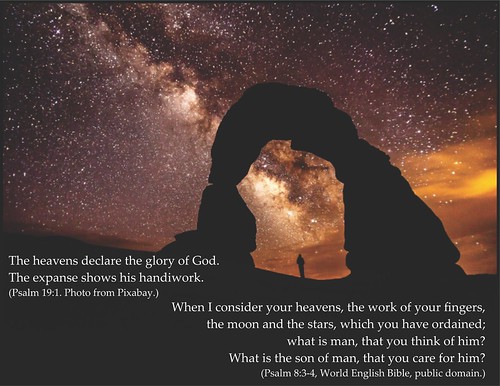
1 The heavens declare the glory of God.
The expanse shows his handiwork.
2 Day after day they pour forth speech,
and night after night they display knowledge.
3 There is no speech nor language,
where their voice is not heard.
4 Their voice has gone out through all the earth,
their words to the end of the world.
2) To serve as God's temple. (The author quotes Psalm 78:69, Psalm 93:1-2, and Isaiah 66:1.) I have some problems with this, or at least with the scripture taken to support it. I'm not sure that it does. Psalm 93:1-2 says:
93:1 Yahweh reigns!
He is clothed with majesty!
Yahweh is armed with strength.
The world also is established.
It can’t be moved.
2 Your throne is established from long ago.
You are from everlasting. (WEB)
We aren't to take the last part of verse 1 literally, surely. Why should we take the rest of it as literal, rather than poetic?
Hebrews speaks of a temple of God in the heavens. Why did God need a temple on earth, then? I'm not convinced.
3) Bishop writes: "Another of God’s purposes, that we’ve already seen, is for creation to become uniquely what it is called to be in Christ." OK. I can see that one, even though there's not explicit scripture cited for it. Bishop might have used Romans 8:18-25. (See below)
4)Bishop's next reason is that God wanted to populate the earth with life. He uses Isaiah 45:18 as part of his justification. Here it is:
45:18 For thus says Yahweh who created the heavens,
the God who formed the earth and made it,
who established it and didn’t create it a waste,
who formed it to be inhabited: (WEB)
5) The author's last reason is this: ". . . God intends for creation to be an arena for comprehensive redemption . . ." He uses Romans 8 as his Biblical justification.
In summary, after reading Bishop, I conclude that, while we can't understand all of God's purposes, we can grasp, from the Bible, that God's plans were to create beings for His glory, and to redeem creation.
Thanks for reading.
Thursday, January 27, 2011
Happy birthday, Mozart!
Here's a splendid performance of the "Gloria" from Mozart's "Coronation Mass."
Sunday, May 23, 2010
Glory be to God for dappled things, by Gerard Manley Hopkins
Enjoy, if you care to explore this for yourself.