License

I have written an e-book, Does the Bible Really Say That?, which is free to anyone. To download that book, in several formats, go here.
Creative Commons License
The posts in this blog are licensed under a Creative Commons Attribution-NonCommercial-ShareAlike 3.0 Unported License. You can copy and use this material, as long as you aren't making money from it. If you give me credit, thanks. If not, OK.
Showing posts with label John 1. Show all posts

Friday, December 08, 2023

Christ didn't come as a baby

 We don't seem to know what day, or even what year, Christ was born, but he was born.


Christ didn't come as a baby. He came as an embryo. Did He retain any of His divine omniscience and omnipotence during that pre-natal period? I don't know, but I suspect that He didn't retain all of it. The Bible teaches that He was tempted like we are. I don't know if fetuses are tempted. However, to really be like us, He must have had an experience much like ours, and I suspect that that meant, after He was born, not being able to speak for a year or so, and, before He was born, giving up some of his powers and awareness. Was this easy for the Creator of the Universe? I wouldn't think so--the cross wasn't.

If He gave anything up, He did it for me, you, and everyone else.

P. S. December 8, 2023: Christ came a long time before coming as an embryo, as creator. See John 1, and, as Paul put it:
Colossians 1:16 For by him all things were created in the heavens and on the earth, visible things and invisible things, whether thrones or dominions or principalities or powers. All things have been created through him and for him. 17 He is before all things, and in him all things are held together. (World English Bible, public domain)

Monday, December 04, 2017

The magnificence of Christ, creator and sustainer

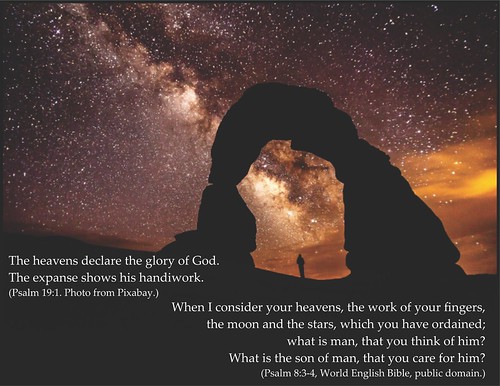
God revealed through the Milky Way


God the Son was important in the creation, and in sustaining that which He created!

John 1:1 In the beginning was the Word, and the Word was with God, and the Word was God. 2 The same was in the beginning with God. 3 All things were made through him. Without him, nothing was made that has been made. 10 He was in the world, and the world was made through him, and the world didn’t recognize him. 12a But as many as received him, to them he gave the right to become God’s children . . .

Colossians 1:14 in whom we have our redemption, the forgiveness of our sins. 15 He is the image of the invisible God, the firstborn of all creation. 16 For by him all things were created in the heavens and on the earth, visible things and invisible things, whether thrones or dominions or principalities or powers. All things have been created through him and for him. 17 He is before all things, and in him all things are held together.

Hebrews 1:3 His Son is the radiance of his glory, the very image of his substance, and upholding all things by the word of his power, who, when he had by himself purified us of our sins, sat down on the right hand of the Majesty on high ...

(Although the passages above indicate that God the Son was the most important agent in the creation, there are scriptural indications that God the Father and God the Holy Spirit were also involved.)

Perhaps you and I don't fully appreciate the magnificence of creation, and, therefore, we may not fully appreciate the magnificence of Christ.

Creation shows that God the son loves diversity. There are about 400,000 species of beetles, and probably at least a million yet to be discovered. (Psalm 104:24 Yahweh, how many are your works! In wisdom, you have made them all. The earth is full of your riches. 25 There is the sea, great and wide, in which are innumerable living things, both small and large animals.)

Creation is unimaginably large. “Recent estimates of the number of galaxies in the observable universe range from 200 billion [(2×10 to the 11th power) to 2 trillion (2×10 to the 12th power)] or more, … containing more stars than all the grains of sand on planet Earth.” (Wikipedia) And that’s only the observable universe.

Creation shows the power of God the Son. Most of the energy on earth comes from the sun. In the sun, Hydrogen nuclei bombard each other at several million degrees, and turn into Helium nuclei, releasing energy by e =m c-squared. The sun is about 93 million miles away. Since it is emitted in all directions, the vast majority of the sun’s emitted energy goes off into space, never hitting the earth, or any other body in the Solar System. But it’s warm enough for life on earth, and light enough for photosynthesis, just from the tiny fraction of the sun’s emitted energy that strikes it. We can scarcely imagine the power of the sun, and it’s a fairly small star.

Creation shows that God the Son likes beauty. He didn’t have to make the universe so that rainbows, or fall foliage, or butterflies, or eclipses, exist. But He did. Using scientific tools, such as microscopes and telescopes, we have found that there is amazing beauty, even in things we can’t get to, or can’t see with the naked eye.


The Creation is sustained by God the Son. How? By laws, like gravity, and created properties, such as that water can exist in three different forms at reasonably normal temperatures. The laws of gravity ensure, for example, that the planets continue to orbit the sun. The properties of water make rain possible, among many other things. God also sustains by processes, like erosion, plate tectonics, and natural selection. We can’t be sure if God is intimately involved in making every raindrop, or lets nature take its course to make each one, but He could make each and every one carefully and magnificently. 

God the Son can, and, at least sometimes, does, change the “normal” course of nature. We call that a miracle.


God, the Son’s, creation is beyond our imagination! He created time and space! God created matter and energy! God created the four fundamental forces, (also called the four interactions) – gravity, the electromagnetic force, the strong force and the weak force. God created the entire electromagnetic spectrum: light, radio waves, wi-fi, microwaves, X-rays, and more. God created the universe with appropriate physical properties for the existence of life

We should not forget that, even though He was largely responsible for the creation of the entire universe, He came to earth. Not as a baby, but as an embryo, a being with just a few cells, and hardly any connection to the world outside his mother’s womb. Then, of course, He became a fetus, and, after about nine months, a baby. Still helpless, dependent, and, presumably, severely limited in His ability to communicate.

And we should not forget what St. Paul said about the Creator and Sustainer of the universe:
5 Have this in your mind, which was also in Christ Jesus, 6 who, existing in the form of God, didn’t consider equality with God a thing to be grasped, 7 but emptied himself, taking the form of a servant, being made in the likeness of men. 8 And being found in human form, he humbled himself, becoming obedient to the point of death, yes, the death of the cross. 9 Therefore God also highly exalted him, and gave to him the name which is above every name, 10 that at the name of Jesus every knee should bow, of those in heaven, those on earth, and those under the earth, 11 and that every tongue should confess that Jesus Christ is Lord, to the glory of God the Father. (From Philippians 2)

Thanks for reading! To God be the glory!

Friday, December 07, 2012

I'm afraid I've won the "War on Christmas"

I think I've won the war on Christmas. I shouldn't have. I should have lost it, and let the Christ of Christmas be the winner in my life. I'm not speaking of the "war on Christmas" that some people are. I'm speaking of another, more important one, the real one.

. . . Christmas itself has now far outstripped Easter in popular culture as the real celebratory center of the Christian year -- a move that completely reverses the New Testament's emphasis. We sometimes try, in hymns, prayers, and sermons, to build a whole theology on Christmas, but it can't in fact sustain such a thing. N. T. Wright, Surprised by Hope: Rethinking Heaven, the Resurrection, and the Mission of the Church. New York: HarperOne, 2008, p. 23.

The War on Christmas, in most people's minds.

Every year, at about this time, we hear about the so-called "War on Christmas." The Wikipedia even has an article on "Christmas Controversy."

To quote the Wikipedia: "Modern-day controversy occurs mainly in western countries such as the United States, Canada, and to a lesser extent the United Kingdom and Ireland, and usually stems from a contrast between the holiday's significant social and economic role in these countries and its strong association with Christianity in an increasingly multiculturally sensitive and religiously diversifying society." Let me consider three of the reasons that some Christians say that there is such a war.

1) Some uninformed people object to the use of Xmas, believing that that is minimizing Christ, for whom Christmas was named. However, Xmas has been a common way  of representing Christ's name in written form. The X comes from the Greek letter chi, which looks like an X, and is the first letter of the word for Christ in Greek, which is Χριστός (Christos). See the Wikipedia article on that Greek letter for more. The labarum, which uses chi and rho, the second letter in the Greek word for Christ, plus a cross, to represent Christ, is an important symbol in some churches.

2) Some Christians, and some others, believe that manger scenes, or crèches, should be displayed by city or other local governments. Other people object, on the grounds that doing that is a violation of the Constitutional separation of Church and State, and the courts have generally agreed with them.

There should be separation of Church and state, such that local, state, and national governments should not officially recognize Wiccan, Christian, Muslim, Hindu, Buddhist, or any other religion's special days. (We do have an official Christmas holiday in this country, and I'm not advocating doing away with that. Even people of other faiths usually seem to enjoy and celebrate the Christmas holiday, at least as a day off. Recognizing Christmas by a national holiday is a longstanding tradition, even though it is, after all, a recognition, by government, of a Christian special day. But let's not go further.)

Back to government recognition of Christmas, or not. Fighting for manger scenes at Christmas time seems like a strange battle. We don't know when Christ was born, not even the exact year, let alone the month and the day.

Besides that, manger scenes are usually inaccurate. There is no Biblical evidence that the shepherds who came to visit Christ stayed very long, and that their visit overlapped with that of the wise men. Almost no Bible scholars think that the wise men came while the shepherds were there. Except for the fact that there were three gifts mentioned, there's no evidence that there were three wise men, or astrologers. Perhaps there were two, or a dozen. It may have been three, but we aren't sure. There's no suggestion, in the Bible, that they came from three different races. The Bible does not say that they came on camels. Perhaps they did, but there's no solid evidence for it.

The current Pope has even gone so far as to point out that there is no evidence that there were any animals in the stable where Christ was born. (The Vatican uses animals in its nativity scenes, and the Pope concedes that Christians, including Catholics, aren't going to stop including them.)

There is no good reason why a church, or a private individual or organization, cannot display a manger scene at Christmas, or on the Fourth of July, for that matter. But Christians shouldn't try to get the government to sponsor an inaccurate symbol to be displayed at what may be the wrong time of year.

3) There are also complaints when "Christmas cards" have no reference to Christmas, or when someone says, or writes, "Happy Holidays," rather than "Merry Christmas."

It's certainly true that these things happen. But should those who hold Christ, and His name, to be deeply significant, be offended? I'm not sure that we should. Commerce, in North America, takes Thanksgiving, Black Friday, Cyber Monday, and all the other days through December 24 as serious shopping times. Jobs depend on selling lots of stuff. There is music played over the speaker systems in stores, and on the radio. We expect to hear "Jingle Bell Rock," "I'm Dreaming of a White Christmas," "The Christmas Song," "Here Comes Santa Claus," and the like, most of them have nothing to do with the birth of Christ. Some do, of course, such as "Silent Night." "Little Drummer Boy" has a little to do with Christ's birth, but drums, as we think of them, weren't developed until centuries after Christ's birth. (Here's one list of the greatest "Christmas" songs. Many of them don't mention Christ.) Santa Claus, not Christ, is the main attraction in most Christmas parades. We expect to see, if we wish, various TV programs dealing with the season, such as one about Rudolph, or Frosty, or the Grinch. The latter, at least, acknowledges the importance of a spirit of generosity, but the TV program about that green creature makes no mention of the birth of Christ, and the others usually don't, either.

We should be generous all year. There's nothing wrong with giving so-called "Christmas presents," but I suspect that, even in the family celebrations of most believers, we don't connect doing that with the gifts that the wise men brought to Jesus, or with Christ's gift of freedom from sin, other than, perhaps, reading part of Luke 2. Most of the symbols associated with Christmas have a life of their own, independent of any connection with the birth of Christ. It is possible to connect most of them with His life, and some of us try to, but sometimes the connection is pretty tenuous, and is easy to forget. Can you tell me what the color red, or Christmas trees, have to do with Christ's birth? I can't.

What am I saying? I'm saying that, in fact, a month or so of the calendar is largely dedicated, not to the birth of Christ, but to increasing sales for the year, to displaying traditional symbols, to greeting others, and giving to other people. Most giving to others, co-workers, the poor, or our own families, is not much connected to Christ's birth. It's just a seasonal habit, and much of it is commercially driven, or because we want to take an income tax deduction, or because we want to feel good about ourselves. Giving to others, in the right spirit, is a good thing, but most of it, in December, is not directly related to Christ's birth. It's no wonder that some people, and some businesses, use "Happy Holidays," rather than "Merry Christmas." And "Merry Christmas" is not about Christ's birth, either. Being merry is about gifts, and families, Christmas bonuses, and days off. A more appropriate exclamation would be "Blessed Christmas," if we mean it. Almost all of us, including those of us who claim to be followers of Christ, spend more time, money, and thought on addressing cards, selecting, wrapping, giving and receiving presents, eating with others, wondering if it will snow, traveling, and listening to, or watching, traditional material in the media than we do thinking about the significance of the birth of Christ. Why blame Walmart or ESPN or whoever, when they say "Happy Holidays?"

The real war on Christmas.

There's nothing intrinsically wrong with taking part in many of the customs of the culture in which we live, associated with the time period between late November and early January. That is, unless doing so turns us into selfish whiners with too much to do to be really generous and loving to others, or into crabs, complaining because we can't find the perfect gift, or because someone else doesn't share our family or church traditions. But taking part in these things should not take up most of our attention. They need to be kept in perspective, eternal perspective.

Christ, the creator and sustainer of the universe, came from heaven, at our great need. He came to develop as an embryo in Mary's womb, to be born, to live as a great teacher, die as a sinless sacrifice for our sins, and come back from death to prove that He had accomplished that task. If I forget that, or fail to emphasize it in my own thoughts, I've won the war on Christmas, the wrong one, when I should have lost it.

If my life, my thoughts, and my words don't make the accomplishment of Christ more important than Christmas traditions, or my hobbies, my job (or lack thereof), my team, my political agenda, my family and friends, or even my church, then I've won the war on Christmas, and Christmas has lost it, as far as my own personal battleground is concerned. Christmas has lost this war because I don't keep the truth of Christ's accomplishment as the most important thing in my head, year round. My mind is not on Christmas, and what it really means. It's on peripheral things.

John 1:1 In the beginning was the Word, and the Word was with God, and the Word was God. 2 The same was in the beginning with God. 3 All things were made through him. Without him was not anything made that has been made. 4 In him was life, and the life was the light of men. 5 The light shines in the darkness, and the darkness hasn’t overcome it. 6 There came a man, sent from God, whose name was John*. 7 The same came as a witness, that he might testify about the light, that all might believe through him. 8 He was not the light, but was sent that he might testify about the light. 9 The true light that enlightens everyone was coming into the world.
10 He was in the world, and the world was made through him, and the world didn’t recognize him. 11 He came to his own, and those who were his own didn’t receive him. 12 But as many as received him, to them he gave the right to become God’s children, to those who believe in his name: 13 who were born not of blood, nor of the will of the flesh, nor of the will of man, but of God. 14 The Word became flesh, and lived among us. We saw his glory, such glory as of the one and only Son of the Father, full of grace and truth.  *John the Baptist

1 Corinthians 15:20 But now Christ has been raised from the dead. He became the first fruits of those who are asleep. 21 For since death came by man, the resurrection of the dead also came by man. 22 For as in Adam all die, so also in Christ all will be made alive. (World English Bible, public domain)


Thanks for reading. God help me, and you. Blessed Christmas!

*  *  *  *

I added the quotation from N. T. Wright on January 2, 2013.
Saturday, December 24, 2011

Jesus, the Light of the World

Hiatus now: John 1:1-5 light and Christ

John 1:1 In the beginning was the Word, and the Word was with God, and the Word was God. 2 The same was in the beginning with God. 3 All things were made through him. Without him was not anything made that has been made. 4 In him was life, and the life was the light of men. 5 The light shines in the darkness, and the darkness hasn’t overcome it. (World English Bible, public domain)

Saturday, March 17, 2007

What I believe about origins

Some time ago, someone asked me what I believed about origins. What the individual wanted was to see which of several categories of belief I fell into. I didn't exactly answer him on that, and I'm sure I told him more than he wanted to hear, but here's part of my answer.

Then, yesterday, a commenter was surprised that I didn't think purposeless chance was the main creative agent.

So I'm posting this on St. Patrick's Day, even though it's not particularly green.

What do I believe?
1) I believe that God was involved in the planning and execution of the origin of matter, the universe, and life.
2) I believe that the Son had the most important role in this (John 1, and other scriptures, teach this), but the Father and the Holy Spirit must have also been involved.
3) I believe that the Son not only created, but that He somehow is maintaining things. (Colossians 1:14-17)
4) I believe that things changed, due to a deliberate sin by human beings, such that God's original plan is not now completely expressed. How much the Fall has changed things, I'm not sure. Probably a lot. Christ came to redeem us, and the rest of creation, from the effects of that sin.
5) I believe that God's design allowed for emergent properties, that is, for example, Carbon was created so that life, as we know it, could be based on it, when life appeared.
6) I believe that God's design for life was comprehensive enough that He allowed what appear to us to be chance processes to work in carrying it out. However, He may also be actually selecting and directing which sperms succeed, which spores germinate, etc.
7) I believe that God somehow created humans specially. We are especially in His image, we have dominion over other living things, and Christ appeared on earth in human form.

* * * * *
Added July 23, 2007: See here for more on the topic of item 7.
8) I'm not sure exactly what the "image of God" means. I believe that all of God's creation, such as a stone, has some of the image of the creator in it. We have more of it than stones, of course. Presumably the image includes things like the capacity to love, to reason, to communicate, and to create (on a much smaller scale). Perhaps the soul (whatever that is) is God's image in us.
9) I don't know if there are living things on other planets or not. The Bible is silent on the subject, and proving that there are such living things wouldn't bother me. (It is impossible to scientifically prove that there aren't living things on some other planet.) The same holds true for alternate universes. God is big enough to be the God of all the universes, however many there are. We only know of one for sure, though, and of one place in it where there is life.
10) I believe that God used the Big Bang to begin the universe as we know it, and that the Bible does not rule this out. Furthermore, I believe that science has no good explanation for what caused the Big Bang, or came before it, while Christianity and Judaism do have such an explanation -- God planned and created the Big Bang.
11) I believe that I don't have all the answers on this subject, and don't think anyone else does, either.
12) I believe that the most commonly held theories, or at least the ones that are heard about most, namely young-earth creationism (YEC) and intelligent design (ID), are not the same. There are serious differences between them.
13) I believe that God has revealed Himself to us in several ways, including through the Bible, the church, and the work of the Holy Spirit, and that of our own consciouses, in our lives, and also through nature. (Psalm 19, Acts 14:17, Romans 1:20) I believe that we, fallen beings that we are, can and do make mistakes in our interpretation of all of these revelations, but that, nonetheless, they are all legitimate.
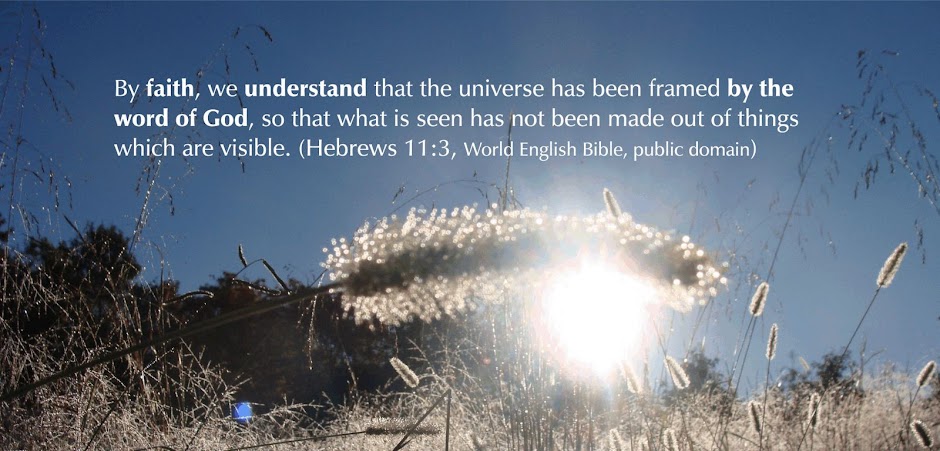
14) I believe that God did deliberately design the natural world. (He included the capacity for chance processes, such as natural selection, as part of the design, so that they influence the way living things appear.) However, I don't believe that it is possible to prove (or disprove) God's creative activity in the past (or in the present, for that matter) scientifically. Hebrews 11:3 seems to indicate this.
15) I believe that demanding that the public schools teach that science has proved that YEC, or ID, are true, is a serious mistake, not least because there is no such proof.
16) I believe that science has not, and can not, rule out God's creative activity, in at least the following: the origin of the universe, the origin of living things, the origin of human beings. Scientists (and others) may sincerely doubt that God did any or all of these things, but they have no right to claim that science has ruled them out. It hasn't. No public school or university class, or textbook, should make such claims, and, if such claims are made, they should be strongly fought.
17) I believe that some people, perhaps well-meaning, perhaps not, have screamed loud and long about some view of origins, (usually YEC, but, lately, also ID) and gotten many Christians, or the world at large, to believe that all Christians believe as they do. This is most unfortunate. I believe that some intelligent people have been lost to the kingdom because of militant YEC views.
18) I believe that Christians can legitimately hold any of several views on origins, including YEC or ID, but also others, and should respect the right of other Christians to hold differing views, and welcome them into fellowship. There are a number of views, all held by Christians, and all of them have strengths, and all of them have weaknesses. The only view that all Christians must reject is the naturalistic view, namely that we are here solely because of purposeless chance. If the Bible means anything, this view is false.
19) I believe that many students who are home-schooled, or who attend private Christian schools, are being seriously short-changed, because they are taught that YEC, or ID, is what the Bible teaches, or even what science has proved. They should also be presented with a fair view of other interpretations. Not only are they being short-changed, but future generations of Christian leaders are being misled, and, in turn, misleading others.

Addendum, July 19, 2007: As this post indicates, the Bible tells us that God created because of His love.

Addendum, January 27, 2012: I added some labels/tags, and one bible verse.

Addendum, December 20, 2012: Here's a link to a post from BioLogos on the impossibility of disproving the existence of God. (We can't prove it scientifically, either.)

Addendum, January 29, 2013: I added point 10, above, and modified point 15.

Addendum, April 8, 2015: I made three minor editorial changes.

Addendum, May 26, 2016: I have discovered a consensus statement on origins, produced by some prominent Christian scientists with different views on the matter, but which they all agree on. I agree with them. (The consensus statement is followed by a listing of points that they don't agree on.)

Thanks for reading.