J. R. R. Tolkien was born on January 3, 1892. I'd like to muse about Tolkien, who has had an influence on me, and on many other people, including C. S. Lewis. Tolkien's discussion with Lewis was one of the influences that led Lewis to belief in Christianity, and in Christ.
Tolkien was an expert in English, as spoken and written long ago, and the literature written in that language, especially Beowulf. He had a long and solid academic career, and authored books related to it, and also The Hobbit and The Lord of the Rings trilogy. These latter were the basis of some immensely successful movies. These books had their foundation in characters, settings, situations, and languages invented by Tolkien. After his death, other books, less accessible, were put together from Tolkien's very extensive writings about this fictional universe.
So why appreciate Tolkien?
1) He was a good writer. His characters, plots and settings ring true, although, as he said, he was merely a sub-creator, not a creator. The books are carefully written, so carefully that it was difficult to get Tolkien to finish them to his own standards, and release them for publication.
2) He was a believer. As the use of the term, sub-creator, indicates, Tolkien believed that God was creator, humans merely subordinate to God.
3) His work influenced much of the fantastic literature published in English in the 20th and 21st centuries, as authors variously used his characters, his situations, his weaponry, and his races of beings, elves and dwarves, generally similar to Tolkien's beings. And, of course, some authors tried to emulate his unsought success. Most sword and sorcery fiction is related to Tolkien's fiction. Some of these authors acknowledge their debt to Tolkien. Most don't. Having good fantastic literature enriches those of us who read it. Ursula K. Le Guin, for one,
said so:
That [The Lord of the Rings] is told
in the language of fantasy is not an accident, or because Tolkien was an escapist, or because he was writing for children. It is a fantasy
because fantasy is the natural, the appropriate, language for the recounting of the spiritual journey and the struggle of good and evil in
the soul. "The Child and the Shadow," pp. 59-71, in Susan Wood,
ed., The Language of the Night: Essays on Fantasy and Science Fiction
(New York: Putnam, 1979). Quote is from p. 68.
Le Guin, herself, an important writer of fantastic literature, was influenced by Tolkien.
In the mid-1950s, she read J. R. R. Tolkien's The Lord of the Rings,
which had an enormous impact on her. But rather than making her want to
follow in Tolkien's footsteps, it simply showed her what was possible
with the fantasy genre.
4) Tolkien's characters had depth. They weren't cardboard characters. Frodo and Gollum both had conflicts as to what was the right thing to do, and what they wanted to do. So did Sam Gamgee. Boromir sought power for selfish reasons, but redeemed himself at his end. Saruman also sought power for selfish reasons, but didn't redeem himself at his end. Galadriel is, perhaps, Tolkien's most interesting character, although she is not a major character in the Lord of the Rings Trilogy. See here for more about her.
Although some of his characters had depth, not all did. Tolkien didn't flesh out Morgoth, Sauron, or any of his orcs.
5) The elves (and the heroic humans) are appealing. Living for thousands of years, in perfect harmony with the natural surroundings, has a certain appeal. And Tolkien's elves didn't seem to grow bored with their long and mostly uneventful lives. And they were willing to hazard all in conflicts with great evil, and many of them lost their lives that way. The hobbits are also appealing. Living simply, not working too hard, eating a lot, not being challenged by changes, living in (mostly) harmony with your extended family sounds good.
6) Tolkien's world portrays the natural world as beautiful, but industrial enterprises as polluting. That, like the idea of very long lives, appeals to many of us.
7) Tolkien's world was not autonomous, and sometimes needed, and got, help from beyond itself. One example of such help was the wizards, Gandalf and Radagast, and probably others, as well as Saruman, before he fell morally. These entities were sent from beyond Middle-Earth, to help the inhabitants. One of them, Gandalf, was even sent back from death. There were more events, and characters, that showed that supernatural powers were interested in Tolkien's world.
8) Tolkien's world included a blessed life beyond death. It also included sacrificial death, such as Gandalf's, and that of Théoden. Death was not necessarily the end of the inhabitants of Tolkien's world.
Did Tolkien get everything right? No. Middle-earth was mostly a male world -- there don't seem to have been any female orcs, and the female ents had vanished from knowledge. There were few female dwarves. The leaders of humans were almost all male. And Tolkien ignored some basic matters. Where did everyone get their food? There's not much to eat in forests, but Elrond, and Galadriel, lived in forests, and weren't supposed to have starved. And the elves of Mirkwood likewise lived in a forest. And how was it possible to feed the denizens of Mordor, who lived in a polluted desert?
But Tolkien's world was not about agriculture. It was about right and wrong, and heroism, and beauty, and supernatural care, and persistence, and friendship.
See here
for my main post about The Hobbit, and here,
here
and here
for those on the three books of the Lord of the Rings trilogy.
Thanks for reading. Read Tolkien.

Musings on science, the Bible, and fantastic literature (and sometimes basketball and other stuff).
God speaks to us through the Bible and the findings of science, and we should listen to both types of revelation.
The title is from Psalm 84:11.
The Wikipedia is usually a pretty good reference. I mostly use the World English Bible (WEB), because it is public domain. I am grateful.
License
I have written an e-book, Does the Bible Really Say That?, which is free to anyone. To download that book, in several formats, go here.

The posts in this blog are licensed under a Creative Commons Attribution-NonCommercial-ShareAlike 3.0 Unported License. You can copy and use this material, as long as you aren't making money from it. If you give me credit, thanks. If not, OK.
The posts in this blog are licensed under a Creative Commons Attribution-NonCommercial-ShareAlike 3.0 Unported License. You can copy and use this material, as long as you aren't making money from it. If you give me credit, thanks. If not, OK.
Wednesday, January 03, 2018


Sunspots 658
Things I have recently spotted that may
be of interest to someone else:

Christianity: Relevant lists five things we shouldn't say to our pastors.
Relevant also offers, and rebuts, several reasons why we don't volunteer.
Christianity Today reports that the government of Egypt is claiming that, for a Muslim, dying to protect a Christian church is worthy of martyrdom.
Computing: Wired has listed, with explanation, the most dangerous people (or groups) on the internet.
Health: (sort of) Listverse describes strange objects that have been removed from people's bodies. Very strange objects.
Humor: (or something) National Public Radio reports on Vanna White's 35th anniversary on Wheel of Fortune.
Politics: National Public Radio analyzes the number, and significance, of the laws signed by President Donald Trump, and compares them to laws signed by previous Presidents in a comparable period.
Science: Undark has posted an annotated list of misleading claims about science, by various politicians, during 2016,
Listverse gives summaries of the histories of 10 interesting numbers. I learned a number of things while reading this one.
I thank one of my brothers for suggesting some of these items!
Thanks for looking!
Image source (public domain)
Christianity: Relevant lists five things we shouldn't say to our pastors.
Relevant also offers, and rebuts, several reasons why we don't volunteer.
Christianity Today reports that the government of Egypt is claiming that, for a Muslim, dying to protect a Christian church is worthy of martyrdom.
Computing: Wired has listed, with explanation, the most dangerous people (or groups) on the internet.
Health: (sort of) Listverse describes strange objects that have been removed from people's bodies. Very strange objects.
Humor: (or something) National Public Radio reports on Vanna White's 35th anniversary on Wheel of Fortune.
Politics: National Public Radio analyzes the number, and significance, of the laws signed by President Donald Trump, and compares them to laws signed by previous Presidents in a comparable period.
Science: Undark has posted an annotated list of misleading claims about science, by various politicians, during 2016,
Listverse gives summaries of the histories of 10 interesting numbers. I learned a number of things while reading this one.
I thank one of my brothers for suggesting some of these items!
Thanks for looking!
Image source (public domain)
Tuesday, January 02, 2018
Sunspots supplement - Paul Samuelson's top 10 statistics, from Ben Beach
Paul Samuelson, columnist on economic issues, has posted the top 10 statistics of 2017, which he has taken from someone named Ben Beach. They make fascinating and interesting reading.
Sunday, December 31, 2017
The Art of Divine Contentment: An Exposition of Philippians 4:11 by Thomas Watson. Excerpt 9
I come to the second, which is the main thing, the lesson itself, “in whatsoever state I am, therewith to be content.” Here was a rare piece of learning indeed, and is certainly more to be wondered at in St Paul, that he knew how to turn himself to every condition, than all the learning in the world besides, which hath been so applauded in former ages, by Julius Cæsar, Ptolemy, Xenophon, the great admirers of learning. The text hath but few words in it; “in every state content:” but if that be true, which once Fulgentius said, that the most golden sentence is ever measured by brevity and suavity, then, this is a most accomplished speech; the text is like a precious jewel, little in quantity, but great in worth and value.
The main proposition I shall insist upon, is this, that a gracious spirit is a contented spirit.
Thomas Watson lived from 1620-1686, in England. He wrote several books which survive. This blog, God willing, will post excerpts from his The Art of Divine Contentment: An Exposition of Philippians 4:11, over a number of weeks, on Sundays. My source for the text is here, and I thank the Christian Classics Ethereal Library for making this text (and many others) available. The previous excerpt is here.
Philippians 4:11 Not that I speak because of lack, for I have learned in whatever state I am, to be content in it. (World English Bible, public domain.)
The main proposition I shall insist upon, is this, that a gracious spirit is a contented spirit.
Thomas Watson lived from 1620-1686, in England. He wrote several books which survive. This blog, God willing, will post excerpts from his The Art of Divine Contentment: An Exposition of Philippians 4:11, over a number of weeks, on Sundays. My source for the text is here, and I thank the Christian Classics Ethereal Library for making this text (and many others) available. The previous excerpt is here.
Philippians 4:11 Not that I speak because of lack, for I have learned in whatever state I am, to be content in it. (World English Bible, public domain.)
Wednesday, December 27, 2017
Sunspots 658
Things I have recently spotted that may be of interest to someone else:
Christianity: A Relevant write says that we shouldn't always say "it's OK," w

Tim Keller has written "Can Evangelicalism Survive Donald Trump and Roy Moore," for The New Yorker. Among other things, Keller offers a short list of characteristics of evangelicals, and points out that "'Evangelical' used to denote people who claimed the high moral ground; now, in popular usage, the word is nearly synonymous with 'hypocrite.'"
A Relevant writer writes about the dumbing down (knowing little theology, and even exalting those who don't know much of it) of Christianity, and how this hurts the cause of Christ.
Relevant reports that Chick-Fil-A, which normally does not open on Sundays, opened, in the Atlanta airport, during a massive flight cancellation problem, so that people could get food.
Computing: Gizmo's Freeware reports on a free application that takes screenshots of your computer automatically, every 5 seconds, or at longer intervals. This may help you to remember what you did, or it may help you see if someone unauthorized is using your computer, and what they are doing on it.
Politics: (or something) Listverse gives the terrible stories of people who managed to survive North Korea's prison camps, and escape the country.
National Public Radio reports on how Russian operatives sowed discord in the US, and other countries, through web attacks of various kinds.
David Brooks, of the New York Times, writes a good piece on how to get us back together.
Science: (or photography) The BBC has posted some photos of amazing cloud formations, plus one of a moonbow. Flickr has a Gallery, currently with six photos of moonbows.
Wired compares LED and incandescent Christmas tree lights. (The kind that makes a string of 50 or more lights.)
I thank one of my brothers for suggesting some of these items.
Thanks for looking!
Image source (public domain)
Sunday, December 24, 2017
The Art of Divine Contentment: An Exposition of Philippians 4:11 by Thomas Watson. Excerpt 8
Let us beg the Spirit of God to teach us; we must be “divinely taught;” the eunuch could read, but he could not understand, till Philip joined himself to his chariot. (Ac. 8.29) God’s Spirit must join himself to our chariot; he must teach, or we cannot learn: “all thy children shall be taught of the Lord”. (Is. 54.13) A man may read the figure on the dial, but he cannot tell how the day goes, unless the sun shines upon the dial: we may read the Bible over, but we can not learn the purpose, till the Spirit of God shines into our hearts. (2 Cor. 4.6) O implore this blessed Spirit! It is God’s prerogative-royal to teach: “I am the Lord thy God, which teacheth thee to profit.” (Is. 48.17) Ministers may tell us our lesson, God only can teach us; we have lost both our hearing and eye-sight, therefore are very unfit to learn. Ever since Eve listened to the serpent, we have been deaf; and since she looked on the tree of knowledge we have been blind; but when God comes to teach, he removes these impediments. (Is. 35.5) We are naturally dead; (Ep. 2.1) who will go about to teach a dead man? yet, behold, God undertakes to make dead men to understand mysteries! God is the grand teacher. This is the reason the word preached works so differently upon men; two in a pew, the one is wrought upon effectually, the other lies at the ordinances as a dead child at the breast, and gets no nourishment. What is the reason? Because the heavenly gale of the Spirit blows upon one, and not upon the other; one hath the anointing of God, which teacheth him all things,! (1 Jno. 2.27) the other hath it not. God’s Spirit speaks sweetly, but irresistably. In that heavenly doxology, none could sing the new song, but those who were sealed in their foreheads, (Re. 14.2) reprobates could not sing it. Those that are skilful in the mysteries of salvation, must have the seal of the Spirit upon them. Let us make this our prayer: Lord, breathe thy Spirit into thy word; and we have a promise, which may add wings to prayer; “if ye then being evil know how to give good gifts unto your children; how much more shall your heavenly Father give the Holy Spirit to them that ask him?” (Lu. 11.13) And thus much of the first part of the text, the scholar, which I intended only as a short gloss or paraphrase.
Thomas Watson lived from 1620-1686, in England. He wrote several books which survive. This blog, God willing, will post excerpts from his The Art of Divine Contentment: An Exposition of Philippians 4:11, over a number of weeks, on Sundays. My source for the text is here, and I thank the Christian Classics Ethereal Library for making this text (and many others) available. The previous excerpt is here.
Philippians 4:11 Not that I speak because of lack, for I have learned in whatever state I am, to be content in it. (World English Bible, public domain.)
Thomas Watson lived from 1620-1686, in England. He wrote several books which survive. This blog, God willing, will post excerpts from his The Art of Divine Contentment: An Exposition of Philippians 4:11, over a number of weeks, on Sundays. My source for the text is here, and I thank the Christian Classics Ethereal Library for making this text (and many others) available. The previous excerpt is here.
Philippians 4:11 Not that I speak because of lack, for I have learned in whatever state I am, to be content in it. (World English Bible, public domain.)
Wednesday, December 20, 2017
Sunspots 657
Things I have recently spotted that may be of interest to someone else:

The Arts: Relevant discusses the extraordinary effort put into filming the Battle of Helm's Deep, in The Two Towers.
Christianity: National Public Radio reports that, at the trial of a white policeman, who was convicted of depriving her African-American son of his civil rights (he was shot in the back, and died), the victim's mother told the shooter that she forgave him. (The shooter apparently told her that he was sorry.)
A Relevant contributor discusses that perennial topic, the so-called "war on Christmas."
Relevant also reports on a survey, which indicates that Muslims and Jews give more to their religions than Christians do.
Computing: Developers of artificial intelligence are thinking about some of the ethical questions associated with this technology, according to Wired.
Here's a web site that will tell you if your information, such as Social Security number or financial accounts, has been compromised. Just enter your e-mail address. It doesn't tell you what to do about such problems.
Wired tells us that a lot of e-mail is being tracked -- the sender is informed as to when a message was opened, where the opening was, and on what type of information appliance, and more.
Finance: Listverse describes some types of money that used to be used in the U. S., but aren't, any more.
Health: National Public Radio reports on the much more frequent deaths of black women, in, or shortly after, giving birth, and points to the stress of being the target of racism as at least one of the causes.
History: Listverse reports on some interesting aspects of life in ancient Egypt.
Politics: FiveThirtyEight reports on the change in attitude toward Israel in Republicans, over the last few decades.
(And Computing) Wired reports on false, or misleading, claims made by the 3 Federal Communications Commissioners who voted to do away with net neutrality.
(And Health) The Centers for Disease Control has been told not to use seven words/phrases, according to the Washington Post and other outlets. One of these is "fetus." (!) Scientific American, and others, are outraged at this directive, and believe that it will have real health consequences, bad ones. Shades of 1984.
Thanks for looking!
Image source (public domain)
Sunday, December 17, 2017
The Art of Divine Contentment: An Exposition of Philippians 4:11 by Thomas Watson. Excerpt 7
There are two pregnant reasons, why there must be so much study and exercitation: 1. Because spiritual things are against nature. Everything in religion is antipodes to nature. There are in religion two things, and both are against nature. (1.) Matters of faith: as, for men to be justified by the righteousness of another, to become a fool that he may be wise, to save all by losing all; this is against nature. (2.) Matters of practice: as, Self-denial; for a man to deny his own wisdom, and see himself blind; his own will, and have it melted into the will of God; plucking out the right eye, beheading and crucifying that sin which is the favourite, and lies nearest to the heart; for a man to be dead to the world, and in the midst of want to abound; for him to take up the cross, and follow Christ, not only in golden, but in bloody paths, to embrace religion, when it is dressed in night-clothes, all the jewels of honour and preferment being pulled of; this is against nature, and therefore must be learned. Self-examination; for a man to take his heart, as a watch, all in pieces; to set up a spiritual inquisition, or court of conscience, and traverse things in his own soul; to take David’s candle and lantern, (Ps. 119. 105) and search for sin; nay, as judge, to pass the sentence upon himself. (2 Sa. 34.17) this is against nature, and will not easily be attained to without learning. Self-reformation; to see a man, as Caleb, or another spirit, walking antipodes to himself, the current of his life altered, and running into the channel of religion: this is wholly against nature. When a stone ascends, it is not a natural motion, but a violent; the motion of the soul heaven-ward is a violent motion, it must be learned; flesh and blood is not skilled in these things; nature can no more cast out nature, than Satan can cast out Satan. 2. Because spiritual things are above nature. There are some things in nature that are hard to find out, as the cause of things, which are not learned without study. Aristotle, a great philosopher, whom some have called an eagle fallen from the clouds, yet could not find out the motion of the river Euripus, and therefore threw himself into it; what then are divine things, which are in sphere above nature, and beyond all human disquisition; as the Trinity, the hypostatical union, the mystery of faith to believe against hope? Only God’s Spirit can light our candle here. The apostle calls these “the deep things of God.” The gospel is full of jewels, but they are locked up from sense and reason. The angels in heaven are searching into these sacred depths. (1 Pe. 22)
Thomas Watson lived from 1620-1686, in England. He wrote several books which survive. This blog, God willing, will post excerpts from his The Art of Divine Contentment: An Exposition of Philippians 4:11, over a number of weeks, on Sundays. My source for the text is here, and I thank the Christian Classics Ethereal Library for making this text (and many others) available. The previous excerpt is here.
Philippians 4:11 Not that I speak because of lack, for I have learned in whatever state I am, to be content in it. (World English Bible, public domain.)
Thomas Watson lived from 1620-1686, in England. He wrote several books which survive. This blog, God willing, will post excerpts from his The Art of Divine Contentment: An Exposition of Philippians 4:11, over a number of weeks, on Sundays. My source for the text is here, and I thank the Christian Classics Ethereal Library for making this text (and many others) available. The previous excerpt is here.
Philippians 4:11 Not that I speak because of lack, for I have learned in whatever state I am, to be content in it. (World English Bible, public domain.)
Thursday, December 14, 2017
Christ's first miracle
John 2:5 His mother said to the servants, “Whatever he says to you, do it.” 6 Now there were six water pots of stone set there after the Jews’ way of purifying, containing two or three metretes* apiece. 7 Jesus said to them, “Fill the water pots with water.” So they filled them up to the brim. 8 He said to them, “Now draw some out, and take it to the ruler of the feast.” So they took it. 9 When
the ruler of the feast tasted the water now become wine, and didn’t
know where it came from (but the servants who had drawn the water knew),
the ruler of the feast called the bridegroom 10 and
said to him, “Everyone serves the good wine first, and when the guests
have drunk freely, then that which is worse. You have kept the good wine
until now!” 11 This beginning of his signs Jesus did in Cana of Galilee, and revealed his glory; and his disciples believed in him.
*text note: 2 to 3 metretes is about 20 to 30 U. S. Gallons, or 75 to 115 liters.
John tells us that this was Christ's first miracle (not counting those miracles He did before He came to earth as a human.) Some other versions of the Bible use "miracle," rather than "sign." I have used the public domain World English Bible.
Christ’s first miracle wasn’t overthrowing the Romans, or bringing anyone back to life, or forgiving someone’s sins, or feeding lots of people, or healing someone. It was helping someone out of a jam, which was probably their own fault. They should have planned better, or ordered more wine in advance. This doesn't mean that Christ will always get us out of self-inflicted jams, but, sometimes, He surely does! He's our Friend, after all.
How did He do this? We don't know, of course. Perhaps he did it by adjusting the molecules of water, somehow, which isn’t surprising, when we remember that He created water in the first place.
Thanks for reading!
*text note: 2 to 3 metretes is about 20 to 30 U. S. Gallons, or 75 to 115 liters.
John tells us that this was Christ's first miracle (not counting those miracles He did before He came to earth as a human.) Some other versions of the Bible use "miracle," rather than "sign." I have used the public domain World English Bible.
Christ’s first miracle wasn’t overthrowing the Romans, or bringing anyone back to life, or forgiving someone’s sins, or feeding lots of people, or healing someone. It was helping someone out of a jam, which was probably their own fault. They should have planned better, or ordered more wine in advance. This doesn't mean that Christ will always get us out of self-inflicted jams, but, sometimes, He surely does! He's our Friend, after all.
How did He do this? We don't know, of course. Perhaps he did it by adjusting the molecules of water, somehow, which isn’t surprising, when we remember that He created water in the first place.
Thanks for reading!
Wednesday, December 13, 2017
Sunspots 656
Things I have recently spotted that may
be of interest to someone else:

Christianity: National Public Radio reports that, at the trial of a white policeman, who was convicted of depriving her African-American son of his civil rights (he was shot in the back, and died), the victim's mother told the shooter that she forgave him. (The shooter apparently told her that he was sorry.)
A Relevant contributor discusses that perennial topic, the so-called "war on Christmas."
Relevant also reports on a survey, which indicates that Muslims and Jews give more to their religions than Christians do.
Computing: Developers of artificial intelligence are thinking about some of the ethical questions associated with this technology, according to Wired.
Here's a web site that will tell you if your information, such as Social Security number or financial accounts, has been compromised. Just enter your e-mail address. It doesn't tell you what to do about such problems.
Wired tells us that a lot of e-mail is being tracked -- the sender is informed as to when a message was opened, where the opening was, and on what type of information appliance, and more.
Finance: Listverse describes some types of money that used to be used in the U. S., but aren't, any more.
Health: National Public Radio reports on the much more frequent deaths of black women, in, or shortly after, giving birth, and points to the stress of being the target of racism as at least one of the causes.
History: Listverse reports on some interesting aspects of life in ancient Egypt.
Politics: FiveThirtyEight reports on the change in attitude toward Israel in Republicans, over the last few decades.
Thanks for looking!
Image source (public domain)
Christianity: National Public Radio reports that, at the trial of a white policeman, who was convicted of depriving her African-American son of his civil rights (he was shot in the back, and died), the victim's mother told the shooter that she forgave him. (The shooter apparently told her that he was sorry.)
A Relevant contributor discusses that perennial topic, the so-called "war on Christmas."
Relevant also reports on a survey, which indicates that Muslims and Jews give more to their religions than Christians do.
Computing: Developers of artificial intelligence are thinking about some of the ethical questions associated with this technology, according to Wired.
Here's a web site that will tell you if your information, such as Social Security number or financial accounts, has been compromised. Just enter your e-mail address. It doesn't tell you what to do about such problems.
Wired tells us that a lot of e-mail is being tracked -- the sender is informed as to when a message was opened, where the opening was, and on what type of information appliance, and more.
Finance: Listverse describes some types of money that used to be used in the U. S., but aren't, any more.
Health: National Public Radio reports on the much more frequent deaths of black women, in, or shortly after, giving birth, and points to the stress of being the target of racism as at least one of the causes.
History: Listverse reports on some interesting aspects of life in ancient Egypt.
Politics: FiveThirtyEight reports on the change in attitude toward Israel in Republicans, over the last few decades.
Thanks for looking!
Image source (public domain)
Sunday, December 10, 2017
The Art of Divine Contentment: An Exposition of Philippians 4:11 by Thomas Watson. Excerpt 6
This word, “I have learned,” is a word that imports difficulty; it shows how hardly the apostle came by contentment of mind; it was not bred in nature. St Paul did not come naturally by it, but he had learned it. It cost him many a prayer and tear, it was taught him by the Spirit. Whence our second doctrine: good things are hard to come by. The business of religion is not so facile as most do imagine. “I have learned,” saith St Paul. Indeed you need not learn a man to sin; this is natural, (Ps. 58.3) and therefore facile, it comes as water out of a spring, It is an easy thing to be wicked; hell will be taken without storm; but matters of religion must be learned. To cut the flesh is easy, but to prick a vein, and not to cut an artery is hard. The trade of sin needs not to be learned, but the art of divine contentment is not achieved without holy industry: “I have learned.”
Thomas Watson lived from 1620-1686, in England. He wrote several books which survive. This blog, God willing, will post excerpts from his The Art of Divine Contentment: An Exposition of Philippians 4:11, over a number of weeks, on Sundays. My source for the text is here, and I thank the Christian Classics Ethereal Library for making this text (and many others) available. The previous excerpt is here.
Philippians 4:11 Not that I speak because of lack, for I have learned in whatever state I am, to be content in it. (World English Bible, public domain.)
Thomas Watson lived from 1620-1686, in England. He wrote several books which survive. This blog, God willing, will post excerpts from his The Art of Divine Contentment: An Exposition of Philippians 4:11, over a number of weeks, on Sundays. My source for the text is here, and I thank the Christian Classics Ethereal Library for making this text (and many others) available. The previous excerpt is here.
Philippians 4:11 Not that I speak because of lack, for I have learned in whatever state I am, to be content in it. (World English Bible, public domain.)
Wednesday, December 06, 2017
Sunspots 655
Things I have recently spotted that may be of interest to someone else:

The Arts: According to Relevant, an upcoming "faith-based," and "pro-second amendment" movie is giving away an assault rifle as a promotion. Faith in what, or whom? Faith in the Christ who rebuked Peter for using a weapon, asked the Father to forgive His executioners, and admonished us to turn the other cheek, or faith in weapons? Perhaps I'm over-reacting . . .
Christianity: A Relevant writer discusses non-ideal family holiday get-togethers.
Christianity Today writes about how many Christians have fallen for fake news, and how to avoid this, and why it matters.
USA Today lists the 10 US states with the most generous people, and the 10 least generous.
Relevant discusses some myths about Christmas that lots of people believe to be true.
Computing: Gizmo's Freeware reports on a utility that searches through your recent searches -- when you remember that you found XYZ, but can't remember how.
Education: (sort of) National Public Radio investigates a high school which had every student accepted to college, whether they should have been, or not.
Politics: The Trump administration has agreed to participate in attempts to reduce some atmospheric emissions, according to Scientific American.
Wired discusses the dangers of attacking ethnic groups on social media, as President Trump recently did.
Two US Senators, one from each party, have jointly introduced legislation which would require the Department of Homeland Security to assist in making voting more secure from hacking, and help replace outdated equipment. Both Senators are on the Senate Intelligence Committee.
FiveThirtyEight discusses the cake-baking case, and how the religious right seems to have changed strategies, and its view of the political landscape.
Thanks for looking!
Image source (public domain)
Monday, December 04, 2017
The magnificence of Christ, creator and sustainer
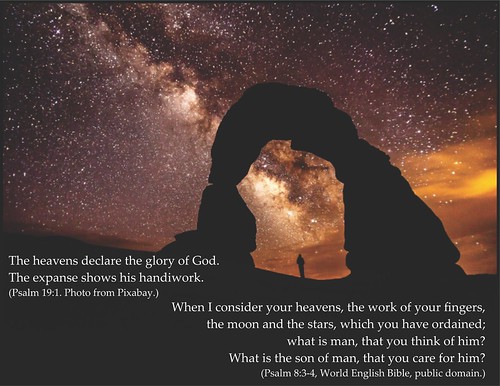
God the Son was important in the creation, and in sustaining that which He created!
John 1:1 In the beginning was the Word, and the Word was with God, and the Word was God. 2 The same was in the beginning with God. 3 All things were made through him. Without him, nothing was made that has been made. 10 He was in the world, and the world was made through him, and the world didn’t recognize him. 12a But as many as received him, to them he gave the right to become God’s children . . .
Colossians 1:14 in whom we have our redemption, the forgiveness of our sins. 15 He is the image of the invisible God, the firstborn of all creation. 16 For by him all things were created in the heavens and on the earth, visible things and invisible things, whether thrones or dominions or principalities or powers. All things have been created through him and for him. 17 He is before all things, and in him all things are held together.
Hebrews 1:3 His Son is the radiance of his glory, the very image of his substance, and upholding all things by the word of his power, who, when he had by himself purified us of our sins, sat down on the right hand of the Majesty on high ...
(Although the passages above indicate that God the Son was the most important agent in the creation, there are scriptural indications that God the Father and God the Holy Spirit were also involved.)
Perhaps you and I don't fully appreciate the magnificence of creation, and, therefore, we may not fully appreciate the magnificence of Christ.
Creation shows that God the son loves diversity. There are about 400,000 species of beetles, and probably at least a million yet to be discovered. (Psalm 104:24 Yahweh, how many are your works! In wisdom, you have made them all. The earth is full of your riches. 25 There is the sea, great and wide, in which are innumerable living things, both small and large animals.)
Creation is unimaginably large. “Recent estimates of the number of galaxies in the observable universe range from 200 billion [(2×10 to the 11th power) to 2 trillion (2×10 to the 12th power)] or more, … containing more stars than all the grains of sand on planet Earth.” (Wikipedia) And that’s only the observable universe.
Creation shows the power of God the Son. Most of the energy on earth comes from the sun. In the sun, Hydrogen nuclei bombard each other at several million degrees, and turn into Helium nuclei, releasing energy by e =m c-squared. The sun is about 93 million miles away. Since it is emitted in all directions, the vast majority of the sun’s emitted energy goes off into space, never hitting the earth, or any other body in the Solar System. But it’s warm enough for life on earth, and light enough for photosynthesis, just from the tiny fraction of the sun’s emitted energy that strikes it. We can scarcely imagine the power of the sun, and it’s a fairly small star.
Creation shows that God the Son likes beauty. He didn’t have to make the universe so that rainbows, or fall foliage, or butterflies, or eclipses, exist. But He did. Using scientific tools, such as microscopes and telescopes, we have found that there is amazing beauty, even in things we can’t get to, or can’t see with the naked eye.
The Creation is sustained by God the Son. How? By laws, like gravity,
and created properties, such as that water can exist in three different forms
at reasonably normal temperatures. The laws of gravity ensure, for example,
that the planets continue to orbit the sun. The properties of water make rain possible, among many other things. God also sustains by processes,
like erosion, plate tectonics, and natural selection. We can’t be sure if God
is intimately involved in making every raindrop, or lets nature take its
course to make each one, but He could make each and every one carefully and magnificently.
God the Son can, and, at least sometimes, does, change the “normal” course
of nature. We call that a miracle.
God, the Son’s, creation is beyond our imagination! He created time and space! God created matter and energy! God created the four fundamental forces, (also called the four interactions) – gravity, the electromagnetic force, the strong force and the weak force. God created the entire electromagnetic spectrum: light, radio waves, wi-fi, microwaves, X-rays, and more. God created the universe with appropriate physical properties for the existence of life
We should not forget that, even though He was largely responsible for the creation of the entire universe, He came to earth. Not as a baby, but as an embryo, a being with just a few cells, and hardly any connection to the world outside his mother’s womb. Then, of course, He became a fetus, and, after about nine months, a baby. Still helpless, dependent, and, presumably, severely limited in His ability to communicate.
And we should not forget what St. Paul said about the Creator and Sustainer of the universe:
5 Have this in your mind, which was also in Christ Jesus, 6 who, existing in the form of God, didn’t consider equality with God a thing to be grasped, 7 but emptied himself, taking the form of a servant, being made in the likeness of men. 8 And being found in human form, he humbled himself, becoming obedient to the point of death, yes, the death of the cross. 9 Therefore God also highly exalted him, and gave to him the name which is above every name, 10 that at the name of Jesus every knee should bow, of those in heaven, those on earth, and those under the earth, 11 and that every tongue should confess that Jesus Christ is Lord, to the glory of God the Father. (From Philippians 2)
Thanks for reading! To God be the glory!
Sunday, December 03, 2017
The Art of Divine Contentment: An Exposition of Philippians 4:11 by Thomas Watson. Excerpt 5
2. You have heard much of Christ: have you learned Christ? The Jews, as Jerome saith, carried Christ in their Bibles, but not in their heart; their sound “went into all the earth”; (Ro. 10.18) the prophets and apostles were as trumpets, whose sound went abroad into the world: yet many thousands who heard the noise of these trumpets, had not learned Christ, “they have not all obeyed.” (Ro. 10.16)
(1.) A man may know much of Christ, and yet not learn Christ: the devils knew Christ. (Mat. 1.24) (2.) A man may preach Christ, and yet not learn Christ, as Judas and the pseudo-apostles. (Ph. 5.15) (3.) A man may profess Christ, and yet not learn Christ: there are many professors in the world that Christ will profess against. (Mat. 7. 22, 23)
Q. What it is then to learn Christ?
1. To learn Christ is to be made like Christ, to have the divine characters of his holiness engraven upon our hearts: “we all with open face, beholding as in a glass the glory of the Lord, are changed into the same image.” (2 Cor. 3.18) There is a metamorphosis made; a sinner, viewing Christ’s image in the glass of the gospel, is transformed into that image. Never did any man look upon Christ with a spiritual eye, but he went away quite changed. A true saint is a divine landscape picture, where all the rare beauties of Christ are lively portrayed and drawn forth; he hath the same spirit, the same judgment, the same will, with Jesus Christ.
2. To learn Christ, is to believe in him; “my Lord, and my God,” (John 20.28) when we do not only believe God, but in God, which is the actual application of Christ to ourselves, and as it were the spreading of the sacred medicine of his blood upon our souls. You have heard much of Christ, and yet cannot with an humble adherence say, “my Jesus;” be not offended if I tell you, the devil can say his creed as well as you.
3. To learn Christ, is to love Christ. When we have Bible-conversations, our lives like rich diamonds cast a sparkling lustre in the church of God, and are, in some sense, parallel with the life of Christ, as the transcript with the original. So much for the first notion of the word.
Thomas Watson lived from 1620-1686, in England. He wrote several books which survive. This blog, God willing, will post excerpts from his The Art of Divine Contentment: An Exposition of Philippians 4:11, over a number of weeks, on Sundays. My source for the text is here, and I thank the Christian Classics Ethereal Library for making this text (and many others) available. The previous excerpt is here.
(1.) A man may know much of Christ, and yet not learn Christ: the devils knew Christ. (Mat. 1.24) (2.) A man may preach Christ, and yet not learn Christ, as Judas and the pseudo-apostles. (Ph. 5.15) (3.) A man may profess Christ, and yet not learn Christ: there are many professors in the world that Christ will profess against. (Mat. 7. 22, 23)
Q. What it is then to learn Christ?
1. To learn Christ is to be made like Christ, to have the divine characters of his holiness engraven upon our hearts: “we all with open face, beholding as in a glass the glory of the Lord, are changed into the same image.” (2 Cor. 3.18) There is a metamorphosis made; a sinner, viewing Christ’s image in the glass of the gospel, is transformed into that image. Never did any man look upon Christ with a spiritual eye, but he went away quite changed. A true saint is a divine landscape picture, where all the rare beauties of Christ are lively portrayed and drawn forth; he hath the same spirit, the same judgment, the same will, with Jesus Christ.
2. To learn Christ, is to believe in him; “my Lord, and my God,” (John 20.28) when we do not only believe God, but in God, which is the actual application of Christ to ourselves, and as it were the spreading of the sacred medicine of his blood upon our souls. You have heard much of Christ, and yet cannot with an humble adherence say, “my Jesus;” be not offended if I tell you, the devil can say his creed as well as you.
3. To learn Christ, is to love Christ. When we have Bible-conversations, our lives like rich diamonds cast a sparkling lustre in the church of God, and are, in some sense, parallel with the life of Christ, as the transcript with the original. So much for the first notion of the word.
Thomas Watson lived from 1620-1686, in England. He wrote several books which survive. This blog, God willing, will post excerpts from his The Art of Divine Contentment: An Exposition of Philippians 4:11, over a number of weeks, on Sundays. My source for the text is here, and I thank the Christian Classics Ethereal Library for making this text (and many others) available. The previous excerpt is here.
Wednesday, November 29, 2017
Sunspots 654
Things I have recently spotted that may be of interest to someone else:

The Arts: Listverse on 10 really unique church buildings.
Computing: Relevant gives us 5 questions we should ask ourselves before posting to social media.
Education: Grammarphobia on when to use commas with lists of things, and when not to.
Finance: (sort of) Wired on the importance of efficient use of curb space, in and by cities.
Food: (sort of) National Public Radio reports that today's dishwashing appliances are much more efficient, in water use, than such devices used to be.
Health: Scientific American on the dangers of marijuana use by teens.
Humor: (or Finance) Listverse reports on some truly strange lawsuits.
Politics: National Public Radio reports on a poll of 38 economists, who agree unanimously that the Republican tax plan will cause the US debt to rise, and that it will not lead to increased economic growth.
Science: National Public Radio reports on studies that pinpoint which ice areas, melting, will affect which cities, causing sea levels to rise. The results are not what we might have thought.
Listverse shows us videos of 10 shape-shifting organisms.
Thanks for looking!
Image source (public domain)
Sunday, November 26, 2017
The Art of Divine Contentment: An Exposition of Philippians 4:11 by Thomas Watson. Excerpt 4
Let me put you upon a serious trial. Some of you have heard much, — you have lived forty, fifty, sixty years under the blessed trumpet of the gospel, — what have you learned?
You may have heard a thousand sermons, and yet not learned one. Search your consciences.
1. You have heard much against sin: are you hearers; or are you scholars? How many sermons have you heard against covetousness, that it is the root, on which pride, idolatry, treason do grow? One calls it a metropolitan sin; it is a complex evil, it doth twist a great many sins in with it. There is hardly any sin, but covetousness is a main ingredient of it; and yet are you like the two daughters of the horse-leech, that cry, “give! give!” How much have you heard against rash anger, that is a short frenzy, a dry drunkenness; that it rests in the bosom of fools; and upon the least occasion do your spirits begin to take fire? How much have you heard against swearing: It is Christ’s express mandate, “swear not at all.” (Mat. 5. 34) This sin of all others may be termed the unfruitful work of darkness. It is neither sweetened with pleasure, nor enriched with profit, the usual vermillion wherewith Satan doth paint sin.
Swearing is forbidden with a subpaena. While the swearer shoots his oaths, like flying arrows at God to pierce his glory, God shoots “a flying roll” of curses against him. And do you make your tongue a racket by which you toss oaths as tennisballs? do you sport yourselves with oaths, as the Philistines did with Samson, which will at last pull the house about your ears?
Alas! how have they learned what sin is, that have not learned to leave sin! Doth he know what a viper is, that will play with it?
Thomas Watson lived from 1620-1686, in England. He wrote several books which survive. This blog, God willing, will post excerpts from his The Art of Divine Contentment: An Exposition of Philippians 4:11, over a number of weeks, on Sundays. My source for the text is here, and I thank the Christian Classics Ethereal Library for making this text (and many others) available. The previous excerpt is here.
You may have heard a thousand sermons, and yet not learned one. Search your consciences.
1. You have heard much against sin: are you hearers; or are you scholars? How many sermons have you heard against covetousness, that it is the root, on which pride, idolatry, treason do grow? One calls it a metropolitan sin; it is a complex evil, it doth twist a great many sins in with it. There is hardly any sin, but covetousness is a main ingredient of it; and yet are you like the two daughters of the horse-leech, that cry, “give! give!” How much have you heard against rash anger, that is a short frenzy, a dry drunkenness; that it rests in the bosom of fools; and upon the least occasion do your spirits begin to take fire? How much have you heard against swearing: It is Christ’s express mandate, “swear not at all.” (Mat. 5. 34) This sin of all others may be termed the unfruitful work of darkness. It is neither sweetened with pleasure, nor enriched with profit, the usual vermillion wherewith Satan doth paint sin.
Swearing is forbidden with a subpaena. While the swearer shoots his oaths, like flying arrows at God to pierce his glory, God shoots “a flying roll” of curses against him. And do you make your tongue a racket by which you toss oaths as tennisballs? do you sport yourselves with oaths, as the Philistines did with Samson, which will at last pull the house about your ears?
Alas! how have they learned what sin is, that have not learned to leave sin! Doth he know what a viper is, that will play with it?
Thomas Watson lived from 1620-1686, in England. He wrote several books which survive. This blog, God willing, will post excerpts from his The Art of Divine Contentment: An Exposition of Philippians 4:11, over a number of weeks, on Sundays. My source for the text is here, and I thank the Christian Classics Ethereal Library for making this text (and many others) available. The previous excerpt is here.
Thursday, November 23, 2017
Gratitude, from St. Augustine
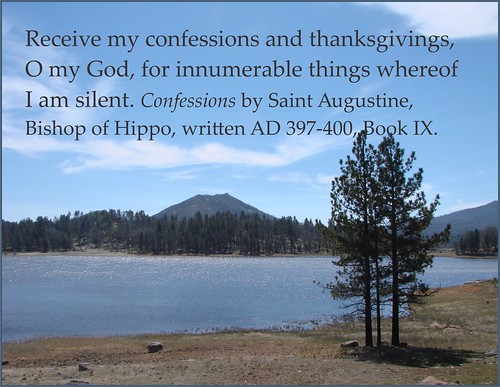
Gratitude, 15 centuries or so ago, and still pertinent.
Thanks for looking!
Wednesday, November 22, 2017
Sunspots 653
 Things I have recently spotted that may
be of interest to someone else:
Things I have recently spotted that may
be of interest to someone else: Computing: Wired reports that there is now a church, sort of, which more or less worships artificial intelligence. The IRS has granted this "church" tax-exempt status.
Health: Time, and other outlets, report that the Centers for Disease Control say that about 90% of Americans don't eat enough fruit and vegetables. Not a surprise.
Politics: Relevant reports that a game manufacturer is trying to block President Trump's wall by acquiring property on the border.
National Public Radio, and other sources, report that the Keystone Pipeline recently spilled 5,000 barrels of oil. Hardly a surprise, unfortunately.
Wired has compiled an annotated list of things Attorney General Jeff Sessions told Congress that he can't remember.
Science: Listverse describes 10 islands, and their unusual animal populations.
Scientific American reports on a body from outside our solar system that is on its way out of it.
The He Lives blog argues that the Intelligent Design movement isn't about science, although it's usually presented that way.
An illustrated and annotated periodic table.
Thanks for looking!
Subscribe to:
Posts (Atom)