License

I have written an e-book, Does the Bible Really Say That?, which is free to anyone. To download that book, in several formats, go here.
Creative Commons License
The posts in this blog are licensed under a Creative Commons Attribution-NonCommercial-ShareAlike 3.0 Unported License. You can copy and use this material, as long as you aren't making money from it. If you give me credit, thanks. If not, OK.
Showing posts with label China. Show all posts

Monday, July 13, 2026

Sunspots 1002


Some things that I have spotted that may be of interest to others:

SpaceDaily reports on an extensive study of the genetics of anxiety. We're a long was from understanding it, but this is a serious first step.


It's been 30 years since Dolly, the sheep, was developed from a cloned cell. Nature reflects on what has happen ed since. (Hint: we don't seem close to cloning a numan.)

You've heard of Leap Years. There are also (or have been) Leap seconds, and now those in charge of such things are considering a leap hour.

MSN and other sources discuss China's attempt to grow a Great Green Wall -- trees: billions of them,  planted in the desert, and whether or not it can help us fight global climate change. 

Wednesday, January 01, 2020

Sunspots 761


Things I have recently spotted that may be of interest to someone else:


Christianity: (or something) NPR reports on how a couple who moved into a neighborhood recently had a deaf child, and the neighbors, who had all lived there a long time, have decided to learn sign language.

N. T. Wright on how most Christians have the wrong idea about heaven.

Christianity Today, and other outlets, report that a Chinese pastor has been sentenced to 9 years in prison.

Computing: Gizmodo reports on what people wanted most to know in the Wikipedia.

Gizmodo also reports that anti-robocalling legislation has been approved by Congress, and signed by President Trump. Gizmodo also guesses that it will help some, but maybe not enough.


Education: CBS News reports that Princeton University has honored lunchroom, and other non-professorial workers, by hanging their portraits.


Environment: A Relevant article on why Christians should care for the environment.

Health: A woman with sickle-cell anemia has been treated with her own cells, modified with CRISPR. The results are promising.
 
Politics: Relevant reports that white evangelicals are further from the mainstream in their attitudes concerning immigration than they are on abortion.

The graphic used in these posts is from NASA, hence, it is free to use like this.

Thanks for looking!

Wednesday, November 13, 2019

Sunspots 754


Things I have recently spotted that may be of interest to
someone else:

Christianity: Relevant has an article about how the Bible says to treat refugees, with Bible quotes. They missed at least one. To quote my own blog: The Bible also says, in reference to a specific refugee crisis:
Isaiah 16:3 Give counsel! Execute justice! Make your shade like the night in the middle of the noonday! Hide the outcasts! Don’t betray the fugitive! 4a Let my outcasts dwell with you! As for Moab, be a hiding place for him from the face of the destroyer. (This was in spite of the fact that the Moabites hadn’t always been good to Israel. See Joshua 24:9, Judges 3:12-30, 1 Samuel 12:9.)


(And politics) Christianity Today has an article decrying our current immigration policies. The article also points to a suggestion, endorsed by several evangelical leaders, that a path to citizenship, for illegals, be created, including restitution -- not amnesty.

 
Politics: Relevant reports that there were NO refugees settled in the US in October.

NPR on how the Chinese government is trying to control Tibetan Buddhists, for example in the recognition of the next Dalai Lama.
FiveThirtyEight discusses the electability of Pete Buttigieg, including a discussion of how his homosexuality might influence voters.

Science: The Scientist report on the use of CRISPR genetic engineering to alter cancer patients' cells, and the introduction of such altered cells back into the patients. The alterations were designed to attack cancer cells. It's not yet clear whether the treatment has successfully fought the cancer.
Gizmodo, and other outlets, report that a trap for catching mammoths has been discovered. It's a large trap.

NPR discusses the uses of Helium, the only chemical element that easily escapes the earth.


The graphic used in these posts is from NASA, hence, it is free to use like this.
 
Thanks for looking!

Sunday, October 27, 2019

Sunspots 751

Things I have recently spotted that may be of interest to someone else:


Christianity: Catherine Rampell on President Trump's attacks on Christian values, and on the Constitutional separation of church and state.

Relevant has an article on how to find hope, no matter the circumstances.
Relevant also reports that the Chinese government ordered the demolition of a 3,000 member megachurch, starting in the middle of a service, in spite of government recognition of the church.


Computing: Gizmo's freeware recommends a web page with 55 image-editing tools, available for free use.

History: The History blog reports on the oldest pearl used as a decoration/ornament by humans.

Politics: FiveThirtyEight analyzes the October 15th Democratic debate.

Michael Gerson says that President Trump's foreign policy is betraying decades of beneficent American ideals.

Catherine Rampell says that Bernie Sanders and Elizabeth Warren seem to be following political expediency, in their health care proposals.

Science: The Scientist reports that genetics, by itself, does not determine what types of people you are sexually attracted to. Unfortunately, there is an app which claims to do just that.

Gizmodo reports on a possible new source of earthquakes in California.

The graphic used in these posts is from NASA, hence, it is free to use like this.
 
Thanks for looking!

Wednesday, September 19, 2018

Sunspots 695

Things I have recently spotted that may be of interest to someone else:


Christianity: Relevant, and other sources, report that China is attacking Christians and churches, and other religions, too. In another report, China is blocking on-line Christian services.

Richard Mouw, in Sojourners, argues against uncritical support for Israel, and claims that the Bible does not teach such support.

Some prominent Christians have recently argued that Christians have no business trying to work for social justice. Russell Moore, of the Southern Baptist Convention, begs to differ.


Food: Listverse has posted 10 little-known facts about Avocados.

In case you didn't know it, cacao (the plant that chocolate comes from) is susceptible to plant diseases. Scientific American reports on attempts to find resistant cacao plants.

Gizmodo on whether breakfast cereal is good for us or not.

Politics: Not a surprise. Scientific American reports that more people are killed by active shooters when they are using semi-automatic weapons.

Earther reports that, as Hurricane Florence neared landfall, President Trump called the government's response to Hurricane Maria, in Puerto Rico, an "unsung success," in spite of plenty of contrary evidence. Then, later, he claimed that the death toll, about 3,000, was a figure made up by Democrats, to make him look bad.

The Trump administration is in process of relaxing regulations on institutions that lend money to military personnel, and has done so without consulting the Pentagon, which is opposed to these changes, according to National Public Radio.

Relevant reports that the number of Christian refugees entering the US has fallen sharply under the Trump administration.

(Not really politics, I hope) Gizmodo reports that a system is being developed to allow the President to send a warning text message to every cell phone in the US, in case of terrorist attacks, weather disasters, and the like.

Science: Barrier islands in the Atlantic Ocean, which protect North and South Carolina from some hurricane damage, are disappearing, says Scientific American.

Gizmodo reports that there is a plan in place to sequence the DNA of all living vertebrate species, about 66,000.

Earther reports on a typhoon that was stronger than Florence, at about the same time.

Scientific American reports on a study that indicates that people who are new to us dislike us less than we think they do.

Thanks for looking!

Wednesday, April 11, 2018

Sunspots 672

Things I have recently spotted that may be of interest to someone else:


The Arts: There is a pulp magazine archive, of magazines published in the middle, more or less, of the last century, which may be accessed free of charge. Warning -- some of the covers are rather racy, and/or demeaning to women. There is a good search feature. I entered "Jack Vance," and was easily able to access his splendid The Dragon Masters, an award-winning story about what human nature is and isn't. Files can be accessed in several formats, including .PDF.

(and Science) Gizmodo on the discovery of pigments.

An atheist movie critic is positive about Paul, Apostle of Christ, which is currently in theaters.

Christianity: Gizmodo and other sources report that China has banned all on-line sales of Bibles.

Finance: On why US automakers might not be well served by relaxing fuel efficiency standards (as the Trump administration is in the process of doing).

Humor: Listverse tells us 10 interesting things about M&Ms.


Politics: A former Postmaster General says that President Trump is wrong -- the Post Office makes money delivering for Amazon.

Science: Scientific American reports that orangutans use plants as medicine.


Thanks for looking!

Image source (public domain)

Wednesday, December 05, 2012

Sunspots 395

Things I have recently spotted that may be of interest to someone else:
Humor:  The Onion has named Kim Jong-Un, of North Korea, the sexiest man alive. The Chinese People's Daily took them seriously.

(Not exactly humor . . .) The Huffington Post has a slideshow on signs that celebrity marriages were doomed from the start.

Science:  Wired reports that microbes have been found in a body of water in Antarctica, 65 feet under the ice.

Business Line (!) speculates that planets around other stars may be "more habitable than earth."

From Flickr, a photo of a turtle's face, close-up.

 Image source (public domain)

Thursday, June 02, 2011

Under Heaven by Guy Gavriel Kay

I recently read Under Heaven, by Guy Gavriel Kay. (The first link in the previous sentence gives plot and publication information.) It was a good read, indeed. The book was, as the Wikipedia article says, a fictionalized setting of the An Shi rebellion in ancient China, an event which took more lives than any other war in recorded history, up until World War II (by which time there were a lot more people living).

Kay considers the war, but most of the book is about the events leading up to it, and he doesn't give much notice that a war is coming until the book is far along. Under Heaven is about characters and setting. It has a plot, too. What characters? What setting?

The book is too long, and too complex, for me to do it justice. See the first link in this post, if you want more detail and scope.

The characters are the most powerful people around the emperor, the family of the late General Shen Gao, and some other individuals who are important to that family. The emperor, himself, is a minor character. Kay occasionally introduces a totally new character, and tells some aspect of his story from the point view of that person for a chapter or more. In one case, he does this for a street beggar.

The book is also a love story. Two of the characters discover that they are in love with each other, after being associated for a long time.

The setting is the ins and outs of China, and surrounding lands, as Kay sees it, at that time. Much of the book bristles with court intrigue and protocol. One way to become important is to be a good poet -- one character in the book is a professional poet. Prospective court officials are tested, in part, on their ability to write poetry. There is a poetry contest between two characters.

The book is fantastic, a little. It would be historical fiction, but for the shamans, and the ghosts. There are ghosts, and they save the life of one of the characters. There are shamans, and they can work magic. They almost succeed into turning one of the characters into a wolf -- they would have, if the magic hadn't been interrupted. The ghosts and the shamans, or their effects, are necessary in the development of a son, and the daughter, of General Shen Gao. There is also a society, the kanlin, who are warriors, as in Crouching Tiger, Hidden Dragon. While it is not clear that they possess extraordinary powers, it is not certain that they don't. They certainly fight well.

Although I found no Christ-figure, and this is by no means a Christian novel, there are characters with integrity, and even characters who sacrifice their own lives, in the book.

If you want to be taken into a complex world, unlike 21st Century North America, try Under Heaven.

Thanks for reading.
Friday, January 28, 2011

Where the Mountain Meets the Moon by Grace Lin

I recently read Where the Mountain Meets the Moon, written and illustrated by Grace Lin, a Chinese-American author and artist. (New York: Little, Brown, 2009) The book won a Newbery Honor medal, meaning that it was close to winning the Newbery award. (There's a video of Lin discussing the book with Al Roker, of NBC, and five young readers, here.)

The plot is simple enough, although I won't give it away. It has a moral, which is that we should be satisfied with the good things we have, rather than strive to obtain things that others have and we don't.

I can tell you the setting, which is once upon a time, in China, mostly rural China. There are some interesting characters, principally Minli, a young girl, her parents, peasants who have no other child, and a dragon (with no name but Dragon) who is unable to fly.

The main appeal of the book (aside from the illustrations, which are marvelous) is the way in which Lin has made the main narrative a way of having many short stories told by various characters, throughout the adventures of Minli. (These tales are mostly Chinese fairy tales.) The first such story begins on page 4, and lasts less than four pages, indicating the importance of the tales, and their brevity. There are 48 short chapters, and I guess that there is a tale within at least 12 of them, probably more. These tales are all interesting in themselves, and do not detract from the main narrative, but are all tied to it. Lin indicates that she researched Chinese lore. It is unclear as to how many of the tales she adapted from past Chinese literature, and how many she made up herself.

I'm glad I read this book. It was unlike anything else I have ever read, but a genuine pleasure to become acquainted with.

I have also read The Year of the Dog: A Novel, by Lin. It's a good book, partly autobiographical, designed for children to read, about the experiences of a Chinese-American girl who is one of only two in her grade in public schools. Lin uses stories, again, but stories of her mother and other relatives. She also illustrated the book, in the way you might expect a good artist from the elementary grades to draw.

Thanks for reading. Read Lin.

Tuesday, April 11, 2006

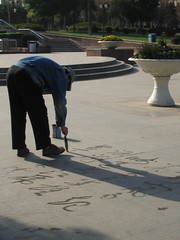
Water calligraphy, continued

In a previous post, using a photo of a man writing on the pavement with water (that's not a typo) from a Chinese Flickr contact of mine, I mused about the impermanence of what we do, including what I write in this blog.

I also indicated that some things, especially the redeemed human soul, are eternal. I indicated, also, that some artistic expressions, such as the poetry of John Keats, make an impression for a long time. I consider blogging, and photography, to be artistic expressions. (Sometimes not very high class art!)

There were (for me) a flurry of comments, and I am grateful. One was as follows:

'writing in water' - beautiful metaphor for the brevity of life and the impermanence of our lives and actions on earth. Yet in a way I take issue with it.
By violet

I e-mailed Violet, asking her how she disagreed, and she was gracious enough to respond. I haven't asked her for permission to quote her remarks, but I'll paraphrase them like this:

You never know what eternal good you may do. Jesus commanded us to offer a drink of water unselfishly to those who need one, and said that that act was worthy of an eternal reward. (Matthew 10:42) So do good, including blogging, believing that what you do is part of God's plan for the world. It may affect others in ways you don't know about.

I agree. Thanks, Violet.

We'll be travelling for the next few days, and I don't expect to post, or comment on your blogs, as much.

He is risen! Thanks for reading.

Saturday, April 08, 2006

Water Calligraphy


water calligraphy
Originally uploaded by mscheng.

I thank mscheng (her Flickr user name) for this photo, which she posted, and I couldn't pass up. The photo was taken recently in Nanjing, China, where mscheng lives. Lest there be any doubt, it really does show a man writing on the pavement with water. He is, of course, very well aware that what he is writing will evaporate. In fact, whatever he has written at the lower right seems to have mostly done so.

You should be able to see a larger view of this photo, and her comments on it, by clicking on it. You can see more interesting photos from mscheng, showing life in China, by clicking here. No password is needed.

mscheng writes that water calligraphy has significance for Buddhists. She wrote me that, on one occasion she heard of (in the US, at a building dedication) monks had written in sand, then wiped it out, saying that they were storing the meaning in themselves, and that the spiritual meaning was more important than the act of writing. (I have paraphrased her message, without, I hope, significantly altering her meaning.)

The tomb of John Keats has the inscription "Here lies one whose name was writ in water." There is a monument to Keats that refers to that. (Keats was an English poet who died in Italy. The inscription was placed at his request.) Keats was referring to the impermanence of fame, and of life.

What I write in this blog is writing in, or with, water. Much of it goes unread, except by me. Even if there may be a few kind souls who read it, they usually don't remember what they have read, and it probably seldom, if ever, affects their lives deeply. Like the Buddhist monks writing in sand, it does affect me, at least sometimes, and, I suppose, the thoughts behind the writing, and the spiritual impact on me, are more important than the blogging.

Keats wrote some great lines. "What mad pursuit?" is the first part of line 9 of his "Ode on a Grecian Urn." Francis Crick (That's the Crick, as in Watson and Crick) used those words as the first three words of the title of one of his books. Dan Simmons peppered his Hyperion Cantos with words from the works of Keats, and, in a sense, Keats was a character in this group of important works of science fiction. So Keats, for one, was not writing in water, at least not all the time. But most of us are. Even Keats will be forgotten, if the world lasts long enough, and be, like the first entry in my Blogroll, "A flower quickly fading."

James 4:14 includes this: "What is your life? For you are a mist that appears for a little time and then vanishes." (ESV) The Bible is right. My whole life is written in, or on, water. It is true that I have offspring (Happy birthday, younger daughter!) but my descendants may eventually all die off, or, if they don't, soon enough they won't remember me. I'm not very significant. I'm not eternal. Yet, looking at it another way, I am eternal, and, therefore, significant. As C. S. Lewis put it: "Nature is mortal; we shall outlive her. When all the suns and nebulae have passed away, each one of you will still be alive. . . . We are summoned to pass in through Nature, beyond her, into that splendour which she fitfully reflects." The Weight of Glory, HarperSan Francisco, 2001, p. 44.

May you choose Christ, so that you may experience that "splendour." May I!

Keep writing, and thanks for reading.

* * * * *

Added April 11th:

Violet commented below, indicating that, in part, she didn't agree with what I wrote above. I e-mailed her, asking for clarification, and she was kind enough to respond. I have paraphrased her response, and discussed it a little, in my post of this date.