Things I have recently spotted that may
be of interest to someone else:
Christianity: Todd Wood, a Young-Earth Creationist, but one who respects and is willing to listen to other views, examines
the results of a poll of pastors, which indicates that over three-quarters of them are not convinced that their own view, whatever it is, is correct.
Computing: I am by no means a expert on
Twitter, but Twitonomy seems to be
a great tool for those who are, and it comes with a non-biased recommendation. Check it out!
Philosophy: He Lives quotes
from rabid atheist Jerry Coyne, who admits that, in his own world view, there is no such thing as free choice.
Politics: An article, with photos, on the first
integrated prom in a small Georgia town, in 2013. Not all proms are integrated yet.
Science: A site showing you how a dog's
vision differs from that of most humans.
National Public Radio shows, and tells, about "pinkhouses,"
a high-tech way of growing plants efficiently indoors.
Image
source (public domain)
Musings on science, the Bible, and fantastic literature (and sometimes basketball and other stuff).
God speaks to us through the Bible and the findings of science, and we should listen to both types of revelation.
The title is from Psalm 84:11.
The Wikipedia is usually a pretty good reference. I mostly use the World English Bible (WEB), because it is public domain. I am grateful.
License
I have written an e-book, Does the Bible Really Say That?, which is free to anyone. To download that book, in several formats, go here.

The posts in this blog are licensed under a Creative Commons Attribution-NonCommercial-ShareAlike 3.0 Unported License. You can copy and use this material, as long as you aren't making money from it. If you give me credit, thanks. If not, OK.

The posts in this blog are licensed under a Creative Commons Attribution-NonCommercial-ShareAlike 3.0 Unported License. You can copy and use this material, as long as you aren't making money from it. If you give me credit, thanks. If not, OK.
Showing posts with label Jerry Coyne. Show all posts
Wednesday, May 29, 2013
Sunspots 420
Labels:
atheism,
free will,
Jerry Coyne,
links,
origins,
photosynthesis,
pink houses,
proms,
race,
Twitter
Wednesday, April 24, 2013
Were religious beliefs/was Islam responsible for the bombings in Boston?
In case you didn't realize it, some people would answer both of the questions above with a resounding "yes!" They would claim that militant intolerance, even violence, are the inevitable consequence of deeply held religious belief.
The Panda's Thumb blog, not exactly a friend of conservative Christian beliefs, at least beliefs on origins, has blasted biologist Jerry Coyne, who, in addition to being an important scientist, is a militant atheist, for his "yes!" responses, and given evidence to show that Coyne, and other people who want to make religious belief the root of all of violence, and other problems, are wrong. There are some pertinent links in the Panda's Thumb post.
Good for the Panda's Thumb!
The Panda's Thumb also posted a reaction to a believer in Intelligent Design, who claimed that "Darwinists" are incapable of showing proper compassion.
Most any tragedy can be used to reinforce our prejudices, and often gets used as such by people with a wide variety of such prejudices. Sigh.
The Panda's Thumb blog, not exactly a friend of conservative Christian beliefs, at least beliefs on origins, has blasted biologist Jerry Coyne, who, in addition to being an important scientist, is a militant atheist, for his "yes!" responses, and given evidence to show that Coyne, and other people who want to make religious belief the root of all of violence, and other problems, are wrong. There are some pertinent links in the Panda's Thumb post.
Good for the Panda's Thumb!
The Panda's Thumb also posted a reaction to a believer in Intelligent Design, who claimed that "Darwinists" are incapable of showing proper compassion.
Most any tragedy can be used to reinforce our prejudices, and often gets used as such by people with a wide variety of such prejudices. Sigh.
Labels:
atheism,
bombing,
Boston,
fundamentalism,
intolerance,
Islam,
Jerry Coyne,
Panda's Thumb,
Politics,
religion
Thursday, April 26, 2012
More criticism of Jerry Coyne from The Panda's Thumb
The Panda's Thumb is a prominent blog, mostly devoted to attacking the Intelligent Design (ID) movement. In my opinion, the ID movement is in need of some criticism.
Jerry Coyne, who has solid academic credentials as an evolutionary biologist, is a self-proclaimed atheist, and a militant one at that -- he wants to stamp out religion entirely. A few days ago, I wrote about a post on The Panda's Thumb that criticized Coyne. The author argued that it is possible for Christianity, or at least a belief in the supernatural, and a belief in evolution to co-exist, and gave two examples, one of them Darwin himself, of important evolutionary biologists who believed so. (I think it is possible for a believing Christian to believe that much or all of the variety in living things came about through natural selection, but that's another story.)
That same author, Nick Matzke, has written another post on that blog, again about Coyne. In this one, Matzke refers to another blog, where an upcoming article by Coyne, in which he argues for his program of eliminating religion from North American life, is criticized seriously for using poor methodology.
Come on, Coyne! You aren't an expert in religion, philosopher, or other fields! And you have proved this.
Thanks for reading.
Jerry Coyne, who has solid academic credentials as an evolutionary biologist, is a self-proclaimed atheist, and a militant one at that -- he wants to stamp out religion entirely. A few days ago, I wrote about a post on The Panda's Thumb that criticized Coyne. The author argued that it is possible for Christianity, or at least a belief in the supernatural, and a belief in evolution to co-exist, and gave two examples, one of them Darwin himself, of important evolutionary biologists who believed so. (I think it is possible for a believing Christian to believe that much or all of the variety in living things came about through natural selection, but that's another story.)
That same author, Nick Matzke, has written another post on that blog, again about Coyne. In this one, Matzke refers to another blog, where an upcoming article by Coyne, in which he argues for his program of eliminating religion from North American life, is criticized seriously for using poor methodology.
Come on, Coyne! You aren't an expert in religion, philosopher, or other fields! And you have proved this.
Thanks for reading.
Friday, April 20, 2012
The Panda's Thumb on accomodating evolution and Christianity
The Panda's Thumb is a prominent, and important, blog, authored by many people, mostly scientists. Its most common theme is attacking the Intelligent Design movement. (I am not a fan of the ID movement myself. I do believe that there is a Designer, who did some designing. See here.)
A recent post in the Panda's Thumb, seriously criticizes Jerry Coyne, an evolutionary biologist and self-proclaimed atheist. According to the Wikipedia article on him, which is linked to in the previous sentence, "He claims that religion and science are incompatible. . ."
Nick Matzke, criticizing Coyne, points out that two of the most important evolutionists ever did not make such claims. One such was Theodosius Dobzhansky, who famously wrote "Nothing in Biology Makes Sense Except in the Light of Evolution." The title of that article is often used today, in writing about origins, even though the article is nearly 40 years old. When I was a graduate student in genetics, I was urged to read Dobzhansky's Genetics and the Origin of Species, and I did. It was an important book.
The other evolutionist was no less than Darwin, himself.
Matzke does not claim that either Dobzhansky or Darwin believed in a personal God, or in Christ's redemptive work, simply that they believed that there could be accomodation between a belief in evolution by natural selection and Christianity -- belief in one does not have to negate belief in the other. He merely claims, with solid documentation and appropriate quotation, that Coyne's claim about incompatibility is a real stretch.
Thanks for reading. Read Matzke.
A recent post in the Panda's Thumb, seriously criticizes Jerry Coyne, an evolutionary biologist and self-proclaimed atheist. According to the Wikipedia article on him, which is linked to in the previous sentence, "He claims that religion and science are incompatible. . ."
Nick Matzke, criticizing Coyne, points out that two of the most important evolutionists ever did not make such claims. One such was Theodosius Dobzhansky, who famously wrote "Nothing in Biology Makes Sense Except in the Light of Evolution." The title of that article is often used today, in writing about origins, even though the article is nearly 40 years old. When I was a graduate student in genetics, I was urged to read Dobzhansky's Genetics and the Origin of Species, and I did. It was an important book.
The other evolutionist was no less than Darwin, himself.
Matzke does not claim that either Dobzhansky or Darwin believed in a personal God, or in Christ's redemptive work, simply that they believed that there could be accomodation between a belief in evolution by natural selection and Christianity -- belief in one does not have to negate belief in the other. He merely claims, with solid documentation and appropriate quotation, that Coyne's claim about incompatibility is a real stretch.
Thanks for reading. Read Matzke.
Tuesday, November 16, 2010
"Religion has no evidence; science does" - Karl Giberson on Jerry Coyne
Karl Giberson, militant Christian, and scientist, writing for the Biologos Forum, has completed (I think) a series on the militant atheism of Jerry Coyne, also a scientist. In this post, he considers the claim that religion uses faith, without evidence, and that science uses evidence, and not faith.
Thanks for reading. Read Giberson.
Monday, February 23, 2009
Jerry Coyne's essay: Are Science and Religion really compatible? 3, responses by others
I have been posting about an essay by Jerry Coyne, wherein he argues that a person who believes in a God who can work miracles cannot be a good scientist, or that religion and science are basically incompatible. The first post is here, and the second is here.
In this post, I present summaries of three reactions to Coyne's essay. The first two are by Christian authors who have attempted to show that science and Christianity are, indeed compatible. Coyne's essay was a review of their books. Edge gave several authors, including these two, the opportunity to react to Coyne. Most of them agree with him.
Karl Giberson differs, as might be expected. Giberson makes two excellent points. First, he says, science has historical baggage that would be embarrassing, if it was brought up constantly. He doesn't mention them, but I will give a couple of examples -- phlogiston and epicycles. We don't talk about science as if it still used these theories. Why not, then, allow theology the same privilege? Why hold Christianity to a outdated belief in a "tyrannical anthromorphic deity," when such belief has been superseded by almost all Christians?
Second, Giberson says: I wonder what would happen if, in the name of pluralism and diplomacy, we could all agree that it was OK for people to believe that evolution was a part of God's plan.
Kenneth R. Miller's response to Coyne is longer, and, I think, deeper.
Miller begins by disagreeing with Coyne's classification of Miller as a creationist. (See my previous post on how Coyne defines such.) Miller points out that he argued against the Intelligent Design side in the Kitzmiller trial. Miller says that he exhibits only one of the four characteristics by which Coyne identified creationists.
Miller then argues that Coyne has invoked "convergence" when he wants to, but only when he wants to. He also says that, although some alleged miracles -- a world-wide flood being one -- are subject to empirical verification or rejection (He says that one has been rejected) others, such as the incarnation and the resurrection, are not, but that Coyne rejects them anyway, because his position really is that there can't have been, or be, any miracles. As Miller says, that's a faith statement on Coyne's part. So he attacks Coyne's logic, and the soundness of his thinking.
Miller says that science, as practiced, requires methodological naturalism, but that Coyne confuses that with philosophical naturalism, a belief that the physical or natural world is all that exists, which is not a requirement for the practice of science, and which science can neither prove or disprove. (This Wikipedia article contrasts the two, but calls philosophical naturalism ontological, or metaphysical, naturalism.) Methodological naturalism assumes that the supernatural is not going to somehow assert itself when we perform experiments, so as to alter the results.
Miller points out that there are real and important questions, such as why science works, and why there is anything at all, that science cannot answer, and that Coyne shows no interest in, because he believes that scientific knowledge is the only legitimate form of knowledge.
He closes his response by saying that, considering the state of belief in evolution in North American today, Coyne is driving away allies that he needs in the important task of changing the perception of so many that what science has to say about the age of the earth, and the relatedness of organisms, is invalid.
Miller's response is masterful, a splendid antidote to Coyne.
He Lives, a good Christian blogger who is also a scientist, has also reacted. I cannot repeat his arguments here fully without committing plagiarism, but will summarize by saying that the author first considers the definitions of incompatibility, and says, convincingly, in my view, that science and Christianity cannot be shown to be incompatible. In fact, they must not be, since there are some good and important scientists who are Christians, and there always have been.
Then, He Lives considers seven common arguments which claim that science and Christianity are incompatible, and shows that each of them fails.
He has written a short, logical, and insightful response, which, although not exactly considering Coyne's essay (He Lives was aware of it) demolishes its central theme.
Compatibility between science and Christianity is possible. Like any marriage of strong-willed, independent, and unlike entities, making this marriage work has been, and will be, difficult. But, since the Bible and the findings of science are both part of God's revelation to us, we need to work at it. It is unfortunate that Coyne and others are actively trying to stop such activity, and are unwilling to acknowledge that their arguments that it can't be done don't hold up.
Thanks for reading. Read Miller and He Lives.
On a much different note (if you'll excuse the word) Happy Birthday, Handel!
In this post, I present summaries of three reactions to Coyne's essay. The first two are by Christian authors who have attempted to show that science and Christianity are, indeed compatible. Coyne's essay was a review of their books. Edge gave several authors, including these two, the opportunity to react to Coyne. Most of them agree with him.
Karl Giberson differs, as might be expected. Giberson makes two excellent points. First, he says, science has historical baggage that would be embarrassing, if it was brought up constantly. He doesn't mention them, but I will give a couple of examples -- phlogiston and epicycles. We don't talk about science as if it still used these theories. Why not, then, allow theology the same privilege? Why hold Christianity to a outdated belief in a "tyrannical anthromorphic deity," when such belief has been superseded by almost all Christians?
Second, Giberson says: I wonder what would happen if, in the name of pluralism and diplomacy, we could all agree that it was OK for people to believe that evolution was a part of God's plan.
Kenneth R. Miller's response to Coyne is longer, and, I think, deeper.
Miller begins by disagreeing with Coyne's classification of Miller as a creationist. (See my previous post on how Coyne defines such.) Miller points out that he argued against the Intelligent Design side in the Kitzmiller trial. Miller says that he exhibits only one of the four characteristics by which Coyne identified creationists.
Miller then argues that Coyne has invoked "convergence" when he wants to, but only when he wants to. He also says that, although some alleged miracles -- a world-wide flood being one -- are subject to empirical verification or rejection (He says that one has been rejected) others, such as the incarnation and the resurrection, are not, but that Coyne rejects them anyway, because his position really is that there can't have been, or be, any miracles. As Miller says, that's a faith statement on Coyne's part. So he attacks Coyne's logic, and the soundness of his thinking.
Miller says that science, as practiced, requires methodological naturalism, but that Coyne confuses that with philosophical naturalism, a belief that the physical or natural world is all that exists, which is not a requirement for the practice of science, and which science can neither prove or disprove. (This Wikipedia article contrasts the two, but calls philosophical naturalism ontological, or metaphysical, naturalism.) Methodological naturalism assumes that the supernatural is not going to somehow assert itself when we perform experiments, so as to alter the results.
Miller points out that there are real and important questions, such as why science works, and why there is anything at all, that science cannot answer, and that Coyne shows no interest in, because he believes that scientific knowledge is the only legitimate form of knowledge.
He closes his response by saying that, considering the state of belief in evolution in North American today, Coyne is driving away allies that he needs in the important task of changing the perception of so many that what science has to say about the age of the earth, and the relatedness of organisms, is invalid.
Miller's response is masterful, a splendid antidote to Coyne.
He Lives, a good Christian blogger who is also a scientist, has also reacted. I cannot repeat his arguments here fully without committing plagiarism, but will summarize by saying that the author first considers the definitions of incompatibility, and says, convincingly, in my view, that science and Christianity cannot be shown to be incompatible. In fact, they must not be, since there are some good and important scientists who are Christians, and there always have been.
Then, He Lives considers seven common arguments which claim that science and Christianity are incompatible, and shows that each of them fails.
He has written a short, logical, and insightful response, which, although not exactly considering Coyne's essay (He Lives was aware of it) demolishes its central theme.
Compatibility between science and Christianity is possible. Like any marriage of strong-willed, independent, and unlike entities, making this marriage work has been, and will be, difficult. But, since the Bible and the findings of science are both part of God's revelation to us, we need to work at it. It is unfortunate that Coyne and others are actively trying to stop such activity, and are unwilling to acknowledge that their arguments that it can't be done don't hold up.
Thanks for reading. Read Miller and He Lives.
On a much different note (if you'll excuse the word) Happy Birthday, Handel!
Saturday, February 21, 2009
Jerry Coyne's essay: Are Science and Religion really compatible? 2, reaction
A previous post considered an essay by Jerry Coyne, who argued that science and religion are incompatible.
I have found two interesting reactions to that essay. I am sure that there are and will be more such. Edge published responses by several people, most agreeing with Coyne, but not all. The responders included Karl Giberson and Kenneth R. Miller, authors of the books that Coyne was reviewing in his essay. David Heddle, of He Lives, analyzed Coyne's claims logically. So has Siris.
In any serious argument, the first thing that ought to be done is to define terms. (It often isn't done, unfortunately, but it ought to be.)
Coyne deserves credit here. He has defined some of his terms. He defines theism thus: ". . . the concept of a transcendent and eternal god who nonetheless engages the world directly and pays special attention to the real object of divine creation, Homo sapiens." In so doing, he explicitly excludes some of the most "liberal" "Christian" theology as pantheism, not theism, or Christianity. I agree with Coyne -- A christian should believe the ideas he includes in that sentence.
Coyne also defines creationism, by saying that "all" creationists believe:
1) in God.
2) ". . . that God miraculously intervened in the development of life, either creating every species from scratch or intruding from time to time in an otherwise Darwinian process."
3) that humans did not evolve from apes, but were specially created.
4) ". . . they all adhere to a particular argument called "irreducible complexity." This is the idea that some species, or some features of some species, are too complex to have evolved in a Darwinian manner, and must therefore have been designed by God. Blood clotting in vertebrates, for example, is a complex sequence of enzyme reactions, involving twenty proteins that interact to produce the final clot." (This is a central belief of the Intelligent Design movement.)
Here, we begin to see some problems with Coyne's definition. Most obviously, Coyne is reviewing two books, one by Kenneth R. Miller, who is, according to Coyne, a creationist, and, hence, trying to do the impossible, namely combine science and belief in God. Coyne explains how Miller rejects item 4 in Coyne's own list of what makes one a creationist. He also says that Karl Giberson, who wrote the other book Coyne is reviewing, writes that ID is both bad science and bad theology. In the same essay where he writes that "all" creationists share four traits, he also writes:
In fact, they exhibit at least three of the four distinguishing traits of creationists: belief in God, the intervention of God in nature, and a special role for God in the evolution of humans. They may even show the fourth trait, a belief in irreducible complexity, by proposing that a soul could not have evolved, but was inserted by God.
So, Coyne's definition of a creationist does not hold up, as he has undercut it in his own essay. The authors he is reviewing don't necessarily accept irreducible complexity, one of his four criteria for characterizing creationists, but only "may" show it, and that only in their belief in the origin of the soul.
It is also true that some believers, including Billy Graham, are willing to at least entertain the possibility that what separated humans from pre-human ancestors was not the creation of human bodies and minds and souls, but the special creation of a soul within a pre-existing type of pre-human creature. So the third part of Coyne's definition may not hold up, either. There those, possibly including Giberson and Miller, who would say that God miraculously created the universe with laws and emergent properties that allowed living things to evolve, perhaps even allowed life to originate, without special miraculous activity during those events. Thus, point two is not necessarily true of all those Coyne says are creationists, either.
Even if Coyne hasn't defined creationist as carefully as he might have, or has lumped gap theorists with various kinds of theistic evolutionists, IDers, and young earth creationists, and others, it is possible that his main idea has merit. Is it possible for a scientist to be a believer, or the reverse? He doesn't think so:
It would appear, then, that one cannot be coherently religious and scientific at the same time. That alleged synthesis requires that with one part of your brain you accept only those things that are tested and supported by agreed-upon evidence, logic, and reason, while with the other part of your brain you accept things that are unsupportable or even falsified.
I have noticed a gap in Coyne's definitions. He hasn't defined science. The quote above comes as close to such a definition as he gets.
There's another idea in Coyne's essay that needs some discussion. He writes:
"In a common error, Giberson confuses the strategic materialism of science with an absolute commitment to a philosophy of materialism."
By this, he means that ruling out supernatural explanations works for science, but, he implies, this pragmatic methodology doesn't necessarily imply that there is no such thing as the supernatural. Maybe not. I suspect that Coyne, although he says that there could be evidence that would persuade him of the supernatural, would finally reject it. At least one prominent evolutionary biologist has explicitly said that he would do so:
Our willingness to accept scientific claims that are against common sense is the key to an understanding of the real struggle between science and the supernatural. We take the side of science in spite of the patent absurdity of some of its constructs, in spite of its failure to fulfill many of its extravagant promises of health and life, in spite of the tolerance of the scientific community for unsubstantiated just-so stories, because we have a prior commitment, a commitment to materialism. It is not that the methods and institutions of science somehow compel us to accept a material explanation of the phenomenal world, but, on the contrary, that we are forced by our a priori adherence to material causes to create an apparatus of investigation and a set of concepts that produce material explanations, no matter how counter-intuitive, no matter how mystifying to the uninitiated. Moreover, that materialism is absolute, for we cannot allow a Divine Foot in the door. The eminent Kant scholar Lewis Beck used to say that anyone who could believe in God could believe in anything. To appeal to an omnipotent deity is to allow that at any moment the regularities of nature may be ruptured, that miracles may happen. "Billions and Billions of Demons," By Richard C. Lewontin. New York Review of Books, January 9, 1997, vol 44, pp. 28+
Perhaps Coyne really doesn't have "an absolute commitment to a philosophy of materialism." I wonder. But Lewontin has, and I don't think he is alone. Richard Dawkins seems to have such a commitment, too. The link in the previous sentence is to the Wikipedia article on him, which says that he is an atheist, and a militant one. Antony Flew has accused him of such an absolute commitment.
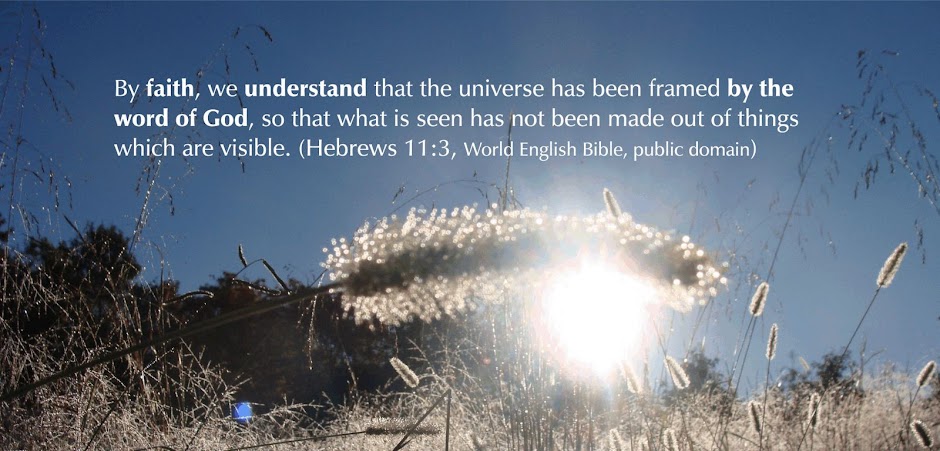
If you start by ruling out, say, that air has weight, you are not going to publish articles and books that claim that it does. If you start by believing that there are no supernatural realities, it is very unlikely that you are going to write and speak as if you do. (The converse is also true, of course.) Hebrews 11:3 tells us that we understand how things were made by faith. Genesis 1:1 doesn't tell us when, how, why, or where things started. But it does tell us that there was a Who who started them. I have a commitment to a philosophy of supernaturalism. I admit it. Does that make me a bad scientist, or mean that I really can't be a scientist? I don't think so. I don't think Lewontin's unshakable commitment to materialism makes him a bad scientist, either. But Lewontin, Dawkins, or Coyne are probably not very reliable guides through the difficult waters of the interface between science and religion. (As an aside, Dawkins has recently reviewed Coyne's latest book.)
Thanks for reading. I will probably summarize the criticism of Coyne by He Lives, and discuss the responses by Giberson and Miller, in a subsequent post.
The third post is here.
I have found two interesting reactions to that essay. I am sure that there are and will be more such. Edge published responses by several people, most agreeing with Coyne, but not all. The responders included Karl Giberson and Kenneth R. Miller, authors of the books that Coyne was reviewing in his essay. David Heddle, of He Lives, analyzed Coyne's claims logically. So has Siris.
In any serious argument, the first thing that ought to be done is to define terms. (It often isn't done, unfortunately, but it ought to be.)
Coyne deserves credit here. He has defined some of his terms. He defines theism thus: ". . . the concept of a transcendent and eternal god who nonetheless engages the world directly and pays special attention to the real object of divine creation, Homo sapiens." In so doing, he explicitly excludes some of the most "liberal" "Christian" theology as pantheism, not theism, or Christianity. I agree with Coyne -- A christian should believe the ideas he includes in that sentence.
Coyne also defines creationism, by saying that "all" creationists believe:
1) in God.
2) ". . . that God miraculously intervened in the development of life, either creating every species from scratch or intruding from time to time in an otherwise Darwinian process."
3) that humans did not evolve from apes, but were specially created.
4) ". . . they all adhere to a particular argument called "irreducible complexity." This is the idea that some species, or some features of some species, are too complex to have evolved in a Darwinian manner, and must therefore have been designed by God. Blood clotting in vertebrates, for example, is a complex sequence of enzyme reactions, involving twenty proteins that interact to produce the final clot." (This is a central belief of the Intelligent Design movement.)
Here, we begin to see some problems with Coyne's definition. Most obviously, Coyne is reviewing two books, one by Kenneth R. Miller, who is, according to Coyne, a creationist, and, hence, trying to do the impossible, namely combine science and belief in God. Coyne explains how Miller rejects item 4 in Coyne's own list of what makes one a creationist. He also says that Karl Giberson, who wrote the other book Coyne is reviewing, writes that ID is both bad science and bad theology. In the same essay where he writes that "all" creationists share four traits, he also writes:
In fact, they exhibit at least three of the four distinguishing traits of creationists: belief in God, the intervention of God in nature, and a special role for God in the evolution of humans. They may even show the fourth trait, a belief in irreducible complexity, by proposing that a soul could not have evolved, but was inserted by God.
So, Coyne's definition of a creationist does not hold up, as he has undercut it in his own essay. The authors he is reviewing don't necessarily accept irreducible complexity, one of his four criteria for characterizing creationists, but only "may" show it, and that only in their belief in the origin of the soul.
It is also true that some believers, including Billy Graham, are willing to at least entertain the possibility that what separated humans from pre-human ancestors was not the creation of human bodies and minds and souls, but the special creation of a soul within a pre-existing type of pre-human creature. So the third part of Coyne's definition may not hold up, either. There those, possibly including Giberson and Miller, who would say that God miraculously created the universe with laws and emergent properties that allowed living things to evolve, perhaps even allowed life to originate, without special miraculous activity during those events. Thus, point two is not necessarily true of all those Coyne says are creationists, either.
Even if Coyne hasn't defined creationist as carefully as he might have, or has lumped gap theorists with various kinds of theistic evolutionists, IDers, and young earth creationists, and others, it is possible that his main idea has merit. Is it possible for a scientist to be a believer, or the reverse? He doesn't think so:
It would appear, then, that one cannot be coherently religious and scientific at the same time. That alleged synthesis requires that with one part of your brain you accept only those things that are tested and supported by agreed-upon evidence, logic, and reason, while with the other part of your brain you accept things that are unsupportable or even falsified.
I have noticed a gap in Coyne's definitions. He hasn't defined science. The quote above comes as close to such a definition as he gets.
There's another idea in Coyne's essay that needs some discussion. He writes:
"In a common error, Giberson confuses the strategic materialism of science with an absolute commitment to a philosophy of materialism."
By this, he means that ruling out supernatural explanations works for science, but, he implies, this pragmatic methodology doesn't necessarily imply that there is no such thing as the supernatural. Maybe not. I suspect that Coyne, although he says that there could be evidence that would persuade him of the supernatural, would finally reject it. At least one prominent evolutionary biologist has explicitly said that he would do so:
Our willingness to accept scientific claims that are against common sense is the key to an understanding of the real struggle between science and the supernatural. We take the side of science in spite of the patent absurdity of some of its constructs, in spite of its failure to fulfill many of its extravagant promises of health and life, in spite of the tolerance of the scientific community for unsubstantiated just-so stories, because we have a prior commitment, a commitment to materialism. It is not that the methods and institutions of science somehow compel us to accept a material explanation of the phenomenal world, but, on the contrary, that we are forced by our a priori adherence to material causes to create an apparatus of investigation and a set of concepts that produce material explanations, no matter how counter-intuitive, no matter how mystifying to the uninitiated. Moreover, that materialism is absolute, for we cannot allow a Divine Foot in the door. The eminent Kant scholar Lewis Beck used to say that anyone who could believe in God could believe in anything. To appeal to an omnipotent deity is to allow that at any moment the regularities of nature may be ruptured, that miracles may happen. "Billions and Billions of Demons," By Richard C. Lewontin. New York Review of Books, January 9, 1997, vol 44, pp. 28+
Perhaps Coyne really doesn't have "an absolute commitment to a philosophy of materialism." I wonder. But Lewontin has, and I don't think he is alone. Richard Dawkins seems to have such a commitment, too. The link in the previous sentence is to the Wikipedia article on him, which says that he is an atheist, and a militant one. Antony Flew has accused him of such an absolute commitment.
If you start by ruling out, say, that air has weight, you are not going to publish articles and books that claim that it does. If you start by believing that there are no supernatural realities, it is very unlikely that you are going to write and speak as if you do. (The converse is also true, of course.) Hebrews 11:3 tells us that we understand how things were made by faith. Genesis 1:1 doesn't tell us when, how, why, or where things started. But it does tell us that there was a Who who started them. I have a commitment to a philosophy of supernaturalism. I admit it. Does that make me a bad scientist, or mean that I really can't be a scientist? I don't think so. I don't think Lewontin's unshakable commitment to materialism makes him a bad scientist, either. But Lewontin, Dawkins, or Coyne are probably not very reliable guides through the difficult waters of the interface between science and religion. (As an aside, Dawkins has recently reviewed Coyne's latest book.)
Thanks for reading. I will probably summarize the criticism of Coyne by He Lives, and discuss the responses by Giberson and Miller, in a subsequent post.
The third post is here.
Friday, February 20, 2009
Jerry Coyne's essay: Are science and religion really compatible?
I have tried to live my life in the belief that it is possible to be a committed scientist and a committed Christian. I won't elaborate on that much, but I hope that this blog has reflected that belief for the past four years plus. (See here, here, and here for posts setting forth some of my beliefs on the interaction between science and Christianity.)
Jerry Coyne, of the University of Chicago, and a prominent evolutionary biologist, has written an important and thought-provoking review of two recent books that have tried to do what I have described, that is, to reconcile science and Christianity, namely Saving Darwin: How to be a Christian and Believe in Evolution, by Karl Giberson and Only A Theory: Evolution and the Battle for America's Soul, by Kenneth R. Miller.
Coyne has a lot of interesting and important things to say in this essay. He classifies Intelligent Design as both unscientific and as a form of creationism. He criticizes liberal theology, which he calls barely distinguishable from pantheism, and seems to have at least some understanding of, shall we say, more conservative religious belief. He recognizes Giberson's and Miller's sincerity and integrity. He favors their criticism of Young-Earth Creationism. But, he concludes,
"Attempts to reconcile God and evolution keep rolling off the intellectual assembly line. It never stops, because the reconciliation never works." and:
"It would appear, then, that one cannot be coherently religious and scientific at the same time."
Ouch. If I were as eloquent as Coyne, I would respond here, giving reasons why he is wrong, at considerable length, and with great eloquence. I'm not so eloquent. I will just say that the Bible teaches that one of the ways in which God reveals Himself to us humans, besides the "more religious" ways, is through nature, which gives us at least a partly religious motive for studying nature. It is also true that many of the greatest scientists who ever lived were Christians, or adherents of some sort of belief in things that can't be studied by science. Johannes Kepler is an example of a great scientist of the past who was a Christian. Francis Collins is an example of an important scientist of today who is. Although he was not a believer in a personal God, no less than Einstein was a deist, or close to it. So I believe Coyne is wrong. There are, and have been, scientists who were religious, and reconciliation between science and religion is possible.
See here and here for two more of my previous posts on this subject.
God willing, I will be posting again about this essay by Coyne, and presenting some criticisms of it, including reactions by Giberson and Miller. These criticisms will attempt to prove that Coyne is wrong.
Thanks for reading.
The second and third parts of this series have now been posted.
Jerry Coyne, of the University of Chicago, and a prominent evolutionary biologist, has written an important and thought-provoking review of two recent books that have tried to do what I have described, that is, to reconcile science and Christianity, namely Saving Darwin: How to be a Christian and Believe in Evolution, by Karl Giberson and Only A Theory: Evolution and the Battle for America's Soul, by Kenneth R. Miller.
Coyne has a lot of interesting and important things to say in this essay. He classifies Intelligent Design as both unscientific and as a form of creationism. He criticizes liberal theology, which he calls barely distinguishable from pantheism, and seems to have at least some understanding of, shall we say, more conservative religious belief. He recognizes Giberson's and Miller's sincerity and integrity. He favors their criticism of Young-Earth Creationism. But, he concludes,
"Attempts to reconcile God and evolution keep rolling off the intellectual assembly line. It never stops, because the reconciliation never works." and:
"It would appear, then, that one cannot be coherently religious and scientific at the same time."
Ouch. If I were as eloquent as Coyne, I would respond here, giving reasons why he is wrong, at considerable length, and with great eloquence. I'm not so eloquent. I will just say that the Bible teaches that one of the ways in which God reveals Himself to us humans, besides the "more religious" ways, is through nature, which gives us at least a partly religious motive for studying nature. It is also true that many of the greatest scientists who ever lived were Christians, or adherents of some sort of belief in things that can't be studied by science. Johannes Kepler is an example of a great scientist of the past who was a Christian. Francis Collins is an example of an important scientist of today who is. Although he was not a believer in a personal God, no less than Einstein was a deist, or close to it. So I believe Coyne is wrong. There are, and have been, scientists who were religious, and reconciliation between science and religion is possible.
See here and here for two more of my previous posts on this subject.
God willing, I will be posting again about this essay by Coyne, and presenting some criticisms of it, including reactions by Giberson and Miller. These criticisms will attempt to prove that Coyne is wrong.
Thanks for reading.
The second and third parts of this series have now been posted.
Subscribe to:
Posts (Atom)
