License

I have written an e-book, Does the Bible Really Say That?, which is free to anyone. To download that book, in several formats, go here.
Creative Commons License
The posts in this blog are licensed under a Creative Commons Attribution-NonCommercial-ShareAlike 3.0 Unported License. You can copy and use this material, as long as you aren't making money from it. If you give me credit, thanks. If not, OK.
Showing posts with label insects. Show all posts

Wednesday, April 10, 2024

Sunspots 971

Things I have spotted that may be of interest to others. I try not to post anything that requires a

password, and/or money, to access. 

A PhysOrg writer discusses the two species of rats that live in the US.

Learn about the matador bug, which waves warning signs, which are part of the insect's back legs.

Newsweek (and other outlets) point out that Hawaii is not protected by NATO. (It's in the Pacific, not the Atlantic).

Bible scholar Ken Schenck gives us a one-post interpretation of Revelation.


PhysOrg also reports on how we are losing estuaries, which are important out of proportion to their sizes.

Monday, July 18, 2022

How many kinds of dragonflies are there?

 Antique Dragonfly - Openclipart

Graphic: Antique dragonfly, from openclipart 

My wife and I were out walking, when I saw a dragonfly. She remarked that this one was black and white, and innocently asked me what kind it was. (I hadn't a clue.) I innocently remarked that dragonflies are of many colors, and that there are hundreds of kinds of them, although most of these kinds don't live around where we do. Then she asked me, innocently, if God made each kind of dragonfly, or if they descended and diverged from other kinds. She also asked, innocently, if there wouldn't be a web page, or something, which told us which of these types of events happened.

Well, yes and no. There are some web pages, and/or books, which claim that each kind of organism was made by a separate miracle. For example, see this page, which doesn't specifically say that each creature was created by a distinct miracle, but says that the six days of Genesis 1 were literal 24-hour days, so it would have been impossible for some kind of evolutionary process to produce all the species of dragonflies. (Genesis 1 does not specifically mention flying insects, let alone dragonflies.)

There are also many books and web pages which claim that animals developed into many species, over long periods of time, by completely natural processes -- there is no God, and never was. Here is the Wikipedia web page on an introduction to evolution.

Though you probably don't hear much from them, there are other sources that believe in a Creator. Some of these believe that the days of Genesis 1 were very long periods of time, thus allowing for evolution of dragonflies from a common ancestor. Others who believe in a creator believe that Genesis 1 was never meant to teach science, and that it is a mistake to do so. Genesis 1-2, they say, were meant to teach important truths, such as that there is only one God, not many, like the peoples living around the Israelites believed. And God is sovereign. Further, humans are more like God than any other animal, and have some responsibility to care for God's creation. Genesis 1 and 2 were not, in their view, to be taken literally. This last group holds that God's marvelous original creation included built-in laws, processes and properties of atoms and molecules, and rocks and clouds, that led, over a very long time, to the world we have today.   

To answer my wife's question, there are about 3000 species of dragonflies living on earth today. There were fossil dragonflies, too. Some dragonfly-like insects had wingspans as long as your arm, or even longer. Just don't ask me to identify them.

Appendix See these posts: "Should Genesis 1-2 be taken literally?"

"Young-earth creationism and the kinds of animals"

"Is Genesis 1-11 history, or myth? Comparing the sequence of events in Genesis 1 and Genesis 2"


Thursday, June 03, 2021

Cicadas and God


Brood X, also known as the Great Eastern Brood, of cicadas has emerged from the ground, in vast numbers, in at least the following parts of North America: Delaware, Indiana, Maryland, Pennsylvania, Virginia, the District of Columbia, and other places. See the Wikipedia article on this brood, and a fine article on CBS News. This blog post indicates that the Greek poet, Homer, mentioned them (and indicates that they are found outside of North America.)

There are several species of cicada. In fact, the Great Eastern Brood includes three species.

Cicadas and God?

I'd like to muse briefly about a couple of questions:

Why do cicadas emerge from the ground and become adults, every seventeen years? (Some types emerge every 13 years.)

Why are there so many of these insects?

Why 17 years? 

The correct answer is that we don't know. There are various speculations about the emergence cycle, but we don't. Nor, so far as I'm aware, do we know what timing mechanism triggers emergence and adulthood. I would guess that the insects could be ready for emergence and sexual maturity in a shorter time than 17 years. (Actually, one source says that parts of Brood X emerged 4 years early, in 2017.)

If small numbers of the insects emerged in, say, 15 or 19 years, it would be more difficult for them to find mates, hence there would be expected to be selection pressure on emerging with the vast majority. Some scientists believe that the long time underground means that the insects are protected from unusually cold outdoor temperatures. Perhaps.

Why so many? 

This source indicates that Brood IX, which became adults in 2020, had a population density of 1.5 million adults per acre.

Again, we don't know for sure why there are so many cicadas. Probably the large numbers mean that predators can't catch and eat them all, especially if the predators can't "count on" that same food source every year. So many of the insects escape, and are able to reproduce.

Psalm 104 says "24 Yahweh, how many are your works! In wisdom, you have made them all. The earth is full of your riches. 25 There is the sea, great and wide, in which are innumerable living things, both small and large animals." (World English Bible, public domain) The Psalmist doesn't mention cicadas, or even locusts, which occur in areas near Israel, in vast numbers. But the "full of your riches" and "innumerable living things" could refer to cicadas. Their presence, loud as they are, is one indication that God is bountiful, one of many. Like the stars above, the vast numbers of insects on the surface indicate God's majesty and power.

Cicadas are not dangerous. They do attack young twigs of certain trees -- that's where the females lay their eggs, which develop into nymphs, or larvae, which fall to the ground, where the animals spend their 17 years of larvahood. But they don't bite humans, or carry diseases.

The noise made by males, as part of courtship, is almost overpowering. There are a lot of cicadas, and each male makes a good bit of noise. Currently, it's impossible to go outside in Maryland, whre I live, without hearing that loud hum constantly. They can also be heard inside our dwelling, even with all the windows shut.

Thanks for reading.

Added, June 7, 2021: Thanks to a reader for this link, which is from The Washingtonian, and says that there are so many cicadas in the DC area that they are showing up on weather radar.
Wednesday, January 09, 2019

Sunspots 710


Things I have recently spotted that may be of interest to someone else:


Christianity: (and Sports) Relevant reports that a Chicago Bears kicker did not make a field goal that would have won the game, but thanked God, anyway.

Education: NPR reports on poor reading scores, which are widespread, and a fundamental reason for them -- educators aren't using scientific findings on learning to read. In some places, this is being remedied.

Food: (and Health) Gizmodo reports that millions of Americans think they have a food allergy, but don't.

Health: NPR reports that increases in drug prices are primarily due to drug company attempts to make more money, rather than research costs.

Humor: (or Food) A sculpture, constructed of a half ton* of butter, has been produced in Pennsylvania, according to NPR.

Politics: NPR reports that the acting Secretary of the Interior may be worse than his predecessor at protecting the environment.

(or possibly, humor) A few days ago, President Trump said that he knew more about drones than anyone. The Washington Post has compiled a list of things the President claims to know more about than anyone else. The list also includes people (not him) that Mr. Trump says are the world expert on various topics.

It's almost that time again, I'm afraid. But FiveThirtyEight analyzes Presidential primary debates, and finds that they are important.

Science: Gizmodo tells us (with pictures) that some hummingbird species have beaks specialized for aggression toward rivals.

(and food) NPR reports on granary weevils, insects that have been eating our stored grain throughout human history.

Scientific American on how the part of the border wall already built is damaging habitat and migration routes for animals, and how adding to the wall will make things worse.


The graphic used in these posts is from NASA, hence, I believe, it is public domain. 

Thanks for looking!

*When this was posted, I had carelessly said a half-pound of butter, not a half ton. I thank one of my brothers for bringing this error to my attention.

Wednesday, May 10, 2017

Sunspots 625

Things I have recently spotted that may be of interest to someone else:


Christianity: An article on the National Association of Evangelical's web site, indicating that almost 90% of "evangelical leaders" don't believe that pastors should endorse politicians from the pulpit. This survey was taken before President Trump's executive order of last week on (more or less) this subject. Christianity Today discusses the executive order, and says, among other things, that only a small minority of churchgoers believe that pastors should endorse politicians from the pulpit.


Computing: (or something) Elon Musk wants to attach our brains to the internet. We're a long way from being able to do this, but, if we could, there are all kinds of issues. "Could I be hacked?," for example.

Benjamin L. Corey asks "How many people in your local community does your church provide comprehensive medical care for?"

Finance: Listverse reports on the hidden costs of shopping at dollar stores.

Humor: (Not exactly) Listverse describes how people survived 10 different bear attacks. (In most or all cases, the bear was surprised. Normally, they don't go around looking for people to attack.)

(Also not exactly) Scientific American reports that all the TVs in the US Food and Drug Administration have been set to show only the Fox News channel.


Politics: NPR reports that President Trump doesn't like compromising, and claims that he hasn't done so.

NPR also informs us that, as of May 6, there are 129 people officially in the race for President of the USA in 2020. Plus some more who may end up running.

Science: Scientific American reports that, contrary to dogma, nerve cells in a single organism do not have identical DNA.

FiveThirtyEight reports on how many insects there are in the world. The answer? A lot, but not as many as there used to be.

Scientific American has a historical essay on our obsession with lawns.

Listverse reports on 10 strange objects in space, including an asteroid, planets, and galaxies.

Sports: (and finance) National Public Radio reports on the shockingly low pay of minor league baseball players.


Image source (public domain)

Wednesday, March 30, 2016

Sunspots 567

Things I have recently spotted that may be of interest to someone else:


Christianity: BioLogos reports that almost 100% of scientists believe that humans evolved over time. However, about 50% of white self-reported evangelical Christians who say that they attend church regularly believe that scientists are deeply divided over that question, when they clearly are not so divided.

Computing: From National Public Radio: a wide-ranging interview on cyber-privacy and the government's right to know. It includes a discussion about President Reagan seeing a scary movie.

Politics: (sort of) The New York Times discusses the effects of growing up in a bad neighborhood, and of leaving such a place fairly early in life.

Science: NPR on the unfortunate confusion about the word, theory, in science and elsewhere.

NPR also reports on what non-human primates are thinking.

NPR also reports on a new sort of artificial organism, manufactured from a previous one in nature, by removing genes, one by one, to get to those genes that the organism absolutely has to have, in order to grow and reproduce. We don't know what several dozen of those necessary genes do.

Listverse reports on 10 interesting strategies in the "war" between plants and bugs.

Sports: FiveThirtyEight backs up my guess that Breanna Stewart may be the best player ever, in women's college basketball, with statistics. (She's had lots of help, from Moriah Jefferson, Morgan Tuck and others.)

Image source (public domain)

Wednesday, September 16, 2015

Sunspots 538

Things I have recently spotted that may be of interest to someone else:


Computing: Jotti is an on-line site that lets you submit a possibly dangerous file for checking. The site checks with several malware detection processes, and gives you a report.

Education: Wired asks if speed reading is really possible.

Difference Between is a web site that posts -- what else -- the difference between lots of things, such as Greek and regular yogurt, Oxycodone and Oxycontin, after and afterward and a lot more. Searchable.

Politics: National Public Radio discusses why Donald Trump appeals to some on the religious right, even though he doesn't have evangelical Christian credentials.

Science: Christianity Today (!) has a splendid display of photos of plankton, near-microscopic organisms that are suspended in the ocean in vast numbers, and in a great variety of species.

Wired tells us that scientists are learning a lot about individual brain cells by making them light-sensitive. Really.

Wired also reports on cochineal, a substance derived from scale insects, which is an important food coloring.

And Wired reports on the largest insects in the world. They live in New Zealand.


Image source (public domain)

Wednesday, June 17, 2015

Sunspots 526

Things I have recently spotted that may be of interest to someone else:

The Arts: The History Blog tells us about the return of the best-known (and almost the only) picture of J. S. Bach to Leipzig

 
Christianity: An article on the errors the so-called Prosperity Gospel makes in interpreting the Bible.


Benjamin L. Corey thinks that John Calvin either didn't understand Christ's teaching, or deliberately disobeyed it, and explains his thinking.


Health: (or something) As of June 11, 2015, Amazon was offering a free book, in Kindle format (the price may go back up in the future) entitled How to Survive by Eating Insects and Learning Entomophagy [eating insects]. I didn't download it, but it caught my attention.


Science: Wired points out that the wings of the dinosaurs in Jurassic World aren't large enough.


The courtship display of a peacock spider, in a 3 minute 2 second video.


Wired also has an essay about dinosaurs in general. If we did produce one now, would it be like the extinct ones? How would we know? and other interesting questions.

Image source (public domain)

Wednesday, February 04, 2015

Sunspots 507

Things I have recently spotted that may be of interest to someone else:
Christianity: Vincent van Gogh was, apparently, a devout Christian. (Thanks to a commenter for the link!)


Ken Schenck says that it's more important for the Bible to form us than to inform us.

 
Computing: Gizmo's Freeware recommends Cookie Spy, a free program that helps you look at your stored cookies, and delete them, if you want to.


Humor: (Not really, but I don't have a category for this) National Public Radio reports on something many of us know -- meetings at work are often a wasted of time, and, therefore, money.


Politics: Columnist George F. Will says that the welfare state is growing too fast, and too large.


Science: Wired reports on a really weird insect parasite. Really weird, and creepy.


Wired also tells us why wet dogs smell so badly.


Wired also tells us why the recent blizzards were worse, because of global warming.


And Wired reports on the smallest snake there is. It can curl up on a quarter.


Image source (public domain)

Wednesday, December 17, 2014

Sunspots 500

Things I have recently spotted that may be of interest to someone else:
Christianity: A video rendering of John Michael Talbot's "Holy is His Name," which is a modernization of the Magnificat, from Luke 1, sung by a young lady. The lyrics are here.

Relevant names seven prominent Christians who have struggled with doubt. You probably have, too.
Computing: Gizmo's Freeware points us to an on-line Color Scheme Generator. It looks like a fine tool.
Wired points out that "many devices are all but impossible to recycle efficiently." The article points out why this is true, and notes some manufacturers that are making recycling easier.
Science: (And photography) A collection of amazing close-ups of insects and their relatives, collected (but not photographed) by me. To see the individual photos, which, sometimes, have a description of what you are seeing, right-click on the photo and open it in a new tab.
Image source (public domain)

Wednesday, September 18, 2013

Sunspots 436

Things I have recently spotted that may be of interest to someone else:
Computing: Time, National Public Radio, and many other news outlets report on Internet neutrality. Can, say, Charter, make, say, Netflix download more slowly, because they want to promote their own competing service? There's a court case.
Education: The Atlantic tells us why we should ignore the U. S. News & World Report annual college rankings.
Health: Fecal transplants are becoming an accepted treatment for some intestinal problems, says the Voice of America. Yes, inserting someone else's poop into your gut.
Politics: It's true -- the wealthiest are getting wealthier, and the rest of us are not, reports NPR. That's the wealthiest, as a group.
Science: Some great stuff this week. Wired has an article, with photos, about zombie ants, ants which are infected by fungi, which enter their brains and then alter the behavior of the ants.
National Public Radio tells us about insects that have gears that mesh -- see the photos and videos, if you don't believe this.

NPR has an article on how gelada baboons are closer to using speech than other primates. There's a "Listen to the Story" link, which you should use, on this page.


Image source (public domain)

Wednesday, June 19, 2013

Sunspots 423

Things I have recently spotted that may be of interest to someone else:

The Arts: I've missed Garrison Keillor on "The Writer's Almanac." He's on summer hiatus. The replacement is OK, but, for one thing, doesn't do Keillor's great sign-off, which is "Be well, do good work, and keep in touch," with a Keillor-esque pause or two.

Health: (or politics, or science) The opinion of the US Supreme Court in the gene patenting case, delivered, for a unanimous court (!) by Justice Clarence Thomas.

Politics: Many Americans are more loyal to their party than to their church, or their religion, according to NPR.

Science: NPR tells us, with photos, and a video, about some enormous walking stick insects, which were thought to have become extinct, but aren't. Their re-discovery is an amazing story.

I just read about the idea of Pleistocene rewilding. If carried out, species similar to those who have gone extinct in Asia, Europe, and the Americas would be introduced. For example, cheetahs would be introduced to the plains of North America. Some such introductions have already taken place, but only on a small scale.


Image source (public domain)

Wednesday, January 02, 2013

Sunspots 399

Yes, you read that title correctly. I have been posting these for nearly 399 consecutive weeks. Thanks to God for the opportunity.

Things I have recently spotted that may be of interest to someone else:

Science: Comet Ison is supposed to be visible late in 2013.

An amazing photo, with accompanying shots, and description, of the turbinate eyes of a male mayfly.

The Arts: (also science, politics, and probably philosophy) A web site that lists, rates, and categorizes free documentary films.

Here's information on the White Council, consisting of Gandalf, Saruman, Galadriel, Elrond, and others (although only those four seem to be shown in The Hobbit: An Unexpected Journey.)

Christianity:  He Lives on faith. Says the writer, "I'm convinced there is no adequate word in English." (To describe Abraham's faith/trust/something.)

Image source (public domain)

Friday, March 09, 2012

The Lord Howe Island stick insect -- big and amazing

I recently heard about the Lord Howe Island stick insect, Dryococelus australis. It's big, and amazing. It also almost became extinct. Here's an article, with photos, and a video. There's also a Wikipedia article on the animal. Enjoy (or not!)

Thanks for looking at this.

Wednesday, March 10, 2010

Sunspots 251

Things I have recently spotted that may be of interest to someone else:


Science:
NPR reports that mosquitos fatten up for the winter. Who knew?

Sports:
The Sporting News reports that a substitute really did come in and play like a superstar, as Louisville beat Syracuse, with Kyle Kuric scoring 22 points in the second half against the number 1 team in men's college basketball.

Politics:
The Toronto Globe and Mail reports that Sarah Palin's family used to use the Canadian healthcare system.


Image source (public domain)

Thursday, February 14, 2008

This isn't love. . .

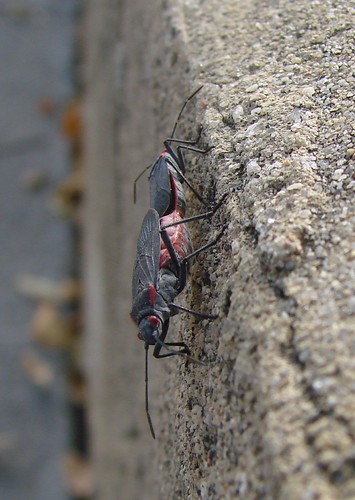
This isn't love. Jadera haematoloma couple, on wall

I took this photo of two Jadera haematoloma bugs, which my source tells me are also known as red-shouldered bugs, yesterday. They apparently spend most of their time locked in coitus, attached to each other. For more information on these insects, see here and here. The second source indicates that they are confined to Florida. Well, maybe. Whatever these insects really are, and they look like the photos in the pages I linked to, they seem to be flourishing in San Diego County, California.

Whatever they are doing, it isn't love. It doesn't match any of the four types of love discussed by C. S. Lewis in his The Four Loves.

For the first time in my blogging history, I have included a short video, which is also of these insects.


Happy Valentine's Day to all, especially my dear wife.

Friday, January 05, 2007

The Fall and the immune system (repost)

Mike Russell, of the Eternal Perspectives blog, does some serious writing. His recent post, "Where'd that come from?" asks about the source of the human immune system. I'd like to comment on his question here. (A previous comment by me corrected his use of "auto-immune system." He meant to say "immune system." I wrote the comment more sharply than I should have, and I apologize. Sorry. As another commenter indicated, either way, it's a good question.)

Russell assumes that the first humans wouldn't have needed an immune system until after the Fall. His question is whether it was original equipment, unused until after the Fall, or added after the Fall. The obvious answer, of course, is that we don't know. Not knowing doesn't stop me from musing.
Some believers think that Adam and Eve somehow evolved from previous human-like beings, under God's direction. If so, they would have already had an immune system. Russell doesn't believe this. I'm going to respond to his question, assuming that Adam, and then Eve, were specially created in an uncorrupted state. I don't have a definite answer.

We can't be sure when mosquitoes and germs were created. Genesis 1:20 says that God created water organisms and winged birds on the fifth day, and living creatures on land on the sixth. Are mosquitoes and bacteria water or land creatures? There is nothing that clearly indicates when either was created in Genesis 1. Most insects are land organisms, but mosquitoes spend part of their lives in the water, part on land. (Moses would not have been expected to write about bacteria, because his readers wouldn't have known what he was talking about, nor would he. God knew.) If they were created, along with other creatures, during the period described by Genesis 1, were mosquitoes biting pests before the Fall? Did bacteria cause disease before the Fall? It is possible that both were created after the Fall, although the Bible says nothing about this.
After the list of entities appearing on each day is given, Genesis 1 adds the phrase, ". . . and God saw that it was good." (KJV)

Did humans need bacteria and insects before the Fall? We can't be sure. Very possibly, bees, which pollinate flowers, would have been needed. If non-fallen humans defecated, dung beetles, maggots, and bacterial decomposers would have been useful even before the Fall. Beneficial bacteria now live in our large intestine. Perhaps they did then. Leaves may have fallen, and fruit fallen off of trees, before the Fall. Decomposers, bacteria and fungi, would have been a good thing, in that case. Alcohol production requires yeast organisms. If unfallen humans drunk alcoholic beverages, yeast organisms would have been good to have.

If pest insects, bacteria, and viruses were created before the Fall, they must have been "good." We don't usually consider them good now. Romans 8:21 says that creation will be liberated from decay, or corruption. I suppose that most Christians consider disease germs, pest insects, and weeds to be part of the corruption of the present fallen world. If the creation was free of corruption at its creation, which is implied by Genesis 1's use of "it was good," then it must have changed. The most likely time for it to have changed is the Fall. I am not aware of any explicit Biblical evidence for this, but will assume it. If new germs and insects, preying on people, were created as a result of the Fall, or if pre-existing organisms were modified at that time so as to do so, and humans didn't have an immune system yet, humans must have been modified to cope with some of the new pests at the same time, by giving them an immune system.

It is possible that humans needed an immune system from the beginning, to ward off accidental invasions of decomposing bacteria. Would accidents, of any kind, especially this kind, have been possible in an unfallen world?

It is possible that humans first appeared with the ability to fight off disease germs, at a time when they didn't need it. I believe that God created some entities with properties that are of benefit to us, or to the rest of His creation, and it took us a long time to find it out, so that the benefits weren't used for a long time. For example, quinine and rubber producing plants were presumably present from before the time when humans appeared. It is doubtful if their uses in fighting malaria, or in making tires, were known to many people until within the past 500 years or less. Their uses probably weren't known to anybody in the Old World until 1400 or so. God may have deliberately pre-configured them to be helpful, and we discovered this much later. The same sort of speculation could be made about some of the chemical elements, and about other things. If that is true, why couldn't God have pre-configured humans with an immune system, before they needed it?

A little on how the immune system operates. It has the built-in capability to develop a response to almost any foreign invader. It doesn't have such responses, but the capability to develop them. That's why flu shots are given, so that recipients will develop a response from the exposure to a non-virulent invader, so that when the real thing comes along, they will already be immune to it. (They are given every year because there are new types of flu every year.) I am suggesting that, just as we have the capacity to develop immunity to invaders we haven't experienced yet, built in from our personal beginnings, it seems possible that Adam and Eve were created with an immune system, which didn't become useful or necessary until after the Fall.

Allergies to certain substances that we'd be better off not reacting to are due to the immune system. The immune system makes some pregnant women develop antibodies against their own babies. The immune system makes auto-immunity possible. Some diseases, such as lupus and rheumatoid arthritis, are developed because a person's immune system reacts against her own body, not against a foreign invader. The immune system, which is so important in fighting off invaders, and in policing the body for cancer cells, acts, in the cases mentioned, as if it may have fallen. It's doing things that harm us.

It seems to me that either an immune system existing before it was needed, or one created right after the Fall, are possible. I haven't answered Russell's question. However, I hope that these speculations help him, or someone else.

Taken from a post of February 26, 2005.