License

I have written an e-book, Does the Bible Really Say That?, which is free to anyone. To download that book, in several formats, go here.
Creative Commons License
The posts in this blog are licensed under a Creative Commons Attribution-NonCommercial-ShareAlike 3.0 Unported License. You can copy and use this material, as long as you aren't making money from it. If you give me credit, thanks. If not, OK.

Monday, December 04, 2017

The magnificence of Christ, creator and sustainer

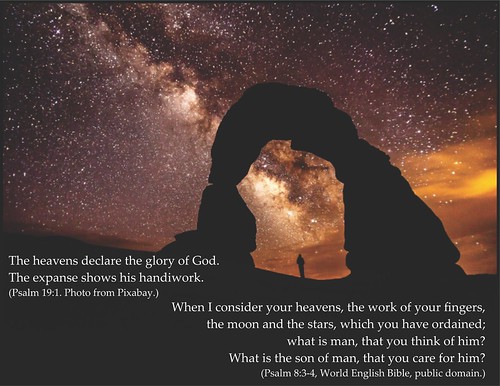
God revealed through the Milky Way


God the Son was important in the creation, and in sustaining that which He created!

John 1:1 In the beginning was the Word, and the Word was with God, and the Word was God. 2 The same was in the beginning with God. 3 All things were made through him. Without him, nothing was made that has been made. 10 He was in the world, and the world was made through him, and the world didn’t recognize him. 12a But as many as received him, to them he gave the right to become God’s children . . .

Colossians 1:14 in whom we have our redemption, the forgiveness of our sins. 15 He is the image of the invisible God, the firstborn of all creation. 16 For by him all things were created in the heavens and on the earth, visible things and invisible things, whether thrones or dominions or principalities or powers. All things have been created through him and for him. 17 He is before all things, and in him all things are held together.

Hebrews 1:3 His Son is the radiance of his glory, the very image of his substance, and upholding all things by the word of his power, who, when he had by himself purified us of our sins, sat down on the right hand of the Majesty on high ...

(Although the passages above indicate that God the Son was the most important agent in the creation, there are scriptural indications that God the Father and God the Holy Spirit were also involved.)

Perhaps you and I don't fully appreciate the magnificence of creation, and, therefore, we may not fully appreciate the magnificence of Christ.

Creation shows that God the son loves diversity. There are about 400,000 species of beetles, and probably at least a million yet to be discovered. (Psalm 104:24 Yahweh, how many are your works! In wisdom, you have made them all. The earth is full of your riches. 25 There is the sea, great and wide, in which are innumerable living things, both small and large animals.)

Creation is unimaginably large. “Recent estimates of the number of galaxies in the observable universe range from 200 billion [(2×10 to the 11th power) to 2 trillion (2×10 to the 12th power)] or more, … containing more stars than all the grains of sand on planet Earth.” (Wikipedia) And that’s only the observable universe.

Creation shows the power of God the Son. Most of the energy on earth comes from the sun. In the sun, Hydrogen nuclei bombard each other at several million degrees, and turn into Helium nuclei, releasing energy by e =m c-squared. The sun is about 93 million miles away. Since it is emitted in all directions, the vast majority of the sun’s emitted energy goes off into space, never hitting the earth, or any other body in the Solar System. But it’s warm enough for life on earth, and light enough for photosynthesis, just from the tiny fraction of the sun’s emitted energy that strikes it. We can scarcely imagine the power of the sun, and it’s a fairly small star.

Creation shows that God the Son likes beauty. He didn’t have to make the universe so that rainbows, or fall foliage, or butterflies, or eclipses, exist. But He did. Using scientific tools, such as microscopes and telescopes, we have found that there is amazing beauty, even in things we can’t get to, or can’t see with the naked eye.


The Creation is sustained by God the Son. How? By laws, like gravity, and created properties, such as that water can exist in three different forms at reasonably normal temperatures. The laws of gravity ensure, for example, that the planets continue to orbit the sun. The properties of water make rain possible, among many other things. God also sustains by processes, like erosion, plate tectonics, and natural selection. We can’t be sure if God is intimately involved in making every raindrop, or lets nature take its course to make each one, but He could make each and every one carefully and magnificently. 

God the Son can, and, at least sometimes, does, change the “normal” course of nature. We call that a miracle.


God, the Son’s, creation is beyond our imagination! He created time and space! God created matter and energy! God created the four fundamental forces, (also called the four interactions) – gravity, the electromagnetic force, the strong force and the weak force. God created the entire electromagnetic spectrum: light, radio waves, wi-fi, microwaves, X-rays, and more. God created the universe with appropriate physical properties for the existence of life

We should not forget that, even though He was largely responsible for the creation of the entire universe, He came to earth. Not as a baby, but as an embryo, a being with just a few cells, and hardly any connection to the world outside his mother’s womb. Then, of course, He became a fetus, and, after about nine months, a baby. Still helpless, dependent, and, presumably, severely limited in His ability to communicate.

And we should not forget what St. Paul said about the Creator and Sustainer of the universe:
5 Have this in your mind, which was also in Christ Jesus, 6 who, existing in the form of God, didn’t consider equality with God a thing to be grasped, 7 but emptied himself, taking the form of a servant, being made in the likeness of men. 8 And being found in human form, he humbled himself, becoming obedient to the point of death, yes, the death of the cross. 9 Therefore God also highly exalted him, and gave to him the name which is above every name, 10 that at the name of Jesus every knee should bow, of those in heaven, those on earth, and those under the earth, 11 and that every tongue should confess that Jesus Christ is Lord, to the glory of God the Father. (From Philippians 2)

Thanks for reading! To God be the glory!

Sunday, December 03, 2017

The Art of Divine Contentment: An Exposition of Philippians 4:11 by Thomas Watson. Excerpt 5

2. You have heard much of Christ: have you learned Christ? The Jews, as Jerome saith, carried Christ in their Bibles, but not in their heart; their sound “went into all the earth”; (Ro. 10.18) the prophets and apostles were as trumpets, whose sound went abroad into the world: yet many thousands who heard the noise of these trumpets, had not learned Christ, “they have not all obeyed.” (Ro. 10.16) 
(1.) A man may know much of Christ, and yet not learn Christ: the devils knew Christ. (Mat. 1.24) (2.) A man may preach Christ, and yet not learn Christ, as Judas and the pseudo-apostles. (Ph. 5.15) (3.) A man may profess Christ, and yet not learn Christ: there are many professors in the world that Christ will profess against. (Mat. 7. 22, 23)

Q. What it is then to learn Christ?
1. To learn Christ is to be made like Christ, to have the divine characters of his holiness engraven upon our hearts: “we all with open face, beholding as in a glass the glory of the Lord, are changed into the same image.” (2 Cor. 3.18) There is a metamorphosis made; a sinner, viewing Christ’s image in the glass of the gospel, is transformed into that image. Never did any man look upon Christ with a spiritual eye, but he went away quite changed. A true saint is a divine landscape picture, where all the rare beauties of Christ are lively portrayed and drawn forth; he hath the same spirit, the same judgment, the same will, with Jesus Christ.

2. To learn Christ, is to believe in him; “my Lord, and my God,” (John 20.28) when we do not only believe God, but in God, which is the actual application of Christ to ourselves, and as it were the spreading of the sacred medicine of his blood upon our souls. You have heard much of Christ, and yet cannot with an humble adherence say, “my Jesus;” be not offended if I tell you, the devil can say his creed as well as you.


3. To learn Christ, is to love Christ. When we have Bible-conversations, our lives like rich diamonds cast a sparkling lustre in the church of God, and are, in some sense, parallel with the life of Christ, as the transcript with the original. So much for the first notion of the word.


Thomas Watson lived from 1620-1686, in England. He wrote several books which survive. This blog, God willing, will post excerpts from his The Art of Divine Contentment: An Exposition of Philippians 4:11, over a number of weeks, on Sundays. My source for the text is here, and I thank the Christian Classics Ethereal Library for making this text (and many others) available. The previous excerpt is here.

Wednesday, November 29, 2017

Sunspots 654


Things I have recently spotted that may be of interest to someone else:


The Arts: Listverse on 10 really unique church buildings.


Computing: Relevant gives us 5 questions we should ask ourselves before posting to social media.

Education: Grammarphobia on when to use commas with lists of things, and when not to.

Finance: (sort of) Wired on the importance of efficient use of curb space, in and by cities.

Food: (sort of) National Public Radio reports that today's dishwashing appliances are much more efficient, in water use, than such devices used to be.

Health: Scientific American on the dangers of marijuana use by teens.

Humor: (or Finance) Listverse reports on some truly strange lawsuits.


Politics: National Public Radio reports on a poll of 38 economists, who agree unanimously that the Republican tax plan will cause the US debt to rise, and that it will not lead to increased economic growth.

Science: National Public Radio reports on studies that pinpoint which ice areas, melting, will affect which cities, causing sea levels to rise. The results are not what we might have thought.

Listverse shows us videos of 10 shape-shifting organisms.

Thanks for looking!

Image source (public domain)

Sunday, November 26, 2017

The Art of Divine Contentment: An Exposition of Philippians 4:11 by Thomas Watson. Excerpt 4

Let me put you upon a serious trial. Some of you have heard much, — you have lived forty, fifty, sixty years under the blessed trumpet of the gospel, — what have you learned?

You may have heard a thousand sermons, and yet not learned one. Search your consciences.
1. You have heard much against sin: are you hearers; or are you scholars? How many sermons have you heard against covetousness, that it is the root, on which pride, idolatry, treason do grow? One calls it a metropolitan sin; it is a complex evil, it doth twist a great many sins in with it. There is hardly any sin, but covetousness is a main ingredient of it; and yet are you like the two daughters of the horse-leech, that cry, “give! give!” How much have you heard against rash anger, that is a short frenzy, a dry drunkenness; that it rests in the bosom of fools; and upon the least occasion do your spirits begin to take fire? How much have you heard against swearing: It is Christ’s express mandate, “swear not at all.” (Mat. 5. 34) This sin of all others may be termed the unfruitful work of darkness. It is neither sweetened with pleasure, nor enriched with profit, the usual vermillion wherewith Satan doth paint sin.


Swearing is forbidden with a subpaena. While the swearer shoots his oaths, like flying arrows at God to pierce his glory, God shoots “a flying roll” of curses against him. And do you make your tongue a racket by which you toss oaths as tennisballs? do you sport yourselves with oaths, as the Philistines did with Samson, which will at last pull the house about your ears?


Alas! how have they learned what sin is, that have not learned to leave sin! Doth he know what a viper is, that will play with it?


Thomas Watson lived from 1620-1686, in England. He wrote several books which survive. This blog, God willing, will post excerpts from his The Art of Divine Contentment: An Exposition of Philippians 4:11, over a number of weeks, on Sundays. My source for the text is here, and I thank the Christian Classics Ethereal Library for making this text (and many others) available. The previous excerpt is here.

Thursday, November 23, 2017

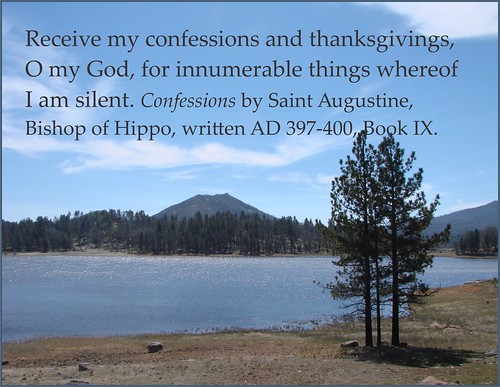
Gratitude, from St. Augustine

Gratitude, 15 centuries or so ago, and still pertinent. 

Thanks for looking!

Wednesday, November 22, 2017

Sunspots 653

Things I have recently spotted that may be of interest to someone else:


Computing: Wired reports that there is now a church, sort of, which more or less worships artificial intelligence. The IRS has granted this "church" tax-exempt status.

Health: Time, and other outlets, report that the Centers for Disease Control say that about 90% of Americans don't eat enough fruit and vegetables. Not a surprise.

Politics: Relevant reports that a game manufacturer is trying to block President Trump's wall by acquiring property on the border.

National Public Radio, and other sources, report that the Keystone Pipeline recently spilled 5,000 barrels of oil. Hardly a surprise, unfortunately.

Wired has compiled an annotated list of things Attorney General Jeff Sessions told Congress that he can't remember.

Science: Listverse describes 10 islands, and their unusual animal populations.

Scientific American reports on a body from outside our solar system that is on its way out of it.

The He Lives blog argues that the Intelligent Design movement isn't about science, although it's usually presented that way.

An illustrated and annotated periodic table.

Thanks for looking!

Sunday, November 19, 2017

The Art of Divine Contentment: An Exposition of Philippians 4:11 by Thomas Watson. Excerpt 3

CHAPTER II
The First Branch of the Text, the Scholar, with the First Proposition.


I begin with the first: The scholar, and his proficiency; “I have learned.” Out of which I shall by the bye, observe two things by way of paraphrase. 1. The apostle doth not say, I have heard, that in every estate I should be content: but, I have learned. Whence our first doctrine, that it is not enough for Christians to hear their duty, but they must learn their duty. It is one thing to hear and another thing to learn; as it is one thing to eat and another thing to concoct. St Paul was a practitioner. Christians hear much, but it is to be feared, learn little.


There were four sorts of grounds in the parable, (Lu. 8. 5) and but one good ground: an emblem of this truth, many hearers, but few learners.


There are two things which keep us from learning. 1. Slighting what we hear. Christ is the pearl of price; when we disesteem this pearl, we shall never learn either its value, or its virtue. The gospel is a rare mystery; in one place, (Ac. 20. 24) it is called “the gospel of grace;” in another, (1 Cor. 4. 4) “the gospel of glory;” because in it, as in a transparent glass, the glory of God is resplendent. But he that hath learned to contemn this mystery, will hardly ever learn to obey it; he that looks upon the things of heaven as things by the bye, and perhaps the driving of a trade, or carrying on some politic design to be of greater importance, this man is in the high road to damnation, and will hardly ever learn the things of his peace.


Who will learn that which he thinks is scarce worth learning?

2. Forgetting what we hear. If a scholar have his rules laid before him, and he forgets them as fast as he reads them, he will never learn. (Ja. 1. 25) Aristotle calls the memory the scribe of the soul; and Bernard calls it the stomach of the soul, because it hath a retentive faculty, and turns heavenly food into blood and spirits; we have great memories in other things, we remember that which is vain. Cyrus could remember the name of every soldier in his huge army. We remember injuries: this is to fill a precious cabinet with dung; but as Hierom saith, how soon do we forget the sacred truths of God? We are apt to forget three things: our faults, our friends, our instructions. Many Christians are like sieves; put a sieve into the water, and it is full; but take it forth of the water, and all runs out: so, while they are hearing a sermon, they remember something: but like the sieve out of the water, as soon as they are gone out of the church, all is forgotten. “Let these sayings, (saith Christ) sink down into your ears;” (Lu. 9. 44) in the original it is, “put these sayings into your ears,” as a man that would hide the jewel from being stolen, locks it up safe in his chest. Let them sink: the word must not fall only as dew that wets the leaf, but as rain which soaks to the root of the tree, and makes it fructify. O, how often doth Satan, that fowl of the air, pick up the good seed that is sown!

Thomas Watson lived from 1620-1686, in England. He wrote several books which survive. This blog, God willing, will post excerpts from his The Art of Divine Contentment: An Exposition of Philippians 4:11, over a number of weeks, on Sundays. My source for the text is here, and I thank the Christian Classics Ethereal Library for making this text (and many others) available. The previous excerpt is here.

Wednesday, November 15, 2017

Sunspots 652


Things I have recently spotted that may be of interest to someone else:


The Arts: E. Stephen Burnett discusses the way Christians often think about popular culture.

Grammarphobia distinguishes between their, they're and there.

Christianity: Benjamin L. Corey says that prominent Young-earth Creationist Ken Ham is actually driving people toward atheism.

Health: FiveThirtyEight reports on a scary subject -- North Korea probably has chemical and biological weapon capability, and biological warfare would be harder to stop than nuclear weapons.

Relevant reports that the constant barrage of Christmas music may be doing psychological harm.

Humor: (or something) Listverse discusses 10 apparently simple questions that the writer says no one can answer.

Politics: Listverse discusses ways Russian social media users tricked US citizens into distrusting one another, and our political processes.

FiveThirtyEight reports on how President Trump's trade policies (everyone is treating the US unfairly, so we'll pull out of trade agreements) are doing.

The editor of Christianity Today blasts a supposedly Bible-based defense of Roy Moore, candidate for the US Senate from Alabama: "Christians don't use Joseph and Mary to explain child molesting accusations."

Relevant also weighs in on the Moore accusations, pointing out that the Republicans from Alabama have mostly come to Moore's defense, unlike the colleagues of some high-profile entertainers.

Scientific American describes four laws that could significantly cut down on gun violence, and gives evidence for that claim.

Thanks for looking!

Image source (public domain)

Sunday, November 12, 2017

The Art of Divine Contentment: An Exposition of Philippians 4:11 by Thomas Watson. Excerpt 2

By our immoderacy we take his work out of his hand. Care, when it is eccentric, either distrustful or distracting, is very dishonourable to God; it takes away his providence, as if he sat in heaven and minded not what became of things here below; like a man that makes a clock, and then leaves it to go for itself. Immoderate care takes the heart off from better things; and usually while we are thinking how we shall do to live, we forget how to die. Care is a spiritual canker that doth waste and dispirit; we may sooner by our care add a furlong to our grief than a cubit to our comfort. God doth threaten it as a curse, “they shall eat their bread with carefulness.” (Ez. 12. 1) Better fast than eat of that bread. “Be careful for nothing.”

Now, lest any one should say, yea, Paul thou preachest that to us which thou hast scarce learned thyself; hast thou learned not to be careful? the apostle seemed tacitly to answer that, in the words of the text; “I have learned, in whatsoever state I am, therewith to be content:” a speech worthy to be engraven upon our hearts, and to be written in letters of gold upon the crowns and diadems of princes.


Thomas Watson lived from 1620-1686, in England. He wrote several books which survive. This blog, God willing, will post excerpts from his The Art of Divine Contentment: An Exposition of Philippians 4:11, over a number of weeks, on Sundays. My source for the text is here, and I thank the Christian Classics Ethereal Library for making this text (and many others) available. The previous excerpt is here.

Wednesday, November 08, 2017

Sunspots 651


Things I have recently spotted that may be of interest to someone else:


The Arts: Here's a web page explaining many of the features of The Garden of Earthly Delights, a really strange painting by Hieronymus Bosch. (His first name is also spelled with a J.)

Listverse tells us where some movies were actually shot.

Christianity: Christianity Today discusses how information appliance use changes the way we read the Bible.

Christianity Today also reflects on the 500th anniversary of Luther's theses.

Ken Schenck has posted 95 theses for today's church.


Computing: National Public Radio reports on Facebook's questions about whether it's doing more harm than good.

Gizmo's Freeware reports on a free Optical Character Recognition web site.

Food: Listverse discusses 10 food plants that have been drastically genetically modified (all prior to the discovery of DNA).


Politics: FiveThirtyEight analyzes tweeting, and finds that those who self-report that they are very conservative, or very liberal, are much more likely to tweet about politics.

Economic columnist Robert Samuelson says that there's no hard evidence that cutting taxes leads to economic growth.

FiveThirtyEight also says that we don't really know how many people are in gangs in the US.

A Wired writer discusses how the Trump administration has stopped collecting all sorts of potentially useful data.

Science: Nature reports that there are actually two species of orangutan, and one of these is in danger of extinction.

A US Government report clearly blames human activity for global climate change.

A poem, "Why I Love Being Married to a Chemist," was featured in The Writer's Almanac for November 7.

Thanks for looking!


Image source (public domain)

Sunday, November 05, 2017

The Art of Divine Contentment: An Exposition of Philippians 4:11 by Thomas Watson. Excerpt 1

Thomas Watson lived from 1620-1686, in England. He wrote several books which survive. This blog, God willing, will post excerpts from his The Art of Divine Contentment: An Exposition of Philippians 4:11, over a number of weeks, on Sundays. My source for the text is here, and I thank the Christian Classics Ethereal Library for making this text (and many others) available. The first excerpt follows:

THE TEXT: Philippians 4. 11, “I have learned, in whatsoever state I am, therewith to be content.”

CHAPTER I
The Introduction to the Text.
These words are brought in by way of prolepsis to anticipate and prevent an objection. The apostle had, in the former verse, laid down many grave and heavenly exhortations: among the rest, “to be careful for nothing.” Not to exclude, 1. A prudential care; for, he that provideth not for his own house, “hath denied the faith, and is worse than an infidel.” (1Ti. 5. 8) Nor, 2. a religious care; for we must give all “diligence to make our calling and election sure.” (2 Pe. 1. 10) But, 3. to exclude all anxious care about the issues and events of things; “take no thought for your life, what you shall eat.” (Mat. 6. 25) And in this sense it should be a Christian’s care not to be careful. The word careful in the Greek comes from the primitive, that signifies “to cut the heart in pieces,” a soul-dividing care; take heed of this. We are bid to “commit our way unto the Lord;” (Ps. 37. 5) the Hebrew word is, “roll thy way upon the Lord.” It is our work to cast away care; (1 Pe 5. 7) and it is God’s work to take care.


Thanks for reading.

Wednesday, November 01, 2017

Sunspots 650


Things I have recently spotted that may be of interest to someone else:


The Arts: An unusual high school band's percussion section.

Christianity: A Christianity Today author on getting rid of her own "tribalism," with lessons for all of us.

Relevant reports that the government of Nepal has made evangelism illegal.


Food: (and drink) Tea growing is expanding rapidly in the US, including in my home state. I thank one of my brothers, who sends me links that I include in this column.

Listverse tells us a lot about pumpkins.

FiveThirtyEight on which candy is most popular for Halloween, and why.

Philosophy: He Lives points out that free will is outside of nature, and of scientific explanations.


Politics: (And computing) FiveThirtyEight analyzes the responses (number of likes, retweets, or replies -- not the content of replies) to Twitter posts from President Trump, former President Obama, and other prominent politicians.

Wired reports that the Federal Communications Commission has made it easier for large companies to expand their media share. This means that one kind of political view may be unchallenged in some media markets. See also here.

FiveThirtyEight reports that the Trump Administration's first FBI crime report is much less informative than previous such annual reports.

Science: A dying female chimpanzee recognizes a former human associate. (Less than 3 minute video.)

Scientific American on whether global climate change is making hurricanes more dangerous.

FiveThirtyEight considers what would happen if there were no number 6. (This was based on a 5-year-old's question, and gets pretty deep into interesting questions.)

Listverse on how animals, of many kinds, have had large effects on the environment.

The Seattle Times on how monarch butterflies have been affected by warmer climate.


Image source (public domain)

Sunday, October 29, 2017

Impressions, by Martin Wells Knapp, 72

In a previous excerpt, Knapp stated that there are four features of "impressions" from God. These are Scriptural; Right (consistent with good morals); Providential (in harmony with God's will); and Reasonable. His discussion of the result of living by "Convictions from Above," according to Christ's example, concludes:

Pardoned by His grace, and filled and led by the Holy Spirit, may we each with joy ascend toward the gleaming towers of the Eternal City.

Fully exemplifying the life of Jesus, so that being made "complete in Him who is the Head of all principality and power," may we do His perfect will on earth "even as it is done in heaven," and then serve Him in the sunshine of His celestial home forever

The writer is aware that he has but imperfectly pointed to "Man's Perfect Model," and only to a few of the many brilliant stars that shine in the constellation of His matchless graces. He trusts that all imperfections of expression may be lost sight of in the light of Him whose grace and beauty he has sought to magnify. His earnest prayer for all who read these pages is: "That ye might be filled with the knowledge of His will in all wisdom and spiritual understanding; that ye might walk worthy of the Lord, unto all pleasing, being fruitful in every good work and increasing in the knowledge of God; strengthened with all might, according to His glorious power, unto all patience and long-suffering, with joyfulness; giving thanks unto the Father who hath made us meet to be partakers of the inheritance of the saints in light: who hath delivered us from the power of darkness and translated us into the Kingdom of His dear Son;" to whom be honor, and power, and glory forever.
Amen.

Praise God, from whom all blessings flow;
Praise Him all creatures here below;
Praise Him above, ye heavenly host;
Praise Father, Son, and Holy Ghost."

The End


Thanks for reading. This blog, over the course of about 15 months or so, has published excerpts from Impressions, and it has been my privilege to do so. I'm not sure what I'll be posting in the near future.

Excerpted from Impressions, by Martin Wells Knapp. Original publication date, 1892. Public domain. My source is here. The previous post in the series is here.

Thursday, October 26, 2017

More about how the Bible says we should treat aliens, foreigners, and strangers

I recently came upon this passage, using my regular Bible reading plan:

Ezekiel 47:21 “So you shall divide this land to yourselves according to the tribes of Israel. 22 It will happen, that you shall divide it by lot for an inheritance to you and to the aliens who live among you, who will father children among you. Then they shall be to you as the native-born among the children of Israel. They shall have inheritance with you among the tribes of Israel. 23 It shall happen, that in whatever tribe the stranger lives, there you shall give him his inheritance,” says the Lord Yahweh.

It seems that these verses should be considered in thinking about what the Bible says about treatment of foreigners, aliens and strangers. See here for a previous post, pointing out other several other passages which are probably pertinent.

Wednesday, October 25, 2017

Sunspots 649

Things I have recently spotted that may be of interest to someone else:


Christianity: Christianity Today says that a Chinese pastor, of an unregistered church, has been arrested, with some of her family, for publicly proclaiming the gospel.

A Relevant writer has some good advice for those attracted, or hooked on, pornography, and other sexual sins.

Relevant discusses martyrdom, which is all too real for hundreds of Christians (almost all in other countries than the US) every year.

A Relevant writer explains the benefits of not agreeing with everything your pastor believes.

And another Relevant writer says that US Christians are NOT under attack.

(And Politics) Michael Gerson, himself a political conservative and a Christian, blasts those who sympathize with the Family Research Council's Values Voter Summit, for straying from Christian values. Writes Gerson: "Now, according to [Steve] Bannon, 'economic nationalism' is the 'centerpiece of value voters.' I had thought the centerpiece was a vision of human dignity rooted in faith." Bannon spoke at the Summit, and was apparently acclaimed.


Computing: Gizmo's Freeware mentions a program that converts Office files to .PDF. It apparently also converts Word files to epub files, too.
 
Health: National Public Radio reports that medical eye drops are bigger than they need to be, or than you actually absorb, and users are paying more because of their size.

History: (or something) Sojourners reports on the Samaritans of today. A tiny group, less than 1,000.

Politics: Scientific American documents how several appointees in the Trump administration are working to set aside scientific findings which show how industries of various kinds are hurting the public.

(and gender) A Pew Research poll finds that Democrats and Republicans have different views of how hard men have it.

Science: According to Scientific American, dodder, a parasitic plant -- you may have seen it, it looks like skinny spaghetti -- passes warning signals between plant hosts, allowing plants that may soon be attacked by insect pests to be better prepared.

Listverse shows us, and describes, 10 newly discovered species of animals.

Image source (public domain) 

Sunday, October 22, 2017

Impressions, by Martin Wells Knapp, 71

In a previous excerpt, Knapp stated that there are four features of "impressions" from God. These are Scriptural; Right (consistent with good morals); Providential (in harmony with God's will); and Reasonable. His discussion of the result of living by "Convictions from Above," according to Christ's example, continues:

He was Glorified. A little while in the crucible of trial, and then an eternity of infinite glory! A brief, stormy voyage on the rough sea of Human Life, and then forever in the heavenly haven with the countless multitudes whom He has rescued! To Him death was simply "glorification," and through Him it likewise is to all who follow fully in His steps. If true to Him we "shall never see death," but, like Him, when our work here is done, we shall be "GLORIFIED" -- hallelujah!

In Him then we see the perfect manhood which results from His indwelling in human hearts, and the blessed life of trial and victory which comes to those who are controlled by "convictions from
above."

In Jesus, "Man's Perfect Model," we see with clear vision the steps our humanity must take to meet the end for which it was created.

(a). Humanity obedient -- Jesus doing the Father's will.

(b). Humanity tempted -- Jesus and the temptation.

(c). Humanity humbled -- Jesus suffering for the salvation of others.

(d). Humanity triumphant -- Jesus and the resurrection.

(e). Humanity exalted -- Jesus ascending to the right hand of the Father.

These are the steps in which we are to follow our illustrious Leader to our prepared place above.


Excerpted from Impressions, by Martin Wells Knapp. Original publication date, 1892. Public domain. My source is here. The previous post in the series is here.

Wednesday, October 18, 2017

Sunspots 648


Things I have recently spotted that may be of interest to someone else:


The Arts: A photo of two children, exploring the outdoors, which is really a commentary on war.
(And Christianity) A Relevant writer argues that horror films often have Christian values, and that the genre can teach us important truths.

Christianity: (And Politics) Sojourners is not happy with the recent actions of Vice-President Pence, at a football game.

Christianity Today reports on bias against Christians. A quotation: “We have a right as Americans not to be persecuted. ... We don’t have a right not to be ridiculed.”

FiveThirtyEight reports that going to a university is not a major factor in young people's loss of faith.

Benjamin L. Corey doesn't think we should say, "God never gives us more than we can handle," and explains why.


Computing: Wired on how difficult it would be to hack North Korea's computers.

Health: The BBC reminds us that flush toilets have a simple mechanism that keeps almost all of the stink from coming back up to us.

Politics: (or something) FiveThirtyEight says that we don't really know what a "typical" sexual harasser is like.

Science: Scientific American reports on a new kind of telescope for amateurs, that makes what you see in it look like what you see in good stellar photos.

A Scientific American writer says that we use far too much plastic, and suggests some ways to change that.

Scientific American also reports on a dwarf planet (of the sun) which isn't a sphere, has some satellites, and also rings.


Image source (public domain)

Sunday, October 15, 2017

Impressions, by Martin Wells Knapp, 70

In a previous excerpt, Knapp stated that there are four features of "impressions" from God. These are Scriptural; Right (consistent with good morals); Providential (in harmony with God's will); and Reasonable. His discussion of the result of living by "Convictions from Above," according to Christ's example, continues:
Jesus was Possessed of Deep, Filial Affection. This was manifested in the provision He made for His precious mother at the crucifixion. All, who like Him are led and indwelt by the Spirit, will, like Him, love their kindred. His gospel turns the hearts of parents to their children and the hearts of children to their parents. I know of a woman who was once a loving, dutiful daughter. She gave up the gospel for the "mind cure" craze, and it froze up her affections for her saintly mother so that she treats her cruelly. A system which does this has not Jesus for its author. Union with Him expels every false affection, but intensifies every lawful love.

Jesus Lived a Life of Prayer. He taught that prayer was the key with which man unlocks the bank of divine blessings. By His example He shows us how to use it. Praying earnestly, persistently, and with pure motives, He always prevailed. Alone in the Garden of Gethsemane, and sometimes all night long on the damp mountain side, Jesus communed and interceded with the Father. One proof of His humanity is that He needed thus to pray. If He had been only Divine, with no humanity, it would not have been so. If Jesus must needs thus pray in order to fulfill His mission, much more must we. All whose lives are molded by convictions from above will, like Him, be possessed of a spirit which "prays without ceasing," and will be led to be much alone with God in prayer.

Jesus was Fearless. Bravest of earth's heroes, He faced danger in every form, and never fled for fear. Before His "time was come" He sometimes wisely evaded an issue which would have been profitless, as when His fellow-townsmen sought His life at the close of His first public address at Nazareth; but on such occasions it was for prudential reasons, and not for lack of courage that He fled. He met the treachery and infidelity of professed friends and the secret conspiracies of His open foes with the same spirit of fortitude. The heroism He manifested in the calm courage with which He met Judas and his murderous band is not surpassed in the annals of history. He was not excited, but calm and self-possessed. He knew that His life was sought. He knew that it would be taken. He had power to defeat the murderous conspiracy and destroy all who were engaged in it, yet He forbore to use it, and in the livid glare of the torch-lights which seemed to dance with fiendish glee over the triumph of wrong, He faced His foes with a majesty that struck them to the earth. He marched as self-possessed to His trial as a king to his throne. It was towards His throne in the affections of ransomed millions. The perfect love, which casts out fear, and which is a part of His legacy to all who serve Him, was enthroned within, and made Him brave to face all perils, only that He might accomplish His mission from the skies and redeem a loved but apostate race. When that love in its purity and perfection sways His followers, they, like Him, are brave to breast all storms, and are entered on the list of the HEROES of THE UNIVERSE, of whom He is the honored Leader.


Excerpted from Impressions, by Martin Wells Knapp. Original publication date, 1892. Public domain. My source is here. The previous post in the series is here.

Wednesday, October 11, 2017

Sunspots 647


Things I have recently spotted that may be of interest to someone else:


Christianity: Christianity Today has published another essay on reaction to the national anthem and the US flag. (The previous two Sunspots each referred to another such essay.)

A Relevant writer says that pursuing physical fitness can be a form of idolatry.

Another Relevant writer asks whether God really wants us to be happy.

Ed Stetzer, in Christianity Today, writes about hypocrisy, and a couple of prominent current hypocrites.


Computing: Wired reports on how to give robots a sense of touch.

Food: Listverse describes some bad things (including dying) that can happen to contestants in eating contest.

National Public Radio reports on trendy (and expensive) non-alcoholic beverages.

Health: Listverse discusses 10 good things that coffee does for you.

History: Listverse describes some amazing accomplishments of self-taught people.

(and Philosophy) The History Blog discusses the story of what happened to the body and head of philosopher Jeremy Bentham. (Here's the Wikipedia article on Bentham.)

Humor: (or something) Listverse describes 10 really strange government agencies, from more than one country.


Politics: FiveThirtyEight says that gun control is about as polarizing issue as there is in the present USA.

Science: (and politics) Scientific American says that Congress has an anti-scientific attitude, and suggests a fix.

NASA will let you send your name to Mars.

NPR reports that a new weed killer is helping some farmers, but harming others.


Image source (public domain)

Tuesday, October 10, 2017

The Sidonians: a warning

These two passages were among those in my Bible reading for today, October 10:

1 Kings 5:1 Hiram king of Tyre sent his servants to Solomon; for he had heard that they had anointed him king in the place of his father, and Hiram had always loved David. 2 Solomon sent to Hiram, saying, 3 “You know that David my father could not build a house for the name of Yahweh his God because of the wars which were around him on every side, until Yahweh put his enemies under the soles of his feet. 4 But now Yahweh my God has given me rest on every side. There is no enemy and no evil occurrence. 5 Behold, I intend to build a house for the name of Yahweh my God, as Yahweh spoke to David my father, saying, ‘Your son, whom I will set on your throne in your place shall build the house for my name.’ 6 Now therefore command that cedar trees be cut for me out of Lebanon. My servants will be with your servants; and I will give you wages for your servants according to all that you say. For you know that there is nobody among us who knows how to cut timber like the Sidonians.”

The Sidonians, then, were involved in the building of Solomon's Temple, although they did not come the the Temple site. They were considered, by Solomon, anyway, to be skilled woodcutters, and necessary for his construction. (The Bible sometimes links Tyre and Sidon. I'm not sure of the relationship.) And this:

Ezekiel 32:30 “There are the princes of the north, all of them, and all the Sidonians, who have gone down with the slain. They are put to shame in the terror which they caused by their might. They lie uncircumcised with those who are slain by the sword, and bear their shame with those who go down to the pit.

This is part of a prophecy against several nations, all of them receiving punishment for their unbelief.

I'm not sure whether God judges nations now, as He did in Ezekiel's time. But God does judge individuals. It seems that it is possible to be an asset in Kingdom work, but fall from grace, and be, literally or figuratively, put "down to the pit." May that not happen to me.

Thanks for reading. 

Monday, October 09, 2017

Are Christianity and science compatible?

Of course, the answer is "yes!"

This page hosts a PowerPoint 2016 presentation on the subject, "are Christianity and science compatible?" and a second presentation, an appendix, with related material. Anyone is free to download, use, and modify these, provided the results are not offered for sale. If you do use one or both of these, you don't have to give me credit.

There are some links, and some block quotations, included. These are not mine. The usual restrictions apply for using those.

Thanks for reading.

Sunday, October 08, 2017

Impressions, by Martin Wells Knapp, 69

In a previous excerpt, Knapp stated that there are four features of "impressions" from God. These are Scriptural; Right (consistent with good morals); Providential (in harmony with God's will); and Reasonable. His discussion of the result of living by "Convictions from Above," according to Christ's example, continues:
It is a part of God's plan that every resurrection and Pentecost shall be preceded by a Gethsemane and Calvary. The Holy Spirit fully followed will sustain in the conflict, and lead to the crown. In stead of being surprised at opposition in the path of duty, it should be remembered that our "Perfect Model" met it, and that, like Him, we are to expect, meet and conquer it.

Jesus was Patient. His patience must have been sorely tried by the stupidity, rashness and carnality of His followers, by the treachery of Judas, by the inconveniences that were inseparable from His homeless life, by the weariness and weakness that came from exposure, hunger, fasting and toilsome journeys from place to place; yet not one impatient word ever fell from His lips.

Jesus Proclaimed the Plain Truth. He insisted on the necessity of repentance and of the new birth; emphasized man's accountability, the judgment and the reality of heaven, and the awfulness and duration of the doom of the damned.

He Preached Against the Popular Sins of His Day. Neither the priesthood nor common people who were living in public or private sin escaped His denunciations. His lightning leaped upon hypocritical ecclesiastics with gleeful fury. Like their brethren today, who love the praise of men more than the praise of God, and seek more earnestly the honors of earth than the gift of the Holy Ghost, they doubtless dubbed Him a "scolding pessimist," and followed their own ways instead of His truth.


Excerpted from Impressions, by Martin Wells Knapp. Original publication date, 1892. Public domain. My source is here. The previous post in the series is here.

Wednesday, October 04, 2017

Sunspots 646


Things I have recently spotted that may be of interest to someone else:


The Arts: A splendid photo of Padar Island, Komodo National Park, Indonesia, from the air, on Flickr.

An amazingly colored bird, also from Southeast Asia, also on Flickr.

From ClassicFM, a photo of a bass drum that broke, when it was used to play the cannon part from Tchiakovsky's 1812 Overture.

Christianity: A commenter, in Christianity Today, on the matter of the NFL and the US flag. (Not the same commenter, or viewpoint, as was mentioned here last week.)

Sojourners reports that a number of high-profile Southern Baptists, and others, have called on President Donald Trump to denounce the alt-right movement.

Heart, Mind, Soul and Strength reminds us that it is important that God is personal, and explains why.

He Lives points out that God is omni-holy. He isn't omni-merciful, or omni-just, though.


Computing: (and Politics) National Public Radio reports that Republican Senator James Lankford is saying that Russian trolls have injected themselves into the current debate over racial treatment and the national anthem, on both sides, in an attempt to divide the US citizenry.

A Wired contributor suggests that we delete Facebook, etc., from our smartphones, and use them only from a computer, and gives reasons for suggesting this. (I did that myself, a couple of years ago, and have not gone back to Facebooking on our smartphone.)
  Finance: Wired analyzes the consumer protection now offered by Equifax.

Food: Scientific American on the science of brewing coffee.

History: Listverse reports on the ways that Christ's disciples died. They were all painful and humiliating.

Humor: (or something) Listverse also reports on 10 famous quotes, and how we don't attribute them correctly.
 

Politics: (and Sports) FiveThirtyEight has analyzed the political preferences of the fan base of all of the National Football League teams. All of them have substantial support from people leaning in both political directions, but some have more of one than the other. Fans of NASCAR are mostly Republican, fans of the NBA are mostly Democratic.

FiveThirtyEight also tries to explain President Donald Trump's behavior.

Science: Scientific American reports on a giant rat species, new to science, from the Solomon Islands. (It was known to the local inhabitants.)

Sports: Phil Mickelson, golfer, took a selfie of himself, with former presidents Clinton, Obama and George W. Bush, but mostly cut himself out of the photo. (In CBS Sports and many other sources.)


Image source (public domain)

Sunday, October 01, 2017

Impressions, by Martin Wells Knapp, 68

In a previous excerpt, Knapp stated that there are four features of "impressions" from God. These are Scriptural; Right (consistent with good morals); Providential (in harmony with God's will); and Reasonable. His discussion of the result of living by "Convictions from Above," according to Christ's example, continues:
It is only those who suffer with Him who shall reign with Him.

Jesus was Possessed of a Deep Abiding joy. Though sorrowful He was always rejoicing. This joy He bequeaths to all His followers.  He says: "That my joy may be in you that your joy may be full."

As near as we can learn the joy of Jesus consisted, as Adam Clark says, in "The fulfilling the will of the Father in tasting death for every man." This, with the anticipation of the rapture it would bring to countless multitudes, was His joy, or at least a fruitful source of it, and a kindred self sacrifice and anticipation of its results in blessing to others will possess all in whom the Spirit dwells. Its manifestation in the life of Jesus was hid beneath the agonizing efforts of pain and loss with which His life was filled in rescuing the race; but the consciousness of His Father's continual approbation and the success of His soul saving work, was a well-spring of joy even in His hours of deepest agony. "For the joy set before Him He endured the cross, despising the shame, and is now set down at the right hand of the throne of God."

Great Success was Preceded by Great Agony. His early ministry was preceded by His humble birth, misunderstood parentage, and the terrible temptation in the wilderness. His public efforts were opposed at every step by persistent and wily foes. Many of the ministry and church members of His day looked upon Him with suspicion and hatred. Even His "Own brethren did not believe on Him."


The resurrection and Pentecost were preceded by Gethsemane and the crucifixion. He endured untold agony upon the bloody battlefield before He should wear the victor's crown. Beloved, "Let this mind be in you that was also in Christ Jesus; who being in the form of God thought it not robbery to be equal with God, but made Himself of no reputation, and took upon Himself the form of a servant, and was made in the likeness of men, and being formed in fashion as a man, He humbled Himself and became obedient unto death, even the death of the cross. Wherefore, also, God hath highly exalted Him and given Him a name which is above every name; that at the name of Jesus every knee should bow . . . and that every tongue should confess that Jesus Christ is Lord to the glory of God the Father." -- Phil. 2:6-11.


Excerpted from Impressions, by Martin Wells Knapp. Original publication date, 1892. Public domain. My source is here. The previous post in the series is here.