I have recently read Does God Exist: The Debate between Theists and Atheists, by J. P. Moreland (a theist) Kai Neilsen (an atheist) and others. (Amherst, NY: Prometheus Books, 1993) The book is a record of such a debate, between these two, at the University of Mississippi, with various remarks by others. Although the book is not for the faint-hearted, as it delves into philosophy quite a bit, it is not written for philosophers, but, as the debate, was conducted so that intelligent persons (some university students and professors qualify) can follow the arguments.
Neither Neilsen nor Moreland claimed to have won decisively. My personal belief is that this is a matter for faith, although a believer can certainly find evidence for the existence of God. (I suppose that an atheist would find evidence for His non-existence, too.)
One part of the book is a brief chapter "The Choice of a Lifetime," (pp. 287-291) by Peter Kreeft.
Kreeft challenges readers to test the question of God's existence. He offers these four tests:
1) Test the lives of other people. "Find out what difference atheism or theism makes to people's lives, especially converts to both positions." (288)
2) Try to be an atheist for a day (or a Christian for a day), that is, if you are a Christian, try to be an atheist, or vice versa. Kreeft makes some suggestions on that. At first, I was mystified by this, but know that sometimes I am certainly tempted to doubt.
3) Think about Pascal's wager.
4) Pray. Kreeft suggests that an atheist ask God for help in seeking the truth of this most important question.
Interesting. Kreeft sounds like he has already made up his mind, and is a Christian, but others haven't.
Thanks for reading.
Musings on science, the Bible, and fantastic literature (and sometimes basketball and other stuff).
God speaks to us through the Bible and the findings of science, and we should listen to both types of revelation.
The title is from Psalm 84:11.
The Wikipedia is usually a pretty good reference. I mostly use the World English Bible (WEB), because it is public domain. I am grateful.
License
I have written an e-book, Does the Bible Really Say That?, which is free to anyone. To download that book, in several formats, go here.

The posts in this blog are licensed under a Creative Commons Attribution-NonCommercial-ShareAlike 3.0 Unported License. You can copy and use this material, as long as you aren't making money from it. If you give me credit, thanks. If not, OK.
The posts in this blog are licensed under a Creative Commons Attribution-NonCommercial-ShareAlike 3.0 Unported License. You can copy and use this material, as long as you aren't making money from it. If you give me credit, thanks. If not, OK.
Friday, October 26, 2007


Thursday, October 25, 2007
Does God Exist?
I recently read "Language, Being, God, and the Three Stages of Theistic Evidence," a chapter by Dallas Willard, in Does God Exist: The Debate between Theists & Atheists, by J. P. Moreland (a Christian) and Kai Nielsen (an atheist) with contributions by others. (Amherst, NY: Prometheus Books, 1993) Much of the book was a debate between the principal authors, at the University of Mississippi.
Willard's chapter is on pages 196-217. It is understandable, and well written, although Willard is an expert in philosophy, and uses this discipline throughout his contribution.
Willard doesn't claim that he has a knock-down argument for the existence of God, but he does say that it is a valid one, and he claims that the arguments for the non-existence of God are weak, at best.
Willard begins by saying that philosophically, there is a physical world, and that anything present in the physical world depends on something previous. If you go back far enough, there must have been something before the physical world itself. The Big Bang, he says, is not really an explanation -- it's an occurrence, which, like everything else, requires something previous. Some atheists endow the Big Bang with almost mystical properties. Willard says that this supports the first part of his argument.
Second, Willard says that order must come only from pre-existing order. However, he does not encourage arguments such as that sometimes made from the existence of intricate biological entities such as the eye.
Thirdly, Willard says that there must be a power acting in human affairs, hence, a God.
I repeat, Willard understands that he has not presented a knock-down argument for God, but he seems to have presented philosophical arguments that cast grave doubt on the philosophical arguments for atheism.
A convinced unbeliever doesn't usually want to pay attention to the evidence for belief. Sometimes such evidence is presently poorly, or material which isn't evidence is treated as if it were. I don't think Willard has done either of these.
Thanks for reading.
Wednesday, October 24, 2007
Sunspots 131

Things I have recently spotted that may be of interest to someone else:
Science:
Fossil remains of a new, really big dinosaur have been discovered.
There are attacks by troops of Rhesus monkeys in India.
Politics:
Slate on what waterboarding is, why it should be illegal, and why the administration hasn't renounced it.
Literature:
A new interview with Harry Potter author J. K. Rowling, which considers the question of her faith.
Elizabeth Moon has a LiveJournal account. She has recently written on mercenaries (she is a former marine, and has written many fantastic novels about various aspects of warfare).
Christianity:
More on divorce from Christianity Today.
This week's Christian Carnival is here. For information on these Carnivals, go here .
Thanks for reading! Keep clicking away.
Image source (public domain)
Tuesday, October 23, 2007
Pray for Southern California, USA
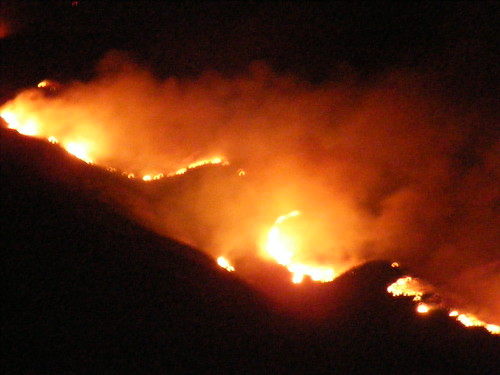
This is Mt. San Miguel, in San Diego County, California, taken today.
This photo was taken by a relative who lives in San Diego County. It isn't the best quality ever, but it makes a point. You can get some idea of the height of those flames from the distance -- he was perhaps 4 miles/6 km away when he took the photo. (May have used the zoom function.) Radio stations, and public safety, have towers on this mountain. At least some of these have stopped functioning. Our relative may be evacuating soon.
People in Southern California need prayer. The Santa Ana winds are supposed to gust up to over 30 mph/40 kph today. The humidity is less than 5%. Over 250,000 people have been evacuated in San Diego County alone. Many roads are closed, because of the fires.
There are other fires in Southern California, too.
Thanks to another relative, for suggesting that I post this, and ask for prayer.
Sunday, October 21, 2007
How Happy Every Child of Grace, by Charles Wesley
This year is the 300th anniversary of Charles Wesley's birth. Wesley wrote many hymns. One that I have never heard is "How Happy Every Child of Grace." I like the words. Here they are, as posted by the Cyberhymnal:
These words were published in 1745, hence are public domain.
Thanks for reading.
How happy every child of grace,
Who knows his sins forgiven!
“This earth,” he cries, “is not my place,
I seek my place in Heaven—
A country far from mortal sight,
Which yet by faith I see,
The land of rest, the saints’ delight,
The heaven prepared for me.”
O what a blessèd hope is ours!
While here on earth we stay,
We more than taste the heavenly powers,
And antedate that day.
We feel the resurrection near,
Our life in Christ concealed,
And with His glorious presence here
Our earthen vessels filled.
O would He more of heaven bestow,
And let the vessels break,
And let our ransomed spirits go
To grasp the God we seek;
In rapturous awe on Him to gaze,
Who bought the sight for me;
And shout and wonder at His grace
Through all eternity!
Thanks for reading.
Saturday, October 20, 2007
Polaris, by Jack McDevitt
I recently read Polaris, by Jack McDevitt. (This is McDevitt's web page.) Polaris was published in 2004 by Ace Books, of New York. McDevitt won the Nebula award for Seeker, a book with the same setting, and main characters, but later in time in McDevitt's sub-creation.
I don't usually give away the plots of books, but, in this case, I'm going to.
The Polaris was a spaceship, and it was used for a flight of a few important people. The purpose of the flight was to view the collision of a star with another object, from as close as safely possible. The Polaris was found, after the collision, but no passengers (nor the pilot) were ever found, in spite of a thorough search.
Alex Benedict, dealer in artifacts of various kinds, and his associate, Chase Kolpath (Chase is female) obtain some material from the Polaris, and become interested in what happened, 60 years after the disappearance. To cut to the chase (sorry!) they find out that the people aboard the Polaris are still alive.
There is an important ethical dilemma in this book. More than one, in fact. One is whether people who are convinced that overpopulation is a potential disaster have the right to take drastic action to prevent it. Another is whether, if a way to prolong human life tenfold is found, it is right to withhold that knowledge. Another is whether it is right to punish criminals with a "mindwipe," which involves removing their memories, and most of their personality, as opposed to sentencing them to death, or to life in prison. And the last one, which is raised in this, and two other of McDevitt's books about Alex Benedict (one of them may not have Chase Kolpath) is whether it's right to look for artifacts of the past for profit, as opposed to letting them be. (If there was no profit motive, would anyone ever look? Would any artifacts at all be preserved for the public? Should they be?) The answers to all of these questions are difficult, and McDevitt offers no easy answers.
McDevitt is a good writer. There is some real science in the book, and the characters seem real enough, too (even the avatars -- computer-generated constructs, based on what is known of an absent person, or a dead one). Much of the book is a murder mystery, or an attempted murder mystery. Someone has been trying to kill Benedict and Kolpath. Who is it, and why?
Even though Rimway, the planet Benedict and Kolpath are based on, is distant from earth, and it is a few millenia in our future, there is some minor recognition of God. ("God willing," for example, on page 119)
Thanks for reading.
Friday, October 19, 2007
Seeker, by Jack McDevitt
"Margolia is a world of gleaming cities and impossible architecture. Its citizens enjoy a life of absolute leisure. (How they'd stand it isn't explained.)" Jack McDevitt, Seeker. New York: Ace, 2006, p. 108.
Seeker won the Nebula award for 2006. I try to read all the Nebula award books. As usual, I'll try to avoid giving away the plot, but muse a bit about some aspects of the book.
This is McDevitt's web page. It includes chapter 14 of the book.
The front cover quotes Stephen King, on McDevitt: "The logical heir to Isaac Asimov and Arthur C. Clarke." In other words, King believes that the most important part of McDevitt's stories is the science. I generally prefer Ursula K. Le Guin's writing, where the most important part of the stories is the people. Clarke invented the synchronous orbiting relay satellite, fictionally. However, let's not forget that Le Guin, in spite of her concern for her characters, invented the ansible, also fictionally. Both are concerned with communication. McDevitt's people are OK. They are more than just cardboard. The protagonist in Seeker is Chase Kolpath, a former space pilot. She is now the assistant to Alex Benedict, who finds, or trades, valuable artifacts. I haven't read the previous books in this series, A Talent for War and Polaris, but I believe the first of these is written as a memoir by Alex. The second and third are written as if by Chase. She is more than a Watson to Alex's Holmes -- she has many of the adventures, and some of the ideas.
There are lots of possible artifacts in Chase's world, since it's about 9,000 years in our future, and humans are living on hundreds of planets. Rimway is the name of her planet. It has almost no crime. Criminals have their brains wiped -- their personality is mostly destroyed, and they are given, as it were, another start in life. Most everyone has an AI, an artificial intelligence, to deal with routine matters, even some non-routine ones. Simulated people take many of the service roles, such as restaurant waiters.
One question I always have, when entering such a world, is "how does the author treat religion?" McDevitt almost totally ignores it, but does include this:
It was a religious ceremony. A priest requested the blessings of the Almighty on the happy couple, and led them in their vows. The best man produced the ring, Adam slipped it on her finger, she waltzed into his arms, and they kissed. p. 77.
Who is getting married isn't important here. McDevitt does assume that there will be some religion, probably Christianity, even in the far future, and that it will have some importance in the lives of at least some people. That's more than many science fiction authors have done.
The quote also shows a weakness in McDevitt's work. Much of what people do and are, their customs and habits, read as if they haven't changed in hundreds of lightyears and thousands of years. That strikes me as very unrealistic. Surely the marriage ceremony would have changed a lot in that time! I know -- if McDevitt had changed everything as much as it's probably going to change, the plot would have gotten lost in all of those societal changes. And it's unrealistic to expect any author to be able to extrapolate changes in every aspect of how we eat, entertain ourselves, how we are named, etc., into the future.
God also appears in this famous quote (famous in the sense that it has been remembered for millennia, in McDevitt's fictional world):
We are leaving this world forever, and we intend to go so far that not even God will be able to find us. p. 133.
One technological extrapolation is avatars -- it is possible to take what is known about someone, even someone long dead, and produce a projected 3-D view of that person. The projection is able to converse, with ideas more or less like the original person would have, depending on how much is known about the original.
How do we treat the relics of our past? We plunder them, we hoard them, we exhibit them in museums, we profit from them, we show them off without understanding them, we casually trash them. That is a central theme of this book, and it is well worth thinking about.
McDevitt is a good read. I had a hard time putting the book down by the time I got to about page 250 (out of 373). There were two previous Chase Kolpath books, A Talent for War and Polaris. I hope to read them.
Thanks for reading.
Thursday, October 18, 2007
Sunspots 130

Things I have recently spotted that may be of interest to someone else:
Humor:
The terrorists must have followed us home, creating a massive art installation in Chicago.
Science:
A physician, writing in Slate, claims that we shouldn't be so obsessed with cleanliness, and, in fact, should ingest more excrement for our health's sake. (warning -- a common four-letter word for excrement is used several times in the article).
Al Gore has won the Nobel Peace Prize. Although he apparently deserves it, for his work on raising awareness of the coming climate change, a UK judge has ruled that there should be reservations about using An Inconvenient Truth in schools, because he was making a case, not always completely backed by scientific evidence. For example, it is not clear that Hurricane Katrina was directly due to increased global warming.
Politics:
Factcheck assesses claims made by the President, by candidates for President, and probably others. It seems to want the truth from both US political parties, and points out when it wasn't forthcoming. The same seems to be true of PolitiFact.
Henry Neufeld proposes his anti-terrorism policy.
Music:
(Actually, Art, in this case) New discoveries about the Mona Lisa, by da Vinci.
Christianity:
An article in Christianity Today on the reasons that the Bible allows for divorce, based on a study of the original language, and its cultural context.
Bonnie argues that the church must teach about proper sexual relationships, not just about improper ones.
Rebecca argues that KJV-onlyism is not truly compatible with a Bible-based doctrine.
An article, written for the "average Christian," on "The Spiritual Value of Wilderness ."
I normally include a link to the current Christian Carnival, but, so far, I haven't discovered the latest one.
Tuesday, October 16, 2007
"The Inner Life of the Cell" video
"The Inner Life of the Cell" video, which, as I understand it, was created at Harvard, is available freely on the Internet, here, lasts perhaps 3 minutes, and is certainly well worth watching. It shows various animations of life processes involving molecules and cells, with no narration at all. Even if you don't know what process is being shown, it is an awesome piece of work, and gives some idea of the tremendous complexity and beauty of molecular and cellular structure. According to my sources, some people have used in devotional presentations. The sponsor, the Howard Hughes Medical Foundation, is not a religious organization.
Thanks for reading. Enjoy watching.
Thanks for reading. Enjoy watching.
Stephen Hawking's singularity at the beginning
When people start using terms like singularity, my brain generally goes into neutral.
Stephen Hawking, one of the most famous scientists of our time (he holds the same professorial chair that Isaac Newton did, and appeared, as a holographic simulation of himself, on an episode of Star Trek: Voyager) wrote A Brief History of Time, a best-selling book (there are those who claim that not many who own the book have actually read and understood it!). In that book, he claimed, as I understood him, that the universe sort of started up by itself -- without a singularity, a special event, at the beginning.
I have recently read a chapter, "In Defense of Rational Theism," by William Lane Craig, in Does God Exist: The Debate between Theists & Atheists (Amherst, NY: Prometheus Books. J. P. Moreland and Kai Nielsen are given as senior authors. The chapter is pp. 139-161). As part of this chapter, Craig, a philosopher, criticizes Hawking's idea that there was no** singularity at the beginning of time. He states that Hawking was on questionable ground on two points, which, he says, are among Hawking's assumptions, not his facts:
1) He assumes that there must have been (be?) multiple universes*, in fact, all possible universes, but we only know about the one we are in now. Craig says that the reason for this particular part of Hawking's metaphysics is that quantum physics would suppose that there was indeterminacy in the universe to begin with, but it collapsed to one particular state, and this collapse -- which is related to the Big Bang, would have required some sort of observer, which, says Craig, quoting Hawking, "smacks of divine intervention," (p. 147 of Craig) which Hawking wanted to deny.
*Philip Pullman used this idea in his His Dark Materials series.
**On October 17th, I changed "of a" to "that there was no," after suddenly realizing that I had written the opposite of what I had wanted to say. Sigh. Thanks, Steve, for your comment. Without it, I wouldn't have noticed this.
2) Craig says that Hawking misused mathematics in his model, specifically that he uses imaginary numbers inappropriately.
I am not equipped to evaluate Craig's claims, but, at least in part, they make sense. Hawking starts out, apparently, by not believing that there is a supernatural God who began the universe. So it is no wonder that he comes out "proving" this! Hebrews 11:3 says that we understand God's work in creation by faith. Hawking seems to have a different sort of faith. (See also this post.)
Thanks for reading.
Monday, October 15, 2007
Three by Sharon Shinn
Sharon Shinn is a writer of fantastic literature, who always has an element of romance (in the sense of a man and woman falling in love) in her novels. Although she has never won the highest awards given in the field, she's good enough to enjoy. Let's put it this way -- my wife, who almost never likes fantastic literature, has enjoyed one of Shinn's books, Summers at Castle Auburn. She also enjoyed, as I did, a trio of so-called Young Adult books by Shinn. These books are The Truth-Teller's Tale (2005), The Safe-Keeper's Secret (2004) and The Dream-Maker's Magic (2006). There is a fourth story, "Wintermoon Wish," with the same premises and setting. That story is in the anthology Firebirds Rising.
As usual, I won't give away the plot, but I will muse briefly about some of the aspects of these books.
All three involve young teenagers growing up. These are more female than male, but male characters are important. One of the books features twin girls, and one has a main character whose mother treats her as if she were a boy -- she isn't. (Shinn's story explains the reasons.)
The world of these books has magic in it. In particular, there are Safe-Keepers, Truth-Tellers, and Dream-Makers. Safe-Keepers are safe listeners for secrets. They don't tell even the most awful things, unless telling would be all right with the originator of the secret, or that person has died. They may pass secrets on to other Safe-Keepers, especially if they are afraid that they will die soon.
Truth-Tellers, on the contrary, always tell the truth, and this includes things that they don't have personal knowledge of. For example, you could ask a Truth-Teller who committed a crime, and he or she would usually respond by naming the guilty party. Truth-Tellers, of course, aren't always popular. Like Safe-Keepers, there may be more than one such person in the kingdom at once. Both Truth-Tellers and Safe-Keepers gradually come to realize their specialness, and those around them do, too, as they grow up.
One of Shinn's nice touches is inventing a tree that goes with each of these. Kirrenberry trees are for Safe-Keepers. They make no noise. Their leaves don't rustle, and, if you make a whistle out of a twig from such a tree, it won't make any music. Chatterleaf trees are noisy, and they are often planted at the homes of Truth-Tellers. Their leaves, of course, are noisy.
There is only one Dream-Maker in the kingdom at a time, and Dream-Making is difficult. Only people who have endured great suffering become Dream-Makers, and being Dream-Maker is an emotional burden. Their special gift is to make some people's wishes come true. They don't control this. Wishes of people who have told the Dream-Maker what their wish is may come true. If so, it is some time after the contact with the Dream-Maker.
The three books, as I say, all take place in the same setting. They are also related, in that characters from one book may be mentioned a little in another one, but the books may be read independently.
There is little or no religion in the books, except for rituals associated with mid-winter and mid-summer. However, both my wife and I were struck by the fact that Jesus Christ is Truth-Teller, Safe-Keeper, and Dream-Maker. Sometimes the Truth that He tells is uncomfortable and unwelcome. We can confess anything we have done to Him without fear. He makes some of our dreams come true.
Thanks for reading.
Sunday, October 14, 2007
O Love Divine, What Hast Thou Done, by Charles Wesley
This year is the 300th anniversary of Charles Wesley's birth. Wesley wrote many hymns. One that I have seldom heard is "O Love Divine, What Hast Thou Done." It has great words. These are the words posted by the Cyberhymnal:
O Love divine, what hast thou done!
The immortal God hath died for me!
The Father’s co-eternal Son
Bore all my sins upon the tree.
Th’immortal God for me hath died:
My Lord, my Love, is crucified!
Is crucified for me and you,
To bring us rebels back to God.
Believe, believe the record true,
Ye all are bought with Jesus’ blood.
Pardon for all flows from His side:
My Lord, my Love, is crucified!
Behold and love, ye that pass by,
The bleeding Prince of life and peace!
Come, sinners, see your Savior die,
And say, “Was ever grief like His?”
Come, feel with me His blood applied:
My Lord, my Love, is crucified!
Then let us sit beneath His cross,
And gladly catch the healing stream:
All things for Him account but loss,
And give up all our hearts to Him:
Of nothing think or speak beside,
My Lord, my Love, is crucified!
These words were published in 1742, hence are public domain.
Thanks for reading.
Thursday, October 11, 2007
Sunspots 129

Things I have recently spotted that may be of interest to someone else:
Humor:
Science:
According to the Wikipedia, goldenrod (which is blooming everywhere in the area where we live) causes little or no hay fever, because its pollen is so "heavy and sticky" that it doesn't blow around very much.
From Montana State Univ., a web site to help in identifying all the butterflies and moths in North America.
The Nobel Prize in Physiology or Medicine has been awarded to three mouse geneticists .
Politics:
(or something) How Wal-Mart is getting people to buy compact flourescent light bulbs.
Music:
(actually, art) Slate on small children and elephants painting, and on what art is.
This week's Christian Carnival is here . For information on these Carnivals, go here .
Thanks for reading! Keep clicking away.
Image source (public domain)
Sunday, October 07, 2007
Soldiers of Christ, Arise by Charles Wesley
This year is the 300th anniversary of Charles Wesley's birth. Wesley wrote many hymns. One that I have seldom heard is "Soldiers of Christ, Arise." These are the words posted by the Cyberhymnal:
Soldiers of Christ, arise, and put your armor on,
Strong in the strength which God supplies through His eternal Son.
Strong in the Lord of hosts, and in His mighty power,
Who in the strength of Jesus trusts is more than conqueror.
Soldiers of Christ, arise, and put your armor on,
Strong in the strength which God supplies through His eternal Son.
Strong in the Lord of hosts, and in His mighty power,
Who in the strength of Jesus trusts is more than conqueror.
Stand then in His great might, with all His strength endued,
But take, to arm you for the fight, the panoply of God;
That, having all things done, and all your conflicts passed,
Ye may o’ercome through Christ alone and stand entire at last.
Stand then against your foes, in close and firm array;
Legions of wily fiends oppose throughout the evil day.
But meet the sons of night, and mock their vain design,
Armed in the arms of heavenly light, of righteousness divine.
Leave no unguarded place, no weakness of the soul,
Take every virtue, every grace, and fortify the whole;
Indissolubly joined, to battle all proceed;
But arm yourselves with all the mind that was in Christ, your Head.
But, above all, lay hold on faith’s victorious shield;
Armed with that adamant and gold, be sure to win the field:
If faith surround your heart, Satan shall be subdued,
Repelled his every fiery dart, and quenched with Jesu’s blood.
Jesus hath died for you! What can His love withstand?
Believe, hold fast your shield, and who shall pluck you from His hand?
Believe that Jesus reigns; all power to Him is giv’n:
Believe, till freed from sin’s remains; believe yourselves to Heav’n.
To keep your armor bright, attend with constant care,
Still walking in your Captain’s sight, and watching unto prayer.
Ready for all alarms, steadfastly set your face,
And always exercise your arms, and use your every grace.
Pray without ceasing, pray, your Captain gives the word;
His summons cheerfully obey and call upon the Lord;
To God your every want in instant prayer display,
Pray always; pray and never faint; pray, without ceasing, pray!
In fellowship alone, to God with faith draw near;
Approach His courts, besiege His throne with all the powers of prayer:
Go to His temple, go, nor from His altar move;
Let every house His worship know, and every heart His love.
To God your spirits dart, your souls in words declare,
Or groan, to Him Who reads the heart, the unutterable prayer:
His mercy now implore, and now show forth His praise,
In shouts, or silent awe, adore His miracles of grace.
Pour out your souls to God, and bow them with your knees,
And spread your hearts and hands abroad, and pray for Zion’s peace;
Your guides and brethren bear for ever on your mind;
Extend the arms of mighty prayer, ingrasping* all mankind.
From strength to strength go on, wrestle and fight and pray,
Tread all the powers of darkness down and win the well fought day.
Still let the Spirit cry in all His soldiers, “Come!”
Till Christ the Lord descends from high and takes the conquerors home.
These words were written by Wesley in about 1741.
*This word is new to me. I assume that it means what you would suppose that it did -- surrounding and containing.
Thanks for reading.
Wednesday, October 03, 2007
Sunspots 128

Things I have recently spotted that may be of interest to someone else:
Humor: The Onion on fig newton ads.
The Onion on a remarkable development in Vice President Dick Cheney's attitude.
Science: (or something) I read, in the latest American Bible Society Record, that there are new languages appearing. They mentioned two: a new combination of Arabic and French, and a Polish-related street gang language. Bible translations are being prepared in both of these, and many others.
"California State University Professor Mike Orkin points out that if a person drives ten miles to buy a [lottery] ticket, he or she is about sixteen times more likely to get killed in a car crash on the way than to win the jackpot." Sean B. Carroll, The Making of the Fittest: DNA and the Ultimate Forensic Record of Evolution . New York: Norton, 2006. pp.41-2
Politics: An "Issue Tracker" from the Washington Post. The web page lists 17 major party presidential candidates, and has links to press coverage on the issues. If, for example, you want to know how Sam Brownback and the budget have been covered, or made the news, you can click on Brownback, then on the Economy and Budget issue category. If, on the other hand, you want to know who has received news coverage because of their stand on the environment, you move the mouse over Environment, and see that, currently, Duncan Hunter has received no news coverage about that, and Hilary Clinton has seen the most. The page, it says, can be added to your own web page or MySpace page. You can go to the candidate's official web sites (which usually, or always) have something about their positions on various issues, by clicking on this related page.
Can you name more than four members of the U. S. President's Cabinet? (Apparently even the White House webmaster can't name all of them . . .) I got four of them.
Computing: C-Net on how the bad people use information on social networks like MySpace, FaceBook, or LinkedIn to attack corporations, or even governments. This phenomenon is known as Spear Phishing.
Christianity: On the use of words for "up" and "down" in the book of Jonah. This week's Christian Carnival is here. For information on these Carnivals, go here.
Thanks for reading! Keep clicking away.
Image source (public domain)
Sunday, September 30, 2007
I Know That My Redeemer Lives, by Charles Wesley
This year is the 300th anniversary of Charles Wesley's birth. Wesley wrote many hymns. One that is still familiar is "I Know That My Redeemer Lives," usually sung to music by Handel. These are the words posted by the Cyberhymnal:
I know that my Redeemer lives,
And ever prays for me;
A token of His love He gives,
A pledge of liberty.
I find him lifting up my head,
He brings salvation near,
His presence makes me free indeed,
And He will soon appear.
He wills that I should holy be,
What can withstand His will?
The counsel of His grace in me
He surely shall fulfill.
Jesus, I hang upon Thy Word;
I steadfastly believe
Thou wilt return and claim me, Lord
And to Thyself receive,
Joyful in hope, my spirit soars
To meet Thee from above,
Thy goodness thankfully adores;
And sure I taste Thy love.
Thy love I soon expect to find,
In all its depth and height;
To comprehend the eternal mind,
And grasp the Infinite.
When God is Mine and I am His,
Of paradise possessed,
I taste unutterable bliss,
And everlasting rest.
The bliss of those that fully dwell,
Fully in Thee believe,
’Tis more than angel tongues can tell,
Or angel minds conceive.
Thou only knowst, who didst obtain,
And die to make it known;
The great salvation now explain,
And perfect us in one!
As the hymn was written 1742, it is public domain.
Thanks for reading.
Saturday, September 29, 2007
Billy Graham on origins
Billy Graham is not necessarily divinely inspired, of course, but his views have been widely respected, and rightly so. I was led to a passage where he was asked his views on origins.
David Frost says that he wished to know how Billy Graham interpreted scripture, and what he thought of evolution. Graham responded that he didn't think anyone could be an absolutely strict literalist, and gave the example of Lazarus, who couldn't have been in Abraham's bosom. Then Graham went on to say this:
Oh, I don't think that there's any conflict at all between science today and the Scriptures. I think that we have misinterpreted the Scriptures many times and we've tried to make the Scriptures say things they weren't meant to say, and I think we have made a mistake by thinking the Bible is a scientific book.
The Bible is not a book of science. The Bible is a book of Redemption, and of course I accept the Creation story. I believe that God did create the universe. I believe that God created man, and whether it came by an evolutionary process and at a certain point He took this person or this being and made him a living soul or not, does not change the fact that God did create man.
Frost asked a further question, and Graham indicated that he hadn't finished his response to the previous one. Graham went on:
. . . I personally believe that it's just as easy to accept the fact that God took some dust and blew on it and out came a man as it is to accept the fact that God breathed upon man and he became a living soul and it started with some protoplasm and went right on up through the evolutionary process. Either way is by faith and whichever way God did it makes no difference as to what man is and man's relationship to God.
Billy Graham: Personal Thoughts of a Public Man, 1997. (Colorado Springs, Colorado: Cook Communications, 1997. p. 72-74) The book indicates that this is taken from the transcript of an interview of Graham by Frost on BBC-2, in 1964. Frost is given as the author of the book, which is said to be excerpts from interviews with Graham over three decades. The first one was in 1964, and may have been the interview above.
Thanks for reading.
* * * *
October 14, 2007: I have just discovered a post by Steve Martin, entitled "Made in God's Image or Evolved from Apes?" which is related to the quotations from Billy Graham (but makes no mention of Graham).
Thursday, September 27, 2007
Extraterrestrial Religion
Are there planets where there is life? Is such life self-aware, and/or able to communicate ideas to others? Are there religions on other planets? I wish to muse about these things. (I recently mused about a similar topic, namely the religion of robots.)
Some authors have supposed that there is such life on planets in our own solar system.
C. S. Lewis, in Out of the Silent Planet, the first novel of his space trilogy, described Mars (Malacandra) as a planet with water, and life, in canals on the planet's surface. There were three intelligent species living there, all three worshiping the Oyarsa of Mars, approximately an archangel. They had some knowledge of Maleldil, Christ, and his redeeming sacrifice. Lewis also supposed that Venus (Perelandra) was inhabited by an intelligent race, human in appearance, who were subjected to a temptation similar to that described of Adam and Eve in the Garden of Eden.
At least one author, Zenna Henderson (see also the Wikipedia page on her) had her aliens, who were indistinguishable from humans in appearance, living on earth, among us, but with a religion that was central to their culture. This religion seemed to be compatible with Christianity.
Harold Myra supposed that the Fall had made our part of the universe into antimatter. He had several unfallen worlds in his galaxy.
Dolphins, chimpanzees, and perhaps other terrestrial species may be self-aware, and have some power of communication, enough to develop a religion, perhaps. So far as I know, there is no evidence that they have such. There are a number of works that suppose dolphins or whales to have such capacity. I am not aware that any of them propose that these creatures have any religion.
Other authors have also considered these themes.
Does the Bible say anything that would preclude intelligent life elsewhere? I don't know of any such thing. Conversely, it doesn't say anything that proves that there is such life.
If there is intelligent life elsewhere, is it necessary that it have a religion? I suppose not, but would be surprised if there were no such, if other species with intelligence exist.
Did the Fall affect other planets? Did Christ die for other planets? Probably, as I read the scripture, although I don't think the Bible is absolutely conclusive on these matters. Romans 8:18-25 may mean that when it says that the "whole creation" has suffered until the time of Paul's writing.
Thanks for reading these musings.
* * * * *
Note added June 23, 2011: A recent post by a Christian author of fantastic literature claims that there can be no non-human intelligent life in the universe. Some other Christian authors disagree, in the comments.
* * * * *
Added November 11, 2012: Ken Ham, of Answers in Genesis, claims that, if there is intelligent life on other planets, "any aliens would also be affected by Adam’s sin, but they can’t have salvation." Ham is responding to statements by a Vatican astronomer, to the contrary. That is, the astronomer claimed that intelligent extraterrestrials could be redeemed.
* * * * *
Added July 27, 2015: A planet with physical characteristics similar to ours has recently been discovered. In response, apparently an atheist wrote that this discovery made belief in God (or in Judaism or Islam) impossible. Benjamin L. Corey begs to differ.
Wednesday, September 26, 2007
Sunspots 127

Things I have recently spotted that may be of interest to someone else:
Science:
Velociraptor, the predatory dinosaur, seems to have had feathers.
An excellent post on what design means.
Politics:
I saw former President Clinton interviewed on the Comedy Channel last week. He wasn't being funny when he put forward an interesting thesis on the nastiness in Washington: Congress is sleep-deprived. Many of them fly to their home districts and back every weekend during Congressional sessions, and the result is that they don't get enough sleep, and that some of them are chronically jet-lagged. No wonder they are grumpy. Clinton is on to something, no doubt.
Computing:
Version 2.3 of OpenOffice is available, for those interested, which might well include those who can't afford Microsoft Office, or who choose not to use it, but still need one or more of a word processor, spreadsheet, drawing program, presentation program. It is freeware -- there's no charge for it.
OSHA, a US government agency has advice on monitor placement, so as to avoid eyestrain.
This week's Christian Carnival is here. For information on these Carnivals, go here.
Thanks for reading! Keep clicking away.
Tuesday, September 25, 2007
Sodom and homosexuality
The story of the destruction of Sodom is told in Genesis 18:16 - 19:29. It is not a pretty story. God sent two angels to the city. They spent the night with Lot, Abraham's nephew. While they were there, all of the men of the city surrounded Lot's house, and demanded that he send out his guests (they, and Lot, thought that the angels were males) so that they could rape them. The next day, the angels took Lot and his family out of the city, and it was destroyed.
It is often stated that Sodom (and its neighboring city, Gomorrah) was destroyed because of its homosexual sin. It is also implied that homosexuality is the worst possible sin. That's not consistent with what the Bible has to say. Here's what Ezekiel said about Sodom:
16:48 As I live, declares the Lord God, your sister Sodom and her daughters have not done as you and your daughters have done. 49 Behold, this was the guilt of your sister Sodom: she and her daughters had pride, excess of food, and prosperous ease, but did not aid the poor and needy. 50 They were haughty and did an abomination before me. So I removed them, when I saw it. (ESV)
Ezekiel listed pride, gluttony, and sloth, and inhospitality, and doesn't directly refer to homosexuality (unless the "did an abomination" refers to that.) Ezekiel also said that the Jews were worse than Sodom. (they "have not done" as the Jews did.)
Jude 1:7 does refer to homosexuality:
7 just as Sodom and Gomorrah and the surrounding cities, which likewise indulged in sexual immorality and pursued unnatural desire*, serve as an example by undergoing a punishment of eternal fire. *text note: Greek other flesh (ESV)
But that can't be taken to make homosexuality the worst sin. Christ, Himself, said, in Matthew 11:20-24, when Capernaum rejected His teaching, that they were worse than the inhabitants of ancient Sodom, and, in Luke 10:1-12, that any town that did not receive the seventy-two disciples, was worse than Sodom.
Pride, according to Ezekiel, was the besetting sin of the inhabitants of Sodom. Here's what John Calvin said about that, in his commentary on this passage: ". . . but we must see how Sodom rushed forward to that degree of licentiousness so as to be horrified by no enormity. God says that they began by pride, and surely pride is the mother of all contempt of God and of all cruelty."
I conclude, therefore, that homosexual behavior is not the worst sin, now, nor was it in Sodom's day. Putting ourselves pridefully up as gods probably is.
For more on this topic, see the last part of this post, from Parableman.
Subscribe to:
Posts (Atom)