Many people think that, once he was incarnated as a human, Christ has remained in a human body, even after His resurrection. I didn't realize, until recently, that there was scripture to back that up. Here it is:
Colossians 2:9 For in him the whole fullness of deity dwells bodily, (ESV).
I checked several other translations, and they agree. This verse, of course, was written by Paul, quite a few years after Christ's death and resurrection. It's always dangerous to base a doctrine on a single verse, but this one is at least evidence for the belief that Christ continues to have a physical body.
Thanks for reading.
Musings on science, the Bible, and fantastic literature (and sometimes basketball and other stuff).
God speaks to us through the Bible and the findings of science, and we should listen to both types of revelation.
The title is from Psalm 84:11.
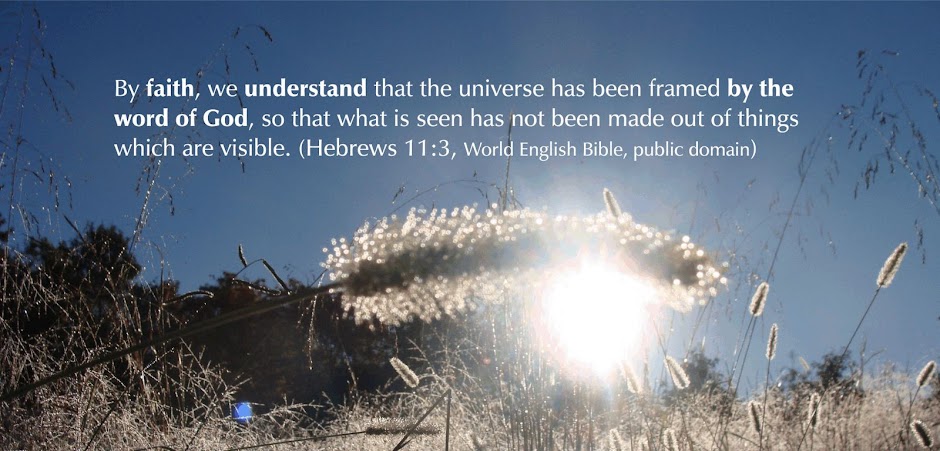
The Wikipedia is usually a pretty good reference. I mostly use the World English Bible (WEB), because it is public domain. I am grateful.
License
I have written an e-book, Does the Bible Really Say That?, which is free to anyone. To download that book, in several formats, go here.

The posts in this blog are licensed under a Creative Commons Attribution-NonCommercial-ShareAlike 3.0 Unported License. You can copy and use this material, as long as you aren't making money from it. If you give me credit, thanks. If not, OK.
The posts in this blog are licensed under a Creative Commons Attribution-NonCommercial-ShareAlike 3.0 Unported License. You can copy and use this material, as long as you aren't making money from it. If you give me credit, thanks. If not, OK.
Sunday, November 01, 2009


Thursday, October 29, 2009
Fantasy and reality: George MacDonald's views
Some thinkers would feel sorely hampered if at liberty to use no forms but such as existed in nature, or to invent nothing save in accordance with the laws of the world of the senses; but it must not therefore be imagined that they desire escape from the region of law. Nothing lawless can show the least reason why it should exist, or could at best have more than an appearance of life.
The natural world has its laws, and no man must interfere with them in the way of presentment any more than in the way of use; but they themselves may suggest laws of other kinds, and man may, if he pleases, invent a little world of his own, with its own laws; for there is that in him which delights in calling up new forms--which is the nearest, perhaps, he can come to creation. When such forms are new embodiments of old truths, we call them products of the Imagination; when they are mere inventions, however lovely, I should call them the work of the Fancy: in either case, Law has been diligently at work.
In the moral world it is different: there a man may clothe in new forms, and for this employ his imagination freely, but he must invent nothing. He may not, for any purpose, turn its laws upside down. He must not meddle with the relations of live souls. The laws of the spirit of man must hold, alike in this world and in any world he may invent. It were no offence to suppose a world in which everything repelled instead of attracted the things around it; it would be wicked to write a tale representing a man it called good as always doing bad things, or a man it called bad as always doing good things: the notion itself is absolutely lawless. In physical things a man may invent; in moral things he must obey--and take their laws with him into his invented world as well.
- excerpted from George MacDonald, "The Fantastic Imagination," in A Dish of Orts, 1893, Public Domain.
Monday, October 26, 2009
Helen Mathews LaBar, 1910-2009

In 1952, Mrs. LaBar started teaching high school English and Math at Birchwood, Wisconsin. She also served as interim principal. After her retirement in 1970, she became a volunteer in nursing homes, which she continued to do into her 90s, leading Bible studies and hymn-singing, first in Wisconsin, and, later, in Michigan. In 1984, she and her husband moved to Union City. Her husband preceded her in death on June 26, 1991.
The LaBars were active in the founding of Wayside Chapel church, near Edgewater, Wisconsin, which was on land they donated, and they continued to be active in that congregation until they moved to Michigan. She was active in the Union City United Methodist Church, and was also involved in home Bible studies in the area, most of them in her home. She also attended Union City Wesleyan church, and Coldwater Nazarene church. She was known as loving the Bible, reading it daily, and memorizing much of it, including the entire book of Mark.
Mrs. LaBar became known as the creator of rugs, woven from used woolen fabric, using an interweaved braiding technique that she originated. She made several hundred such rugs, gave demonstrations, and taught many others this skill.
She loved music, and was pianist for Wayside Chapel church for many years, and also occasionally played for the Methodist Church in Union City, in addition to playing in nursing homes. She also loved making and connecting with friends, her family, reading, crossword puzzles, Scrabble*, and flower gardening.
Survivors include four sons, Martin and Faye of Liberty, South Carolina, Michigan, Montana, and Tennessee. There are ten grandchildren, who live in Alaska, California, Indiana, Kentucky, Maine, Michigan, New Mexico, and Pennsylvania, and nine great-grandchildren, who range in age from five years old to two weeks old today.
*She beat me more than I beat her, when I last played her a few months ago.
Photo courtesy of Pauline LaBar-Shelton
Sunday, October 25, 2009
Colossians 1:16-17 poster

Sunday, October 18, 2009
Blackberry leaves with Virginia mountains in the distance

This photo was taken from just off the Blue Ridge Parkway, between Buena Vista and Montebello, Virginia, three years ago today. The leaves in the right foreground are blackberry leaves. In the distance, of course, are some of the Virginia mountains.
The photo is a live link to our Flickr photostream, and, if you click on it, you should go to the photo's own page. There's an icon above the photo, saying that you can see more sizes, including higher resolution versions of this photo. The photo is natural color.
Thanks for looking. Isn't God a great artist?
Wednesday, October 14, 2009
Sunspots 232
Things I have recently spotted that may be of interest to someone else:

Science:
Science Daily reports that a large, but faint new ring has been discovered around Saturn.
Christianity:
(maybe) He Lives comments on a misguided attempt to remove liberal political bias from the Bible, by producing a new translation.
Image source (public domain)
Sunday, October 11, 2009
What was Solomon singing about?
My daily Bible reading (see here) goes through the entire Protestant scripture in a year. So, it goes through the Song of Solomon. (Also known as the Song of Songs, Canticles, and probably by other names.) I read it this year. I've read it a number of times. I decided that it was time for me to do some musing about this book.
There is a classic idea about what the book is about. Matthew Henry's commentary says :". . . here is not the name of God in it; it is never quoted in the New Testament; we find not in it any expressions of natural religion or pious devotion, no, nor is it introduced by vision, or any of the marks of immediate revelation." Henry went on to give his interpretation, namely that the book is a ". . . nuptial song, wherein, by the expressions of love between a bridegroom and his bride, are set forth and illustrated the mutual affections that pass between God and a distinguished remnant of mankind." Henry believed that it originally portrayed the relationship between God and Israel, and now portrays that between God and the church. Robert Jamieson, in his commentary, agreed with Henry on the value and purpose of the book. John Wesley also agreed. The Wikipedia article on the book indicates that this idea goes back at least to Origen. It also says that the New Testament shows some influence from the book.
My source for John Calvin's commentaries indicates that Calvin didn't prepare a commentary on this book (or on a few others from the Old Testament.)
Is the view of Origen, Henry, Jamieson and Wesley tenable? Well, maybe.
However, the author of the introduction to the Song of Songs in the New International Version Study Bible (Grand Rapids, MI: Zondervan, 2005 -- the contributor was probably John H. Stek) believes that the book is love poetry, erotic love poetry. There is some evidence for that. For one thing, some or all of the commentators mentioned above say that the Israelites weren't supposed to read the book before they were 30 years old -- it mentions "breast" several times, and, taken literally, seems to be about a relationship including sexual activity. If so, fine. After all, God invented erotic love.
The book of Ezekiel, Chapter 23, speaks of God's relationship to the Israelites, using a marital relationship, including erotic love, as a symbol of God's love.
Thanks for reading.
Wednesday, October 07, 2009
Sunspots 231
Maybe some of you don't want to know, but Wired has an article on the chemicals found in a cup of coffee, and their significance to the human body.
I'm having a blogging hiatus, God willing.
I'm having a blogging hiatus, God willing.
Monday, October 05, 2009
Two Bible study tools
I have recently discovered what looks to be a fine Bible resource, namely a compilation of what are said to be all the places where the New Testament quotes the Old Testament. As might be expected, it's a long web page.
Perhaps it will be useful to you. I have not checked the page for completeness.
Another web page is a sort of metasearch engine for scripture passages. The Bible Verse Finder lets you input a verse, or passage, and returns links to more than fifty different kinds of Bibles, including many English translations, several other languages (including Greek -- 1881 Westcott and Hort), and an audio version or two. Some of these will handle only a single verse. Others will work for a passage.
I hope this information is useful to someone.
Sunday, October 04, 2009
Sun and Shield: Where it comes from

You are looking at my blog, Sun and Shield. What is the source of that title? Here you see it, in poster form.
The background of this chart is a scanned bagel. That's right, scanned. I just lay it on the scanner and scanned it, rather than photographing it. Perhaps not a smart thing to do -- crumbs might have caused some damage to the scanner. I used bread to represent good things. I first made a poster like this by using chocolate cake (not scanned, photographed!), but decided that I wasn't really sure whether chocolate cake was a good thing for me.
I constructed this poster with the Corel X4 Graphics Suite. If you really want a higher resolution version of this graphic, the graphic, itself, is a link to our Flickr photostream, where there is an "all sizes" button just above the graphic, I believe. Feel free to use this, provided that the use is not for any commercial purpose.
This is my life verse. It has promises, and, of course, also an important condition. I hope that I meet it. With God's help, I do.
Thanks for reading, and looking.
Thursday, October 01, 2009
Have you been spanked lately? Discipline of Christians
I misplaced my car keys this morning. How should I react?
What is discipline? The Free Dictionary tells us that the word may be used as a noun, or as a verb. Here are three of the noun meanings:
Does this mean that apparent believers who are going through such bad circumstances are being disciplined? Not always. See Hebrews 11:32-38. See also 2 Corinthians 11:22-28. Neither does it mean that going through bad circumstances is a sign of God's love. It may be, but we shouldn't count on bad circumstances as showing us that we are loved. We are loved, but bad circumstances may just be our own fault, or just normal things that happen to everybody. Everyone's light bulbs have to be replaced, sooner or later. Everyone's kids go through teething.
Discipline by the church: Sometimes, God chooses to discipline through the church. (This is in addition to discipline through words, which may be administered by the church.)
This post, which quotes Jesus, in Matthew 18:15-17, discusses what to do if a Christian offender, when dealt with, refuses to repent. Jesus said to let such a person be as a Gentile and a tax collector, which seems to mean excommunication, or, as the Amish put it, shunning. See the Wikipedia article on Shunning, which is not just about the Amish, but is broader, and also indicates other scripture which commands this practice. I am linking to these passages. They are Romans 16:17; 1 Corinthians 5:11-13; 2 Thessalonians 3:6, 3:14-15; 2 John 1:10-11. Does that mean to stop talking to such people, or to stop loving them? Of course not. It means that we must no longer treat some people as part of our Christian fellowship.
Finally, death: I don't want to get into the question of eternal security here. There has been many an argument on this subject, and I won't repeat those. Whatever the state of their salvation at the time, Ananias and Sapphira died.
Jeremiah 30:11 and 46:28 tell us what we already know, namely that God's discipline is just. We should continually be examining ourselves, to see if we are achieving true Christlikeness. As Paul put it in 2 Corinthians 13:5: Examine yourselves, to see whether you are in the faith. Test yourselves. Or do you not realize this about yourselves, that Jesus Christ is in you?—unless indeed you fail to meet the test!
I should have prayed that I would find my keys. (I haven't yet) I should have looked for them, as thoroughly as I could. I should have asked myself how God could be using this to teach me something -- more care, more dependence on God, and less on things, or less pride in not losing my keys, for example.
God help me to meet all the tests of being like Christ.
* * * * *
October 2, 2009: My wife found my keys, thank God.
Bonnie has written a post on discipline which, like everything Bonnie writes, is well worth reading.
Hebrews 12:5b “My son, do not regard lightly the discipline of the Lord,
nor be weary when reproved by him.
6 For the Lord disciplines the one he loves,
and chastises every son whom he receives.”
nor be weary when reproved by him.
6 For the Lord disciplines the one he loves,
and chastises every son whom he receives.”
7 It is for discipline that you have to endure. God is treating you as sons. For what son is there whom his father does not discipline? 8 If you are left without discipline, in which all have participated, then you are illegitimate children and not sons. 9 Besides this, we have had earthly fathers who disciplined us and we respected them. Shall we not much more be subject to the Father of spirits and live? 10 For they disciplined us for a short time as it seemed best to them, but he disciplines us for our good, that we may share his holiness. 11 For the moment all discipline seems painful rather than pleasant, but later it yields the peaceful fruit of righteousness to those who have been trained by it.
12 Therefore lift your drooping hands and strengthen your weak knees, 13 and make straight paths for your feet, so that what is lame may not be put out of joint but rather be healed. (ESV, emphasis added. All Bible quotations from the ESV.)
What is discipline? The Free Dictionary tells us that the word may be used as a noun, or as a verb. Here are three of the noun meanings:
1. Training expected to produce a specific character or pattern of behavior, especially training that produces moral or mental improvement.
2. Controlled behavior resulting from disciplinary training; self-control.
4. Punishment intended to correct or train.
The verb meanings are closely related.
If God disciplines us because He loves us, and this discipline is designed to train us, that leaves two important questions.
1) Why does He do this? Or, better put, what particular improvement is God trying to achieve in us? I think the answer is simple, yet profound: Galatians 2:20 I have been crucified with Christ. It is no longer I who live, but Christ who lives in me. And the life I now live in the flesh I live by faith in the Son of God, who loved me and gave himself for me.
God wants us to be the best representatives of Christ, in this world, that we can be.
Just as Tiger Woods needs to practice, and listen to others, in order to achieve greatness in golf, we have to practice, and listen to others, to achieve Christ truly in us.
2) How does He do it?
There is no magic formula given in the Bible. Just as no good teacher, parent, coach or boss will treat every pupil, child, team member, or employee exactly alike, God doesn't discipline all of us in the same way. (I'm not speaking of favoritism here. Jane may need someone to get in her face, but Joan may do better with a quiet word.)
I believe that God disciplines us in at least these ways:
Discipline through words: The Holy Spirit speaks to us; through our conscience; through the words of family, friends, and co-workers, even non-Christian co-workers or friends who have our best interests in mind; through the Bible; through Christian leaders and peers. Nathan disciplined David in this way. It worked. God sent other prophets to the Israelites, and even to the people of other nations. Sometimes it worked, usually it didn't.
Discipline through harsh circumstances, such as persecution, famine, disease, war, loss of loved ones, loss of property, emotional anguish. Generally, God seems to try words first. But that doesn't always work.If God disciplines us because He loves us, and this discipline is designed to train us, that leaves two important questions.
1) Why does He do this? Or, better put, what particular improvement is God trying to achieve in us? I think the answer is simple, yet profound: Galatians 2:20 I have been crucified with Christ. It is no longer I who live, but Christ who lives in me. And the life I now live in the flesh I live by faith in the Son of God, who loved me and gave himself for me.
God wants us to be the best representatives of Christ, in this world, that we can be.
Just as Tiger Woods needs to practice, and listen to others, in order to achieve greatness in golf, we have to practice, and listen to others, to achieve Christ truly in us.
2) How does He do it?
There is no magic formula given in the Bible. Just as no good teacher, parent, coach or boss will treat every pupil, child, team member, or employee exactly alike, God doesn't discipline all of us in the same way. (I'm not speaking of favoritism here. Jane may need someone to get in her face, but Joan may do better with a quiet word.)
I believe that God disciplines us in at least these ways:
Discipline through words: The Holy Spirit speaks to us; through our conscience; through the words of family, friends, and co-workers, even non-Christian co-workers or friends who have our best interests in mind; through the Bible; through Christian leaders and peers. Nathan disciplined David in this way. It worked. God sent other prophets to the Israelites, and even to the people of other nations. Sometimes it worked, usually it didn't.
Does this mean that apparent believers who are going through such bad circumstances are being disciplined? Not always. See Hebrews 11:32-38. See also 2 Corinthians 11:22-28. Neither does it mean that going through bad circumstances is a sign of God's love. It may be, but we shouldn't count on bad circumstances as showing us that we are loved. We are loved, but bad circumstances may just be our own fault, or just normal things that happen to everybody. Everyone's light bulbs have to be replaced, sooner or later. Everyone's kids go through teething.
Discipline by the church: Sometimes, God chooses to discipline through the church. (This is in addition to discipline through words, which may be administered by the church.)
This post, which quotes Jesus, in Matthew 18:15-17, discusses what to do if a Christian offender, when dealt with, refuses to repent. Jesus said to let such a person be as a Gentile and a tax collector, which seems to mean excommunication, or, as the Amish put it, shunning. See the Wikipedia article on Shunning, which is not just about the Amish, but is broader, and also indicates other scripture which commands this practice. I am linking to these passages. They are Romans 16:17; 1 Corinthians 5:11-13; 2 Thessalonians 3:6, 3:14-15; 2 John 1:10-11. Does that mean to stop talking to such people, or to stop loving them? Of course not. It means that we must no longer treat some people as part of our Christian fellowship.
Finally, death: I don't want to get into the question of eternal security here. There has been many an argument on this subject, and I won't repeat those. Whatever the state of their salvation at the time, Ananias and Sapphira died.
Jeremiah 30:11 and 46:28 tell us what we already know, namely that God's discipline is just. We should continually be examining ourselves, to see if we are achieving true Christlikeness. As Paul put it in 2 Corinthians 13:5: Examine yourselves, to see whether you are in the faith. Test yourselves. Or do you not realize this about yourselves, that Jesus Christ is in you?—unless indeed you fail to meet the test!
I should have prayed that I would find my keys. (I haven't yet) I should have looked for them, as thoroughly as I could. I should have asked myself how God could be using this to teach me something -- more care, more dependence on God, and less on things, or less pride in not losing my keys, for example.
God help me to meet all the tests of being like Christ.
* * * * *
October 2, 2009: My wife found my keys, thank God.
Bonnie has written a post on discipline which, like everything Bonnie writes, is well worth reading.
Wednesday, September 30, 2009
Sunspots 230
Things I have recently spotted that may be of interest to someone else:

Humor:
Jan tells us why women go to the bathroom/restroom/lavatory/head/whatever with each other .
Science:
Wired reports that some scientists think we have been looking for extraterrestrial life that's too much like life here on earth.
Slate, on why Iran needs so many centrifuges to do whatever it's doing with nuclear material.
Christianity:
He Lives is not sure that God is omni-anything, except omniholy.
Image source (public domain)
Tuesday, September 29, 2009
Sorry, NCIS: Los Angeles
We taped the first episode of the new CBS series, NCIS: Los Angeles, last Tuesday. (This program is a spin-off from the long-running NCIS, and an episode of that program introduced most of the characters during the previous TV season.)
In case anybody cares, there is a real NCIS.
We don't plan to visit the new program again.
The old NCIS has six main characters, two female. (A few years ago, there were three main female characters.) The new program, according to the TV Guide Fall Preview issue, and to our viewing of the first episode, seems to have just two main characters, both male. There are a lot less potential relationships between the characters. NCIS has all sorts of interactions among the six, as well as with minor recurring characters, such as Ducky's mother, Jimmy Palmer, the assistant medical examiner, or Tobias, from the FBI. Almost none of these relationships are romantic. They are relationships of friendship, of rivalry, between subordiates and a boss, or mentoring relationships. The old NCIS features a lot of, well, investigation. Granted, it was only partly believable. McGee can break into any computer system on the planet, Abby is an expert in forensic chemistry, and apparently all other types of forensic science. Gibbs, DiNozzo, Ziva and McGee do a lot of investigation of crime scenes. Ducky examines corpses, finding all sorts of clues. But it is investigation, and we often learned something from watching, and we listen to people think. The new program seems to major on car chases and exchanges of gunfire.
The old NCIS is set in the District of Columbia, or near it. (There are Naval bases in that area.) The new is set in Los Angeles. Why Los Angeles? There is no major Navy or Marine presence there. If it has to be in the West, why not Puget Sound, or or the San Diego area, which are the major locations of the Navy and Marines in the West? We don't understand, except that Los Angeles has more glamor, if not much of the Navy or Marines.
We have gotten used to various quirks of the old NCIS, such as Abby's warm emotions, and her tattoos, Gibbs' handcrafting of a boat, and ineptness at high technology, DiNozzo's many courtships and stealing of other people's food, Ziva's struggles with English idioms, and her abilities as a hand-to-hand fighter, Ducky's one-way conversations with dead bodies, and monologues on all sorts of experiences that he has had, and the occasional head slap from one character to another, usually from Gibbs. Perhaps there will be as many quirks in the new series, but it will have to go some to equal the old. There are also frequent moral dilemmas in the old series. Perhaps there will be some in the new one, but we don't plan to give it a chance. We don't think watching gunfire and car chases, and lots of gee-whiz technology, equal watching human interactions, emotions, and thought processes. Sorry, NCIS: Los Angeles. I'll stick with plain vanilla NCIS.
Well, that's my first review of a TV program -- actually two programs in one. One good entertainment. One not so good.
Thanks for reading.
Monday, September 28, 2009
The Last Safe Place on Earth, by Richard Peck
Richard Peck is an award-winning author, mostly writing for young people (which means that I can understand what he writes). My wife and I have enjoyed his A Year Down Yonder (Which won the Newbery award), A Long Way from Chicago, and The Teacher's Funeral: A Comedy in Three Parts. These books are humorous, and about life in the early twentieth century, in rural America. They are coming-of-age novels, too. So I checked out The Last Safe Place on Earth, expecting the same. Wrong!
No date is given for this book, but the telephone and autos are taken for granted as part of life, and computers, and cell phones, aren't, so it must have been meant for the 1960s through the 1980s. The Diary of a Young Girl, by Anne Frank, which was published in English in 1952, and Fahrenheit 451, published in 1953, by Ray Bradbury, are important class assignments. The setting is apparently a suburban community. Todd, a tenth-grader, is the protagonist, and the entire story is told from his point of view.
Todd's family consists of his sister Diana, his little sister, Marnie, and his parents. Diana isn't his biological sister, but his cousin. Her parents were killed in an auto wreck when she was small. She is also a tenth grader. Marnie is in elementary school. The family has moved to this community to escape crime and other problems they were experiencing elsewhere. Diana, Todd, and his parents are good to each other, and clearly love each other, but they are in lots of activities. Their lives are scheduled pretty thoroughly. So they get Laurel, also a tenth-grader, recommended by others, and apparently posing no reasons for worry, not even a boyfriend, to babysit Marnie. Todd finds that he is strongly attracted to Laurel.
So what is Peck getting at? In a word, intolerance.
It turns out that Laurel, and her family, are fundamentalist Christians. Laurel has a lot of time with Marnie, in the afternoons, before the parents and older children get home from their activities. Todd is awakened one night by Marnie, in the bathroom. She has tried to flush her Halloween witch costume down. The reason is that Laurel has told her that witches and ghosts are real, and evil. Marnie's mother tells Laurel that her services aren't wanted anymore.
There are other examples of intolerance, not involving fundamentalist Christians. High school kids are naturally pretty intolerant, although they usually don't think so, and Peck captures that. But he also has Laurel's church oppose Frank's book, apparently because it shows Jews in a favorable light.
There is plenty of food for thought for me here. How should I treat Halloween? Is it a harmless part of our culture, or a celebration of the devil's work? Do I really listen to ideas that are foreign to me, or do I just ignore them? How aggressively do I try to evangelize others? Are people who don't believe in Christ as I do really lost eternally?
Unfortunately, Peck seems a little intolerant himself. Laurel's family, and the other families in her church, are shown as all having serious problems, which they hide, even from themselves. (Laurel's father has gone elsewhere, perhaps to look for work, perhaps for other reasons. Laurel's young teen brother hot-wires cars and wrecks them.) Fundamentalists aren't the only people, Christian or not, who pretend that they have it all together when they don't, and, on the other hand, many of them have exemplary family lives, and Peck should know that. If he does, he's not letting on.
Todd's family is appealing. They have disagreements, and face problems, but work things out. They can drop their scheduled lives to help each other, and even to help one of Todd's friends, and Laurel, herself, when she has nowhere to turn.
Peck is a good writer. This book is more than just a good read, however. There's a message, and that message is one that needs to be received with great care.
Sunday, September 27, 2009
Blessings on the righteous in the Old Testament: musings
Psalm 1 and Jeremiah 17:5-8 say about the same thing, namely that those who trust in God will flourish like a tree planted by a stream, while those who don't are cursed. Here's the passage from Jeremiah:
5 Thus says the Lord:
“Cursed is the man who trusts in man
and makes flesh his strength, [1]
whose heart turns away from the Lord.
6 He is like a shrub in the desert,
and shall not see any good come.
He shall dwell in the parched places of the wilderness,
in an uninhabited salt land.
“Cursed is the man who trusts in man
and makes flesh his strength, [1]
whose heart turns away from the Lord.
6 He is like a shrub in the desert,
and shall not see any good come.
He shall dwell in the parched places of the wilderness,
in an uninhabited salt land.
7 “Blessed is the man who trusts in the Lord,
whose trust is the Lord.
8 He is like a tree planted by water,
that sends out its roots by the stream,
and does not fear when heat comes,
for its leaves remain green,
and is not anxious in the year of drought,
for it does not cease to bear fruit.” (All scripture quotation and links are ESV, which allows such use, if properly credited. Emphasis added for reasons explained below.)
I confess that I have trouble with one aspect of this, namely that it sounds a little like the prosperity gospel, a popular, but, I believe, sadly misguided belief (perhaps even heresy is appropriate) that Christians are supposed to be well off financially and health-wise.
Why don't I (and many smarter people) think that Christians are promised good finances and good health? Well, for one thing, Christ, the founder of Christianity, is said to have had few material possessions, nor to have sought them. In Matthew 8:20, he said that he had no building that He could claim as His house. When He sent out the Twelve, he told them not to take anything but the bare necessities with them. It is possible that the soldiers, beneath the cross, gambled for the only clothing He had.
Another reason that I don't believe this is that almost all Christians born before the Twentieth Century have died, and many of them must have died of sicknesses of various kinds.
The Bible, in Hebrews 11, describes those Old Testament characters who were our examples in faith. Here's what verses 35-38 say:
35 Women received back their dead by resurrection. Some were tortured, refusing to accept release, so that they might rise again to a better life. 36 Others suffered mocking and flogging, and even chains and imprisonment. 37 They were stoned, they were sawn in two, they were killed with the sword. They went about in skins of sheep and goats, destitute, afflicted, mistreated— 38 of whom the world was not worthy—wandering about in deserts and mountains, and in dens and caves of the earth.
That doesn't sound like prosperity, in the usual sense, to me.
I think that perhaps what Psalm 1 and Jeremiah 17 are talking about is relationship with God, not prosperity. I have emphasized six words which speak of water for the blessed, and lack of water for the cursed. In John 4, Jesus promised the Samaritan woman living water. In John 7, He said:
37b “If anyone thirsts, let him come to me and drink. 38 Whoever believes in me, as the Scripture has said, ‘Out of his heart will flow rivers of living water.’” 39 Now this he said about the Spirit, whom those who believed in him were to receive, for as yet the Spirit had not been given, because Jesus was not yet glorified.
John here explains "living water," and he explains it as an indwelling presence. I believe that the prosperity, the health, that God promises His followers is that we have a relationship with the God of the Universe, which ought to be enough prosperity for anyone.
Thanks for reading.
* * * * *
I mistakenly let this one get published before I meant to, so I deleted it and re-published for this date. superrustyfly commented on it, for which I thank him. That comment is reproduced below, as part of the post, not as a comment:
superrustyfly (http://superrustyfly.wordpress.com/) has left a new comment on your post "Blessings on the righteous in the Old Testament: m...":
I noticed this and recounted in my mind that the Psalms and Proverbs and other wisdom books tend to speak in generalities what it comes to what people should and should not do, and the blessings and curses that may befall them. As far as prosperity gospel, they need to exegete their scriptures better and at least recognize that Christianity is match with carrying a cross.
Just a little two cents to add.
Saturday, September 26, 2009
Kudzu

Kudzu has been discovered growing in Canada, according to the Toronto Globe and Mail. As you can see from the photo above, kudzu is a vining plant. It happens to be a member of the pea, or Fabaceae family of flowering plants. That means that it has structures in the roots, nodules, which Nitrogen-fixing bacteria can live in. These bacteria take Nitrogen out of the air in the soil, and begin the process of making it available to the kudzu plant, and, thence, to anything that will eat that plant. Nitrogen is found in proteins, and in DNA and RNA, and elsewhere. Living things absolutely must have it in order to exist.
Which brings up a question. How many signs of insect damage (or damage from plant-eating vertebrates, for that matter) do you see in the photo? The answer is none. In spite of kudzu's remarkably rapid growth -- the vines can grow up to a foot a day in good weather -- and that it is a source of protein, it is not eaten readily by many animals. Goats will eat it. I once tried to feed some captive mice some kudzu leaves. Apparently they would gladly have starved to death rather than eating the stuff, so I relented, and put them back on a more normal diet.
Why won't the animals of the Southeastern part of North America, where kudzu grows, eat the plant? Most likely, the answer is that kudzu is not native to that area. It is native to Japan, and parts of China. Presumably, in these areas there are various kinds of insects, and other animals, that eat it. But not in the Southeastern US. When kudzu was brought here, to stop erosion, the animals that eat it were left behind. As a result, kudzu grows almost unchecked. But it is checked. How? by frost. The first common green plant to perish when the weather gets cooler seems to be kudzu. The last plant to start growing in the summer is kudzu. It covers many a hill or field during the time between the first autumn freeze, and the last freeze of the next Spring.
This photo:

Shows how kudzu is anything but green in the winter.
It is not good stewardship to bring non-native living things into an area. They often tend to mess up ths organisms that are already there.
Orson Scott Card's Ender books
Orson Scott Card is one of the giants of present-day fantastic literature. The Wikipedia article on him says that he is the only author to ever win both the Nebula and the Hugo Awards in the same year, two years in a row.
I believe that I have read all but one of the books by Card that are set in the so-called Enderverse. There are, so far, four books in the Ender series, and four in the Shadow series, and, also several short stories. I wish to do four things in this post. (Ender is a nickname given to Andrew Wiggin, the central character of the Enderverse, by his sister, when both of them were young. It also can take the meaning of "one who ends something.")
First, I often post about religious aspects of fantastic literature. (See here for the most important such post, which links to several others.) Card is a Mormon. I am far from an expert on Mormonism. As I understand it, its adherents place considerable value on the family unit. That comes through in Card's books. They are as much books about family dynamics and relationships as they are about novel ideas and far planets. There are at least four families of importance in the Ender books, with Ender, his sister and his brother being one such. Both Ender and his sister also become part of another significant family.
There are religions in some of the Ender books. In Speaker for the Dead, the humans on the planet Lusitania are from Brazil, and they practice a form of Catholicism. There are hints of the practice of some oriental religions in the books.
There are ideas about the relationship between matter, or body, and spirit, which are prominent. They may come from Mormonism, or Card, like many another writer before him, may have just made them up. These ideas are part of a helpful Wikipedia article on "Concepts in the Ender's Game series." See the sections on Philote and Philotic Web. The article, and Card, present these ideas as physics -- The Way Things Are, not as religion per se, but, like real physics, they have religious implications. In this case, the implications are related to the nature of the soul, and its immortality.
Second, I wish to commend Card for what has been called the Hierarchy of Exclusion, introduced in Speaker for the Dead, and used in his later novels. What is a hierarchy of exclusion? It is a classification of intelligent beings, based on how well we understand them, or could understand them. The terms, which Card mostly took from Swedish, are useful in fantastic literature, much like Ursula Le Guin's invention of the concept of an ansible is. I don't know if anyone but Card has used them in fiction. Ansible has been used by more than Le Guin. Both Card's terms, and Le Guin's, may someday become a reality. Some stage from Card's Hierarchy should be immediately applicable if we encounter another species somewhere. One of the books, Xenocide, has a title which comes from one possible way of dealing with another species -- Ender, himself, unwittingly was almost a Xenocide -- he nearly wiped out another intelligent species.
In C. S. Lewis's Out of the Silent Planet, there are three intelligent non-human species on Malacandra -- Mars. All of them could be called ramen, in relation to humans. They, and the humans, are capable of communication and co-existence.
Third, I wish to comment briefly on Card's biology. Card creates sub-creations with bizarre means of reproduction, or, perhaps better put, means of establishing a new generation. One such is the diggers, of his Homecoming Saga. (The link does not explain this biology, and I'm not going to try, either.)
In the Ender books, there are two other important species, the buggers, or Formics and the piggies, or Pequininos. The buggers are something like intelligent wasps, bees or ants, with a queen, and sterile workers. The species is propagated from colony to colony by queen producing queen. (I don't recall a "male" bugger mentioned in the books.) The piggies are even more un-human in their propagation. When a piggie dies, or is sacrificed, and properly prepared, that creature becomes a tree. There are, actually, two kinds of trees, mother-trees and father-trees, and new piggies begin their existence in the mother-trees. As I said, Card can be bizarre.
Card also uses a so-called virus, the Descolada virus, which is of extra-terrestrial origin, quasi-intelligent, and able to make fundamental changes in the biology of the species it infects. It can infect humans. Card doesn't explain how a microscopic parasite can have enough information, or information processing ability, to be even quasi-intelligent. Another example of strange biology.
Fourth, a little about Children of the Mind, the fourth book in the Ender series.
Ender is, by now, about 3,000 years old, earth time. He is, physiologically, a mature adult. He has done so much near-light-speed travel that he finds himself millenia from the time of his origin. His sister, Valentine, has done much the same thing, much of it with Ender. Both of them have married. Valentine has children of her own, and Ender has married into an intelligent, and deeply dysfunctional family of Lusitanians. Their brother, Peter, who was, in his time, a vicious bully, then the wise leader of the human planets, is long dead. Jane, a conscious being who lives, as it were, in the unused processing time of the computers used by humans on many planets, is a key character. She is capable of moving containers large enough to hold several humans at a time to other planets, with no time elapsed. Jane's processing power is so great that she uses Ender's mind to construct a new Valentine, with a personality like that Ender remembers from his youth, and a new Peter, again a young man. Ender finally dies, and Peter takes on his personality and memories. With various members of Ender's and Valentine's families, and with the help of piggies and their trees, and the hive queen, Lusitania foils an attempt, by all the other planets with humans, to destroy it entirely. The new Peter, and his wife, and Jane, now in a human body, are left to continue their lives.
In some ways, the Ender books resemble the Hyperion series, by Dan Simmons, also an award winner, where intelligent entities live in the unused computer processing capacity of the computers run by humans, and it is possible for computers to bring about instantaneous travel between planets.
There are moral questions in the book. How to treat other species is one. How to deal honestly with family problems, and forgive, is another. There is, I would say, much more conversation than action, although there is a lot of action, domestic, interplanetary, scientific.
Orson Scott Card has a splendid imagination. He deserved his awards. Thanks for reading.
Friday, September 25, 2009
Was Psalm 51 performed in public?
Psalm 51 sets forth David's confession of sin, related to his actions concerning Bathsheba. He committed adultery with her, with or without her consent, and ordered that her husband, a good soldier, be placed so that he would be killed in battle. Thus he also committed murder, by proxy. He also tried to cover up his adultery, so that the husband, Uriah, would think that he was the father of Bathsheba's child. In spite of all these sins against Uriah, David recognized, in Psalm 51:4, that only one sin really mattered:
After reading this for decades, it suddenly occurred to me that Psalm 51 may have been a confession made publicly. The Bible doesn't say that it was, but apparently most of the Psalms were designed to be sung in public worship by the Israelites, and the heading of the Psalm, in the ESV, begins with "To the choirmaster," indicating that perhaps David expected that the Psalm would be performed as part of the worship of Israel. It is unlikely, with the palace servants (and perhaps some jealous wives), the prophet Nathan, and Joab, head of David's army, knowing the facts of the case, that David's actions could have been a secret. More likely they were public gossip. I understand that we can't know this for sure. The story may have been known only to David, Bathsheba, Joab and Nathan. David may have written Psalm 51 as his private confession to God, and some later writer saw to it that the public heard and read it, after David's death. But it's interesting to think about.
The application, of course, is that whether or not our sins are public knowledge, we need to confess them. No matter who else might have been hurt, God is the first person we should seek forgiveness from.
Thanks for reading.
4a Against you, you only, have I sinned
and done what is evil in your sight,
After reading this for decades, it suddenly occurred to me that Psalm 51 may have been a confession made publicly. The Bible doesn't say that it was, but apparently most of the Psalms were designed to be sung in public worship by the Israelites, and the heading of the Psalm, in the ESV, begins with "To the choirmaster," indicating that perhaps David expected that the Psalm would be performed as part of the worship of Israel. It is unlikely, with the palace servants (and perhaps some jealous wives), the prophet Nathan, and Joab, head of David's army, knowing the facts of the case, that David's actions could have been a secret. More likely they were public gossip. I understand that we can't know this for sure. The story may have been known only to David, Bathsheba, Joab and Nathan. David may have written Psalm 51 as his private confession to God, and some later writer saw to it that the public heard and read it, after David's death. But it's interesting to think about.
The application, of course, is that whether or not our sins are public knowledge, we need to confess them. No matter who else might have been hurt, God is the first person we should seek forgiveness from.
Thanks for reading.
Thursday, September 24, 2009
Matter, by Iain Banks
Matter, by Iain M. Banks, was published in 2008.
Apparently, Banks is an important writer, but this is the first time I have read his work. The book is long (593 pages, including a glossary, and some appendixes, which I found useful).
As a reviewer said, the book seems to be about the construction and operation of shell worlds (artificial worlds with several levels, which may be inhabited by different types of intelligent beings) and the interactions between many intelligent species, or about warfare in a civilization with perhaps World War II technology, until well past the halfway point, when a reader realizes that it's about something else, entirely, and that the first part was a long introduction.
I won't give away the plot. You can check the first link, above, if you want to read about that, or you can read another review, here.
Let me muse about a few things.
The title comes, I believe, from a discussion between two beings, one apparently a far-future descent of humans, one not, on p. 348. The human asks the non-human about wars. Why must they be carried out in matter, rather than in simulation? The non-human replies ". . . where would be the fun in just playing a game?" (New York: Orbit Books, 2008).
The setting is far in the future, and the whole galaxy (perhaps more than one galaxy) seems to be inhabited.
One assumption that Banks makes, and a lot of other writers also seem to, is that members of non-human intelligent races would all think alike. We don't. Why should the Klingons? Or the Oct, one of the species in Matter?
One of the issues in Matter has to do with the relationship between species at different levels of technological development. How much interference should be used? How much guidance? These may, some day, become real issues.
There are gods in Matter, who are actually highly developed species, apparently immortal, or nearly so. They aren't omniscient or omnipotent.
On technological progress:
"The type of progress you guys are used to doesn't scale into this sort of civilisational level; societies progress until they Sublime --god-like retirement, if you will -- and then others start again, finding their own way up the tech-face. But it is a tech-face, not a tech-ladder; there are a lot of routes to the top and any two civs who've achieved this summit might well have discovered quite different abilities en route. Ways of keeping technology viable over long periods of time are known to have existed aeons ago, and just because something's ancient doesn't mean it's inferior." (540)
Banks doesn't seem to acknowledge the real Author, either in his worldview, or explicitly, but he has written a book on a grand scale. I enjoyed it.
I have posted on the possibility of intelligent life on other worlds.
Thank you so much for reading!
Wednesday, September 23, 2009
Sunspots 229
Things I have recently spotted that may be of interest to someone else:

Science:
Wired tells us that a 48 pound trout has been caught. Is this fish a record? Well, maybe not. It was from genetically engineered stock.
Carl Zimmer, in Discover, on the neuroanatomy of sexual desire.
Wired reports that the ancestors of Tyrannosaurus rex may have been about your size, or mine.
Christianity:
From Threads from Henry's Web: "God can teach me through my stupidity, my carelessness, or my stubbornness. But if I become convinced that I have nothing to learn, that I have nailed down all the details, learning will stop."
From He Lives: ". . . there is no secular or humanist model of free will." (italics in original)
Image source (public domain)
Subscribe to:
Posts (Atom)