
License

I have written an e-book, Does the Bible Really Say That?, which is free to anyone. To download that book, in several formats, go here.
Creative Commons License
The posts in this blog are licensed under a Creative Commons Attribution-NonCommercial-ShareAlike 3.0 Unported License. You can copy and use this material, as long as you aren't making money from it. If you give me credit, thanks. If not, OK.

Wednesday, March 23, 2005

Blood Sacrifices

Both the Old and New Testaments, or Covenants, required a blood sacrifice. The author of Hebrews speaks about this:

Hebrews 9:11 But when Christ appeared as a high priest of the good things that have come, then through the greater and more perfect tent (not made with hands, that is, not of this creation) 12 he entered once for all into the holy places, not by means of the blood of goats and calves but by means of his own blood, thus securing an eternal redemption. 13 For if the blood of goats and bulls, and the sprinkling of defiled persons with the ashes of a heifer, sanctify for the purification of the flesh, 14 how much more will the blood of Christ, who through the eternal Spirit offered himself without blemish to God, purify our conscience from dead works to serve the living God.

15 Therefore he is the mediator of a new covenant, so that those who are called may receive the promised eternal inheritance, since a death has occurred that redeems them from the transgressions committed under the first covenant. 16 For where a will is involved, the death of the one who made it must be established. 17 For a will takes effect only at death, since it is not in force as long as the one who made it is alive. 18 Therefore not even the first covenant was inaugurated without blood. 19 For when every commandment of the law had been declared by Moses to all the people, he took the blood of calves and goats, with water and scarlet wool and hyssop, and sprinkled both the book itself and all the people, 20 saying, “This is the blood of the covenant that God commanded for you.” 21 And in the same way he sprinkled with the blood both the tent and all the vessels used in worship. 22 Indeed, under the law almost everything is purified with blood, and without the shedding of blood there is no forgiveness of sins.

23 Thus it was necessary for the copies of the heavenly things to be purified with these rites, but the heavenly things themselves with better sacrifices than these. (ESV)

It is possible to obtain quite a bit of blood from an animal, or a human, without loss of life. The sacrifices mentioned above were more than mere blood sacrifices. They required that the sacrificial animal, or Christ, be killed.

Why a blood sacrifice? I'm not sure, but will speculate.

Blood is the life, according to the Old Testament. (Genesis 9:4, Leviticus 17:11, 14, Deuteronomy 12:23.) What does that mean? Much, maybe all, of the meaning is religious or symbolic. However, there are biological ways in which blood is life, too:

Blood carries Oxygen and food molecules to the body, thus giving life in an even more fundamental way than breathing. Blood also carries metabolic waste products to the kidneys, which remove them. This is also a requirement for life. Without this function, we would die in our poisonous metabolic byproducts.

Blood carries hormones, signals from one part of the body to another. It also contains antibodies, molecules which fight off infections. It has white blood cells, which also defend us. It carries molecules which can clot, plugging holes in our skin or blood vessels.

Perhaps for these reasons, blood has been used as a sacrifice for sin. In the New Testament, Christ's blood also paid the price necessary to defeat death, itself.

Here's a fictional treatment of this:

And there, on the golden gravel of the bed of the stream, lay King Caspian, dead, with the water flowing over him like liquid glass. His long white beard swayed in it like water-weed. And all three stood and wept. Even the Lion wept: great Lion-tears, each tear more precious than the Earth would be if it was a single solid diamond. . . .
"Son of Adam," said Aslan, "go into that thicket and pluck the thorn that you will find there, and bring it to me."
Eustace obeyed. The thorn was a foot long and sharp as a rapier.
"Drive it into my paw, son of Adam," said Aslan. . . .
"Must I?" said Eustace.
"Yes," said Aslan.
Then Eustace set his teeth and drove the the thorn into the Lion's paw. And there came out a great drop of blood, redder than all the redness that you have ever seen or imagined. And it splashed into the stream over the dead body of the King. . . . And the dead King began to be changed. His white beard turned to grey, and from grey to yellow, and got shorter and vanished altogether; and his sunken cheeks grew round and fresh, and the wrinkles were smoothed, and his eyes opened, and his eyes and lips both laughed, and suddenly he leaped up and stood before them--a very young man, or a boy. . . . And he rushed to Aslan and flung his arms as far as they would go round the huge neck; and he gave Aslan the strong kisses of a King, and Aslan gave him the wild kisses of a Lion. -C. S. Lewis, The Silver Chair, New York: Macmillan, 1953, pp. 203-4.

On Feb 11, 2007, I changed the scripture version used from the KJV to the ESV, and deleted Numbers 35:33, deciding that, although its in the Bible, it is not pertinent to the topic of this post. I also added emphasis to the word "blood" as it occurs in the quotation of Hebrews 9.

Tuesday, March 22, 2005

Temptations in Narnia: The Magician's Nephew

This book is about a time before the Pevensie children were born. Digory Kirke, who grows up to become the professor, in The Lion, the Witch, and the Wardrobe, has an Uncle who is a bad magician, a mother who is dying, and a new friend, Polly. Uncle Andrew has been dabbling at magic to transport people between worlds. He is too cowardly to test it himself, and tricks Digory and Polly into testing it for him.

Polly is tempted when Uncle Andrew calls her "a very attractive young lady." She is probably from 10 to 14 years old. This appeals to her pride, one of the seven deadly sins, or her vanity.

Uncle Andrew is tempted to use the children for his own purposes, regardless of any consequences to them. Is he really tempted, in that he has a choice in the matter? I'm not sure. He may be so far gone that he automatically makes bad choices.

Uncle Andrew is tempted by pride, one of the seven deadly sins, to consider himself above all rules:

"Oh, I see. You mean that little boys ought to keep their promises. Very true: most right and proper, I'm sure, and I'm very glad you have been taught to do it. But of course you must understand that rules of that sort, however excellent they may be for little boys--and servants--and women--and even people in general, can't possibly be expected to apply to profound students and great thinkers and sages. . . ."

"All it means," [Digory] said to himself, "is that he thinks he can do anything he likes to get anything he wants." - C. S. Lewis, The Magician's Nephew, New York: Macmillan, 1955, p. 16-17.

He is also tempted, by pride, to sacrifice guinea pigs, Digory, Polly, or anything else, to achieve his goals. When Digory and Polly meet the witch, she has the same kinds of thoughts.

Digory and Polly, in the Wood Between the Worlds, are tempted to explore a world other than their own, just because they can. They do so. They almost forgot to mark their way back. They are tempted to quarrel over almost forgetting this, and do so.

Digory is tempted, apparently out of an insatiable curiosity, to strike the bell in Charn that releases the spell that has kept the witch-queen, Jadis, in a state of suspended animation for a long time, perhaps millenia. This results, eventually, in Jadis coming to our world, London in the early part of the 20th century. It also results in Digory and Polly sending the witch to another world, Narnia, to get her out of London. This is good for our world, but a terrible evil for Narnia. Uncle Andrew, a cab-driver and his horse are inadvertently brought to this world, too.

The witch had been tempted to destroy every living thing on her planet, so that she could survive. She yielded to this temptation:

". . . Then I spoke the Deplorable Word. A moment later I was the only living thing beneath the sun."

"But the people?" gasped Digory.

"What people, boy?" asked the Queen.

"All the ordinary people," said Polly, "who'd never done you any harm. And the women, and the children, and the animals."

"Don't you understand?" said the Queen . . . "I was the Queen. They were all my people. What else were they there for but to do my will."

"It was rather hard luck on them, all the same," said he.

"I had forgotten that you are only a common boy. How should you know about reasons of State? You must learn, child, that what would be wrong for you or for any of the common people is not wrong in a great Queen such as I. . . ." - C. S. Lewis, The Magician's Nephew, New York: Macmillan, 1955, pp. 54-55.

Uncle Andrew is tempted not to believe that Aslan is a rational, moral being, able to speak. He yields to this temptation:

Now the trouble about trying to make yourself stupider than you really are is that you very often succeed. Uncle Andrew did. He soon did hear nothing but roaring in Aslan's song. Soon he couldn't have heard anything else even if he had wanted to. And when at last the Lion spoke and said, "Narnia awake," he didn't hear any words: he heard only a snarl. - C. S. Lewis, The Magician's Nephew, New York: Macmillan, 1955, pp. 112-113.

Digory is tempted to get an apple from the garden of the phoenix in a way that he shouldn't. He is also tempted by the promise of immortality which might come from eating such an apple. The witch does yield to this temptation. Digory doesn't. Because he doesn't, Narnia is protected from the witch for many years, his mother is healed of a fatal illness, and the Wardrobe, which is one of the gateways that connects the two worlds, is eventually built from a tree which grew from the core of the apple that cured Digory's mother.

Monday, March 21, 2005

O Sacred Head, Now Wounded

In honor of Holy Week, and J. S. Bach's birthday, 1685 (Also our younger son-in-law's, quite a few years later).

O sacred Head, now wounded, with grief and shame weighed down,
Now scornfully surrounded with thorns, Thine only crown;
How pale Thou art with anguish, with sore abuse and scorn!
How does that visage languish, which once was bright as morn!

What Thou, my Lord, hast suffered, was all for sinners’ gain;
Mine, mine was the transgression, but Thine the deadly pain.
Lo, here I fall, my Savior! ’Tis I deserve Thy place;
Look on me with Thy favor, vouchsafe to me Thy grace.

Men mock and taunt and jeer Thee, Thou noble countenance,
Though mighty worlds shall fear Thee and flee before Thy glance.
How art thou pale with anguish, with sore abuse and scorn!
How doth Thy visage languish that once was bright as morn!

Now from Thy cheeks has vanished their color once so fair;
From Thy red lips is banished the splendor that was there.
Grim death, with cruel rigor, hath robbed Thee of Thy life;
Thus Thou hast lost Thy vigor, Thy strength in this sad strife.

My burden in Thy Passion, Lord, Thou hast borne for me,
For it was my transgression which brought this woe on Thee.
I cast me down before Thee, wrath were my rightful lot;
Have mercy, I implore Thee; Redeemer, spurn me not!

What language shall I borrow to thank Thee, dearest friend,
For this Thy dying sorrow, Thy pity without end?
O make me Thine forever, and should I fainting be,
Lord, let me never, never outlive my love to Thee.

My Shepherd, now receive me; my Guardian, own me Thine.
Great blessings Thou didst give me, O source of gifts divine.
Thy lips have often fed me with words of truth and love;
Thy Spirit oft hath led me to heavenly joys above.

Here I will stand beside Thee, from Thee I will not part;
O Savior, do not chide me! When breaks Thy loving heart,
When soul and body languish in death’s cold, cruel grasp,
Then, in Thy deepest anguish, Thee in mine arms I’ll clasp.

The joy can never be spoken, above all joys beside,
When in Thy body broken I thus with safety hide.
O Lord of Life, desiring Thy glory now to see,
Beside Thy cross expiring, I’d breathe my soul to Thee.

My Savior, be Thou near me when death is at my door;
Then let Thy presence cheer me, forsake me nevermore!
When soul and body languish, oh, leave me not alone,
But take away mine anguish by virtue of Thine own!

Be Thou my consolation, my shield when I must die;
Remind me of Thy passion when my last hour draws nigh.
Mine eyes shall then behold Thee, upon Thy cross shall dwell,
My heart by faith enfolds Thee. Who dieth thus dies well.

Words: Attributed to Bernard of Clairvaux, 1153 (Salve caput cruentatum); translated from Latin to German by Paul Gerhardt, 1656 (O Haupt voll Blut und Wunden), and from Latin to English James W. Alexander, 1830. (My source: The Cyberhymnal)

Music: “Passion Chorale,” Hans L. Hassler, 1601; harmony by Johann S. Bach, 1729

Sunday, March 20, 2005

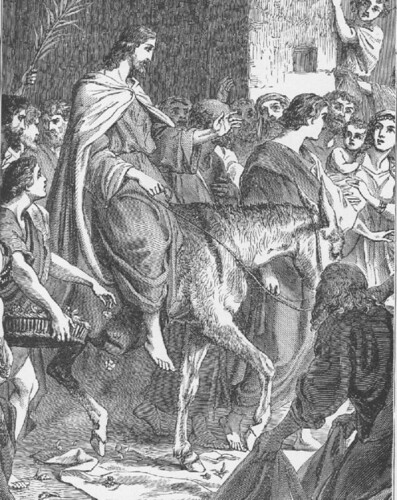
Triumphal Entry

Triumphal entry

I scanned this picture from an old Bible story book, Half Hours With the Bible: New Testament, Being a Consecutive Arrangement of the Narrative and Other Portions of the Holy Scriptures, New York: Clifton Publishing Company, which I got from my parents. The publication date isn't given, but there is an inscription on a flyleaf, dated "Dec 25th 1898." Hence the picture should be public domain, and I offer it as such, if anyone is interested. The artist isn't indicated.


Creative Commons License

This work is licensed under a Creative Commons License.


Saturday, March 19, 2005

Sunspots 2

John Dekker tells me that "Hapax legomena" (One of the curious blog names I mentioned in Sunspots 1) refers to words in a text which only occur once in that text.

* * * * *

John C. Dvorak, computer commentator extraordinaire, says that actual number of active bloggers isn't as large as many people think. He has some other interesting thoughts, in his "Conformism in the High-Tech Era."

* * * * *

Our older daughter informs me, correctly, that I erred in the post on temptations in The Horse and His Boy. It's Hwin, not Whin. Sorry.


Friday, March 18, 2005

Embryonic stem cells without embryos?

An essay, "Eggs alone," in the March 10, 2005 issue of Nature states that normal human females begin their reproductive period with about a million eggs. Ann A. Kiessling, the author, who is at the Harvard Institutes of Medicine, says that the vast majority of these eggs, about 20,000 per year, "die in the ovary." (Volume 434:145--Nature is not freely available on the Internet, but the essay can be obtained here for a fee, and should be available in all university libraries. Nature is among the most important scientific periodicals in English. The original Watson and Crick paper was published there, for instance.)

Some ovarian growths may come from eggs which develop without fertilization. (Such growths occur naturally.) Teratomas, the author says, have some differentiated tissues, indicating that, if they indeed come from unfertilized eggs, such eggs, or the tissue developing from them, might work as if they were human embryonic stem cells. (This article, from eMedicine, indicates that parthenogenesis, or the development of an unfertilized egg, is the most likely cause of such growths, which agrees with Kiessling.) There would be no destruction of human embryos involved in using these as stem cells. As she writes, we would, however, be exchanging "the moral dilemma of using human embryos for obtaining stem cells with the moral dilemma of collecting eggs from the ovaries of women for therapeutic instead of reproductive purposes."

She further writes that, as far as she can see, there would be no moral problems with using such eggs for therapy on the woman who is carrying them, and suggests Type 1 diabetes or spinal-cord injuries as two such applications for therapy from self-derived cells. As she points out, few persons object to storing your own blood for later use in a surgical procedure, and she sees use of egg cells derived from your own body as morally equivalent. It remains to be seen whether this sort of treatment is possible, and would be effective. I would be amazed if there were no moral objections to this, or any other procedure involving human eggs.

Thursday, March 17, 2005

Cal Thomas on Global Warming

A recent column by Cal Thomas (who is an evangelical, I believe) says:

Do evangelicals have time on their hands because they've finished the mission to "go and make disciples of all nations"? Is this not a great enough commission that "global warming" and a host of other "issues" must be added to make evangelicals contemporary and relevant?

Thomas is referring to recent publicity over a position paper, "For the Health of the Nation," from the National Association of Evangelicals, and criticizes two officials of that organization, and Ron Sider, by name. He goes on to write:

Look at past efforts of religious activists — left and right — and note their limited success when the focus has been on transforming culture, rather than converting hearts.

Thomas is correct in believing that the primary business of Christians is to "go and make disciples," and he is also correct that Christians have sometimes ignored this in favor of peripheral causes. Trying to stop global warming, he says, "distracts and dilutes the primary calling of evangelicals." However, there are differences of opinion on whether various causes are issues, or "issues." There are differences of opinion as to whether global warming is a serious threat.

Thomas has taken positions on embryonic stem cell research and the Schiavo case (and other issues). Many evangelicals have taken the same positions that he has on these. Did Thomas criticize them for their activism? Where is his consistency? Are opposition to embryonic stem cell research or trying to thwart the wishes of Michael Schiavo ways of "making disciples?"

Surely Thomas would not have us go back to the days of slavery? Much of the opposition to that awful institution was from evangelical Christians, in spite of supposedly Bible-based justifications of slavery. Christians involved themselves in a social cause while following God's will.

There is a scriptural basis for trying to protect the environment, perhaps as good as those for abolishing slavery or for taking a stand on the Schiavo case. Genesis 1 says that God put humans in charge of other creatures, and the earth itself. The Babylonian captivity of the Israelites was for seventy years, because they had disobeyed God's command to let their land lie fallow every seventh year for 490 years (II Chronicles 36:21). Psalm 24:1 says that the earth is still God's, not ours. God had Noah build a boat large enough for many animals. Matthew 10:29 says that God knows about the death of sparrows. There are other Bible passages which also indicate that we are to be stewards of the earth, taking as good care of it as possible.

Thomas is entitled to his opinion on global warming. Christians can, and will, disagree about the significance of various perceived threats to the environment. But to imply that Christians shouldn't be concerned about the environment is a mistake.

* * * * *

Note added March 19. The Evangelical Ecologist has posted a similar statement here.

Wednesday, March 16, 2005

Colors: White

White light isn't exactly colored light. It is a mixture of all the other colors of the rainbow, at least in theory. White surfaces and objects reflect most colors of light, thus seeming to reflect white light. So white isn't exactly a color, but I'm including it in this series. White is the second most common color word in English.

For anyone who read my other posts on colors (here's the first) I am not going to include white text, as I did for red, orange, yellow, etc.

Easton's Bible Dictionary, available through the Blueletter Bible, says the following, in its article on "Colour": White occurs as the translation of various Hebrew words. It is applied to milk ( Gen 49:12), manna ( Exd 16:31), snow ( Isa 1:18), horses ( Zec 1:8), raiment ( Ecc 9:8). Another Hebrew word so rendered is applied to marble ( Est 1:6), and a cognate word to the lily ( Sgs 2:16). A different term, meaning "dazzling," is applied to the countenance ( Sgs 5:10).

White occurs 75 times in 66 different Bible verses. It is used to describe animal skin color, the effects of leprosy, fabric, snow, cleansing, fields ready to harvest, a white stone given to believers, and a few other items. Revelation has more use of the word than any other in the New Testament.

In our culture, white is often used as a symbol of purity. Brides are supposed to wear white for this reason. One reason that we associate it with purity--it's not the only one--is that snow, after it has cleaned out the acid and particles in the air, is clean and white. There are Christian songs that speak of cleansing, and becoming "Whiter than Snow."

Besides snow, some other important substances are white, including cotton fibers (usually), salt, sugar, milk (usually) and the white of eggs. Part of the visible human eye is white, as are our teeth, ideally. There are white flowers, and white rocks, and white domestic animals. Wild animals in snowy parts of the earth are often white, at least during snow season. Clouds are white, unless they are too thick for much light to get through, or unless tinted red by sunlight near the time of sunset or sunrise.

White blood cells are a vital part of our body's defenses. White matter is part of our brain.

In sports, it is common to mark boundaries in white, and to use white balls, or the equivalent (although not in all sports). In team sports in the U. S., the home team often wears white. (If anyone can tell me why, I'd appreciate knowing.)

Part of the appeal of the bald eagle as a symbol, in the United States, is because of its white head.

Unfortunately, it is possible that prejudice toward dark-skinned persons may be partly because of the symbolic uses, above. Except for albinos, however, no human is really white, which makes preference for white skin seem especially irrational.

White is symbolic in fantastic literature. In Tolkien's Middle-Earth, you can pretty well tell how a race, or an individual, is going to act, based on how dark they are. Generally, the lighter, the better. Gandalf started out as Gandalf the Grey, and Saruman was Saruman the White, but Saruman fell under the influence of the Dark Lord, and became Saruman of Many Colors, while Gandalf fell to his apparent death in Moria, and came back as Gandalf the White. The White Tree was one of the symbols of the kings of Gondor.

The White Witch in C. S. Lewis' Narnia books was not good, but evil. Through the Looking-Glass has white and black chess-pieces. In Ursula K. Le Guin's Earthsea books, most of the characters were meant to be dark-skinned. A recent TV movie adaptation mostly changed that, which understandably upset Le Guin.

White is a common last name. There was a Supreme Court Justice named Byron (Whizzer) White. Some variations are also common, such as Weiss, which is white in German. There are several fairly common last names that include White, such as Whiteside and Weissman.

Since I began these posts on colors, on Feb 14th, I have read some about how we see color. Mr. I was an artist who had become color-blind after an auto accident, and was a patient of Oliver Sacks. He also could not dream or think in color after the accident. Sacks writes that he discussed the case with Francis Crick, among others, and that:

His retinal cones were still reacting to light of different wavelengths, and his primary visual cortex (an area which has been named V1) was registering this information, but it was clear that this wavelength discrimination was not in itself sufficient for the experience of color. The actual perception of color had to be constructed, and constructed by an additional process in another part of the visual cortex.

The experience of white, then, depends, first, upon the effect of white light on sensory cells in the retina. It also depends on additional activity of the brain.

My job, and yours, is to reflect the light, all the light, from the purest Source. May we do so.

Tuesday, March 15, 2005

Sunspots 1

Katherine Fedor, at K's Cafe: The 30 Second Blog, has nailed a lot of us again, and in probably less than 30 seconds. She begins: "Opening my laptop is practically lethal to whatever else I'm doing. It's like diving into the deep, dark chasms at the bottom of the ocean. There's almost no return. . . ."

Don't tell my wife. You don't have to.

* * * * *
Ish commented, wanting to know what the point of cataloging the temptations in the Narnia books might be. Good question. My answer is threefold:
1) Moral choices are usually the most important parts of a story, and temptations, by definition, are moral choices. Consider, for example, Frodo's choice to take the ring to Mordor, and Galadriel's choice not to take the ring when Frodo offered it.
2) The first word in the description of my blog is "musings." One reference says that musing is "a calm lengthy intent consideration." It doesn't say there has to be a point or purpose! Sorry. Sometimes, for me, there probably isn't.
3) I wanted an excuse to re-read the books.

Thanks, Ish.

* * * * *
How creative we can be! Here are some interesting titles for blogs:

Not Crunchy, Pseudo-Polymath, Revenge of Mr Dumpling, Hapax Legomena (I haven't a clue what that means, but the blogger spends a lot of time discussing classic--as in centuries old--Christianity), The Adventures of the Absent Minded Albino, Dignan's 75 Year Plan, Doggie's Breakfast, Unbeknown Paedobaptist, The Duchy of Burgundy Carrots, and The Wildebeest's Wardrobe.


Monday, March 14, 2005

Temptations in Narnia: Horse & His Boy

Shasta, Aravis, Bree and Whin all want to leave Calormene and escape to Narnia. (Bree and Whin are talking Narnian horses who have been captured and have worked in Calormene, without revealing their abilities.) Shasta was found in a boat by a fisherman, who has been hard on him. Aravis is escaping an arranged marriage with an old, ugly man. (Shasta and Aravis are perhaps 15 or so. Both are human.) The four set out for Narnia. They are separated, but eventually get back together, and finally make it to Narnia.

Aravis, Shasta and Bree (who has been a warhorse of a Calormene nobleman) are tempted to pride, and succumb to it. Each of them wants to look good. Bree is afraid that he will look bad in comparison to free Narnian horses. Shasta tries to strike up grand airs. Aravis looks down on Shasta.

Aravis and Shasta quarrel frequently.

Aravis has no concern for a slave girl, whom she drugs, so that she can escape. Aslan punishes her by scratching her in an amount equal to the suffering caused by a lashing of the slave girl.

Shasta steals some supplies, so that the four of them can travel through Tashbaan

Susan, Edmund and Tumnus plan to deceive the Calormenes, in order to escape Tashbaan.

Over and over, Bree is tempted to pride, one of the seven deadly sins.

Rabadash, the Calormene prince, may have lusted (one of the seven deadly sins) after Queen Susan of Narnia. He set out to war on Archenland, without a provocation, and planned to do the same to Narnia, itself. This was probably avarice, one of the seven deadly sins. He was also wrathful, another deadly sin, when he was defeated by the troops of Archenland and Narnia. Aslan struck at his pride, by turning him into a donkey. He was never tempted to leave Tashbaan again, after he was miraculously restored to his human form in front of a large crowd of people, believing Aslan, who told him that he would become a donkey permanently if he left it. Aslan warns him:

"Rabadash," said Aslan. "Take heed. Your doom is very near, but you may still avoid it. Forget your pride (what have you to be proud of?) and your anger (who has done you wrong?) and accept the mercy of these good kings." C. S. Lewis, The Horse and His Boy, New York: Collier, 1954. p. 208.

Sunday, March 13, 2005

Science and the Bible link

David Mobley, at A Physicist's Perspective (you can read his blog, in spite of the title) has expanded on a theme I touched on here, neither of us being aware of the other. Many others have said the same things, namely that God created some people to do science, science can glorify God, and that, properly understood, science and scripture shouldn't conflict.

Orual and Eugene Peterson

I was going to delete the subscription to my Bloglines search for "C. S. Lewis," after seeing another depressing list of a couple dozen hits, most of which weren't (to me) worth reading. But I won't yet. This morning's search turned up an autobiographical testimony of a young man whose repentance and redemption came, in part, because he identified with Orual of Lewis' Till We Have Faces. His blog also led me to an interview with Eugene H. Peterson, who says, among a lot of other things, that "I think relevance is a crock. I don't think people care a whole lot about what kind of music you have or how you shape the service. They want a place where God is taken seriously, where they're taken seriously, where there is no manipulation of their emotions or their consumer needs."

Jaspax, the author of the autobiography cited above, who was raised as a charismatic, also posted a link to something called The Icon Faq, a scripture-based defense of the use of icons in Orthodox religion. Charismatic and Orthodox Christianity are both foreign to me!

This wasn't what I was going to post today, but never mind . . .

Friday, March 11, 2005

Colors: Gold and Silver

The Wikipedia has an article on silver as a color. (There is also one about it as a metal, of course.) The article says that its shine is what makes this color unique. It isn't just a gray. It also says that silver color ". . . cannot be reproduced by a simple solid color, because the shiny effect is due to the material's brightness varying with the surface angle to the light source." In art, therefore, metallic paints are used for silver. Gold does not get an article as a color. The Wikipedia article on gold as a metal says what we already know, namely that gold is a shiny yellow color. The shiny effect presumably is similar to silver's. The same article says something that's probably not well known, namely that gold can be "black, ruby, or purple when finely divided."

One of the 16 standard VGA colors is silver, but, as you can see it's a dull gray, with no luster. (I can see this in FrontPage, which I use to draft these posts. There's a drop-down box with 16 colors, and one of them is named silver. The same is true in other Office applications.) I'm not going to put any gold color on this page. It just wouldn't work. (I did try to add color to my other Colors posts, beginning with Red.)

The word, gold, occurs in 361 verses in the Bible. All but one are about the metal. There are 61 verses with golden. All of these refer to the metal.

Silver occurs in 282 verses. In all of these, the reference is to metal.

There are 164 verses with both silver and gold, 4 with both silver and golden. Clearly, there's a lot in the Bible about these precious metals.

This is the only Bible verse that I could find that comes close to referring to either of these as a color: Psalm 68:13 says: "Though ye have lien among the pots, [yet shall ye be as] the wings of a dove covered with silver, and her feathers with yellow gold." Even this verse may not have meant to refer to colors, but to metal. The idea seems to be that God can turn Cinderella (lying among blackened pots) to a princess.

The word, gold, does occur as a color in popular use. Goldilocks is one example. The story has also been told as Silverhair. (See here for a page on the naming of this tale.) C. S. Lewis wrote The Silver Chair. Senior citizens are sometimes called silverhaired, or are referred to as being in their golden years. Sharon Shinn, one of my favorite fantasy authors, wrote Heart of Gold, about a race of people who were gold colored. Galadriel, the most important elf in J. R. R. Tolkien's Lord of the Rings books, probably was named for her golden hair, which was characteristic of her family. The Ring, itself, may have been made of gold, but, if so, it had properties that ordinary gold does not. As in the Bible, the main use of the word gold (and silver) in our culture is as a precious metal, valuable, shiny, and easily workable.

Gold, Silver, and Golden occur occasionally as last names. So do Goldblum, Goldberg, Goldsmith, Silverberg, and other variations. Robert Silverberg is an important author of fantastic fiction. See here for my page (not post, at least not yet) on some of his works.

These posts are not about metals, but colors. Nonetheless, I quote Lamentations 4:1: "How is the gold become dim! [how] is the most fine gold changed! the stones of the sanctuary are poured out in the top of every street."
Also James 5:3 "Your gold and silver is cankered; and the rust of them shall be a witness against you, and shall eat your flesh as it were fire. Ye have heaped treasure together for the last days."
Gold doesn't become dim, and neither metal can be cankered, but God was using these statements to show that purity is not necessarily permanent.

Peter compared the Christian life to the purifying of gold by heat: 1 Peter 1:7: "That the trial of your faith, being much more precious than of gold that perisheth, though it be tried with fire, might be found unto praise and honour and glory at the appearing of Jesus Christ:"

I'm planning future posts on white and black.

I hope that I shine, because I am pure.

Thursday, March 10, 2005

From other sources

From a missionary's e-mail, a prayer request, which, for me, was also a serious challenge: "As my plate is getting fuller, please pray that my time alone with the Lord will not be compromised. This is the most important element of my life in [Country X], in [City Y], SC, anywhere I live. It is so easy for me to get wrapped up in ministry preparations as Martha did and forget that sitting at the feet of Jesus is the best option. Pray that I am found at the feet of Jesus more than at the 'act' of ministry."

K's Cafe has a splendid parody of Habakkuk 3:17-19, which begins:

"Though there are spiders in the toilet
and cockroaches in the garage,"

Ish, of The Path, deserves a wider audience, and not just because this post, "A Life of Service: Musing on the small things done for God" refers to one of my posts. Hers (?--may be his) should be read for its own sake. Unfortunately, for some reason Bloglines reports that her site has no RSS feed.


God willing, I will finish the series on colors, and that on temptations in the Narnia books. Thanks to anyone who is reading this.

Wednesday, March 09, 2005

Technology: Some biblical basics

Let's say that technology is the application of science. The distinction between these two servants of mankind is not always clear, but let's say that science discovers phenomena, and technology puts these discoveries to use. (This Wikipedia article considers the relationship between science, technology, and engineering)

I Kings 4 says that "And God gave Solomon wisdom and understanding exceeding much, and largeness of heart, even as the sand that [is] on the sea shore." (verse 29--all quotes from scripture are KJV, as it is public domain) It goes on to say that he described plants, and taught about various kinds of animals.

Proverbs 25:2b says that "the honour of kings [is] to search out a matter." These passages imply that trying to make scientific discoveries is part of what humans should be doing.

One sort of "matter" that can be searched out is how the universe is made, including how living things are made. In this sense, scientists are pursuing glory. One of the best examples of this was the astronomer Johannes Kepler, who discovered the orbits of the planets then known, and the relationships between these orbits. "When he finally hit upon that secret key to the universe, he attributed it to Divine Providence. . . 'Now, however, behold how through my effort God is being celebrated in astronomy.'" Owen Gingerich, The Eye of Heaven: Ptolemy, Copernicus, Kepler. (New York: American Institute of Physics, 1993. Quote is from p. 307. Gingerich gives the source of his quotation of Kepler as a letter to Maestlin, one of Kepler's teachers, written October 3, 1595.)

To bring the notion of science discovering something about God—pursuing glory—closer to our own time, Francis Collins, director of the National Human Genome Research Institute (also known as the Human Genome Project), said "When something new is revealed about the human genome . . . I experience a feeling of awe at the realization that humanity now knows something only God knew before. It is a deeply moving sensation that helps me appreciate the spiritual side of life, and also makes the practice of science more rewarding. A lot of scientists don't know what they are missing by not exploring their spiritual feelings." (Quoted by Gregg Easterbrook in "Science and God: A Warming Trend," Science 277:890-893, 1997. Quote is from page 892.) Science, the discovery of phenomena, can be an activity that glorifies God. What about technology, putting these discoveries to use?

Some Negatives about Technology
There are at least three biblical passages that indicate how technology may be wrong, or at least misused.
First, worshipping the results of our technology is wrong, as well as just plain stupid. Isaiah 44:9-20 tells about someone making an idol and then worshipping it.

Second, pride in our accomplishments is wrong. Daniel 4:30-32 tells about the king taking pride in the city of Babylon, because he built it. (He probably didn't do any of the actually physical work himself). God should get the credit for our accomplishments.

Third, supposing that there are no limits to human ability is wrong. Genesis 11:5-9 tells about the builders of the tower of Babel, who thought that there was no limit to what they could do. According to the Bible story, God destroyed their ability to work together.

 There are times when we seem to have violated one or more of the above. Although, for example, there is at least one Christian involved at high levels of the Human Genome Project, all of the staff are not Christians, and there may be inordinate pride in the accomplishments, and some of the participants may suppose that there is no limit to human ability.

Besides the above principles, based on scriptural accounts of human experience, scripture has more general principles, including the Golden Rule (Matthew 7:12) which requires us to act toward others only in ways that we would wish them to act toward us, and the Ten Commandments (Exodus 20:1-17, Deuteronomy 5:6-21), which, among other things, prohibit idolatry, murder, adultery, stealing, and coveting the possessions of others. Using technology to enslave, murder or steal the possessions of others would be violations of the Golden Rule and the Ten Commandments. Using the Internet to access pornography (coveting and adultery in cyberspace) also would be. Note that in all of these cases, the technology isn't intrinsically wrong, but it is put to a wrong use.

A further problem with technology is degradation of the environment. Scripture teaches that the earth is God's, not ours (Psalm 24:1). Humans were given stewardship—put in charge of the earth and its organisms (Genesis 1). Noah was to rescue not just humans, but the animals (Genesis 7). Jesus said that God is concerned about the sparrows (Matthew 10:29). It seems clear that humans have not taken the care of the earth that they should have, and technology has too often assisted in this poor stewardship of the environment, in fact, leading to its degradation.

Some Positives about Technology
Although there are ways in which we can misuse technology, there are Bible stories that seem to affirm the use of current technology, and the development of new technology.
Technological development can sometimes glorify God. Noah's ark, the tabernacle and the temple were technological constructs, and God gave instructions for the building of each of them. In the building of the temple, and other projects completed during the reign of Solomon, there was apparently extensive use of resources. Solomon sent 10,000 workers to Lebanon to cut down cedar trees each month (I Kings 5:14), in addition to the servants of King Hiram who helped them. They may have worked there for as long as seven (I Kings 6:38) or even twenty years (II Chronicles 8:1). All this was at least allowed by God, and some of it was directed by Him. Jeremiah 22:6 contains an amazing statement. This verse says that God finds the royal palace (not the temple) at Jerusalem as beautiful as the mountains of Lebanon. If God can find a human construction to be beautiful, and one that is created to satisfy human needs, then we surely can, too, at least sometimes. It would seem that technological development, by and of itself, is not wrong, although it may be done for wrong reasons, or with the wrong attitude.

Part of the image of God in humans may be the desire to create things. (See below) The fact that we can create and use technology has certainly lead to some unfortunate consequences, such as radioactive nuclear waste and child pornography on the Internet, as well as more commonplace tragedies, like deaths and injuries in highway accidents. It may also lead to our being able to alleviate some of the consequences of our own mistakes of the past, or even some of the consequences of the fall. Our desire to create things has led to the creation of great art, music and literature, plus useful articles of clothing, furniture, tools and recipes. These are fortunate consequences of technology, probably a consequence of the image of God in humans.

Technology can be used to make us better stewards and ministers. We live in a fallen world. Whatever Eden was, and was like, we aren't in it, and don't deserve to be. Fallen creatures that we are, we have done things with technology that we should not have. However, we also can do good. We can track populations of endangered species. We can help people be healthier, and obtain food that wouldn't otherwise have been available. We can enable the Good News to be spread widely and rapidly, in ways that grip the viewer, listener, or reader, using technology.

I try to be a good steward, and support uses of technology, and development of new technology, that seem designed to benefit, not harm. I try to obey the Golden Rule. I know that humans in general, and I personally, have made and will make mistakes in this area.

A verse that is very relevant to all of the above, and summarizes it nicely, is I Corinthians 10:31 ("So whether you eat or drink or whatever you do, do it all for the glory of God.") May that summarize our uses of technology!

Is the development of technology really a part of God's image in humans?I, do not, of course, have a firm answer. God did command Adam and Eve to take care of the garden before the fall, but there does not seem to be any firm evidence that they sought knowledge, except, of course, for their desire for the forbidden fruit.
There seem to be three possibilities:
1) The pursuit and application of knowledge were present before the Fall, but the Bible says nothing about them. (The Bible says very little about any aspect of human life before the Fall.)

2) The pursuit and application of knowledge are not part of God's image, but of our fallen nature. If that's true, then God has certainly allowed this aspect of us to be used, and it is at least a God-enabled ability. Theologians generally seem to believe that creative instincts are part of God's image. They can be warped by Satan, but Satan created none of these.

3) Humans had the potential to pursue and apply knowledge before the Fall, but these were not needed in an unfallen world.

I thank many of my students, and various authors and speakers, for most or all of these ideas.

Thanks for reading!

Tuesday, March 08, 2005

Temptations in Narnia: The Silver Chair

It had been a few years since I read the Narnia series, but, if I had had to pick a favorite, without re-reading, I would have named The Silver Chair. I had forgotten some of the reasons. Most of them are set out below. They involve a really great character, Puddleglum, the quintessential pessimist, and many moral choices/temptations.

In The Silver Chair, the Pevensie children do not appear. Eustace, their cousin, from The Voyage of the Dawn Treader, who was a "record stinker," and also became a dragon, but was cured of both of these, is involved. He involves Jill Pole, a schoolmate. The two of them are drawn into Narnia, as they are trying to get there to escape hazing from schoolmates. Aslan has called them to Narnia to find the lost prince, Rilian, King Caspian's son. (This is the same Caspian as in the previous two books, Prince Caspian: The Return to Narnia, and The Voyage of the Dawn Treader. He is much older in Silver Chair. Eustace is a little older than he was on his first trip to Narnia.) They come into the same planet (?) as Narnia, but enter it on a high mountain, overlooking Narnia proper, a long way from it. This appears to be one part of Aslan's country.

Jill is tempted to show off in front of Eustace, at a steep cliff, and does. As a result, Eustace falls down. Aslan saves him by blowing him to Narnia. This is an example of pride.

Jill is tempted to not drink, and not to trust the Lion, but does trust him.

Jill and Eustace are tempted to squabble over Jill's actions on the mountain, and do.

Caspian is tempted to kill Drinian, who did not stop Rilian from seeking the green lady. This would have been an example of wrath, one of the seven deadly sins. He does not do so, and forgives Drinian.

Rilian was ensnared by the green witch. Was this a temptation? If so, it was probably partly lust, one of the seven deadly sins.

Jill is tempted not to repeat the signs Aslan has told her to remember and repeat to herself. She succumbs:

. . . whatever the Lady had intended by telling them about Harfang, the actual effect on the children was a bad one. They could think about nothing but beds and baths and hot meals and how lovely it would be to get indoors. They never talked about Aslan, or even about the lost prince, now. And Jill gave up her habit of repeating the signs over to herself every night and morning. She said to herself, at first, that she was too tired, but she soon forgot all about it. And though you might have expected that the idea of having a good time at Harfang would have made them more cheerful, it really made them more sorry for themselves and more grumpy and snappy with each other and with Puddleglum. C. S. Lewis, The Silver Chair, New York: Macmillan, 1953, p. 77-78.

This isn't any of the deadly sins, unless it's sloth. My take on this is that apathy and neglect are as bad or worse than any of the deadly sins.

Jill and Eustace are tempted to pay attention to the charm and beauty of the green witch, and do so.

After missing two of the signs, and also beginning to eat talking stag without realizing it, Eustace, Jill and Puddleglum escape the giants of Harfang house, and get into a vast system of caves. They are tempted to doubt the authenticity of the sign that they followed in getting into the subterranean realm.

They saw the ruined city of giants out of a window in Harfang, and saw that UNDER ME was carved into the pavement. Jill had been told to look for a writing on the stones in the ruined city. They are captured, and, finally, brought to Prince Rilian. (He is enchanted, and doesn't realize who he is, except for an hour every night.) He mocks their interpretation of the meaning of this writing. Puddleglum responds:
"Don't you mind him," said Puddleglum. "There are no accidents. Our guide is Aslan; and he was there when the giant king caused the letters to be cut, and he knew already all things that would come of them; including this." C. S. Lewis, The Silver Chair, New York: Macmillan, 1953, p. 131.

They are tempted not to follow the fourth (and last) sign, when Rilian, sane, but tied in the silver chair that renews his enchantment every night, asks them, "by Aslan himself" (p. 141) to cut him loose. They decide to cut him loose.

They are tempted to believe the witch, who tries to persuade them that there is no world aboveground, no Aslan, and enchant them all, as well as enchanting Rilian again. All try to resist, but are almost ensnared. Finally, Puddleglum extinguishes the witch's fire, which was producing enchanting smoke, by stamping on it with his bare webbed foot, and frees them from the spell. This illustrates I Corinthians 10:13, where God promises a way of escape, if we want one.

Aslan forgives them for the temptations succumbed to:

They turned and saw the Lion himself, so bright and real and strong that everything else began to look pale and shadowy compared with him. And in less time than it takes to breathe Jill forgot about the dead King of Narnia and remembered only how she had made Eustace fall over the cliff, and how she had helped to muff nearly all the signs, and about all the snappings and quarrellings. And she wanted to say "I'm sorry" but she could not speak. Then the Lion drew them towards him with his eyes, and bent down and touched their pale faces with his tongue, and said:
"Think of that no more. I will not always be scolding. You have done the work for which I sent you into Narnia." C. S. Lewis, The Silver Chair, New York: Macmillan, 1953, p. 202.

And there will be an end to temptations:

"Sir," said Caspian. "I've always wanted to have just one glimpse of their world. Is that wrong?"
"You cannot want wrong things any more now, that you have died, my son," said Aslan. C. S. Lewis, The Silver Chair, New York: Macmillan, 1953, p. 205.

I have included another quote from this book in a post on a different subject.

This is the fourth in a series, which began with this post.

Monday, March 07, 2005

Should pig cells be transplanted into humans?

Catez put up an interesting post, asking whether Christians should oppose incorporating pig cells, which apparently were to reproduce in their host, into humans. Like Catez, I have no clear answers.

Leviticus 19:19 says: Ye shall keep my statutes. Thou shalt not let thy cattle gender with a diverse kind: thou shalt not sow thy field with mingled seed: neither shall a garment mingled of linen and woollen come upon thee. (KJV)

These prohibitions against mixing things were in the context of having the Israelites show God's holiness. The first prohibition seems to speak against crossbreeding different stocks, and says nothing directly against incorporating tissue from other species into humans. However, even the prohibition as it reads doesn't always seem to have been followed. Why do I say this? There are seven verses in the Bible that include the word "mule." (II Sam. 13:29, 18:9, I Kings 1:33, 38, 44, Psa. 32:9, Zec 14:15) Mules, as we now use the word, and, presumably, as it was used in the Old Testament, are a cross-species hybrid, between horses and donkeys, which sounds like a "diverse kind" to me. Some research with the Blue Letter Bible indicates that the I Kings 1 verses translate the Hebrew pirdah as mule, and that this Hebrew word occurs nowhere else in the Bible, so it is doubtful if it meant anything but a mule, at least here. All three of the uses in this chapter are commands given by King David, to have his son, Solomon, ride David's mule to his coronation ceremony. There is no indication here that God abhors mules. On the contrary, this one was used for an important ceremony, with religious overtones.

If crossing horses and donkeys did not earn God's wrath in Old Testament times, my guess would be that incorporating pig tissue into humans is not prohibited, in and of itself.

A question that should be asked about any proposed scientific development is "what is the motive?" If the motive is self-promotion, bring about someone's destruction, unjustly taking advantage of other people, or destroying a significant part of God's creation, any type of human endeavor, scientific or otherwise, is suspect.

Using pig pancreas cells in a human to help her with a diabetic condition should have been motivated from a desire to help her live a reasonably normal life. I hope it was.

There have been more questionable uses of cross-species tissue growth. An article in New Scientist, Feb 28, 2004, "Art, but not as we know it," reported on the artist, Laura Cinti, who placed cells producing human hair into cacti, where they were able to produce hair, at least for a time. (Only the response to the first question posed to Cinti is now available freely, here. You can pay for the rest of the article.) This may have been mostly self-promotion, and therefore seems suspect, but I don't want to get my blog into the field of art criticism.

When smallpox vaccination, using cowpox germs to engender an immune reaction to smallpox, which is antigenically similar, was first proposed, there were complaints that this was unnatural, and cartoons showing humans with cow's heads growing out of their bodies. Most people now take the use of non-human tissue for medical reasons as a matter of course. (However, the development reported in the post by Catez is different, in that this procedure uses living pig tissue, not merely materials produced by a pig, cow, or bacterium, in a human.)

If the decision were up to me, I'd say, prayerfully, that God gave us abilities to help others, and put us, at least temporarily, in charge, and that transplanting cells from a different species into humans, to help them with a medical condition that doesn't seem remediable by other means, is acceptable.

Sunday, March 06, 2005

Colors: Purple, Scarlet & Crimson

It's time for another post on colors. I'm combining three of them in a single post.

Here are the Wikipedia articles on purple, scarlet, and crimson. Crimson is bluer than scarlet. Purple is bluer still, according to these articles. All three of these, unlike brown, are colors of the rainbow. There are, I'm sure, differences of opinion as to what is purple, what blue, what red, what scarlet, and what crimson.
Easton's Bible Dictionary has an interesting article on colors in the Bible. It says that both purple and scarlet were worn by the wealthy and important. Purple was worn by kings.

Purple occurs 48 times in the Bible. 26 of these are in combination with blue and scarlet, in various fabrics associated with temple worship. Most of the other references have to do with clothing worn by royalty, including Jesus, who was mockingly given a purple robe to wear (John 19:2, 5). Lydia, perhaps the first convert to Christianity in Europe, was a merchant of purple cloth (Acts 16:14).

Scarlet occurs 52 times in the Bible. Half of them are in the combination of blue, purple and scarlet, as above. Scarlet is used to describe our sins in Isaiah 1:18. Scarlet thread is used in rituals for cleansing, especially in Lev 14:4-52. Rahab hung scarlet thread in her window, so that her family would be spared when Jericho was taken. (Joshua 2:18, 21) Scarlet thread was used to identify the first-born twin when Tamar had Judah's sons. (Genesis 38) There is a woman in Revelation, who sits on a scarlet beast, and wears scarlet. (Chapter 17)

Crimson occurs five times in the Bible. Three of them are in II Chronicles 2:7 through 3:14, referring to temple furnishings. One is in Isaiah 1:18, where our sins are compared to both scarlet and crimson, probably for emphasis, but where they will be made white. (There are several songs that speak of the transition from crimson, or scarlet, to white.) The fifth is in Jeremiah 4:30, where it says that even though Israel clothes herself in crimson, she will be punished.

Vine's Expository Dictionary of New Testament Words (accessed through the Blue Letter Bible) says that the word for crimson is derived from an Arabic name for an insect which was the source of scarlet dye. Easton's Bible Dictionary (also accessed through the Blue Letter Bible) says that scarlet and crimson "were the firmest of dyes, and thus not easily washed out."

Roman Catholics have used purple to indicate penance. As I write, there are many churches that have placed a purple cloth draped over a cross on their lawns, to commemorate Christ's suffering.

Here's an example of blood being scarlet, or at least redder than red:
And there, on the golden gravel of the bed of the stream, lay King Caspian, dead, with the water flowing over him like liquid glass. His long white beard swayed in it like water-weed. And all three stood and wept. Even the Lion wept: great Lion-tears, each tear more precious than the Earth would be if it was a single solid diamond. . . .
"Son of Adam," said Aslan, "go into that thicket and pluck the thorn that you will find there, and bring it to me."
Eustace obeyed. The thorn was a foot long and sharp as a rapier.
"Drive it into my paw, son of Adam," said Aslan. . . .
"Must I?" said Eustace.
"Yes," said Aslan.
Then Eustace set his teeth and drove the the thorn into the Lion's paw. And there came out a great drop of blood, redder than all the redness that you have ever seen or imagined. And it splashed into the stream over the dead body of the King. . . . And the dead King began to be changed. His white beard turned to grey, and from grey to yellow, and got shorter and vanished altogether; and his sunken cheeks grew round and fresh, and the wrinkles were smoothed, and his eyes opened, and his eyes and lips both laughed, and suddenly he leaped up and stood before them--a very young man, or a boy. . . . And he rushed to Aslan and flung his arms as far as they would go round the huge neck; and he gave Aslan the strong kisses of a King, and Aslan gave him the wild kisses of a Lion. C. S. Lewis, The Silver Chair, New York: Macmillan, 1953, pp. 203-4.
U. S. military personnel wounded in combat may be given a purple heart. There is a bird named the purple 
martin.

Nathaniel Hawthorne wrote The Scarlet Letter, wherein Hester was forced to advertise her adultery by wearing a scarlet A, and Sir Arthur Conan Doyle wrote A Study in Scarlet. Scarlet fever is an infectious disease. There is a bird named the scarlet tanager.

Alabama sports teams are known as the Crimson Tide. Harvard publishes a newspaper called the Harvard Crimson.

Scarlet, crimson and purple have a lot of significance. They signify the cleansing blood of Christ, royalty, and being specially marked.

Thanks for reading!

Saturday, March 05, 2005

To Grandmother's: A Cautionary Tale

She was a good girl, and she loved her grandmother. Her mother called her away from the TV, and said, "Your grandmother is sick. Please go over there and take this basket for her. I'll call and tell her to unlock the door for you."

She took the basket, which had bananas, chocolate candy, and other attractive goodies, and went through the alleys and the empty lots to her grandmother's house.

On the way, she met a wolf. Now, she hadn't read the right stories, and so she didn't know he was a wolf, but he had, and he was. He politely asked her where she was going. She gave him the address. The wolf said, "Have a nice walk!" and scooted off to the address by way of a couple of dark shortcuts.

Now, depending on whether you have read this story in the KJV or the NIV*, the wolf either:
1) ate the grandmother, and put on her nightclothes, or
2) scared the grandmother into enough health that she ran out of the house, grabbing her cell phone on the way out.

The wolf scrounged around in a drawer or two until he had something to wear that looked like what the grandmother had been wearing. When she came to the door, and, like the wolf, found it open, she came in. The wolf was lying in the bed, pretending to be her grandmother.

Well, the stories say that he told her that his voice was low because he was hoarse from being sick, that his eyes were big so he could see her, and that his ears were big so he could hear her, and that his teeth were big so he could eat her. After that, either he did eat her (KJV) or she ran away, and got a cop to come in and finish off the wolf (NIV). The cop was already on the way there, after 911 was finally convinced that the grandmother, though hysterical, had called in a real emergency.

Did you ever hear anything so ridiculous? What granddaughter with an IQ higher than that of a pickled pig's foot would confuse her grandmother and a wolf, under any circumstances? None, that's who. So what did go on in Little Red Riding Hood's brain? (Whoops--I gave it away . . . ) What went on in Little Red Riding Hood's brain is that she found the wolf strangely attractive. If she hadn't, she would have known that it wasn't her grandmother after the first question, even if the bedroom was totally dark. So she just hung around, when she should have run out of there at top speed.

James says that we are "drawn away of . . . [our] own lust, and enticed." (1:14, KJV) That's what really happened to Little Red Riding Hood. May I be certain that it never happens to me.

This post combines (sort of) two series, one on colors, and one on temptations. I plan to continue both.

*See here for one version of the story, in which LRRH is surgically released from the wolf, after being swallowed. Here's another, in which the wolf just eats her.

* * * * *

Our youngest daughter suggested that I would be interested in the James Thurber and Roald Dahl versions of LRRH. I was. Both of them involve pistols, which is not characteristic of our pacifist daughter. She also suggested the Steven Sondheim "Into the Woods" lyrics, which have LRRH speaking here. (Scroll the text, or search for LRRH). Thanks!

I also made one correction above, and am reposting and changing the date and time.

Temptations in Narnia: Prince Caspian

Prince Caspian: The Return to Narnia is the second book (in the order that C. S. Lewis wrote them) in the Narnia series. The four Pevensie children are called back to Narnia, centuries after the events in the first book (time in England and Narnia isn't synchronous) to rescue Prince Caspian, the true king, who is being attacked by his uncle, the usurper, Miraz. Here are some of the main instances of moral choice/temptation in this book:

Trumpkin, the dwarf, doubts the authenticity of the Pevensie children, who are the Kings and Queens of Narnia returned. He finally accepts them for real, but it takes a while. Here, then, is a temptation that isn't on the list of seven: doubt. Lewis believed that doubt was important. He wrestled with doubts when his wife died. John 3:16 emphasizes doubt's opposite, belief. The Old Testament emphasizes that the Israelites sinned because they doubted what God had done for them.

Aslan tells Lucy that the children, and Trumpkin, are to go a certain way. The others don't believe that she has heard directions from Aslan. Later, Aslan tells Lucy that it would have been better if she, by herself, had followed his directions.

Nikabrik, the dwarf, is tempted, and succumbs to it, to ally himself with a hag and a werewolf, and even to have these bring back the White Witch (which doesn't happen).

Reepicheep, the mouse, is tempted to put honour too high in his scale of values. Aslan chides him for this, but seems to decide to overlook it.

Glozelle and Sopespian are tempted to assassinate Miraz, and do so.

Aslan, Bacchus, Susan and Lucy travel through some towns. The inhabitants are asked to join them. Most are tempted not to, and don't.

Brown again

Jeremy (I recommend his blog highly) comments that he believes brown "does appear in the rainbow. It's just not one of the major colors that we organize colors according to, so we don't notice it except as a passing color." I don't think so.

Let me use an analogy to explain. Musical instruments, or the human voice, don't emit pure tones, with only a single wavelength and frequency. The violin string, or the trombone, vibrate at the frequency of the tone the musician is trying to produce, and also at higher frequencies, called overtones. The pattern of these is one of the things that enables us to tell a violin from a flute, or to tell different voices apart. If we could produce musical instruments that produced a single tone, we could still get combinations, by having more than one played at the same time, or, on a piano, by playing more than one note at once. We call these chords. They produce harmony.

Well, light consists of discrete waves/particles, each with a single frequency. Some of them, with particular frequencies, are red, for example. Others are yellow, etc. There aren't any single waves/particles that are brown, or white. Brown and white are the light equivalent of chords. For sound, the ear and the brain put two or more frequencies together to make a chord. For light, the eye and the brain put many colors together, and we perceive white, or a couple of colors together, and we perceive brown. Brown isn't part of the rainbow.

Thursday, March 03, 2005

Temptations in Narnia: Lion, Witch, & Wardrobe

It's been a while since I posted any "Musings on . . . fantastic literature." (Cybernarcissism-I'm quoting the About section of my blog page.)

My intention, God helping me, is to begin a series on temptations in the Narnia books, by C. S. Lewis. This is the first of that series. I expect to deal with Tolkien, and probably also with Patricia A. McKillip.

Here's an article on temptation from the International Standard Bible Encyclopedia.

A temptation, let us say, is an enticement to do wrong. However, let us say further that you aren't doing wrong if you have no choice in the matter. Temptation, nearly always, means that you are making a moral choice.

I am not attempting to summarize the seven books, at least not directly. They still appear on lists (here's one, and here's a page for teachers about Lewis' books) of good fiction for children, not specifically because of their moral lessons, but because of their stories. Moral choices are part of most good stories. Also, because of their characters. The children are appealing characters. Reepicheep, Puddleglum, and even Uncle Andrew are marvelous creations. A movie, or movies, is in production, based on one or more of the books. (Here's the movie site on the books, which is a good introduction to them.)

I think I know that the characters aren't real people, and that speculating on their moral lives is fantasizing about fantasy, but never mind.

The historic church used to emphasize seven deadly sins. According to the Wikipedia, they are as follows:
Pride
Envy
Wrath
Sloth
Avarice (covetousness, greed)
Gluttony
Lust

I shall attempt to associate some of the temptations with these sins. I don't think that all of the temptations in the Narnia books fit into any of these seven categories.


The Lion, the Witch and the Wardrobe

Edmund is tempted to betray Aslan and his siblings. He yields, for a time, falling into the service of the White Witch. He is also tempted to pretend that Lucy has imagined their visit to Narnia, and yields to that, too, betraying her. Part of his temptation is to pride. Some of it is envy of Lucy.

After Edmund has repented of his (may I say it?) sin, Lucy is tempted to spend too much time with Edmund when he is wounded, when she should have been attending to the healing of others. Aslan rebukes her.

I'm not sure that the White Witch, her dwarf, or the wolf, Fenris Ulf, are really tempted. They seem to just do evil when the opportunity presents itself. One of the features of the Narnia books is that some species of sentient, rational beings seem to never do wrong (like the beavers) and some of them seem to never do right (like the wolves or the hags). I'm not sure that these are really tempted, or can be.

There are people out there who know these books (and/or temptation!) well. Please feel free to comment.

Wednesday, March 02, 2005

Colors: Gray

Gray is commonly used to indicate uncertainty or ambiguity, as in "that's a gray area." (See my post, only partly tongue in cheek, on my own uncertainties.) It is also used to indicate gloom or despair, as in "gray skies."

The Wikipedia article on gray says that it is produced by mixing black and white. You won't find gray in rainbows, because it is a mixture.

Gray is also spelled grey, in British English.

There are six uses of the word, gray, in the Bible. All of them are in the Old Testament, and all of them refer to the hair of older persons. Gray is used to refer to older people now, as in "gray power."

The brain contains gray matter.

Grayscale images are images with shades of black and white. Black and white TVs are actually grayscale TVs.

The South mostly wore gray in the Civil War. There are gray squirrels, and gray foxes.

Gandalf the wizard was called Gandalf the Grey in Tolkien's books. He became Gandalf the White later.

Eeyore, in Winnie-The-Pooh, was an old grey donkey.

I wish I had put this sort of thing in earlier, beginning with my post on red, but I attend a non-liturgical church (We have our rituals, but they aren't printed in the bulletin!) and it just didn't occur to me. Our younger daughter attends one, and she reminded me that, to liturgical churches, colors have significance in worship. I did a Google search, something like "blue green Episcopal," and the first hit was here. This church's web page had the following table on the significance of these colors in worship:

BLUE - heavenly strength and faithfulness
WHITE - purity, innocence, and joy
GOLD - purity and splendor
RUBY or RED - the blood of life, sacrifice, and therefore, love
GREEN - Spring, hope, eternal life, and the Holy Trinity
YELLOW - the revealed truth, as the sun breaking through clouds after a storm
BROWN - the earthly, or the mundane
GRAY - the earthly, or mundane, and humility
PURPLE and VIOLET - royalty, or penance

I thank the church, and my daughter, and I'm sorry I didn't think of this earlier.

Having been properly humbled (gray signifies that) I close this post. Thanks for reading.

* * * * *

My wife found a typo in this post, which I have corrected, as of March 5th, 4:11 P. M. EST. Thanks to her, and I should be even more humble.

Tuesday, March 01, 2005

Immune system, again

Mike Russell, at Eternal Perspectives, has answered his own question on the origin of the immune system. He believes in the gap theory. Not a lot of people do, but those who do often know a lot about the Bible, including something about its original language.

My musings on his question are here. Another way of putting the question is "when did non-human organisms start to die?" I don't think there is an answer that will satisfy everybody.

Gray (or is it grey?)

I think Thomas is my favorite bible character, but I’m not sure. Maybe it’s Gideon. Maybe not.

Some people never seem to doubt anything. They seem to have the answers to every question, and they think their answers are God-given. For example, some people say, in unequivocal terms, that the current Israeli regime is always right, and the Palestinians are terrorists, and always wrong, on the authority of scripture. They ignore scripture that indicates that God's promise of the land to Israel came with conditions. They are sure God brought the Israelis back, when it may have been earthly powers who did. Some people understand what the bible says about the origin of human beings, eternal security, baptism, church government, and speaking in tongues. They know what kind of church music is best. They have the correct answers all ready, with no exceptions or ambiguity. It’s all black and white. No gray. That’s not me. I’m gray around my face, and my brain has gray matter. I also think in gray a lot. I can see more than one side to most questions.

Part of my trouble is that I’m an academic. Academics are supposed to argue about questions and answers, and to present more than one side of an issue if they are teaching or writing about it. (They also often use parentheses, and maybe footnotes1, to set out contrary positions as fairly as they can.) But that’s not the whole story. There are academics who argue passionately for one side in some quarrel or other, and don’t seem to credit the other side with any sense whatsoever.

Am I right? Are the black and white people wrong? Naturally, I’m not sure.

One thing that I have noticed is that the black and white thinkers don’t always agree with each other. The question of eternal security will do here. There is scripture to support more than one side of the disagreement over whether, once saved, you are always saved, but you’d never know it from listening to many Christians. There’s only one way, and that’s it. Trouble is, someone else says the same thing about a different way. So there is a problem with being black and white on issues—you can be loudly and spectacularly wrong, or at least disagreed with.

On the other hand (of course!) there are problems with being gray. I can think of but two times when a biblical character is mentioned as being unsure. One of these is Thomas. The other is Gideon. That’s not very many. Paul and Peter, and the other writers of the New Testament, don’t seem to be exhorting us to be wishy-washy, or to nurse our doubts. Quite the contrary. So there’s also a problem with being gray.

I take some consolation from Gideon. Even though an angel appeared to him, and spoke to him, he still wasn’t sure. He asked for a sign. (More than one, in fact) And God didn’t strike him dead for testing Him. God gave him his signs. (I thought the angel was one!) God is not threatened or challenged if I’m really not sure about what He wants me to do, or believe.

I also take some consolation from Thomas. He refused to believe eyewitnesses. He wanted absolute proof. And then, Christ gave it to him. If I really need a sign, or a divine revelation, God can do that.

There are some gray questions, and some gray-thinking people. But there are some things that are certain. Even Thomas testified to that. He proclaimed Jesus as dead and risen Lord. My conclusion (I think) is that lots of things are uncertain, and it’s OK not to be sure of everything, but I’d better be sure of a few things, and the right ones. Thomas doubted, but he got the most important answer right. Jesus is the risen Lord and Christ. (John 20:28) That’s one thing I’d better be black and white on. The rest? Mostly gray.

1This footnote is to notify my regular readers that I intend to produce another post on Gray, at a later date, more or less like the one on, say, Green.

* * * *

August 24, 2009: That post is here.


Creative Commons License

This work is licensed under a Creative Commons License.


Monday, February 28, 2005

Colors: Brown

Brown doesn't appear in the rainbow. Nevertheless, we can see brown. What's going on here?

Here's the Wikipedia entry on brown. The article says that brown is a mixture of two colors (more than one such pair exists, according to this reference.) If that is true, then brown can't be in the rainbow, because the colors mixed are not adjacent to each other.

Here's another reference on the same question, which comes to the same conclusion.

The King James Bible has just four references to brown, all of them in Genesis 30, and all referring to the color of a domestic animal. I confess that I've always had trouble with this passage. The Bible describes Jacob gaining livestock property from his father-in-law by, Genesis says, exposing animals, in the act of mating, to certain visual stimuli. From this I conclude (as if I needed this passage to prove it) there are things I don't understand about the Bible. (I think I understand as much as I need to.) My take on what happened is that Jacob thought doing this would work. God knew it wouldn't, but intervened on Jacob's behalf, anyway.

It seems strange that there are no references to brown earth, brown rocks, brown wood, or brown bread in the Bible. I suppose that, like us, people living back then took these things for granted, and didn't describe them much.

There is a National Football Team, the Cleveland Browns. (To me, their color is orange, not brown!)

One of Tolkien's wizards was Radagast the Brown. Tolkien didn't write a lot about him.

I suppose any article on brown should refer to Charlie Brown, the main character of Peanuts.

There are star-like objects, called brown dwarfs. The Wikipedia article on them says that they are probably the most common objects at or near the size of stars in our galaxy.

I hesitate to say this, having mentioned the appropriate bodily function in a recent post, but excrement is usually brown. The reason is that bile, one of the important products of the liver, by way of the gall bladder, is brown. As this page from the MadSci network says, it could be worse.

Brown vs. Board of Education of Topeka was a landmark Supreme Court decision.

Brown, like Green, is a relatively common last name in North America, going back to England and Germany, (as Braun) and perhaps other countries. Brownian motion, named for an English scientist, Robert Brown, who discovered it in the 19th century, is a jiggly motion of microscopic particles, caused by random collisions with even smaller particles. Einstein published a paper explaining this phenomenon. His paper changed the views of scientists--molecules were finally understood as being real objects. Most of them hadn't accepted this before. Robert Brown also described and named the nucleus of the living cell, although he didn't discover it.

I sometimes think of myself as brown, dull, common. Common, nothing special about me. That's true. It also isn't true. I'm not special, but God knows me as unique and of infinite worth.

Sunday, February 27, 2005

Honoring two people

I am trying not to embarrass my family, at least not directly, with my blogging. So I won't give her name, her age, or her picture, but my wife's birthday is today.

Two days ago, February 25, 2005, my father, William Franklin LaBar, who can no longer be embarrassed, would have been 100 years old.

Abishag: Beauty contestant and bedwarmer

King David was old, and cold. So his servants looked for a woman to lie in the bed as a human bed warmer. Abishag was chosen for this task. I Kings 1:1 - 2:25 tells us all we are going to know about Abishag.
The servants did not look for the warmest young virgin. (They didn't look for a warm dog, or a warm male, either.) Instead of looking for a girl with a perpetual fever, or just hot skin, they looked for the most beautiful. Why? We don't know. The most likely explanation is that they were hoping that her beauty would arouse the King sexually, which, presumably, would have warmed him physically. If that was their motive, it didn't work. The Bible specifically says that David "had no intimate relations with her." (1:4) The second beauty contest in the Bible is described in Esther 2:1-18. A previous post is on a subject related to the winner of that contest.

Servanthood: sometimes humiliating
It is hard to imagine a more humiliating job. Lie in the bed with an old man, and warm him up. I doubt seriously that that was the life that Abishag imagined for herself, growing up in Shunem. David probably drooled, at least when asleep. He may have been incontinent. Maybe he snored. Perhaps he was hard of hearing. He probably didn't know much about the subjects that a young woman would have liked to discuss. Perhaps he droned on and on, to anyone who would listen, about killing Goliath, and told other stories from his days of glory, over and over. He was not the Old Testament version of the knight in shining armor that young women supposedly long for. The Bible doesn't say so, but it is possible that Abishag was required to remove some or all of her clothing, so as to be a more effective bedwarmer. However, the Bible says nothing about Abishag's reaction to all this, except that "she took care of the king and waited on him," (1:4) and "attended him" (1:15). It's hard to imagine a more striking example of servanthood.

Let's don't forget Jesus, the even more striking example. Whereas Abishag got promoted to the palace, He was temporarily demoted from creator and sustainer of the universe (Colossians 1:16-17) to a servant's role (Philippians 2:6-11). While God does not call us to do something that is not for our ultimate good, He has not promised that we won't be called to humble, perhaps even humiliating, duties. When accepted in good grace, as coming from Him, they can be the most rewarding ones.

Someone else's tool
David's son Adonijah was a proud man, who coveted the kingship. He had himself put forward as king in David's place, while David was still alive. (David had, with God's blessing, already selected Solomon as his successor.) So David was persuaded to have Solomon crowned before his death, and Adonijah's rebellion fell apart. The persuasion took place in David's bedroom, with Abishag standing by, taking care of David. Adonijah was not killed at the time.

After David passed away, Adonijah asked Bathsheba, Solomon's mother, to do him a favor. That was to ask her son, King Solomon, to give him Abishag as his wife. Had they fallen in love? Probably not. It's hard to believe that Adonijah spent much time in David's bedroom, or that Abishag had had much time for courtship. Adonijah had probably heard of Abishag's reputation, and perhaps seen her. (Was she at the funeral? Would a servant have been allowed there?) No doubt, becoming the wife of a son of David would have been a major step up for a servant who had served as a human bedwarmer, whether or not love was involved. At any rate, Solomon saw this as an attempt, on Adonijah's part, to assert himself, and had him killed. (Taking a deposed king's wives was a sign that you were taking the former king's place. See II Samuel 16:21)

So Abishag, a servant girl, was a witness to palace politics, and even part of palace politics, while she was just doing her job. Sometimes that, too, could happen to us. We don't like it when it happens. We like to be in control. Jesus wasn't always in control, either. He was obedient to his parents (Luke 2:51). Before that, it seems, He was absolutely dependent on them, like any other baby. We, too, can be pawns in someone else's game, not in control, but eventually triumph, so long as our own motives are to be Christ's humble servant.

We don't know what else may have happened to Abishag. Perhaps she married someone in Solomon's court. Perhaps she became one of Solomon's many wives. Perhaps she went back home to Shunem. I like to think that she is beautiful still, but has gone to where there are no beauty contests, to serve a Higher King. If so, my prayer is that I join her, and the host of others.

* * * * *

November 24, 2008. I corrected one grammatical mistake, added links to the scripture used, added some tags, and added the line below to this post on this date.

Thanks for reading!

* * * * *

On June 8, 2011, a kind friend referred me to an article, partly humorous, on Abishag in the Biblical Archaeology Review.