I am a Facebook member, and, as such, decided to post about something I'm grateful for, each day. Here is the result, or most of it:
4. I'm thankful for Silicon atoms. They have an amazing ability to hook up with other atoms to form large entities. Without Silicon atoms, and the things they combine with, glass, most rocks, and the semiconductors needed in modern electronics would not be possible.
5. I'm thankful for the tilt of the earth's axis, that makes seasons possible.
7. I'm thankful that I exist. I guess my dad produced a billion or more sperm over his lifetime, and my mother was carrying at least a few hundred eggs when she reached reproductive age, and, presumably, if that one egg and that one sperm hadn't gotten together, I wouldn't be here.
8. I'm thankful to live in a country with a (mostly) functioning democracy. When elections are lost in some countries, the losers get out the guns, or riot. Sometimes the army steps in to remove those in power. These things have never happened here.
9. I'm thankful for a praying wife, and a God who answers her prayers. (Not always with "yes," of course!)
10. I'm thankful that air molecules (and other gases, liquids, and even solids) can be compressed, so that there can be pressure differences, propagated from a source of vibration. In other words, I'm grateful for sound, whether it be the crash of something falling on the floor, or the angels singing to the shepherds. I'm also grateful that I can hear it.
11. I'm thankful for electromagnetic radiation. (This includes light, X-rays, radio waves, and a lot of other forms of energy.) Without it, I couldn't see this screen. Without it, my laptop wouldn't be connected to the Internet right now. Without it, the earth would be a lifeless frozen ball.
12. I'm thankful for my skeleton. Without it, I'd be a blob of meat on the ground, without easy means of movement, of my whole body or my arms -- rather like a jelly fish out of water. My skeleton also protects my brain and my eyes. It makes a good place to attach my muscles. It has marrow which makes some kinds of blood cells.
13. I'm grateful for plant pigments. Most higher plants have chlorophyll, which is a green pigment. Many of them have other pigments that are exposed when the chlorophyll breaks down. The result is beauty, on a magnificent scale.
14. I’m thankful for the phenomena described by the famous equation Einstein developed, e=mc2. It tells us that mass can be changed into energy, lots of energy. This energy, released by nuclear fusion in the sun, is (very slowly) reducing the mass of the sun, and provides the energy that plants turn into food, and that keeps the earth warm enough for life.
15. I’m thankful for lawnmowers and kitchen sinks. When I taught, I was seldom sure if I had really accomplished anything. When I wash some dishes, or mow some grass, or do other routine chores, like washing clothes, mopping, and the like, it’s easy to get a feeling of accomplishment. (The yard IS mowed now. The socks ARE matched and put away. The flowers ARE watered.) I’m also thankful for such routine tasks, which allow me to pay some attention to something else, without danger of messing up the job at hand.
16. I’m thankful for circles. Circles are beautiful curves. In nature, they are produced when some phenomenon is propagated in all directions at the same rate. For example, if a pebble is dropped into still water, the result is circular ripples. Trees generally grow at an equal rate, adding tissue outward from a center in all directions. When a tree is cut cross-wise, the result is a circle. (Actually, it’s often lots of circles, as growth rings are exposed.) Some flowers have a circular shape. Sound travels outward as an expanding sphere, so that, at any one level, sound waves from a point source are circular. The moon and the sun are almost perfectly spherical, and they appear as almost perfect circles. The pupils of my eyes are circular. Many human-made objects are circular, or have a circular cross-section. Where I grew up, pies were circular in shape. Coins are circular. Ice cream cones and eggs have a circular cross-section. I like circles.
17. I'm thankful for sensory neurons. They tell me, for example, what this looks like on the page, how the keyboard sounds, and where my fingers are, so that I can type this.
We often hear that there are five senses. There are more than twice that many in humans, depending on how they are counted. The sense of touch is actually more than one sense -- we sense pressure, pain, and both heat and cold. Both the senses of smell and taste depend on more than one type of sensory neuron. There are sensory neurons in the brain, monitoring the state of the blood, hence our body's states. There is a sense of balance. There are kinesthetic sense neurons that tell us where various parts of our body are located, so, for example, we can (almost) put the tips of our index fingers together in front of our face, with our eyes closed. And then there are senses found in some animals, that we don't have, such as being able to detect heat at a distance. We are fearfully and wonderfully made.
18. I’m thankful for decomposers. Mostly, they are pretty yucky organisms – fungi, bacteria, maggots, and perhaps even vultures should be included. But they carry out a necessary job, which is breaking down once-living things, or cast-off parts of living things, making the minerals and organic substances in the remains available for other organisms. If they didn’t, much of the material needed for life would be lying around in the form of dead leaves, grasses, dead animals, poop and the like, piling up over time, except when a fire burned the stuff. It is possible to circumvent some decomposition by embalming – think of mummies. But what’s the point? What’s left is not really human, but just the carcass of what used to be one.
I’ve already been decomposed a lot. My skin cells flake off, for example. Perhaps you have some atoms in you that used to be in me, and perhaps I have some that used to be in you.
19 I’m thankful for J. R. R. Tolkien and C. S. Lewis. I worked in the library when I was in college, and had access to the stacks. I looked around quite a bit, and found The Fellowship of the Ring, which had recently been published. Although the Christianity in Fellowship and related books is not obvious, Tolkien’s enormously popular books were written from a Christian world-view, and, largely, re-shaped the writing of fantastic literature. I have read seven of his books several times, and some others once. Tolkien strongly influenced C. S. Lewis, to become a Christian, and for years after that. Lewis became a leading author of apologetics, as well as of science fiction and fantasy works, which were, and still are, well received. I first found The Lion, The Witch, And The Wardrobe while messing around in the University of Wisconsin library, which was my introduction to Lewis. It had nothing to do with my graduate program, but Lewis has had quite a bit to do with my life. As Puddleglum says in The Silver Chair, “There are no accidents.” As to the Christianity in their fiction, Lewis, and especially Tolkien, were writing the books they need to write, and their Christianity showed through.
20. I’m thankful for sugars. Sugars are not only tasty, but essential. Photosynthesis, the process by which atmospheric Carbon (in Carbon Dioxide) is inserted into living things, produces sugar as an end product. Plants use this sugar to make food molecules, and for structure. Some of the sugar produced by photosynthesis is used to make amino acids, the building blocks of protein. Some is used to make fats. Some is used to make carbohydrates, such as cellulose, a molecule used to enable plant structures to grow to great sizes, or to assume beautiful shapes like leaves and flowers. We, of course, get protein, carbohydrates and fats from plants, or from animals that eat plants, and we use cellulose in the manufacture of paper and of some kinds of cloth. Cellulose is also an important part of wood.
If you are hospitalized and need food energy, you are given glucose solution intravenously. Glucose is a sugar. Table sugar, derived from sugar beets or sugar cane, is a combination of glucose and another kind of sugar. There are many kinds of sugar. One of the most important is deoxyribose, which is one of the building blocks of DNA.
I know that sugar on my teeth allows tooth decay bacteria to grow, and too much sugar in my diet may help me to gain weight, or perhaps to behave abnormally, but, overall, sugars are of enormous positive importance. In Bible times, honey was a major source of sugar, apparently. Sugar beets and sugar cane were not available to the people of the Bible.
21. I’m thankful for music. It seems clear that God invented it. Although it may not be meant to be taken strictly literally, Job 38 is a lecture to Job, on the creation of the earth, and it says that the morning stars sang together then. The angels also sang at the birth of Christ. The disciples sung a hymn when they left for the Mount of Olives, where Christ would be arrested during Passion Week. Revelation (again, perhaps not to be taken literally) suggests that there will be a vast choir in heaven, perhaps singing forever, perhaps singing to mark special occasions, such as the triumph of Christ. The Bible, thus, associates the four most important events that took place in the past, or will take place in the future with music. Music is not just for these epic events. The Psalms have a number of admonitions to sing to God. 1 Corinthians 14:15 and Ephesians 5:19 do, too.
22. I’m thankful for that amazing substance, water. Water is one of the raw materials used in photosynthesis, the manufacture of food. Water is beautiful, whether in lakes, ponds, rivers, oceans, clouds, snow, dewdrops or rainbows. Water is unusual in several ways. It exists as a solid, liquid, and gas at temperatures commonly experienced. This makes the water cycle possible. It requires an unusual amount of energy to change it from one state to another, which helps to stabilize air temperature, keeps iced drinks cool, and also means that our bodies don’t succumb to exposure to cold temperatures quickly. It is transparent, which allows us to see (our eyes have fluid in them.) It dissolves many other substances, including hormones, food, waste products, neurotransmitters, enzymes and antibodies. I’m mostly water, and so are you, and all other living things.
23. I’m thankful for memory. I can remember a lot of things, some beautiful, some exciting, some inspiring, some pleasant, some rather ordinary – maybe those are the best kind. There are also, of course, some memories of failure, or tragedy. Our memories change with time, so that I’m probably not remembering a lot of stuff the way it really happened, but remembering is still important. Without quite a bit of memory, I wouldn’t be the person I am – just consider someone with Alzheimer’s, or some other form of dementia. However, I’m also thankful for forgetting. I’ve forgotten a lot of bad stuff, as well as some ordinary stuff. (I’ve also forgotten some good stuff, but, on balance, we’re probably better off to forget.) Most important, God says that He has forgotten forgiven sin!
25. I’m thankful for the Bible, the most important way God has chosen to communicate with 21st century people. It’s a great book, written so that it spoke to the culture of ancient Israel, and it still speaks to me, although through imperfect instruments, including my own prejudices, my own culture, translators who may not have gotten it all quite right, and language itself, which is inherently ambiguous. Do I understand all of the Bible? Definitely not, but I understand enough of it. In one sentence, it tells me that I have a sin problem, and that there is a sinless remedy for it, which I need, and can’t provide for myself.
26. I’m thankful for the medicine and medical care available to me. I recognize that there are many millions of people in this country who don’t have health insurance, and I know of at least two people who have died because they didn’t have it – they didn’t go for treatment until it was too late – but I have and can get, medical care. God can, and does heal, but He also chooses to work through rest, exercise, good food, medicines, therapy, surgery, and through conscientious people who provide such services, and I’m grateful for this. Healthcare isn’t the most important thing in the world, although sometimes we act like it is, but it is important, and I’m glad to get it.
27. I’m thankful for emptiness. This sentence would be difficult to understand without spaces. Thissentencewouldbedifficulttounderstandwithoutspaces. Music needs rests, speakers should pause once in a while, printed documents and books use white space, and the sky is more beautiful with gaps between the stars than if it were solid uniform light. Our lives should have gaps, when nothing is scheduled, so we can renew ourselves, or so that God can use us to do something that wasn’t on “our” schedule.
Some people say that we have a “God-shaped hole” in our souls that we try to fill, unfortunately often with pleasure, power, sex, drugs, and other inappropriate things. Jesus said that a person who had had an evil spirit expelled was in danger of having that hole filled again, with even worse spirits. I’m thankful for emptiness.
29. My underwear says that it’s made of 100% cotton. Both parts of my underwear. That’s all I’m going to say about my wardrobe. However, I’m thankful for fibers, including cotton. Why? To shamelessly quote the Wikipedia: “They are very important in the biology of both plants and animals, for holding tissues together.
Human uses for fibers are diverse. They can be spun into filaments, string, or rope, used as a component of composite materials, or matted into sheets to make products such as paper or felt. Fibers are often used in the manufacture of other materials. The strongest engineering materials are generally made as fibers, for example carbon fiber and Ultra-high-molecular-weight polyethylene.
Synthetic fibers can often be produced very cheaply and in large amounts compared to natural fibers, but for clothing natural fibers can give some benefits, such as comfort, over their synthetic counterparts.”
So. Imagine a world without fiber. No paper, not much clothing, string, rope, fabric in autos, or trees, and, besides, we and other animals would pretty much become a blob of glup.
Fiber is also used in a moral sense, as in “moral fiber,” or “the fiber of my being.” I hope that, in the fiber of my being, I want to follow Christ. Thanks for reading. Perhaps your information equipment uses optical fibers, so you could. I know that your own information processing system uses nerve fibers.
My wife reminded me that I should have mentioned that fiber in the diet helps prevent colon cancer. She’s right.
30. I’m thankful for the blood of Christ. As 1 Peter puts it: “18 knowing that you were redeemed, not with corruptible things, with silver or gold, from the useless way of life handed down from your fathers, 19 but with precious blood, as of a faultless and pure lamb, the blood of Christ;” (World English Bible, public domain) The only way to redemption from sin’s penalty, death, is trust in the power of the sacrifice of Christ, which sacrifice was validated by His resurrection. Why blood? We don’t know for sure, of course, but blood is symbolic of life. Many crime dramas, on TV and the movies, show blood. Lots of it. Fake blood. But we understand that if we lose too much real blood, we’ll die. We also understand that if the heart, which pumps blood all over the body, stops, we’ll die.
Why is blood so essential to biological life? It carries food and Oxygen all over the body. It carries off Carbon Dioxide and other wastes. It transports the hormonal signals that tell the body to do so many different things. It carries white blood cells and antibodies, which fight off invasions. It helps regulate temperature. It connects an unborn embryo or fetus with its mother. Blood does this, and many more things. How appropriate that it was taken, by the ancient Hebrews, as a symbol of life.
You probably noticed that, for some reason, the entries kept getting longer.
Musings on science, the Bible, and fantastic literature (and sometimes basketball and other stuff).
God speaks to us through the Bible and the findings of science, and we should listen to both types of revelation.
The title is from Psalm 84:11.
The Wikipedia is usually a pretty good reference. I mostly use the World English Bible (WEB), because it is public domain. I am grateful.
License
I have written an e-book, Does the Bible Really Say That?, which is free to anyone. To download that book, in several formats, go here.

The posts in this blog are licensed under a Creative Commons Attribution-NonCommercial-ShareAlike 3.0 Unported License. You can copy and use this material, as long as you aren't making money from it. If you give me credit, thanks. If not, OK.
The posts in this blog are licensed under a Creative Commons Attribution-NonCommercial-ShareAlike 3.0 Unported License. You can copy and use this material, as long as you aren't making money from it. If you give me credit, thanks. If not, OK.
Thursday, December 01, 2011


Wednesday, November 30, 2011
Sunspots 342

Humor: (sort of) National Public Radio reports on the growing parenting advice industry -- parenting advice for parents with offspring 20 or more years old, that is.
Science: National Public Radio also reports that cultures that learned to rely on agriculture for most of their food have developed differently shaped jaws than hunter-gathering societies have.
Politics: (or Humor) I'm getting a lot from NPR this week. Here's an article on which candidate's T-shirts are selling best. (And on other political merchandise.)
Image source (public domain)
Sunday, November 27, 2011
Prayers in the Bible: Paul thanks God for Philemon
Philemon 1:4 I thank my God always, making mention of you in my prayers, 5 hearing of your love, and of the faith which you have toward the Lord Jesus, and toward all the saints; 6 that the fellowship of your faith may become effective, in the knowledge of every good thing which is in us in Christ Jesus. (World English Bible, public domain)
This is part of a series on prayer. The previous post is here. Thanks for reading.
This is part of a series on prayer. The previous post is here. Thanks for reading.
Friday, November 25, 2011
Misconceptions about Evolution
Wednesday, November 23, 2011
Sunspots 341

Humor: (or maybe not) "Sleep texting" is when someone sends text messages while they are in bed asleep. Really.
Science: (or something) Turkey breasts are so large that their size prevents normal copulation, hence most turkeys raised for meat are the result of artificial insemination.
Christianity: Anne offers a re-writing of 1 Corinthians 13, for our time.
Image source (public domain)
Tuesday, November 22, 2011
What Todd Wood would like to hear an evolutionary creationist say
Todd C. Wood is an articulate young-earth creationist, who, unlike most young-earth creationists, has impeccable scientific credentials, and engages regularly with academic scientists who are not young-earth creationists, or Christians at all.
Wood has recently (no date given) had an essay published by something called The Colossian Forum. In his essay, Wood pleads for a little humility in discussions about origins among Christians. He points out some scientific challenges to young-earth creationism, and admits that he does not have the answers. He also points out that Christian scientists who agree that young-earth creationism is wrong don't agree on much else, including what to call themselves, or the nature of Adam and Eve. It's not just those who don't believe young-earth creationism, Wood writes. Young-earth creationists also have a lot of important issues that they don't agree on.
"I don't know," is the right answer to a lot of questions, and it should be used much more often. Wood uses it.
Thanks, Todd Wood.
Sunday, November 20, 2011
Prayers in the Bible: Paul concludes 2 Timothy
2 Timothy 4:18 And the Lord will deliver me from every evil work, and will preserve me for his heavenly Kingdom; to whom be the glory forever and ever. Amen.
19 Greet Prisca and Aquila, and the house of Onesiphorus. 20 Erastus remained at Corinth, but I left Trophimus at Miletus sick. 21 Be diligent to come before winter. Eubulus salutes you, as do Pudens, Linus, Claudia, and all the brothers. 22 The Lord Jesus Christ be with your spirit. Grace be with you. Amen. (World English Bible, public domain)
These are last verses of Paul's second letter to his friend, co-worker, and apprentice, Timothy. They include a personal request, greetings, and news about Trophimus. But they are also flavored with three types of prayer. "to whom be the glory forever and ever," in verse 18 is Adoration, pure and simple. The first part of the same verse is Thanksgiving. In this case, it is praise in advance, for something God hasn't done yet, but is going to do. Amazing!
The last verse is the most common type of prayer in the New Testament. It is a prayer of supplication, or intercession, for a fellow believer, in this case, Timothy.
Thanks for reading. This post is one of a series on prayer. The previous post in the series is here.
Saturday, November 19, 2011
Creation in the Bible: Seven different stories?
A recent article in the Biologos forum, by Thomas Burnett, argues, with justification, that there are seven creation stories in the Old Testament, and that to get a complete picture of the relationship between God, humans, and creation at large, all seven must be taken into account.
That's thought-provoking, and I hope to explore it in this blog soon.
Thanks for reading.
That's thought-provoking, and I hope to explore it in this blog soon.
Thanks for reading.
Friday, November 18, 2011
Bertrand Russell's world-view
Such, in outline, but even more purposeless, more void of meaning, is the world which Science presents for our belief. Amid such a world, if anywhere, our ideals henceforward must find a home. That Man is the product of causes which had no prevision of the end they were achieving; that his origin, his growth, his hopes and fears, his loves and his beliefs, are but the outcome of accidental collocations of atoms; that no fire, no heroism, no intensity of thought and feeling, can preserve an individual life beyond the grave; that all the labours of the ages, all the devotion, all the inspiration, all the noonday brightness of human genius, are destined to extinction in the vast death of the solar . . . system, and that the whole temple of Man's achievement must inevitably be buried beneath the débris of a universe in ruins—all these things, if not quite beyond dispute, are yet so nearly certain, that no philosophy which rejects them can hope to stand. Only within the scaffolding of these truths, only on the firm foundation of unyielding despair, can the soul's habitation henceforth be safely built. (Bertrand Russell, "A Free Man's Worship," in Mysticism and Logic and Other Essays, 1918. Public domain, Project Gutenberg edition.)
In other words, there is no real purpose to the universe and no after-life. A clear declaration of atheism, by an atheist.
In other words, there is no real purpose to the universe and no after-life. A clear declaration of atheism, by an atheist.
Thursday, November 17, 2011
Keeping the U. S. schoolchild fat and unfit
Fox News, and a number of other outlets, report that a conference committee of the U. S. Congress removed several excellent suggestions from the U. S. Department of Agriculture, relating to school lunches.
Among other provisions removed were some which would have lowered the amount of french fries and pizza served, made it illegal to count the tomato sauce on a pizza as a vegetable, and lowered the salt content. All these provisions would have made school lunches, and our school kids, healthier.
As Fox News reported: "A group of retired generals advocating for healthier school lunches also criticized the spending bill. The group, called Mission: Readiness has called poor nutrition in school lunches a national security issue because obesity is the leading medical disqualifier for military service." The statement by the retired generals (and other military types) is here.
Oh, dear. And why did the conference committee do this? One reason given by legislators was to stay away from adding regulations to local school districts. One reason not given was pressure from food companies that would have been affected by the changes proposed by the USDA.
Wednesday, November 16, 2011
Sunspots 340
Things I have recently spotted that may be of interest to someone else:

Science: National Public Radio reports on a new method, perhaps, for harnessing nuclear fusion for power, and a new way of financing such technological research.
National Public Radio also reports on the small number of women who work for important computer firms.
Politics: The New York Times reviews a book on racial discrimination in the US, which book is not kind to either the left or the right.
The Arts: Norton Juster, author of The Phantom Tollbooth, which turned 50 a few days ago, reflects on the book for NPR.
Image source (public domain)
Tuesday, November 15, 2011
E. Stephen Burnett on "safe" stories, and on story pointing us to God.
E. Stephen Burnett is always good reading. In this post at Speculative Faith, he says a couple of things that I would like to say myself, but he says better.
They are these:
Christians shouldn't confine themselves to reading, or watching, only "safe" stories. (This is not to say that we shouldn't be discriminating -- he's not advocating, for example, watching a movie which glorifies senseless violence against women.)
And the second main point is that reading, watching, or listening to good stories, or good art of all kinds, can give us an experience that brings us closer to God. See here for visual representation of Philippians 4:8, which bears on that point.
I've made Burnett's main points, but he makes them better, with discussion and illustration, and he has another point to make, too.
Thanks for reading!
Sunday, November 13, 2011
Prayers in the Bible: Paul for the Thessalonians
2 Thessalonians 2:16 Now our Lord Jesus Christ himself, and God our Father, who loved us and gave us eternal comfort and good hope through grace, 17 comfort your hearts and establish you in every good work and word. (World English Bible, public domain)
Another prayer for Christians, which is the most common type of prayer in the New Testament.
This is part of a year-long series on prayers in the Bible. Thanks for reading. The previous post is here.
Another prayer for Christians, which is the most common type of prayer in the New Testament.
This is part of a year-long series on prayers in the Bible. Thanks for reading. The previous post is here.
Wednesday, November 09, 2011
Sunspots 339
Things I have recently spotted that may be of interest to someone else:

Science: The Hubble space telescope has gotten a picture of material around a black hole, according to Wired. The article also notes that there are objects further away from us, in light-years, than the age of the universe, in years.
Wired also reports that bacteria are far more able to exchange genes with other species than we had thought. These genes may include genes for antibiotic resistance.
Christianity: (Well, not exactly) Two Pakistani Muslims are keeping a formerly Jewish business going, and using kosher methods, says CNN.
Image source (public domain)
Sunday, November 06, 2011
Prayers in the Bible: Paul prays for the Thessalonians
1 Thessalonians 3:11 Now may our God and Father himself, and our Lord Jesus Christ, direct our way to you; 12 and the Lord make you to increase and abound in love one toward another, and toward all men, even as we also do toward you, 13 to the end he may establish your hearts blameless in holiness before our God and Father, at the coming of our Lord Jesus with all his saints.
This is one of several prayers by Paul, for the Christians in various parts of the world he knew. We should be praying for other Christians, too.
Thanks for reading. This is one of a series. The previous post in the series is here.
This is one of several prayers by Paul, for the Christians in various parts of the world he knew. We should be praying for other Christians, too.
Thanks for reading. This is one of a series. The previous post in the series is here.
Wednesday, November 02, 2011
Sunspots 338

Science: Karl Zimmer has posted the winners of a science movie festival.
Politics: (or Philosophy) PETA plans to take Sea World to court, on the grounds that dolphins under their care, and displaying as an attraction for customers, are being held in slavery.
Christianity: Russell Purvis challenges our thinking on how to explain and understand salvation.
Image source (public domain)
Sunday, October 30, 2011
Prayers in the Bible: Paul prays for the Philippians
Philippians 1:9 This I pray, that your love may abound yet more and more in knowledge and all discernment; so that you may approve the things that are excellent; that you may be sincere and without offense to the day of Christ; 11 being filled with the fruits of righteousness, which are through Jesus Christ, to the glory and praise of God. (World English Bible, public domain)
A most appropriate prayer for Christians to pray for other believers!
Thanks for reading. Pray for me. This is part of a series on prayers in the Bible. The previous post is here.
A most appropriate prayer for Christians to pray for other believers!
Thanks for reading. Pray for me. This is part of a series on prayers in the Bible. The previous post is here.
Saturday, October 29, 2011
Wednesday, October 26, 2011
Sunspots 337
Things I have recently spotted that may be of interest to someone else:

Science: Wired reports on how we alter each other's memories of events. A little scary -- I may not remember correctly what happened to me, but think I do.
Christianity: Weekend Fisher has done a study on the Gnostic gospels, comparing them to the canonical four gospels. (I have never read the Gnostic gospels.) She points out that two of the Gnostic gospels have no mention of place, at all, whereas all four canonical gospels are rich in geographic, or more localized, location information.
The Biologos Forum has a post about research into why Christian young people leave church.
Image source (public domain)
Monday, October 24, 2011
Psalm 104:24-25: Biodiversity, with Echinoderms (starfish and their relatives)
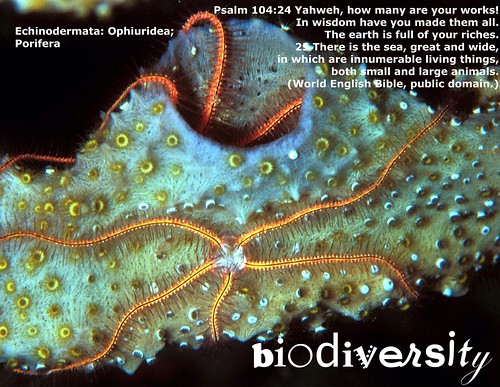
The animals in the picture above are brittle stars, a member of the same phylum as starfish, sea urchins, and others, and a sponge, also an animal. Echinoderms, among other oddities, have five-fold symmetry. The graphic serves as a link to a Flickr picture, which, among other information, has the credit for the original photo. (Altered and posted with permission of the underwater photographer.)
Here's an amazing video, less than three minutes, from the BBC, showing starfish (also known as sea stars), Nemertean worms, and sea urchins, swarming around a dead seal pup, off the coast of Antarctica.
I thank a friend who looked at one of the previous posts in this series for the tip on this video.
Thanks for looking and reading.
Sunday, October 23, 2011
Prayers in the Bible: Paul's benediction on the Ephesians
Ephesians 6:23 Peace be to the brothers, and love with faith, from God the Father and the Lord Jesus Christ. 24 Grace be with all those who love our Lord Jesus Christ with incorruptible love. Amen. (World English Bible.)
That pretty well covers it. In fact, grace covers it.
Thanks for reading. This is part of a series. The previous post is here.
That pretty well covers it. In fact, grace covers it.
Thanks for reading. This is part of a series. The previous post is here.
Friday, October 21, 2011
Psalm 104:24-25: How diverse are marine animals?
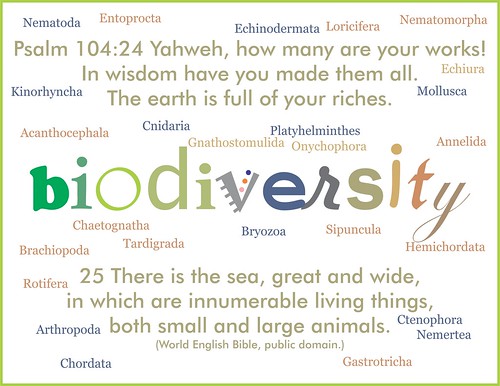
The graphic above gives the names of most (not all) of the 36 phyla of animals which are currently known. (There are 36 recognized phyla, at present.) You probably have little or no idea as to what a member of the Loricifera or the Echiura would be like. I don't either. (If you want to know, use the link in this paragraph.)
A phylum is a large group of animals. For example, mice belong to the Chordata (so do we) and ladybugs belong to the Arthropoda. Mice and ladybugs are not very much alike, and those two phyla are probably as much like each other as any two other phyla of animals. What amazing diversity. In the previous paragraph, I said "at present" because we may discover other animals that don't belong to any of the 36 phyla, or we may learn more about one of the phyla, and this knowledge may lead zoologists to divide that phylum into two such.
What amazing diversity! Thank God. Thanks for reading.
Thursday, October 20, 2011
Psalm 104:24-25: Biodiversity in marine animals
Psalm 104 is a fine nature poem, indeed. It was apparently written by David.
As a biologist, I have been struck, for many years, with verses 24-25:
24 Yahweh, how many are your works!
In wisdom have you made them all.
The earth is full of your riches.
25 There is the sea, great and wide,
in which are innumerable living things,
both small and large animals. (World English Bible, public domain)
I have recently made some attempts to illustrate this, using computer graphics, and some photos, of marine animals, from Flickr members, with their permission. This picture:
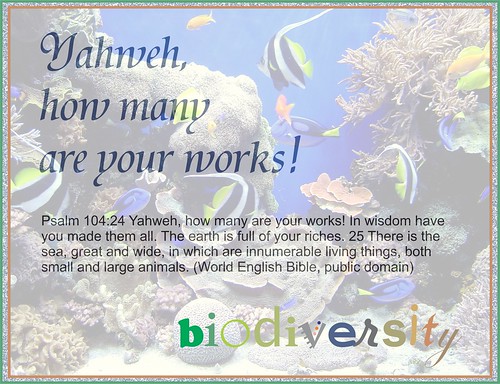
is the first in a series of these attempts. It was first posted on Flickr, with appropriate credit given to the photographer -- the photograph was taken at the Monterey, California, aquarium. (The picture serves as a link to the Flickr post.) There are at least three phyla, represented by the fish, the sponges, and the corals, in the photo. The word, biodiversity, was produced using a different color, and a different typeface, for each letter, to represent diversity. The colors of the letters were chosen to be colors that could be found in marine organisms.
Thanks for looking!
As a biologist, I have been struck, for many years, with verses 24-25:
24 Yahweh, how many are your works!
In wisdom have you made them all.
The earth is full of your riches.
25 There is the sea, great and wide,
in which are innumerable living things,
both small and large animals. (World English Bible, public domain)
I have recently made some attempts to illustrate this, using computer graphics, and some photos, of marine animals, from Flickr members, with their permission. This picture:
is the first in a series of these attempts. It was first posted on Flickr, with appropriate credit given to the photographer -- the photograph was taken at the Monterey, California, aquarium. (The picture serves as a link to the Flickr post.) There are at least three phyla, represented by the fish, the sponges, and the corals, in the photo. The word, biodiversity, was produced using a different color, and a different typeface, for each letter, to represent diversity. The colors of the letters were chosen to be colors that could be found in marine organisms.
Thanks for looking!
Wednesday, October 19, 2011
Sunspots 336

Humor: (sort of) A curry eating contest put two contestants in the hospital, according to National Public Radio.
Science: Wired reports that scientists have found that meerkats can recognize other meerkat individuals by the sound of their "voice."
Science: Wired reports that scientists have found that meerkats can recognize other meerkat individuals by the sound of their "voice."
Carl Zimmer discusses a recent finding -- the largest known virus.
A video from TED on how babies learn languages.
Image source (public domain)
Sunday, October 16, 2011
Prayers in the Bible: Hezekiah prays for deliverance
Isaiah 37:8 So Rabshakeh returned, and found the king of Assyria warring against Libnah, for he had heard that he was departed from Lachish. 9 He heard news concerning Tirhakah king of Ethiopia, “He has come out to fight against you.” When he heard it, he sent messengers to Hezekiah, saying, 10 “Thus you shall speak to Hezekiah king of Judah, saying, ‘Don’t let your God in whom you trust deceive you, saying, “Jerusalem won’t be given into the hand of the king of Assyria.” 11 Behold, you have heard what the kings of Assyria have done to all lands, by destroying them utterly. Shall you be delivered? 12 Have the gods of the nations delivered them, which my fathers have destroyed, Gozan, Haran, Rezeph, and the children of Eden who were in Telassar? 13 Where is the king of Hamath, and the king of Arpad, and the king of the city of Sepharvaim, of Hena, and Ivvah?’”
14 Hezekiah received the letter from the hand of the messengers and read it. Then Hezekiah went up to Yahweh’s house, and spread it before Yahweh. 15 Hezekiah prayed to Yahweh, saying, 16 “Yahweh of Armies, the God of Israel, who is enthroned among the cherubim, you are the God, even you alone, of all the kingdoms of the earth. You have made heaven and earth. 17 Turn your ear, Yahweh, and hear. Open your eyes, Yahweh, and behold. Hear all of the words of Sennacherib, who has sent to defy the living God. 18 Truly, Yahweh, the kings of Assyria have destroyed all the countries and their land, 19 and have cast their gods into the fire; for they were no gods, but the work of men’s hands, wood and stone; therefore they have destroyed them. 20 Now therefore, Yahweh our God, save us from his hand, that all the kingdoms of the earth may know that you are Yahweh, even you only.”
21 Then Isaiah the son of Amoz sent to Hezekiah, saying, “Thus says Yahweh, the God of Israel, ‘Because you have prayed to me against Sennacherib king of Assyria, 22 this is the word which Yahweh has spoken concerning him. The virgin daughter of Zion has despised you and ridiculed you. The daughter of Jerusalem has shaken her head at you. 23 Whom have you defied and blasphemed? Against whom have you exalted your voice and lifted up your eyes on high? Against the Holy One of Israel. 24 By your servants, have you defied the Lord, and have said, “With the multitude of my chariots I have come up to the height of the mountains, to the innermost parts of Lebanon. I will cut down its tall cedars and its choice fir trees. I will enter into its farthest height, the forest of its fruitful field. 25 I have dug and drunk water, and with the sole of my feet I will dry up all the rivers of Egypt.” 26 Have you not heard how I have done it long ago, and formed it in ancient times? Now I have brought it to pass, that it should be yours to destroy fortified cities, turning them into ruinous heaps. 27 Therefore their inhabitants had little power. They were dismayed and confounded. They were like the grass of the field, and like the green herb, like the grass on the housetops, and like a field before its crop has grown. 28 But I know your sitting down, your going out, your coming in, and your raging against me. 29 Because of your raging against me, and because your arrogance has come up into my ears, therefore will I put my hook in your nose and my bridle in your lips, and I will turn you back by the way by which you came. 30 This shall be the sign to you. You will eat this year that which grows of itself, and in the second year that which springs from the same; and in the third year sow and reap and plant vineyards, and eat their fruit. 31 The remnant that is escaped of the house of Judah will again take root downward, and bear fruit upward. 32 For out of Jerusalem a remnant will go forth, and survivors will escape from Mount Zion. The zeal of Yahweh of Armies will perform this.’ 33 Therefore thus says Yahweh concerning the king of Assyria, ‘He will not come to this city, nor shoot an arrow there, neither will he come before it with shield, nor cast up a mound against it. 34 By the way that he came, by the same he shall return, and he shall not come to this city,’ says Yahweh. 35 ‘For I will defend this city to save it, for my own sake, and for my servant David’s sake.’”
36 The angel of Yahweh went out and struck one hundred and eighty-five thousand men in the camp of the Assyrians. When men arose early in the morning, behold, these were all dead bodies. 37 So Sennacherib king of Assyria departed, went away, returned to Nineveh, and stayed there. 38 It happened, as he was worshiping in the house of Nisroch his god, that Adrammelech and Sharezer his sons struck him with the sword; and they escaped into the land of Ararat. Esar Haddon his son reigned in his place. (World English Bible)
Hezekiah, and the nation, were threatened with destruction. Hezekiah did the right thing. He prayed. And God answered his prayer!
This is one of a series of posts quoting prayers from the Bible. The previous post is here. Thanks for reading.
Saturday, October 15, 2011
Mouse gene works in fish
Stephen Matheson has been writing a series of posts about the limbs of vertebrates, and their relationships. In one of this series, he discusses experiments in which a mouse regulatory gene works in fish embryos, which strikes me as simply amazing.
Thanks for reading
Thanks for reading
Tuesday, October 11, 2011
Sunspots 335

Sports: National Public Radio reports that the Women's NBA league has improved in attendance and TV viewing, but is not exactly a great success.
Christianity: (Or Judaism) Heart, Mind, Soul and Strength has posted a list of the categories of the commandments found in the first five books of the Bible. (For example, of over 600 laws found there, 14 had to do with business practices.) That wasn't her main purpose, which was to deal with worship.
From the same blog -- a fine piece on what worship pleases God, and what doesn't.
Image source (public domain)
Faster than light?
A (mostly) political columnist, no less, has devoted an entire column to the possible discovery that some neutrinos may travel faster than the velocity of light. As he says, this is a discovery that will change the way we look at the world, in a profound way.
If it's true, that is. Krauthammer seems to think it is. See here for the Wikipedia's take on the experiments. These results had not been reported in earlier, similar experiments.
Thanks for reading.
If it's true, that is. Krauthammer seems to think it is. See here for the Wikipedia's take on the experiments. These results had not been reported in earlier, similar experiments.
Thanks for reading.
Monday, October 10, 2011
Lisa Randall on science and religion
Can a scientist be religious? Only at the price of inconsistency, she argues, because scientific determinism is not compatible with belief in a deity who can willfully intervene in the world. Sympathetic though I am to her conclusion, I would point out that scientific determinism is equally incompatible with free will and moral responsibility. Jim Holt, "Will the Large Hadron Collider Explain Everything?" a review of Knocking on Heavens Door, by Lisa Randall, Harvard physicist, New York Times Book Review, October 9, 2011.
Thanks for reading.
Thanks for reading.
Sunday, October 09, 2011
Prayers in the Bible: one from Isaiah
Isaiah 33:2 Yahweh, be gracious to us. We have waited for you.
Be our strength every morning,
our salvation also in the time of trouble. (World English Bible, public domain.)
A great prayer to start the day with.
This is one of a series on prayers in the Bible. The previous post is here. Thanks for reading.
Thursday, October 06, 2011
Climate change and the velocity of light
"Last month, scientists at CERN, the prestigious high-energy physics lab in Switzerland, reported that neutrinos might—repeat, might—travel faster than the speed of light. If serious scientists can question Einstein's theory of relativity, then there must be room for debate about the workings and complexities of the Earth's atmosphere." Robert Bryce, "Five Truths About Climate Change," Wall Street Journal, October 6, 2011.
I am not a climatologist. Neither is Mr. Bryce, according to the Wikipedia article on him. But, like him, I want to enter the discussion on global climate change.
Bryce refers to a recent experimental result, which may mean that some neutrinos travel may travel faster than the velocity of light. Bryce correctly notes that this result has not been confirmed. But I believe that he has compared apples and oranges.
The theory of relativity (actually, there are two of these, both due to Einstein) is a theory. That is, it is a group of ideas that attempts to explain the way things are. As I understand it, the evidence for global climate change is not theoretical, but, rather, is data, collected over a number of years, and Bryce is questioning the evidence -- the data, not a theory.
Scientists have frequently made mistakes. One kind of mistake is working with an inadequate theory. Another is experimental errors -- equipment malfunctions, for example. Usually, science is self-correcting. A better theory is proposed. Someone tries to repeat the data collection, and finds experimental errors. I don't think that either of these has occurred as relates to global climate change, at least not on a large scale. I think Bryce is wrong.
Thanks for reading.
Wednesday, October 05, 2011
Sunspots 334
Things I have recently spotted that may be of interest to someone else:
Science: National Public Radio reports on the paw paw, a fruit native to North America that you may have never heard of.
Science: National Public Radio reports on the paw paw, a fruit native to North America that you may have never heard of.
Wired reports on a possible case of human change in response to natural selection, namely lowering of the age when women had their first child, within the past 200 years.
Christianity: E Stephen Burnett points out that our own fallen human nature is never a movie villain. It's usually some monster, or some monstrous human.
Image source (public domain)
Tuesday, October 04, 2011
Elizabeth Moon's Paksenarrion -- Christian or not?
This is a rewrite of a post of June 6, 2007.
I have previously posted about Elizabeth Moon's trilogy, The Deed of Paksenarrion (Riverdale, NY: Baen, 1992 -- combines three novels published previously). One question I wish to muse about is the question of Christianity in this work.
The Wikipedia article on Moon, dated June 6, 2007, discusses the question of religion, and the relation of the trilogy to board games, briefly:
Elizabeth Moon, not gaming herself, heard some people playing "Paladins" (Holy warriors in the service of a god) and doing so very poorly. Her reaction was of course that "such a person wouldn't act like that"... and in thinking about what they would act like, Paksenarrion was born.
The Wikipedia article on the trilogy, on the same date, says:
The Deed of Paksenarrion has an engrossing religious theme with Christian aspects. While this world appears to be polytheistic, there is a "High Lord" and saints, such as Gird, Falk, etc, who serve him. Also, there are prominent themes of atoning sacrifice and redemptive love, with Paksenarrion becoming a kind of Christ figure. However, some believe that comparing this work to themes such as "Hero as Redeemer" and "Hero as Saint" from The Hero with a Thousand Faces shows this is not particularly Christian. There are also several references to the World tree. [The links in this paragraph were copied from the Wikipedia article on the trilogy.]
In other words, religious, yes. Christian, maybe. I concur. This page states that Moon is an Episcopalian. Elliot has posted on religion in these books, and on Moon. One of his posts quotes a web page with an interview with Moon, describing her conversion experience.
I have previously laid out the following characteristics, one or more of which must be present, to satisfy myself that a novel is a Christian novel:
1) A Christ-figure
2) Belief, by central characters, in important Christian doctrines, such as a belief in the Trinity, or the resurrection
3) Monotheistic prayer or other worship
4) Expression of a relationship with God as Lord, by a main character
5) Consciousness of supernatural guidance
6) Explicit rejection of evil, by a main character
And I also said that if the work shows an overall Christian world-view, even though those characteristics aren't present, it could rightly be called a Christian novel, and I categorized Susan Palwick's The Necessary Beggar as Christian for that reason.
I have found some of these characteristics in The Deed of Paksenarrion, but most or all of them are polytheistic. That is, there is a High Lord, to be sure, but there are also saints. Gird, in particular, is one that Paksenarrion relies on. (There is occasional mention of Falk, and of Camwyn, both apparently of status like that of Gird.)
One of the characters in the book explains it like this, in response to a question on how Gird got his powers:
"Then came a new threat. Powers of evil, exactly what we don't know. Many feared them too much to resist, and fled far away. But Gird went out to face them with his old cudgel. No one saw that battle, but the dark powers fled the land for many years, and Gird was not seen on earth again. Gird's best friend, who had been away on a journey, had a dream in which he saw Gird ascending to the Court of the High Lord—saw him honored there, and given a cudgel of light to wield. It was after that, when he told his dream, that the priests of the High Lord recognized Gird as a saint. We don't claim Gird is a god. We say he is a favored servant of the High Lord; he has been given powers to aid his followers and the cause of right." (Chapter 25 of Sheepfarmer's Daughter, which is the first part of the Deed, pp. 255-6 of the combined book. This first part is on-line here.) It isn't just Gird, either. On p. 96, chapter 10, followers of Falk are also said to have healing powers. Some soldiers follow Tir. I'm not sure whether Tir is a saint or not.
There is a two-book combined prequel, The Legacy of Gird, and I am currently reading that, but expect to post this before I finish finding out about Gird.
I recognize that the Catholic church believes in saints, and that, as I understand it, they aren't recognized as such until after death, and until a process has proceeded that, among other things, requires that some after-death miracles are attributed to them. As a life-long Protestant, I have trouble with what I see as rivals to the work of Christ, including saints. However, the Bible does suggest that Peter's brief presence was sufficient to bring about healing.
1) So, is there a Christ-figure in the Deed? That, of course, depends on how you define Christ-figure. Paksenarrion, in some senses, qualifies. She is celibate throughout the book, and apparently throughout her life, except for being brutally raped. She is given some power to heal. She has a strong sense of right and wrong. Finally, and most importantly, she willingly offers herself to the evil priests of Liart (Chapter 27 of the last part of the book) expecting that they will torture her for five days, and finally kill her, in order that they give up five captives, including Duke Phelan, who is to be king. She is tortured publicly, expertly and brutally, and the torture includes rape. She depends on her call to be a servant of the High Lord, and of Gird, to endure this, and, finally, she is rescued -- miraculously healed of most of the damage from the torture, and freed from the evil group. At least one reader thinks that she died and was resurrected during this episode. I didn't interpret the events that way.
An especially interesting parallel is that the Thieves' Guild is purified of its worshipers of Liart because of what happened to Paksenarrion, so that, in a sense, her sacrifice redeems thieves:
"Arvid, there may have been another way to save Phelan: I don't know. Paladins don't know everything; we only know where we must go. But think of this: was there any other way to save the Thieves Guild?"
He stared at her, mouth open like any yokel's. "Thieves Guild," he said finally. "What does Gird care about the Thieves Guild?"
"I don't know," said Paks. "But he must care something, to spend a paladin's pain on it . . ." (P. 992 of the combined book, Chapter 28 of Oath of Gold, the last part of the trilogy. Arvid was chief of the Guild.)
So we have a good figure who offers herself as a living sacrifice for others. A Christ-figure.
Moon, herself, has written about the sacrifice and torture of Paksenarrion, here. I didn't read anything in her post that changes my assessment of the book. It seems clear from other posts by Moon that she is a practicing Christian.
2) I don't find any belief in the essential Christian doctrines in the book. There is no explicit prayer for forgiveness of sin.
3) Intercessory prayer is mentioned several times, but it is often to, or through, Gird or another saint, as much as to the High Lord. However, Paksenarrion, herself, prays mostly, to the High Lord. It is the High Lord who comes to her aid during her torture.
4) Paksenarrion comes to realize that she has been specially called for a purpose, by the High One. There are a few paladins of Gird, but she is not one of them. The realization is a slow process, and others see this, sometimes, before she does.
It is clearly the High Lord who rehabilitates her after her torture. A symbol of Liart, an evil god, which has been branded onto her forehead, is replaced, miraculously, with a circle, a symbol of the High God.
5) Paksenarrion does come to recognize supernatural guidance (see above).
6) There are a number of instances where Paksenarrion explicitly rejects evil. Perhaps the most important is early in her career, when she tells the Duke not to torture an evil man, because the Duke's army is not like them, and she wants it to stay that way. (pp. 307-8, Chapter 31 of Sheepfarmer's Daughter) Many of the others involve sensing, and combating, evil non-human beings.
Perhaps the most remarkable episode is this one:
It was then as if several selves were present, mysteriously separate and conjoined. Trapped inside her body was the same child she had been, feeling each new torment as a wave of intolerable pain,each ragged scream as a fresh humiliation. The seasoned soldier watched with pity as her body gave way to exhaustion and pain as any body would, feeling no shame at the sight or sound or smell of it, for this was something that could happen to anyone, and she had never inflicted it on others. And someone else, someone newer, refused the soldier's tactics of defiance, anger, vengeance, and looked into her own fear to find the link to those around her, to find the way to reach those frightened tormentors, the ones not already lost to evil. (978, Chapter 27 f Oath of Gold.) Here Paksenarrion not only rejects evil, but does not allow herself to desire vengeance, even while she is being tortured cruelly by experts over a five-day period. She also tries to find a way to change some of those who are watching this torture from evil to good.
7) Does Elizabeth Moon's trilogy have a Christian world-view? I would have to say that it is not strictly Christian, but that the leading character comes to have a fictionalized Christian world-view.
Probably no one cares, but here's my bottom line. The Deed of Paksenarrion, though it has polytheistic elements, has an essentially Christian idea, that of a good person sacrificing herself to rescue someone else from punishment. On that score, it's a Christian novel, as much as, say Tolkien's The Lord of the Rings. But it's certainly not explicitly Christian, and is not sold as such. Thus, in my view, Moon's work has much more opportunity to be salt and light to a world that needs such things.
Do Christians have to write only books that are explicitly Christian? Should they read only such books? No, and no. I am reminded of Till We Have Faces, by C. S. Lewis. Lewis was a Christian, but this book, arguably his best novel, has characters with a pre-Christian, or pagan, world-view. Nonetheless, it's a great read, and presents Christian truth, especially that God Himself is the only real answer to our questions about justice.
I have found a few other web pages that briefly mention Christianity in the Deed. This page says that the trilogy has "Christian themes," and recognizes the sacrifice of Paksenarrion for others. This post says that there are parallels to Christian ideas, and that the trilogy, especially the last part, is about "Faith," even faith in miraculous resurrection.
This page may be modified later, as I think of things, as you comment, or as I read about Gird.
Thanks for reading.
See this post for links to references to this topic in the Claw of the Concilator blog.
See here for a subsequent post on biblical morals in the Paksenarrion books.
On April 2, 2009, E Stephen Burnett wrote an essay, asking questions about how far a Christian author could go in writing fiction which has a God who is significantly different from the Christian God, and whether a Christian could legitimately create a fictional character who is in defiance of God. I posted tentative answers to these questions, which are related to the subject of the post above, on April 13, 2009.
Thanks for reading. Read Moon, if you have to time to commit to reading about 1,000 pages!
Monday, October 03, 2011
Remaking God in fiction, re-done
E. Stephen Burnett wonders if authors are on safe ground when they remake God in fiction. (He says that The Shack did that, for example.) He asks, but does not answer, three good questions, which he extrapolates from the writing of C. S. Lewis.
The questions (paraphrased) are:
1) Can a Christian writer write a story about a God who is different? (Different commands or personality.)
2) Can a Christian writer write a story with a character who defies God?
3) What purpose is served by doing either 1) or 2)?
Burnett is a good writer, but he does not make clear, at least to me, exactly what he is asking. I think he is asking if a Christian writer can do these things and remain in God's will.
Let me muse about these matters.
Question 1 - Can a Christian writer write a story about a God who is different?
As I see it, there is possible danger in such writing. I believe that it would be possible to write a story about a God who was so different from the Christian God that the story would be blasphemous. It would also be possible for a reader, or the writer, to become too interested in a false god -- a violation of the first of the Ten Commandments.
However, in a sense, the Old and New Testaments present seriously different views of God. The Old Testament God required sacrifices, and adherence to Jewish dietary laws. The New Testament God was a sacrifice, and Christians are no longer required to keep the dietary laws. But, of course, this was not fiction.
J. R. R. Tolkien, an influential writer, usually considered to have been a Christian, presented a false god, or several of them, in his writing. Sauron, although he was, in Tolkien's phrase, "but a servant,"of a more powerful being, was worshiped, and demanded such worship. He was clearly thoroughly evil. Melkor/Morgoth, the great enemy, Sauron's master, was even more powerful, and more evil, and also was a god, to some. In fact, Tolkien had a whole pantheon of lesser beings, some good, some not so. Was he blasphemous? Most would say that he was not. He was merely telling a story. These evil beings were the equivalent of Satan, the real enemy of God, and of God's people, and lesser demons. The good ones were something like angels. Some of them, possibly, were like saints, in the Roman Catholic sense of the term. (Tolkien was a Roman Catholic).
Even though Tolkien had some evil gods, they were not supreme. As in the real world, there was a supreme, good God.
It seems to me that it could be legitimate to present God in a different way, as Tolkien did, if maintaining his goodness, love and supremacy. Some readers might become too obsessed with such fictional deities, but that would be their doing, not the author's. It would be possible to fantasize lustfully about Salome, or Bathsheba, or to covet Solomon's wealth or wisdom, but that would not be the fault of Matthew and Mark, or of the author of 2 Samuel or of 1 Kings.
It seems to me that The Shack also presents God in a legitimate way, although apparently I disagree with Burnett about this.
Elizabeth Moon, an important writer of fantasy and science fiction, has written several novels in an imaginary setting. I have previously posted on the question of whether these works should be taken as Christian novels, or not. I am not sure if Moon meant to portray a polytheistic religion, with a supreme God, and lesser gods, or one that is like Roman Catholicism, with a supreme God, and saints, especially Gird, who was once a living man. As a Protestant, I don't believe in the efficacy of prayer to any but the Triune Supreme God, and believe that prayer to saints comes close to, perhaps is, a violation of the first of the Ten Commandments.* To expand on that, there are some Christian elements. (See my post.) Moon, who is an Episcopalian, and active in her church, has posted a summary of the religion in these books.
Lois McMaster Bujold is also an important writer of both fantasy and science fiction. Like Moon, she has incorporated religious ideas into the fabric of one of her imaginary worlds. (There is a fantasy series by Bujold that I have yet to read, and I would guess that she has done that for this sub-creation, also.) I have also written previously about whether one of her novels can be classified as Christian, and, again, concluded that, although there are Christian elements, it can not. Bujold has done some experimenting -- she has constructed a theology based on five more or less co-equal gods. These gods can reveal themselves to people, and are otherwise real to some of her characters. I do not know whether Bujold is a Christian. There are a few Christian ideas, and apparently a Christian character, in her science fiction series.
C. S. Lewis, perhaps the most important Christian writer of the twentieth century, wrote fantastic fiction, for children, and for adults, as well as about Christianity. In fact, Barnett uses Perelandra, a fantastic novel by Lewis, as a focal point in his essay. By emphasizing Lewis, I think Barnett has answered his own question, with a firm "yes." Why? Because Lewis also wrote a sequel, That Hideous Strength, wherein Merlin is possessed by angelic beings, a non-Biblical concept. And, especially, Lewis wrote Till We Have Faces, a book set in a pre-Christian time, with a pagan goddess, Ungit, who was represented by an idol, and with the god of the mountain, apparently the Greek Cupid.
Question 2 - Can a Christian writer write a story with a character who defies God?
Again, I turn to the Bible. Job and Paul defied God, at least at first. Pharaoh, and several Israelite and non-Israelite kings also did so, for their entire lives, or began by following God, but ended up defying Him, as apparently Saul and Solomon did. And let us not forget Satan.
Enough said. The answer is "yes."
Question 3 - What purpose is served by doing either 1) or 2)?
As to writing about a character who defies God, the purpose should be to set forth an example that we must not follow, or of the error of such defiance. (Kings David and especially Manasseh defied God, but repented, and so can and must we.)
What about writing about a different God, or god?
Till We Have Faces made a point that Christians must take to heart. That point is that God is not required to answer our questions. He is, Himself, the answer. Could this point have been made in a book written of a time and society where there were Christians? I suppose so, but it would have been a drastically different book, and perhaps Orual's defiance, had it been of the one true God, would have turned Christian readers off, whereas defying pagan gods is not so likely to. Defiance, and its answer, was necessary to make Lewis's point.
Bujold's gods of Chalion seem to me to be a different matter. She seems to have done what writers of fantastic literature should do, namely present us with a universe like ours, but with some substantial difference, then describe what that would be like. Ursula K. Le Guin did this about gender in her The Left Hand of Darkness, for example. What would it be like if gender was not fixed? But is it legitimate to tinker with a universe by imagining different gods? I'm not sure. Not to have done so would have made the story quite different, but there could still have been goodness, service, and sacrifice in it, as Bujold's Cazaril showed so well. And creating a theology with no single supreme being strikes me as dangerous.
Let me answer the question for Elizabeth Moon (I have used Bujold and Moon because I am familiar with their work, and because of their prominence.) What about Moon's whole zoo-full of gods (or maybe saints) and spirits? Is that wrong, for a Christian writer? Well, let's put it this way. I submit that Tolkien did the same thing. There are all sorts of evil spirits, and good ones, and a pantheon of gods, in his sub-creation. There is little or no worship of a supreme being, private or public. There is no clear Christ-figure. Yet what he did is accepted as having been good, even Christian fiction, by many Christian writers, probably including Burnett.
I would say that if there is a story that an author must tell, and the author herself is not in defiance of God, there may be legitimate reason to write such a story, even though it presents different gods. I think that's what happened to Tolkien. There are certainly dangers. Pride and idol worship, being attracted by the occult, or having gods before the one true God, come to mind. Prayerful care must be taken. I also think it is possible to write a story with a god who differs from God, or including defiance of God, if the author's intent is to present a lesson that is best presented in that way.
Thanks for reading. Read Burnett's essay.
*On October 2, 2011, I changed a key sentence about Elizabeth Moon's Paksenarrion novels, which was "In a word, they are polytheistic, hence not Christian," to the two sentences before the asterisk in the work above. The reason is that I have re-read the books, and it seems clear that they describe one Supreme God, who is to be worshiped. I didn't come away with that impression in my first reading, several years ago, but I should have. I also changed what I said about Tolkien, adding the idea that some of the good beings, who are no longer mortal, may have been saints, rather than minor gods, and made a few minor editorial changes, related to the ones just described, or to improve the clarity of the post.
This is a re-post, with some revisions, of a post from April 13, 2009. I have removed (unintentionally) the previous post.
Sunday, October 02, 2011
Prayers in the Bible: Paul's prayer for the Corinthians
2 Corinthians 13:14 The grace of the Lord Jesus Christ, the love of God, and the fellowship of the Holy Spirit, be with you all. Amen. (World English Bible)
That's the last verse in 2 Corinthians, and, of course, it's a prayer. May I be one tenth as concerned for some fellow Christian as Paul was for the several churches.
This is part of a series on prayers in the Bible. Thanks for reading. The previous post is here.
That's the last verse in 2 Corinthians, and, of course, it's a prayer. May I be one tenth as concerned for some fellow Christian as Paul was for the several churches.
This is part of a series on prayers in the Bible. Thanks for reading. The previous post is here.
Wednesday, September 28, 2011
Sunspots 333
Things I have recently spotted that may be of interest to someone else:

Science: Wired reports that on-line gamers have significantly assisted scientists in solving the three-dimensional structure of a protein. The research paper is here.
Science: Wired reports that on-line gamers have significantly assisted scientists in solving the three-dimensional structure of a protein. The research paper is here.
Politics: (or something) CNN reports on a study that attempts to explain why some store clerks can seem rude.
Computing: Google created a doodle in honor of Jim Henson, creator of the Muppets.
Christianity: The Dead Sea Scrolls are now visible on-line.
Image source (public domain)
Tuesday, September 27, 2011
Female Headship: Biblical Examples
Although Ephesians 5:22 is often quoted as proof that the husband is to be the head of the house, there are some examples of female spiritual leadership in families in the Bible. One such is the wife of Manoah, who was Samson's mother. Another is Hannah, who seems to have taken the lead, rather than her husband doing so, in praying and acting in the matter of having a child, in 1 Samuel 1. Abigail, in 1 Samuel 25, acted without her first husband's knowledge, and was apparently blessed and scripturally commended for doing so. (She later married David.) In Exodus 4, Zipporah, Moses' wife, took action in relation to the circumcision of their sons,when Moses hadn't, and, in doing so, apparently kept God from killing Moses. In Exodus 2, it was the mother of Moses who was responsible for his escape from the command of Pharaoh that all male Hebrew babies should be killed. The Virtuous Woman/Excellent Wife, idealized in Proverbs 31, is described as making business decisions (perhaps not spiritual ones) on her own, and, also, as having a husband at the time.
I am not including all of the women of faith from the Bible in this brief discussion. Rahab and Naomi may not have taken spiritual leadership while they had a husband, but they took it when they were single. Deborah acted in leadership of Israel. We don't know whether she also acted as spiritual leader in her home. A church was begun in Lydia's home. She may not have had a husband. Dorcas may not have, either. There are other examples, in both the Old and New Testaments, of godly female leaders. Some of them may have been the spiritual leader of their husband. We don't know. 2 Timothy 1:5 says that Timothy's mother and grandmother were the spiritual leaders in Timothy's family. His father is mentioned in Acts 16:3. It is possible that that father died early in Timothy's life. Priscilla and Aquila seem to have been equals in ministry. I submit that most likely at least some of the women in this paragraph were spiritual leaders in their home, and had a husband at the time.
My conclusion is that wives and mothers, at least some of the time, took spiritual leadership in Biblical homes, and, therefore, God may expect many wives and mothers to do this now, in the twenty-first century.
Thanks for reading. This is an excerpt from a previous post.
Added June 21, 2012: See this post. Mary, Christ's mother, seems to have exercised spiritual leadership.
Sunday, September 25, 2011
Prayers in the Bible: Paul's prayer for the Corinthians
2 Corinthians 1:1 Paul, an apostle of Christ Jesus through the will of God, and Timothy our brother, to the assembly of God which is at Corinth, with all the saints who are in the whole of Achaia: 2 Grace to you and peace from God our Father and the Lord Jesus Christ.
3 Blessed be the God and Father of our Lord Jesus Christ, the Father of mercies and God of all comfort; 4 who comforts us in all our affliction, that we may be able to comfort those who are in any affliction, through the comfort with which we ourselves are comforted by God. (World English Bible, public domain)
Here, Paul prays for grace for the church at Corinth. He also includes some adoration, and thanksgiving. A good pattern for us.
This is part of a series on prayers in the Bible. Thanks for reading. The previous post is here.
Thursday, September 22, 2011
Why do sickness and death bother us so much?
Why do sickness and death bother us so much? Every one reading this, and the vast number who won't, will die, barring some miraculous event. All of us get sick, sometimes as a minor inconvenience, sometimes as a crippling incapacitation, and sometimes to death.
Why, then, don't we just accept this state of things? Why do we expect things to go right, when they almost never do?
There are probably a lot of different reasons for our rebellion against the way things are. I hope I understand part of the reasons.
I think that, deep in our DNA, or our unconscious, is the knowledge that things shouldn't be like this. So we complain, and rebel against the way things are. What do I mean, things shouldn't be like this? The Bible teaches us that the first humans lived in a world without human sickness and death. (Plants and animals probably died, or were killed by humans.) But that world changed drastically, because those first humans disobeyed God, the Creator. I believe that we somehow know that there has been a change, and long for it to be reversed, and complain at the consequences of that change, the Fall.
Some of us question God's goodness, or even His existence, because of the consequences of sin in the world. How could a loving God allow such terrible things to happen? If I had the full answer to that, I would be God, which I certainly am not. But part of the answer is that God suffers with us, probably more than we suffer ourselves. Jesus wept at the tomb of Lazarus. Jesus also took the consequences of our sin upon Himself, for those who are willing to let Him do so for them. In the process, Jesus, Himself, suffered. Granted, He didn't suffer as long as, say, a burn victim, but He did suffer.
Another part of the answer is that God is going to provide a Heaven for those who believe, free from sickness and death.
It is not wrong to want to do something about sickness. Jesus healed every person who asked Him to do so. He also raised a few people from death. The Bible suggests that we pray for sick believers. But healing everyone is not God's final answer. (See here for more of what the Bible says on that subject.) Consider, also, that everyone Jesus healed died, most likely of sickness, later in their life. Those He raised from the dead
died a second time. The Bible says that death is the last enemy to be defeated.
I think we, including me, concentrate too much on sickness. Although all the churches I have attended, and can remember, prayed most of their prayers for the sick, the New Testament church didn't pray in that pattern.
Thanks for reading.
Wednesday, September 21, 2011
Sunspots 332
Things I have recently spotted that may be of interest to someone else:


Guess what? Natural selection still works. The widespread use of Roundup, the weedkiller, has led to the appearance of Roundup-resistant strains of weeds, according to Business Week.
Politics: (sort of -- I don't have a category for this) The New York Times has reviewed an important new book on the subject of why marriage is less frequent among blacks than whites, in the U. S. The book's title is Is Marriage For White People? How the African American Marriage Decline Affects Everyone. The review is also an analysis of the issue.
(or maybe Science) Wired reports on the new patent legislation. The reported indicates that the new law is an improvement, but is still less than thrilled, saying that it gives advantages to corporations, rather than individual inventors..
Image source (public domain)
Sunday, September 18, 2011
Prayers in the Bible: Job prays for his friends
Job 42:7 It was so, that after Yahweh had spoken these words to Job, Yahweh said to Eliphaz the Temanite, “My wrath is kindled against you, and against your two friends; for you have not spoken of me the thing that is right, as my servant Job has. 8 Now therefore, take to yourselves seven bulls and seven rams, and go to my servant Job, and offer up for yourselves a burnt offering; and my servant Job shall pray for you, for I will accept him, that I not deal with you according to your folly. For you have not spoken of me the thing that is right, as my servant Job has.”
9 So Eliphaz the Temanite and Bildad the Shuhite and Zophar the Naamathite went, and did what Yahweh commanded them, and Yahweh accepted Job.
10 Yahweh turned the captivity of Job, when he prayed for his friends. Yahweh gave Job twice as much as he had before. (World English Bible, public domain)
Job interceded for his friends. Were they really friends? Sometimes, during the 30 or so chapters when they were lecturing Job on his supposed secret sins, they must not have seemed like friends. But they did sit with him in his agony of body and mind. Most of the prayer in the New Testament is prayer for other believers. (See here) Intercession, or supplication. Ours should be, too. For our friends, in other words.
Note that it sounds like God gave Job back what Satan had been allowed to take from him, after Job proved that he really did have his heart in the right place, that is, when he prayed for his friends, when he really would have liked to have said, yet again, "I told you so!"
Thanks for reading. This is part of a series. The previous entry is here.
Subscribe to:
Posts (Atom)