God has a great work on hand in this world. This work is involved in the plan of salvation. It embraces redemption and providence. God is governing this world, with its intelligent beings, for His own glory and for their good. What, then, is God’s work in this world? Rather what is the end He seeks in His great work? It is nothing short of holiness of heart and life in the children of fallen Adam. Man is a fallen creature, born with an evil nature, with an evil bent, unholy propensities, sinful desires, wicked inclinations. Man is unholy by nature,
born so. “They go astray as soon as they be born, speaking lies.”
God’s entire plan is to take hold of fallen man and to seek to change him and make him holy. God’s work is to make holy men out of unholy men. This is the very end of Christ coming into the world:
“For this purpose was the Son of God manifested that he might destroy the works of the devil.”
God is holy in nature and in all His ways, and He wants to make man like Himself.
“As he who hath called you is holy, so be ye holy in all manner of conversation; because it is written, Be ye holy, for I am holy.”
This is being Christlike. This is following Jesus Christ. This is the aim of all Christian effort. This is the earnest, heartfelt desire of every truly regenerated soul. This is what is to be constantly and earnestly prayed for. It is that we may be made holy. Not that we must make ourselves holy, but we must be cleansed from all sin by the precious atoning blood of Christ, and be made holy by the direct agency of the Holy Spirit. Not that we are to do holy, but rather to be holy. Being must precede doing. First be, then do. First, obtain a holy heart, then live a holy life. And for this high and gracious end God has made the most ample provisions in the atoning work of our Lord and through the agency of the Holy Spirit. - From The Essentials of Prayer, by E. M. Bounds.
Although E. M. Bounds
died in 1913, this book was first published in 1925, by an admirer of
the author's life. Bounds was known for praying from four until seven
each morning.
This post is one of a series, taken from The Essentials of Prayer, by Bounds. Found through the Christian Classics Ethereal Library, here. The Essentials of Prayer is in the public domain. The previous post in the entire series on the book is here. Thanks for reading. Read this book, and, more importantly, practice, prayer.
Musings on science, the Bible, and fantastic literature (and sometimes basketball and other stuff).
God speaks to us through the Bible and the findings of science, and we should listen to both types of revelation.
The title is from Psalm 84:11.
The Wikipedia is usually a pretty good reference. I mostly use the World English Bible (WEB), because it is public domain. I am grateful.
License
I have written an e-book, Does the Bible Really Say That?, which is free to anyone. To download that book, in several formats, go here.

The posts in this blog are licensed under a Creative Commons Attribution-NonCommercial-ShareAlike 3.0 Unported License. You can copy and use this material, as long as you aren't making money from it. If you give me credit, thanks. If not, OK.
The posts in this blog are licensed under a Creative Commons Attribution-NonCommercial-ShareAlike 3.0 Unported License. You can copy and use this material, as long as you aren't making money from it. If you give me credit, thanks. If not, OK.
Sunday, October 21, 2012


Saturday, October 20, 2012
Two Covenants, contrasted
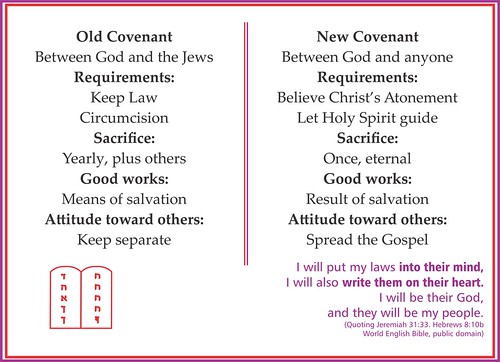
The graphic above is a link to the same picture, on my Flickr photostream. If you are interested, you may be able to see this picture at a larger size by following that link.
The quotation in the lower right is:
I will put my laws into their mind,
I will also write them on their heart.
I will be their God,
and they will be my people.
(Hebrews 8:10b, quoting Jeremiah 31:33)
World English Bible, public domain)
As I understand it, the new Covenant, and the need for it, explained in great detail in Hebrews, does not do away with the Ten Commandments. (The new Covenant is also called the New Testament.) However, it makes it possible to please God, in a way that the old Covenant did not, because the new Covenant establishes a relationship with God that the old one did not, and also has a much more radical, and effective, solution to the sin problem, that the old Covenant did not.
I used a graphic representation of the Ten Commandments to represent the Law of the First, or Old, Covenant. Jesus, or other New Testament writers, affirmed, in some way, every one of the Ten Commandments, except, perhaps, for the fourth, to remember the Sabbath. Jesus said that the Sabbath was made for man, not man for the Sabbath, in Mark 2:27. He also healed people, and picked grain to eat, on the Sabbath. (Matthew 12:1-12) Paul said that there should be flexibility in observing special days (Romans 14:6). There is abundant evidence, from the New Testament, that Christians thought that it was important to worship together. Now, most Christian groups do that in celebration of Christ's Resurrection, on Sunday. (The Jewish Sabbath was from sundown on Friday till sundown on Saturday.)
There were a lot of Ceremonial laws (some say about 600 or more) that the Jews believed that they should keep. They included things that seem strange to us (Exodus 23:19b says that a kid shouldn't be boiled in his goat mother's milk; Leviticus 19:19b says that clothing made of both linen and wool should not be used; there are instructions for dealing with mold (?) in cloth and houses in Leviticus 13). Then there were the dietary laws! (Most famously, Jews were not to eat pork, but there were quite a few other animals prohibited, too.) Peter saw a vision, in Acts 11, that was guidance from God that he could set those dietary restrictions aside, and, more important, that Gentiles could become Christians, without following the Jewish Ceremonial laws. The Jerusalem Council (Acts 15) relieved Gentile Christians of almost all of the Ceremonial Jewish Law. Paul, and the author of Hebrews, explained that the Law (First Covenant) was not able to reconcile people with God's desire to be free from sin. Belief in Christ's death and resurrection is able to do that.
I am not at all sure that the Hebrew symbols in the graphic of the Ten Commandments have any correspondence to the actual Hebrew of the Ten Commandments.
Thanks for reading!
Thursday, October 18, 2012
John Wesley on elections
From The Works of the Reverend John Wesley, A. M., Volume IV, 3rd edition, London: John Mason, 1829, entry from Thursday, October 6, 1774:
"I met those of our society who had votes in the ensuing election, and advised them: 1, To vote, without fee or reward, for the person they judged most worthy: 2, To speak no evil of the person they voted against: and, 3, to take care their spirits were not sharpened against those who voted on the other side."
(From the Google Books archive.)
"I met those of our society who had votes in the ensuing election, and advised them: 1, To vote, without fee or reward, for the person they judged most worthy: 2, To speak no evil of the person they voted against: and, 3, to take care their spirits were not sharpened against those who voted on the other side."
(From the Google Books archive.)
Wednesday, October 17, 2012
Sunspots 388

Humor: An academic journal which rejects
all material submitted to it for publication. (It ceased
"publication" several months ago, but its web site is still available.)
(Humorous, or odd, to us, anyway.) Some people in Senegal take their sheep seriously. Very seriously. The Huffington Post reports on a televised sheep beauty contest.
Science: National Public Radio on apple
trees in the US. They are dwarfs!
Computing: Microsoft offers a free (and, according
to an expert who should know -- definitely not me -- safe) site
that evaluates the strength of a password for you. All you have to
do is to type it in. I discovered that one of my passwords, which I thought would be pretty difficult to crack, was weak. Whoops!
Christianity: From the BioLogos Forum, a look at how
ancient
theologians (Luther, Origen, Calvin, Augustine, and Aquinas) interpreted Genesis 1.
Tuesday, October 16, 2012
An argument (theological, actually) against Intelligent Design
keiths has recently posted an article challenging Intelligent Design. In particular it challenges the idea that the similarities between organisms are not the result of evolution by natural selection, and common descent, but due to the use of a common design, or pattern, for several organisms, by a Designer.
keiths's challenge is basically this: Why should a Designer have been limited only to designs that mimic exactly the sorts of results we would expect if similarity were due to evolution from common ancestor(s) by natural selection? In other words, why should a Designer be a mimic of evolution, when there must have been many other ways to Design living things?
This is, at least in part, a theological argument, although keiths doesn't say so. (I have no knowledge of his personal beliefs, except that he is clearly not a fan of Intelligent Design or Young-Earth Creationism.) Why should God (assuming God to be the Designer, which most proponents of Intelligent Design do) have been constrained in this way, and, also, why should God have mimicked the results expected from common descent through natural selection? Why would God have done this, when doing so presented abundant evidence for descent from common ancestor(s) by natural selection, if such common descent didn't actually occur?
Good questions, I believe.
Thanks for reading. Read keiths's post, if you wish.
keiths's challenge is basically this: Why should a Designer have been limited only to designs that mimic exactly the sorts of results we would expect if similarity were due to evolution from common ancestor(s) by natural selection? In other words, why should a Designer be a mimic of evolution, when there must have been many other ways to Design living things?
This is, at least in part, a theological argument, although keiths doesn't say so. (I have no knowledge of his personal beliefs, except that he is clearly not a fan of Intelligent Design or Young-Earth Creationism.) Why should God (assuming God to be the Designer, which most proponents of Intelligent Design do) have been constrained in this way, and, also, why should God have mimicked the results expected from common descent through natural selection? Why would God have done this, when doing so presented abundant evidence for descent from common ancestor(s) by natural selection, if such common descent didn't actually occur?
Good questions, I believe.
Thanks for reading. Read keiths's post, if you wish.
Monday, October 15, 2012
The Language of Flowers, by Vanessa Diffenbaugh
I recently read The Language of Flowers by Vanessa Diffenbaugh. This is the publisher's web site for the book. Here's the Amazon page on the book, which includes an interview with the author. This was her first novel. It is well written, and shows extensive thought and research.
As usual, I try not to give away much of the plot. Trust me, there is one, although the book is more about relationships than plot surprises. It's really more about relationships, especially about relationships between foster children and those who interact with them, than about flowers.
The concept of Language of Flowers, or floriography, refers to the use of flowers as signals, whether they are displayed or given as gifts. The Wikipedia has an article on the subject. The author has appended a long appendix at the end of the book on such usage. Samples: Wheat (Triticum) - Prosperity; Strawberry (Fragaria) - Perfection; Violet (Viola) - Modest Worth; Raspberry (Rubus) - Remorse. It would be possible to suppose that flowers really have some sort of magical powers, but, in an appendix, Diffenbaugh specifically denies that flowers have magical powers. She does say that researchers have found some effects, however: "A study from Rutgers University shows that flowers increase feelings of enjoyment and satisfaction, and Harvard researchers found that people feel less anxious and more compassionate in the presence of flowers." There are a lot of wedding flowers sold in the book.
The author, in her first novel, uses flashbacks extensively. It works.
Although there is a lot about reconciliation in the book, the characters seem to have no religious, or church experiences. In one place, the protagonist, Victoria Jones, says ". . . I didn't know how to pray."
The book was well worth reading. I expect Diffenbaugh will do more good work.
As usual, I try not to give away much of the plot. Trust me, there is one, although the book is more about relationships than plot surprises. It's really more about relationships, especially about relationships between foster children and those who interact with them, than about flowers.
The concept of Language of Flowers, or floriography, refers to the use of flowers as signals, whether they are displayed or given as gifts. The Wikipedia has an article on the subject. The author has appended a long appendix at the end of the book on such usage. Samples: Wheat (Triticum) - Prosperity; Strawberry (Fragaria) - Perfection; Violet (Viola) - Modest Worth; Raspberry (Rubus) - Remorse. It would be possible to suppose that flowers really have some sort of magical powers, but, in an appendix, Diffenbaugh specifically denies that flowers have magical powers. She does say that researchers have found some effects, however: "A study from Rutgers University shows that flowers increase feelings of enjoyment and satisfaction, and Harvard researchers found that people feel less anxious and more compassionate in the presence of flowers." There are a lot of wedding flowers sold in the book.
The author, in her first novel, uses flashbacks extensively. It works.
Although there is a lot about reconciliation in the book, the characters seem to have no religious, or church experiences. In one place, the protagonist, Victoria Jones, says ". . . I didn't know how to pray."
The book was well worth reading. I expect Diffenbaugh will do more good work.
Sunday, October 14, 2012
Prayer and Trouble, part 14, by E. M. Bounds
Just as prayer is wide in its range, taking in everything, so trouble is infinitely varied in
its uses and designs. It takes trouble sometimes to arrest attention, to stop men in the busy
rush of life, and to awaken them to a sense of their helplessness and their need and sinfulness.
Not till King Manasseh was bound with thorns and carried away into a foreign land and
got into deep trouble, was he awakened and brought back to God. It was then he humbled
himself and began to call upon God.
The Prodigal Son was independent and self-sufficient when in prosperity, but when money and friends departed, and he began to be in want, then it was he “came to himself,” and decided to return to his father’s house, with prayer and confession on his lips. Many a man who has forgotten God has been arrested, caused to consider his ways, and brought to remember God and pray by trouble. Blessed is trouble when it accomplishes this in men! It is for this among other reasons that Job says:
“Behold, happy is the man whom God correcteth. Therefore, despise not thou the chastening of the Almighty. For he maketh sore, and bindeth up; he woundeth, and his hands maketh whole. He shall deliver thee in six troubles; yea, in seven there shall no evil touch thee.”
One thing more might be named. Trouble makes earth undesirable and causes heaven to loom up large in the horizon of hope. There is a world where trouble never comes. But the path of tribulation leads to that world. Those who are there went there through tribulation. What a world set before our longing eyes which appeals to our hopes, as sorrows like a cyclone sweep over us! Hear John, as he talks about it and those who are there:
“What are these which are arrayed in white robes? and whence came they? . . . And he said to me, These are they which came out of great tribulation, and have washed their robes and made them white in the blood of the Lamb . . . And God shall wipe away all tears from their eyes.”
Oh, children of God, ye who have suffered, who have been sorely tried, whose sad experiences have often brought broken spirits and bleeding hearts, cheer up! God is in all your troubles, and He will see that all shall “work together for good,” if you will but be patient, submissive and prayerful. From The Essentials of Prayer, by E. M. Bounds.
Although E. M. Bounds died in 1913, this book was first published in 1925, by an admirer of the author's life. Bounds was known for praying from four until seven each morning.
This post is one of a series, taken from The Essentials of Prayer, by Bounds. Found through the Christian Classics Ethereal Library, here. The Essentials of Prayer is in the public domain. The previous post in the entire series on the book is here. Thanks for reading. Read this book, and, more importantly, practice, prayer.
its uses and designs. It takes trouble sometimes to arrest attention, to stop men in the busy
rush of life, and to awaken them to a sense of their helplessness and their need and sinfulness.
Not till King Manasseh was bound with thorns and carried away into a foreign land and
got into deep trouble, was he awakened and brought back to God. It was then he humbled
himself and began to call upon God.
The Prodigal Son was independent and self-sufficient when in prosperity, but when money and friends departed, and he began to be in want, then it was he “came to himself,” and decided to return to his father’s house, with prayer and confession on his lips. Many a man who has forgotten God has been arrested, caused to consider his ways, and brought to remember God and pray by trouble. Blessed is trouble when it accomplishes this in men! It is for this among other reasons that Job says:
“Behold, happy is the man whom God correcteth. Therefore, despise not thou the chastening of the Almighty. For he maketh sore, and bindeth up; he woundeth, and his hands maketh whole. He shall deliver thee in six troubles; yea, in seven there shall no evil touch thee.”
One thing more might be named. Trouble makes earth undesirable and causes heaven to loom up large in the horizon of hope. There is a world where trouble never comes. But the path of tribulation leads to that world. Those who are there went there through tribulation. What a world set before our longing eyes which appeals to our hopes, as sorrows like a cyclone sweep over us! Hear John, as he talks about it and those who are there:
“What are these which are arrayed in white robes? and whence came they? . . . And he said to me, These are they which came out of great tribulation, and have washed their robes and made them white in the blood of the Lamb . . . And God shall wipe away all tears from their eyes.”
Oh, children of God, ye who have suffered, who have been sorely tried, whose sad experiences have often brought broken spirits and bleeding hearts, cheer up! God is in all your troubles, and He will see that all shall “work together for good,” if you will but be patient, submissive and prayerful. From The Essentials of Prayer, by E. M. Bounds.
Although E. M. Bounds died in 1913, this book was first published in 1925, by an admirer of the author's life. Bounds was known for praying from four until seven each morning.
This post is one of a series, taken from The Essentials of Prayer, by Bounds. Found through the Christian Classics Ethereal Library, here. The Essentials of Prayer is in the public domain. The previous post in the entire series on the book is here. Thanks for reading. Read this book, and, more importantly, practice, prayer.
Friday, October 12, 2012
The US Presidential campaigns on Global Climate Change
I have examined the "Issues" pages of the Obama and Romney campaign web sites, to see what they say about global climate change.
I found no evidence that Governor Romney's campaign site so much as mentions global climate change. The Issues page of that site does include a link to an Energy page, which is here. However, lest I mis-characterize Mr. Romney on the subject, I quote my own blog, from July 1 of this year: ". . . Republican Presidential candidates Mitt Romney and John Huntsman believe that the climate is changing globally, and that humans are influencing that." At that time, when the Republican candidates for President were interested in support from my state, South Carolina (There was a debate between them in South Carolina) the state's most widely circulated newspaper had an article which was my source. That article is no longer available, as far as I can determine. I don't know if Romney still holds to that view. He has changed his views on several issues, apparently. The other Republican candidates for President, at that time, did not agree with Romney and Huntsman, but Romney is the candidate.
President Obama's campaign site also has an Energy page, under Issues, which is here. The only mention of climate change is a graphic, which says "climate change is not a hoax."
In case you didn't know it, there are some people who believe that "Global warming is the liberal hoax that the world is becoming dangerously warmer . . ."
Both major party candidates said more about global climate change, leading up to the 2008 election, than either of the candidates are saying this time.
The Green Party, as would be expected, has a lot more to say about the subject than the two major parties.
Thanks for reading.
* * * *
Added on October 19, 2012: Shell, Chevron, and BP all state that there is such a thing as Global Climate Change, and that using fossil fuels contributes to this. So does Exxon Mobil.
I found no evidence that Governor Romney's campaign site so much as mentions global climate change. The Issues page of that site does include a link to an Energy page, which is here. However, lest I mis-characterize Mr. Romney on the subject, I quote my own blog, from July 1 of this year: ". . . Republican Presidential candidates Mitt Romney and John Huntsman believe that the climate is changing globally, and that humans are influencing that." At that time, when the Republican candidates for President were interested in support from my state, South Carolina (There was a debate between them in South Carolina) the state's most widely circulated newspaper had an article which was my source. That article is no longer available, as far as I can determine. I don't know if Romney still holds to that view. He has changed his views on several issues, apparently. The other Republican candidates for President, at that time, did not agree with Romney and Huntsman, but Romney is the candidate.
President Obama's campaign site also has an Energy page, under Issues, which is here. The only mention of climate change is a graphic, which says "climate change is not a hoax."
In case you didn't know it, there are some people who believe that "Global warming is the liberal hoax that the world is becoming dangerously warmer . . ."
Both major party candidates said more about global climate change, leading up to the 2008 election, than either of the candidates are saying this time.
The Green Party, as would be expected, has a lot more to say about the subject than the two major parties.
Thanks for reading.
* * * *
Added on October 19, 2012: Shell, Chevron, and BP all state that there is such a thing as Global Climate Change, and that using fossil fuels contributes to this. So does Exxon Mobil.
Thursday, October 11, 2012
Debt versus Deficit
This post is not meant to take sides, but to inform. There's plenty of blame to go around, of course. That blame includes you and me, when we expect government to do things that benefit us that it can't currently pay for, or when we wrongly evade paying taxes.
There are certainly complications, such as different ways of counting what is in the budget, and the following is simplified, but is as close to the facts as I can get.
A Deficit is created when more is spent, during a fiscal year, than comes in during that year. The US Government has often run a deficit. A deficit adds to the public debt. A deficit could also be a budget deficit, meaning that there is a plan to spend more money than projected income, during a future fiscal year.
The public debt is the total amount that we owe -- funds that that we have borrowed. The current debt is somewhere over 16 trillion dollars, according to this source, which claims to be produced by a conservative (whatever that means!). That figure "doesn’t include state and local debt, and it doesn’t include the so-called unfunded liabilities of entitlement programs like Social Security and Medicare."
So we owe, thus, at least $16,000,000,000,000, (sixteen trillion dollars) which is the sum of all the previous deficits, and the current one. The US Census Bureau says that there are about 314 million of us, which means that each of us has a share of the current debt of approximately $51,000. The US has had a federal debt, sometimes rather small, for most of our existence as a nation, except for around 1835.
Who do we owe this money to? If you listen to politicians, from both sides, you'd think we owed it all to the Chinese. Not so. According to this Wikipedia article on the United States public debt, we owe about 2.25 trillion to the Chinese and Japanese, combined. Of that, we owe a little more to the Chinese, but not much more than we owe Japanese entities. The majority of the debt is owed to people or institutions in the US. The total owed to foreign entities is about 5.3 trillion dollars.
Who spends the money? Congress must approve most expenditures. There are exceptions, but mostly, it's Congress. The Executive Branch, which the President is responsible for, then spends the money. A President is required to submit a budget to Congress, but Congress usually makes lots of changes. Presidents seldom get their own way in budgetary matters, at least not entirely. (Presidents can veto spending bills adopted by Congress.) Overspending, thus, must be agreed upon by Congress and the President.
How can we stop running deficits? We could cut spending, we could increase revenue, from taxes, fees, and other sources, or we could do both. Most experts seem to agree that we need to do both. Both Presidential candidates seem to agree. Governor Romney, for example, says that he wants to close some tax loopholes, which should increase revenue, and wants to eliminate funding for the Corporation for Public Broadcasting, and, presumably, for other things, which would cut spending.
It is difficult for Congress and the President to cut spending, for several reasons. Cutting spending usually hurts someone, and groups whose special interests are threatened complain, usually loudly, to Congress. There are things that most of us agree that we need, such as air traffic controllers, federal courts, and at least some military. These take money. It is difficult to raise taxes, because nobody wants to pay more.
Not only the President and Congress, but external forces also cut revenue. The current recession, which, we hope, we are coming out of, is an example. It caused large decreases in government income -- as people lost their jobs, and as businesses had less income, they paid less in taxes. External forces, such as the attacks of September 11, 2001, also may lead to unforeseen increased spending.
Occasionally, Congress and the President are able to agree on plans to produce a budget surplus. That is, there is a plan to spend less than will be taken in, during a fiscal year. Unfortunately, that doesn't happen very often. Under President Clinton, there was a surplus of about 250 billion dollars in Fiscal 2000. Budget surpluses could be applied to the federal debt, but they could also be used to cut taxes, or to justify spending that wasn't originally planned.
What is the fiscal cliff? The Congress, with one house currently controlled by Democrats, and one by Republicans, hasn't agreed on very much lately. But they did agree, in the recent past, to pass legislation that would cut federal spending, including for the military, seriously, and would also allow tax rates to go up significantly, unless some solution for the federal deficit was agreed upon by Congress in a future session. That latter agreement has not occurred. Unless Congress agrees on some such plan, or repeals the legislation requiring them to, there will be serious consequences, such as job loss, perhaps downgrading of the credit rating of the US, insufficient national defense. That event, which may happen within the next few months, is known as the fiscal cliff.
Some final notes. 1) Although both Mr. Romney and Mr. Obama have indicated that they want to do something about the deficit, either of them would have to work with Congress in order to do that.
2) Both candidates usually speak of their plans, but their plans are over a longer period than their Presidency. Mr. Obama has, at most, about 4 years left, and Mr. Romney, at most, about 8. Their plans are usually for 10 or more years.
3) In my opinion, neither candidate, and most of Congress, has really explained all this to the U.S. citizenry. It's too easy to just let things go along, as we get deeper and deeper into debt.
4) Presidents cannot veto particular items in a bill. Presidents of both parties have requested a line item veto, but the Supreme Court has said that that would be unconstitutional.* Congress may, for example, combine expenses for 10 different things, nine of which the President agrees with, but one which the President considers to be fiscally irresponsible, into a single bill. But the entire bill must be signed, or vetoed.
5) There are looming problems with the infrastructure of the US, which are going to require lots of money to fix. My own state of South Carolina, depending on who is assessing, has some of the worst roads in the country. Many sewer and water systems, bridges, school buildings, harbors, dams, etc., are in serious need of repair, and most or all of the funds will have to come from the federal government, or state or local governments, or a combination thereof.
6) A significant portion of the federal budget must be spent on interest on the debt that we owe, each year, until the debt is paid.
7) I haven't touched on the financial pressure brought on by an aging population, or the rising healthcare expenses.
Thanks for reading!
*I originally said that Congress had not authorized the line item veto, but that is incorrect. I have corrected this on the original publication date.
* * * * *
On November 10, 2012, I'm linking to a previous post, "Taxes create jobs!" which discusses the relationship between jobs and taxes.
On November 12, 2012, I'm linking to a post by Ken Schenck, which argues that, although it is possible that government assistance to the poor may harm people, there is Biblical evidence that indicates that, at least some of the time, it's a good thing for governments to do.
There are certainly complications, such as different ways of counting what is in the budget, and the following is simplified, but is as close to the facts as I can get.
A Deficit is created when more is spent, during a fiscal year, than comes in during that year. The US Government has often run a deficit. A deficit adds to the public debt. A deficit could also be a budget deficit, meaning that there is a plan to spend more money than projected income, during a future fiscal year.
The public debt is the total amount that we owe -- funds that that we have borrowed. The current debt is somewhere over 16 trillion dollars, according to this source, which claims to be produced by a conservative (whatever that means!). That figure "doesn’t include state and local debt, and it doesn’t include the so-called unfunded liabilities of entitlement programs like Social Security and Medicare."
So we owe, thus, at least $16,000,000,000,000, (sixteen trillion dollars) which is the sum of all the previous deficits, and the current one. The US Census Bureau says that there are about 314 million of us, which means that each of us has a share of the current debt of approximately $51,000. The US has had a federal debt, sometimes rather small, for most of our existence as a nation, except for around 1835.
Who do we owe this money to? If you listen to politicians, from both sides, you'd think we owed it all to the Chinese. Not so. According to this Wikipedia article on the United States public debt, we owe about 2.25 trillion to the Chinese and Japanese, combined. Of that, we owe a little more to the Chinese, but not much more than we owe Japanese entities. The majority of the debt is owed to people or institutions in the US. The total owed to foreign entities is about 5.3 trillion dollars.
Who spends the money? Congress must approve most expenditures. There are exceptions, but mostly, it's Congress. The Executive Branch, which the President is responsible for, then spends the money. A President is required to submit a budget to Congress, but Congress usually makes lots of changes. Presidents seldom get their own way in budgetary matters, at least not entirely. (Presidents can veto spending bills adopted by Congress.) Overspending, thus, must be agreed upon by Congress and the President.
How can we stop running deficits? We could cut spending, we could increase revenue, from taxes, fees, and other sources, or we could do both. Most experts seem to agree that we need to do both. Both Presidential candidates seem to agree. Governor Romney, for example, says that he wants to close some tax loopholes, which should increase revenue, and wants to eliminate funding for the Corporation for Public Broadcasting, and, presumably, for other things, which would cut spending.
It is difficult for Congress and the President to cut spending, for several reasons. Cutting spending usually hurts someone, and groups whose special interests are threatened complain, usually loudly, to Congress. There are things that most of us agree that we need, such as air traffic controllers, federal courts, and at least some military. These take money. It is difficult to raise taxes, because nobody wants to pay more.
Not only the President and Congress, but external forces also cut revenue. The current recession, which, we hope, we are coming out of, is an example. It caused large decreases in government income -- as people lost their jobs, and as businesses had less income, they paid less in taxes. External forces, such as the attacks of September 11, 2001, also may lead to unforeseen increased spending.
Occasionally, Congress and the President are able to agree on plans to produce a budget surplus. That is, there is a plan to spend less than will be taken in, during a fiscal year. Unfortunately, that doesn't happen very often. Under President Clinton, there was a surplus of about 250 billion dollars in Fiscal 2000. Budget surpluses could be applied to the federal debt, but they could also be used to cut taxes, or to justify spending that wasn't originally planned.
What is the fiscal cliff? The Congress, with one house currently controlled by Democrats, and one by Republicans, hasn't agreed on very much lately. But they did agree, in the recent past, to pass legislation that would cut federal spending, including for the military, seriously, and would also allow tax rates to go up significantly, unless some solution for the federal deficit was agreed upon by Congress in a future session. That latter agreement has not occurred. Unless Congress agrees on some such plan, or repeals the legislation requiring them to, there will be serious consequences, such as job loss, perhaps downgrading of the credit rating of the US, insufficient national defense. That event, which may happen within the next few months, is known as the fiscal cliff.
Some final notes. 1) Although both Mr. Romney and Mr. Obama have indicated that they want to do something about the deficit, either of them would have to work with Congress in order to do that.
2) Both candidates usually speak of their plans, but their plans are over a longer period than their Presidency. Mr. Obama has, at most, about 4 years left, and Mr. Romney, at most, about 8. Their plans are usually for 10 or more years.
3) In my opinion, neither candidate, and most of Congress, has really explained all this to the U.S. citizenry. It's too easy to just let things go along, as we get deeper and deeper into debt.
4) Presidents cannot veto particular items in a bill. Presidents of both parties have requested a line item veto, but the Supreme Court has said that that would be unconstitutional.* Congress may, for example, combine expenses for 10 different things, nine of which the President agrees with, but one which the President considers to be fiscally irresponsible, into a single bill. But the entire bill must be signed, or vetoed.
5) There are looming problems with the infrastructure of the US, which are going to require lots of money to fix. My own state of South Carolina, depending on who is assessing, has some of the worst roads in the country. Many sewer and water systems, bridges, school buildings, harbors, dams, etc., are in serious need of repair, and most or all of the funds will have to come from the federal government, or state or local governments, or a combination thereof.
6) A significant portion of the federal budget must be spent on interest on the debt that we owe, each year, until the debt is paid.
7) I haven't touched on the financial pressure brought on by an aging population, or the rising healthcare expenses.
Thanks for reading!
*I originally said that Congress had not authorized the line item veto, but that is incorrect. I have corrected this on the original publication date.
* * * * *
On November 10, 2012, I'm linking to a previous post, "Taxes create jobs!" which discusses the relationship between jobs and taxes.
On November 12, 2012, I'm linking to a post by Ken Schenck, which argues that, although it is possible that government assistance to the poor may harm people, there is Biblical evidence that indicates that, at least some of the time, it's a good thing for governments to do.
Wednesday, October 10, 2012
Sunspots 387

Humor: (dark humor) Pippa the
Weathergirl on global
warming.
Leonard Pitts was going
to rant about something, but thought about it. Whoops!:
This was going to be a rant. Then I thought about it, which was a mistake. As any experienced ranter can tell you, thinking about it has the unfortunate tendency of turning a good, clean rant into a muddy quagmire of fine points, conditional sentences, and digressions as delicately balanced as a Swiss watch.
Science: National Public Radio tells us that there are strange
black spidery things that appear seasonally on Mars. We don't know
what they are.
Politics: National Public Radio reports on
something you may have noticed by its absence: Neither Romney nor Obama are saying
much about their religious faith. It's probably better that way.
What do you get when you mix religion and politics? Politics.
This is not exactly politics, but here goes: There's
a big
fight about feral (wild) cats. Should they be caught and euthanized,
caught and sterilized, or let be? Feral cats have contributed significantly to the endangerment of other kinds of animals.
Ken Schenck, Dean of the Seminary, Indiana Wesleyan University (I am also a Wesleyan) on why pastors/churches should not endorse any particular political candidate.
Tuesday, October 09, 2012
Miss Peregrine's Home for Peculiar Children, by Ransom Riggs
I recently read Miss Peregrine's Home for Peculiar Children, by Ransom Riggs. (Here's his blog.)
It's published by Quirk Press, and that's appropriate. It's a quirky book. The book began as a few old photos, but was expanded into a novel. It includes photos, from the collection of Riggs, and collected by others. They are interesting in themselves. According to the Wikipedia article on the book, an editor suggested that Riggs not publish a book of old photos, which was his original intention, but write a novel using the photos. The photos are reproduced in the book, and there are credits at the end.
The plot is summarized in the Wikipedia article, and I'll muse briefly about a couple of things. First, the book was on best-seller lists for some time -- it was certainly popular. Second, it was marketed to children, and, except for being spooky (let's put it this way -- Tim Burton plans to make a movie about it) is OK for them to read, in my opinion. It may teach them something about World War II. Third, a sequel is clearly intended. The book ends at a place that tells us that. Fourth, there is a definite conflict between good and evil in the book.
Last, the peculiarities. The book supposes that there are children with unusual powers. In fact, there have always been such children. In some societies, they have been welcomed. In many others, persecuted. The protagonist, Jacob, comes to know a number of these children, at Miss Peregrine's Home, and they are able to do many things, usually one per child, such as create light, pick up heavy objects, defy gravity, foretell the future, see monsters, and the like. Miss Peregrine, herself, is able to create a time loop, so that it's always the same calendar date. But she and the children do recognize this, and do age, in a sense. Well, you'll have to read the book to see what I mean.
A good book. It wasn't written to any certain formula. I enjoyed it.
I read this book through a 21st century (OK, I could have done it in the 20th, I guess) technological advance -- I borrowed the electronic edition from a public library. Thank God for libraries!
Thanks for reading. Read Riggs, if this sort of thing interests you.
It's published by Quirk Press, and that's appropriate. It's a quirky book. The book began as a few old photos, but was expanded into a novel. It includes photos, from the collection of Riggs, and collected by others. They are interesting in themselves. According to the Wikipedia article on the book, an editor suggested that Riggs not publish a book of old photos, which was his original intention, but write a novel using the photos. The photos are reproduced in the book, and there are credits at the end.
The plot is summarized in the Wikipedia article, and I'll muse briefly about a couple of things. First, the book was on best-seller lists for some time -- it was certainly popular. Second, it was marketed to children, and, except for being spooky (let's put it this way -- Tim Burton plans to make a movie about it) is OK for them to read, in my opinion. It may teach them something about World War II. Third, a sequel is clearly intended. The book ends at a place that tells us that. Fourth, there is a definite conflict between good and evil in the book.
Last, the peculiarities. The book supposes that there are children with unusual powers. In fact, there have always been such children. In some societies, they have been welcomed. In many others, persecuted. The protagonist, Jacob, comes to know a number of these children, at Miss Peregrine's Home, and they are able to do many things, usually one per child, such as create light, pick up heavy objects, defy gravity, foretell the future, see monsters, and the like. Miss Peregrine, herself, is able to create a time loop, so that it's always the same calendar date. But she and the children do recognize this, and do age, in a sense. Well, you'll have to read the book to see what I mean.
A good book. It wasn't written to any certain formula. I enjoyed it.
I read this book through a 21st century (OK, I could have done it in the 20th, I guess) technological advance -- I borrowed the electronic edition from a public library. Thank God for libraries!
Thanks for reading. Read Riggs, if this sort of thing interests you.
Sunday, October 07, 2012
Prayer and Trouble, Part 13, by E. M. Bounds
It takes faith of a high order and a Christian experience far above the average religion of this day, to count it joy when we are called to pass through tribulation. God’s highest aim in dealing with His people is in developing Christian character. He is after begetting in us those rich virtues which belong to our Lord Jesus Christ. He is seeking to make us like Himself. It is not so much work that He wants in us. It is not greatness. It is the presence in us of patience, meekness, submission to the Divine will, prayerfulness which brings everything to Him. He seeks to beget His own image in us. And trouble in some form tends to do this very thing, for this is the end and aim of trouble. This is its work. This is the task it is called to perform. It is not a chance incident in life, but has a design in view, just as it has an Allwise Designer back of it, who makes trouble His agent to bring forth the largest results.
The writer of the Epistle to the Hebrews gives us a perfect directory of trouble, comprehensive, clear and worth while to be studied. Here is “chastisement,” another word for trouble, coming from a Father’s hand, showing God is in all the sad and afflictive events of life. Here is its nature and its gracious design. It is not punishment in the accurate meaning of that word, but the means God employs to correct and discipline His children in dealing with them on earth. Then we have the fact of the evidence of being His people, namely, the presence of chastisement. The ultimate end is that we “may be partakers of his holiness,” which is but another way of saying that all this disciplinary process is to the end that God may make us like Himself. What an encouragement, too, that, chastisement is no evidence of anger or displeasure on God’s part, but is the strong proof of His love. From The Essentials of Prayer, by E. M. Bounds.
Although E. M. Bounds died in 1913, this book was first published in 1925, by an admirer of the author's life. Bounds was known for praying from four until seven each morning.
This post is one of a series, taken from The Essentials of Prayer, by Bounds. Found through the Christian Classics Ethereal Library, here. The Essentials of Prayer is in the public domain. The previous post in the entire series on the book is here. Thanks for reading. Read this book, and, more importantly, practice, prayer.
The writer of the Epistle to the Hebrews gives us a perfect directory of trouble, comprehensive, clear and worth while to be studied. Here is “chastisement,” another word for trouble, coming from a Father’s hand, showing God is in all the sad and afflictive events of life. Here is its nature and its gracious design. It is not punishment in the accurate meaning of that word, but the means God employs to correct and discipline His children in dealing with them on earth. Then we have the fact of the evidence of being His people, namely, the presence of chastisement. The ultimate end is that we “may be partakers of his holiness,” which is but another way of saying that all this disciplinary process is to the end that God may make us like Himself. What an encouragement, too, that, chastisement is no evidence of anger or displeasure on God’s part, but is the strong proof of His love. From The Essentials of Prayer, by E. M. Bounds.
Although E. M. Bounds died in 1913, this book was first published in 1925, by an admirer of the author's life. Bounds was known for praying from four until seven each morning.
This post is one of a series, taken from The Essentials of Prayer, by Bounds. Found through the Christian Classics Ethereal Library, here. The Essentials of Prayer is in the public domain. The previous post in the entire series on the book is here. Thanks for reading. Read this book, and, more importantly, practice, prayer.
Wednesday, October 03, 2012
Sunspots 386

Humor: (I know -- it's not funny at all) You
probably don't wonder why women have so much more difficulty finding things that fit them than men do, but, if you do wonder, it's because women's
sizes are anything but standard. (From the New York Times.)
Science: (not Science Fiction) Fox News
reports that scientists are working
on a real warp drive, which drive was popularized in the Star
Trek TV series (all of them) and the Star Trek movies.
The cost of sequencing a person's genes is getting
affordable, less than $5,000, and going down. National Public Radio reports
that this has promise, and raises numerous ethical questions. Also practical ones -- will your doctor be able to interpret the results and
explain them to you?
The Arts: The trailer
for the soon-to-be-released Hobbit film.
Politics: National Public Radio has done a graphic
analysis of candidate Romney's 47 percent who don't pay income
taxes, showing why they don't.
(or Christianity) The Christian Post reports
that an Egyptian man is to be put on trial for tearing out pages of the Bible. The blog that pointed me to this says that Christians should
protest this arrest and trial. I agree. We should protest this.
Computing: (Or Education) National Public Radio reports on Coursera, which offers free on-line education, high quality education.
Christianity: "This God of rough edges will not be
smoothed out, neither by the fundamentalists who think he is mainly interested in populating hell, nor the liberals who imagine hell is
empty." Mark Galli, reviewing the movie, Hellbound?, for
Christianity Today.
Tuesday, October 02, 2012
Data remains, but theories come and go: Luminiferous ether
Project Gutenberg, a wonderful organization, publishes a few public domain books, mostly old ones with an expired copyright, every day. I often check to see what's newly available. Today, the offerings included a title which intrigued me, namely The Ether of Space, by Sir Oliver Lodge. (London and New York: Harper, 1909)
I have copied the last sentence of the book, and the summary:
I regard the non-disturbance of the ether of space by moving matter as established.
You are probably wondering what on (or off) of earth the "ether of space" might be. The short answer is that there is no such thing.
Why, then, you may ask, was Sir Oliver Lodge, who must have been a man of some importance, since he had received a knighthood, writing about it? Why? Because he (and most of his contemporary physicists) had believed that, if light was a wave, something must be waving -- there had to be a medium to carry the light waves. They postulated the existence of a luminiferous aether, or luminiferous ether, as the material which constituted that medium. The proposal for such a substance, permeating space, goes back at least to Newton. ("luminiferous" means "light-bearing.")
By 1887, the Michelson-Morley experiment had sounded the death knell of the idea -- Michelson and Morley had found no evidence that light traveled faster in one direction than another, whereas, if it was traveling through ether, you would expect that it would travel faster if it was going in the same direction that the ether was. Lodge was well aware of the experiment. He wrote:
The experiment thus seems to prove that there is no motion through the ether at all, that there is no etherial drift past the earth, that the ether immediately in contact with the earth is stagnant—or that the earth to that extent carries all neighbouring ether with it.
Why not just say that there is no evidence that ether exists, and that we might as well discard the idea? (Other physicists had begun to do so by 1909.) Because Lodge had a mistaken world-view. His data were good and useful. His theory was wrong, or at least unnecessary.
Science changes over time, usually in this manner. An experiment comes along that casts doubt on the prevailing theory, and a few brave souls suggest that the prevailing theory may be wrong. But most of the scientists in that field don't change. Eventually, they become irrelevant, or die, and the replacement theory is accepted. (For more on this, see The Structure of Scientific Revolutions by Thomas S. Kuhn.)
Einstein's view of light required no luminiferous ether, as Newton's had. Newton's data were good, and so were Lodge's. But their theories weren't able to explain everything relevant, and eventually, they were displaced. Einstein's may be, too. We'll see, eventually.
There are parallels in many areas, such as religion and politics, but I'll refrain from going further in those directions. Thanks for reading. If you could, you were using light.
I have copied the last sentence of the book, and the summary:
I regard the non-disturbance of the ether of space by moving matter as established.
SUMMARY.
The estimates of this book . . . are that the ether of space is a continuous, incompressible, stationary, fundamental substance or perfect fluid, with what is equivalent to an inertia-coefficient of 1012 grammes per c.c.; that matter is composed of modified and electrified specks, or minute structures of ether, which are amenable to mechanical as well as to electrical force and add to the optical or electric density of the medium; and that elastic-rigidity and all potential energy are due to excessively fine-grained etherial circulation, with an intrinsic kinetic energy of the order 1033 ergs per cubic centimetre.You are probably wondering what on (or off) of earth the "ether of space" might be. The short answer is that there is no such thing.
Why, then, you may ask, was Sir Oliver Lodge, who must have been a man of some importance, since he had received a knighthood, writing about it? Why? Because he (and most of his contemporary physicists) had believed that, if light was a wave, something must be waving -- there had to be a medium to carry the light waves. They postulated the existence of a luminiferous aether, or luminiferous ether, as the material which constituted that medium. The proposal for such a substance, permeating space, goes back at least to Newton. ("luminiferous" means "light-bearing.")
By 1887, the Michelson-Morley experiment had sounded the death knell of the idea -- Michelson and Morley had found no evidence that light traveled faster in one direction than another, whereas, if it was traveling through ether, you would expect that it would travel faster if it was going in the same direction that the ether was. Lodge was well aware of the experiment. He wrote:
The experiment thus seems to prove that there is no motion through the ether at all, that there is no etherial drift past the earth, that the ether immediately in contact with the earth is stagnant—or that the earth to that extent carries all neighbouring ether with it.
Why not just say that there is no evidence that ether exists, and that we might as well discard the idea? (Other physicists had begun to do so by 1909.) Because Lodge had a mistaken world-view. His data were good and useful. His theory was wrong, or at least unnecessary.
Science changes over time, usually in this manner. An experiment comes along that casts doubt on the prevailing theory, and a few brave souls suggest that the prevailing theory may be wrong. But most of the scientists in that field don't change. Eventually, they become irrelevant, or die, and the replacement theory is accepted. (For more on this, see The Structure of Scientific Revolutions by Thomas S. Kuhn.)
Einstein's view of light required no luminiferous ether, as Newton's had. Newton's data were good, and so were Lodge's. But their theories weren't able to explain everything relevant, and eventually, they were displaced. Einstein's may be, too. We'll see, eventually.
There are parallels in many areas, such as religion and politics, but I'll refrain from going further in those directions. Thanks for reading. If you could, you were using light.
Monday, October 01, 2012
Please prove you're not a robot
The above is a clearer than usual "Please prove you're not a robot" picture. For the very few who may read this, and don't know what this is about, Blogger users (I'm one) can elect to ask for verification before a reader's comment will be accepted. I don't do that, but the result is some spam comments in my e-mail on most days. I can understand those who do use this system.

Am I really a robot? Well, now, I don't think so, but that might be hard to prove, in this day and time. First, we have to agree on a test. The Turing test is a famous test, introduced by Alan Turing, which was designed to test to see if a computer could fake responses to questions and statements well enough to fool someone interacting with it, who couldn't see who, or what, was producing the responses.
ELIZA, a computer program, produced about 15 years after Turing's proposal, seemed, at least in some cases, to pass the test, posing as a therapist, or a good listener.
You can check out an implementation of ELIZA here.
Note that Blogger has chosen to test for visual recognition, in trying to screen out spam comments, rather than allowing typed entries. Does that mean that Blogger can't tell the difference? Perhaps.
Computers are getting more sophisticated. Will they ever be able to completely fool us, on the phone, e-mailing, on Facebook, as movie stars or elected officials? I don't know. We live in interesting times.
Thanks for reading. I'm not a robot. I hope you aren't.
Sunday, September 30, 2012
Prayer and Trouble, Part 12, by E. M. Bounds
Paul, in urging patience in tribulation, connects it directly with prayer, as if prayer alone would place us where we could be patient when tribulation comes. “Rejoicing in hope, patient in tribulation, continuing instant in prayer.” He here couples up tribulation and prayer, showing their close relationship and the worth of prayer in begetting and culturing patience in tribulation. In fact there can be no patience exemplified when trouble comes, only as it is secured through instant and continued prayer. In the school of prayer is where patience
is learned and practiced.
Prayer brings us into that state of grace where tribulation is not only endured, but where there is under it a spirit of rejoicing. In showing the gracious benefits of justification, in Romans 5:3, Paul says:
“And not only so, but we glory in tribulation also: knowing that tribulation worketh patience; and patience, experience; and experience, hope; and hope maketh not ashamed; because the love of God is shed abroad in our hearts by the Holy Ghost which is given unto us.”
What a chain of graces are here set forth as flowing from tribulation! What successive
steps to a high state of religious experience! And what rich fruits result from even painful
tribulation!
To the same effect are the words of Peter in his First Epistle, in his strong prayer for those Christians to whom he writes; thus showing that suffering and the highest state of grace are closely connected; and intimating that it is through suffering we are to be brought to those higher regions of Christian experience:
“But the God of all grace, who hath called us into his eternal glory, by Christ Jesus, after that ye have suffered awhile, make you perfect, stablish, strengthen and settle you.”
It is in the fires of suffering that God purifies His saints and brings them to the highest things. It is in the furnace their faith is tested, their patience is tried, and they are developed in all those rich virtues which make up Christian character. It is while they are passing through deep waters that He shows how close He can come to His praying, believing saints. From The Essentials of Prayer, by E. M. Bounds.
Although E. M. Bounds died in 1913, this book was first published in 1925, by an admirer of the author's life. Bounds was known for praying from four until seven each morning.
This post is one of a series, taken from The Essentials of Prayer, by Bounds. Found through the Christian Classics Ethereal Library, here. The Essentials of Prayer is in the public domain. The previous post in the entire series on the book is here. Thanks for reading. Read this book, and, more importantly, practice, prayer.
is learned and practiced.
Prayer brings us into that state of grace where tribulation is not only endured, but where there is under it a spirit of rejoicing. In showing the gracious benefits of justification, in Romans 5:3, Paul says:
“And not only so, but we glory in tribulation also: knowing that tribulation worketh patience; and patience, experience; and experience, hope; and hope maketh not ashamed; because the love of God is shed abroad in our hearts by the Holy Ghost which is given unto us.”
What a chain of graces are here set forth as flowing from tribulation! What successive
steps to a high state of religious experience! And what rich fruits result from even painful
tribulation!
To the same effect are the words of Peter in his First Epistle, in his strong prayer for those Christians to whom he writes; thus showing that suffering and the highest state of grace are closely connected; and intimating that it is through suffering we are to be brought to those higher regions of Christian experience:
“But the God of all grace, who hath called us into his eternal glory, by Christ Jesus, after that ye have suffered awhile, make you perfect, stablish, strengthen and settle you.”
It is in the fires of suffering that God purifies His saints and brings them to the highest things. It is in the furnace their faith is tested, their patience is tried, and they are developed in all those rich virtues which make up Christian character. It is while they are passing through deep waters that He shows how close He can come to His praying, believing saints. From The Essentials of Prayer, by E. M. Bounds.
Although E. M. Bounds died in 1913, this book was first published in 1925, by an admirer of the author's life. Bounds was known for praying from four until seven each morning.
This post is one of a series, taken from The Essentials of Prayer, by Bounds. Found through the Christian Classics Ethereal Library, here. The Essentials of Prayer is in the public domain. The previous post in the entire series on the book is here. Thanks for reading. Read this book, and, more importantly, practice, prayer.
Friday, September 28, 2012
A source of interesting, and beautiful, photos from NASA
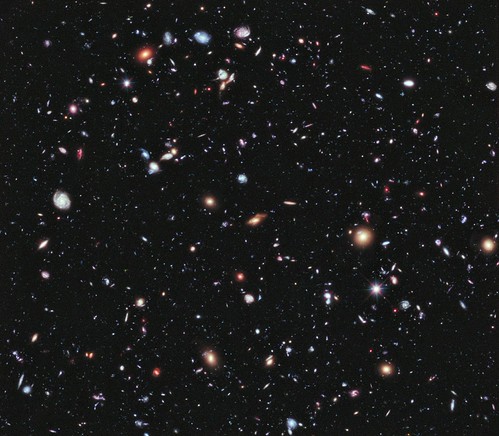
What does the photo show? It shows a small part of the sky out there, and about 5,500 galaxies, some nearer and/or larger, some smaller and/or further away. The Wikipedia article on galaxies indicates that the smallest ones have about ten million stars apiece, and the largest ones have about ten million times ten million stars each, which is about 10 times as many stars in each one as the dollar amount of the national debt. Clearly, there are a lot of stars out there! How many of these have planets? Obviously, we don't know, but, most likely, many millions of planets, some of them suitable for earth-type living things, are out there. The furthest galaxies in the picture are said to be over 13 billion light years away, which means that it took over 13 billion years for light from them to reach NASA's instruments.
I am a member of Flickr, a sort of hybrid between photography, a blog, and a social network. Members post photos, and other members can subscribe to those photos, which means that they can see, if they choose, all the photos published by such other members. I have been a subscriber to NASA's photostream for a few years, and there are often interesting, beautiful, or spectacular shots posted from current work. (See here for NASA's policy on use of their photographs, which allows use such as this.) Non-members, including you, can see Flickr photos without needing a password. The graphic above is also a link to the photo on Flickr, with description. Larger sizes are available, at least to other Flickr members. See here for a fuller explanation of the picture.
In addition to the above photo, which was assembled from years of data collection by orbiting telescopes, recent photos have included various weather phenomena, as seen by satellites, shots of equipment used, or soon to be used, by NASA, and a satellite photo of the result of the attack on the World Trade Center on September 11, 2001.
I have previously posted on related topics, including "extraterrestrial religion," "numbering the stars," and "God's complexity." I don't know whether there are other intelligent beings in the universe, and, if there are, whether they need salvation from sin or not. I believe that, should there be or have been such, God's plan includes their salvation, in ways we might, or might not, understand. It is likely, it seems to me, that Christ's death on the cross, on earth, and His subsequent resurrection, was sufficient atonement for all the intelligent beings that have ever sinned, whatever they might have looked like, or look like now, and whatever planet they lived on, or live on now, including me and you.
Thanks for reading.
Wednesday, September 26, 2012
Sunspots 385

Science: (not Science Fiction) Fox News
reports that scientists are working
on a real warp drive, which drive was popularized in the Star
Trek TV series (all of them) and the Star Trek movies.
The cost of sequencing a person's genes is getting
affordable, less than $5,000, and going down. National Public Radio reports
that this has promise, and raises numerous ethical questions. Also practical ones -- will your doctor be able to interpret the results and
explain them to you?
The Arts: The trailer
for the soon-to-be-released Hobbit film.
Politics: National Public Radio has done a graphic
analysis of candidate Romney's 47 percent who don't pay income
taxes, showing why they don't.
Christianity: "This God of rough edges will not be
smoothed out, neither by the fundamentalists who think he is mainly interested in populating hell, nor the liberals who imagine hell is
empty." Mark Galli, reviewing the movie, Hellbound?, for
Christianity Today.
Tuesday, September 25, 2012
The glory of God's creation, from R. D. Blackmore's Lorna Doone
I recently re-read Lorna Doone, by R. D. Blackmore. I first read a condensed version of the book while I was in elementary school. The Wikipedia article on the book says that it was originally published anonymously in 1869, as a print run of only 300, because the author had difficulty finding a publisher, but that the book has never been out of print since. Here are a few excerpts from the book, all having to do with the glory found in the non-human world:
The rising of the sun was noble in the cold and warmth of it; peeping down the spread of light, he raised his shoulder heavily over the edge of grey mountain, and wavering length of upland. Beneath his gaze the dew-fogs dipped, and crept to the hollow places; then stole away in line and column, holding skirts, and clinging subtly at the sheltering corners, where rock hung over grass-land; while the brave lines of the hills came forth, one beyond other gliding. Then the woods arose in folds, like drapery of awakened mountains, stately with a depth of awe, and memory of the tempests. Autumn's mellow hand was on them, as they owned already, touched with gold, and red, and olive; and their joy towards the sun was less to a bridegroom than a father. Yet before the floating impress of the woods could clear itself, suddenly the gladsome light leaped over hill and valley, casting amber, blue, and purple, and a tint of rich red rose; according to the scene they lit on, and the curtain flung around; yet all alike dispelling fear and the cloven hoof of darkness, all on the wings of hope advancing, and proclaiming, "God is here." Then life and joy sprang reassured from every crouching hollow; every flower, and bud, and bird, had a fluttering sense of them; and all the flashing of God's gaze merged into soft beneficence. So perhaps shall break upon us that eternal morning, when crag and chasm shall be no more, neither hill and valley, nor great unvintaged ocean; when glory shall not scare happiness, neither happiness envy glory; but all things shall arise and shine in the light of the Father's countenance, because itself is risen.
R. D. Blackmore. Lorna Doone: A Romance of Exmoor (public domain). From Chapter XXXIII, "An Early Morning Call."
Now though it is part of my life to heed, it is no part of my tale to tell, how the wheat was coming on. I reckon that you, who read this story, after I am dead and gone (and before that none shall read it), will say, "Tush! What is his wheat to us? We are not wheat: we are human beings: and all we care for is human doings." This may be very good argument, and in the main, I believe that it is so. Nevertheless, if a man is to tell only what he thought and did, and not what came around him, he must not mention his own clothes, which his father and mother bought for him. And more than my own clothes to me, ay, and as much as my own skin, are the works of nature round about, whereof a man is the smallest.
R. D. Blackmore. Lorna Doone: A Romance of Exmoor (public domain). From Chapter L, "A Merry Meeting a Sad One."
God has made the earth quite large, with a spread of land large enough for all to live on, without fighting. Also a mighty spread of water, laying hands on sand and cliff with a solemn voice in storm-time; and in the gentle weather moving men to thoughts of equity. This, as well, is full of food; being two-thirds of the world, and reserved for devouring knowledge; by the time the sons of men have fed away the dry land. Yet before the land itself has acknowledged touch of man, upon one in a hundred acres; and before one mile in ten thousand of the exhaustless ocean has ever felt the plunge of hook, or combing of the haul-nets; lo, we crawl, in flocks together upon the hot ground that stings us, even as the black grubs crowd upon the harried nettle! Surely we are too much given to follow the tracks of each other.
R. D. Blackmore. Lorna Doone: A Romance of Exmoor (public domain). From Chapter LXIX, "Not to be Put up With."
The rising of the sun was noble in the cold and warmth of it; peeping down the spread of light, he raised his shoulder heavily over the edge of grey mountain, and wavering length of upland. Beneath his gaze the dew-fogs dipped, and crept to the hollow places; then stole away in line and column, holding skirts, and clinging subtly at the sheltering corners, where rock hung over grass-land; while the brave lines of the hills came forth, one beyond other gliding. Then the woods arose in folds, like drapery of awakened mountains, stately with a depth of awe, and memory of the tempests. Autumn's mellow hand was on them, as they owned already, touched with gold, and red, and olive; and their joy towards the sun was less to a bridegroom than a father. Yet before the floating impress of the woods could clear itself, suddenly the gladsome light leaped over hill and valley, casting amber, blue, and purple, and a tint of rich red rose; according to the scene they lit on, and the curtain flung around; yet all alike dispelling fear and the cloven hoof of darkness, all on the wings of hope advancing, and proclaiming, "God is here." Then life and joy sprang reassured from every crouching hollow; every flower, and bud, and bird, had a fluttering sense of them; and all the flashing of God's gaze merged into soft beneficence. So perhaps shall break upon us that eternal morning, when crag and chasm shall be no more, neither hill and valley, nor great unvintaged ocean; when glory shall not scare happiness, neither happiness envy glory; but all things shall arise and shine in the light of the Father's countenance, because itself is risen.
R. D. Blackmore. Lorna Doone: A Romance of Exmoor (public domain). From Chapter XXXIII, "An Early Morning Call."
Now though it is part of my life to heed, it is no part of my tale to tell, how the wheat was coming on. I reckon that you, who read this story, after I am dead and gone (and before that none shall read it), will say, "Tush! What is his wheat to us? We are not wheat: we are human beings: and all we care for is human doings." This may be very good argument, and in the main, I believe that it is so. Nevertheless, if a man is to tell only what he thought and did, and not what came around him, he must not mention his own clothes, which his father and mother bought for him. And more than my own clothes to me, ay, and as much as my own skin, are the works of nature round about, whereof a man is the smallest.
R. D. Blackmore. Lorna Doone: A Romance of Exmoor (public domain). From Chapter L, "A Merry Meeting a Sad One."
God has made the earth quite large, with a spread of land large enough for all to live on, without fighting. Also a mighty spread of water, laying hands on sand and cliff with a solemn voice in storm-time; and in the gentle weather moving men to thoughts of equity. This, as well, is full of food; being two-thirds of the world, and reserved for devouring knowledge; by the time the sons of men have fed away the dry land. Yet before the land itself has acknowledged touch of man, upon one in a hundred acres; and before one mile in ten thousand of the exhaustless ocean has ever felt the plunge of hook, or combing of the haul-nets; lo, we crawl, in flocks together upon the hot ground that stings us, even as the black grubs crowd upon the harried nettle! Surely we are too much given to follow the tracks of each other.
R. D. Blackmore. Lorna Doone: A Romance of Exmoor (public domain). From Chapter LXIX, "Not to be Put up With."
Sunday, September 23, 2012
Prayer and Trouble, part 11, by E. M. Bounds
In the New Testament there are three words used which embrace trouble. These are tribulation, suffering and affliction, words differing somewhat, and yet each of them practically meaning trouble of some kind. Our Lord put His disciples on notice that they might expect tribulation in this life, teaching them that tribulation belonged to this world, and they could not hope to escape it; that they would not be carried through this life on flowery beds of ease. How hard to learn this plain and patent lesson! “In the world ye shall have tribulation; but be of good cheer; I have overcome the world.” There is the encouragement.
As He had overcome the world and its tribulations, so might they do the same. Paul taught the same lesson throughout his ministry, when in confirming the souls of the brethren, and exhorting them to continue in the faith, he told them that “we must, through much tribulation, enter into the kingdom of God.” He himself knew this by his own experience, for his pathway was anything but smooth and flowery. He it is who uses the word “suffering” to describe the troubles of life, in that comforting passage in which he contrasts life’s troubles with the final glory of heaven, which shall be the reward of all who patiently endure the ills of Divine Providence:
“For I reckon that the sufferings of this present time are not worthy to be compared with the glory which shall be revealed in us.”
And he it is who speaks of the afflictions which come to the people of God in this world, and regards them as light as compared with the weight of glory awaiting all who are submissive, patient and faithful in all their troubles:
“For our light affliction, which is but for a moment, worketh for us a far more exceeding and eternal weight of glory.”
But these present afflictions can work for us only as we cooperate with God in prayer. As God works through prayer, it is only through this means He can accomplish His highest ends for us. His Providence works with greatest effect with His praying ones. These know the uses of trouble and its gracious designs. The greatest value in trouble comes to those who bow lowest before the throne. - From The Essentials of Prayer, by E. M. Bounds.
Although E. M. Bounds died in 1913, this book was first published in 1925, by an admirer of the author's life. Bounds was known for praying from four until seven each morning.
This post is one of a series, taken from The Essentials of Prayer, by Bounds. Found through the Christian Classics Ethereal Library, here. The Essentials of Prayer is in the public domain. The previous post in the entire series on the book is here. Thanks for reading. Read this book, and, more importantly, practice, prayer.
As He had overcome the world and its tribulations, so might they do the same. Paul taught the same lesson throughout his ministry, when in confirming the souls of the brethren, and exhorting them to continue in the faith, he told them that “we must, through much tribulation, enter into the kingdom of God.” He himself knew this by his own experience, for his pathway was anything but smooth and flowery. He it is who uses the word “suffering” to describe the troubles of life, in that comforting passage in which he contrasts life’s troubles with the final glory of heaven, which shall be the reward of all who patiently endure the ills of Divine Providence:
“For I reckon that the sufferings of this present time are not worthy to be compared with the glory which shall be revealed in us.”
And he it is who speaks of the afflictions which come to the people of God in this world, and regards them as light as compared with the weight of glory awaiting all who are submissive, patient and faithful in all their troubles:
“For our light affliction, which is but for a moment, worketh for us a far more exceeding and eternal weight of glory.”
But these present afflictions can work for us only as we cooperate with God in prayer. As God works through prayer, it is only through this means He can accomplish His highest ends for us. His Providence works with greatest effect with His praying ones. These know the uses of trouble and its gracious designs. The greatest value in trouble comes to those who bow lowest before the throne. - From The Essentials of Prayer, by E. M. Bounds.
Although E. M. Bounds died in 1913, this book was first published in 1925, by an admirer of the author's life. Bounds was known for praying from four until seven each morning.
This post is one of a series, taken from The Essentials of Prayer, by Bounds. Found through the Christian Classics Ethereal Library, here. The Essentials of Prayer is in the public domain. The previous post in the entire series on the book is here. Thanks for reading. Read this book, and, more importantly, practice, prayer.
Saturday, September 22, 2012
I'm an information junkie. Are you?
I confess. I'm an information junkie. If I see part of a sporting event on TV, I want to know who won it, even if I've never seen the team, or individual, before. I listen to National Public Radio news programs a lot, and I often stay in the car after arriving at my destination, because I want to hear the rest of the story. I read a lot, on-line and in classical media. When the Watergate Hearings were on TV, I watched a lot of them. I didn't need to, but I wanted to. My wife and I have four information appliances in our home. I don't think we are ever actively using all four at once, but we often use two at a time, and occasionally three. Maybe you are like that. Maybe not. In this day of Twitter, texting while driving, libraries, magazine sales at the checkout counter, GPS devices, walking with earbuds in your ears, hundreds of TV channels, and lots and lots of on-line sites, including some apparently important ones that I've never heard of, a lot of people out there must be like that.
I guess I should stop and say that "information" has a technical meaning, or several such. I used an information appliance to look that linked source up, by the way.
Why am I like this? Why are you? I'm not sure. Part of it is that we need to know things for various reasons, such as to rear our children, do our job, study the Bible, converse with other people. Some of it must be that wanting to know things must be part of the image of God in us. Unfortunately, some of our information searching is sinful, however. Seeking out pornography, stealing someone's identity, finding out about things that we covet, when we don't need them, being a fan of the wrong sort of celebrity, seeking out stuff to gossip about, in various ways, are bending information hunger into wrong directions.
Am I ever going to see all of the sports events on TV, no matter how many channels I have at my disposal? Am I ever going to know all of the news being pumped out? Am I ever going to read all the books I've thought about reading? No. Neither are you.
Is that bad? Not necessarily. Most of the stories I can look at, in all kinds of media, have little value now. Almost none of them will have much importance ten years from now. Very, very few of them will have any importance in 2112.
There's a moral in that last paragraph. I need to pay attention to it. What's that moral? Ultimately, there's only one story that's of eternal importance. That's the story of Christ. He created, He sustains, He lived for us, died for us, was resurrected for us, and, by His death and resurrection, paid the penalty for our sins. He is now waiting for us. That story makes the Southeast Conference, National Public Radio, NBC, the local newspaper, all the magazines available at the supermarket, all the sites on the Internet, all the books in the library, all the tweets in cyberspace seem so insignificant that it's hardly worth paying attention to them, in comparison.
Thanks for reading. I hope that wasn't too much information!
I guess I should stop and say that "information" has a technical meaning, or several such. I used an information appliance to look that linked source up, by the way.
Why am I like this? Why are you? I'm not sure. Part of it is that we need to know things for various reasons, such as to rear our children, do our job, study the Bible, converse with other people. Some of it must be that wanting to know things must be part of the image of God in us. Unfortunately, some of our information searching is sinful, however. Seeking out pornography, stealing someone's identity, finding out about things that we covet, when we don't need them, being a fan of the wrong sort of celebrity, seeking out stuff to gossip about, in various ways, are bending information hunger into wrong directions.
Am I ever going to see all of the sports events on TV, no matter how many channels I have at my disposal? Am I ever going to know all of the news being pumped out? Am I ever going to read all the books I've thought about reading? No. Neither are you.
Is that bad? Not necessarily. Most of the stories I can look at, in all kinds of media, have little value now. Almost none of them will have much importance ten years from now. Very, very few of them will have any importance in 2112.
There's a moral in that last paragraph. I need to pay attention to it. What's that moral? Ultimately, there's only one story that's of eternal importance. That's the story of Christ. He created, He sustains, He lived for us, died for us, was resurrected for us, and, by His death and resurrection, paid the penalty for our sins. He is now waiting for us. That story makes the Southeast Conference, National Public Radio, NBC, the local newspaper, all the magazines available at the supermarket, all the sites on the Internet, all the books in the library, all the tweets in cyberspace seem so insignificant that it's hardly worth paying attention to them, in comparison.
Thanks for reading. I hope that wasn't too much information!
Friday, September 21, 2012
Colossians 1:16-17 poster
A poster, attempting to portray Colossians 1:16-17, which says that "all things have been created through him, and for him. He is before all things, and in him all things hold together." (World English Bible, public domain)
This, as I see it, means two important things, for Christians. One is
that God the Son was the most important agent of creation, whenever
and however that occurred, and the other is that God hasn't gone off
and left the universe alone -- it is continuously being held together.
Don't ask me how.
I chose what I hope is a royal purple color for the text. I
chose a spider web for the background, because it illustrates things being held
together. I tweaked it a little in Corel Draw.
Thanks for looking, and reading. The graphic serves as a link to a larger version, posted to Flickr.
Wednesday, September 19, 2012
Sunspots 384

Humor: (or something). ThatOneRule
has over 1800 rules for living, submitted by users. Sample: "Practice does not make perfect. Only perfect practice makes perfect." (Rule 1822)
Science: National Public Radio on a very blue berry, including how it gets so blue, and the probable function of its color.
Wired reports on population
levels in lemmings, which seem to have significantly shrunk, as a
result of climate change.
Computing: Beyond Google: BrainPickings.org has an
annotated list
of image search tools.
Monday, September 17, 2012
The My America series
Some time ago, I read My Brother's Keeper: Virginia's Diary, by Mary Pope Osborne, and The Journal of C.J. Jackson: a Dust Bowl Migrant by William Durbin, and found them excellent. They are part of the My America and My Name is America series, a series of books about, and for young teens. Based on the two I read, the books are fictitious diaries about various troubled times in our history, from the viewpoints of various types of young people. I found them to be good reading, and, as far as I can tell, they are true to the facts. The Dust Bowl volume includes photos, and a map of the Southwest, featuring US highway 66.
Thanks for reading.
Thanks for reading.
Sunday, September 16, 2012
Prayer and Trouble, part 10, by E. M. Bounds
As is the infinite variety of trouble, so also is there infinite variety in the relations of prayer to other things. How many are the things which are the subject of prayer! It has to do with everything which concerns us, with everybody with whom we have to do, and has to do with all times. But especially does prayer have to do with trouble. “This poor man cried and the Lord heard him, and saved him out of all his troubles.” O the blessedness, the help, the comfort of prayer in the day of trouble! And how marvelous the promises of God to us in the time of trouble!
“Because he hath set his love upon me, therefore will I deliver him; I will set him on high because he hath known my name. He shall call upon me, and I will answer him; I will be with him in trouble; I will deliver him and honor him.”
“If pain afflict, or wrongs oppress,
If cares distract, or fears dismay;
If guilt deject, if sin distress,
In every case, still watch and pray.”
If cares distract, or fears dismay;
If guilt deject, if sin distress,
In every case, still watch and pray.”
How rich in its sweetness, how far-reaching in the realm of trouble, and how cheering to faith, are the words of promise which God delivers to His believing, praying ones, by the mouth of Isaiah:
“But now, thus saith the Lord that created thee, O Jacob, and he that formed thee, O Israel, Fear not: for I have redeemed thee, I have called thee by thy name; thou art mine. When thou passest through the waters, I will be with thee; and through the rivers, they shall not overflow thee: when thou walkest through the fire, thou shalt not be burned: neither shall the flame kindle upon thee . . . For I am the Lord thy God, the Holy One of Israel, thy Saviour.” From The Essentials of Prayer, by E. M. Bounds.
Although E. M. Bounds died in 1913, this book was first published in 1925, by an admirer of the author's life. Bounds was known for praying from four until seven each morning.
This post is one of a series, taken from The Essentials of Prayer, by Bounds. Found through the Christian Classics Ethereal Library, here. The Essentials of Prayer is in the public domain. The previous post in the entire series on the book is here. Thanks for reading. Read this book, and, more importantly, practice, prayer.
Saturday, September 15, 2012
Sins of omission; unintentional sin
James 4:17 To him therefore who knows to do good, and doesn’t do it, to him it is sin.
Matthew 25:26 “But his lord answered him, ‘You wicked and slothful servant. You knew that I reap where I didn’t sow, and gather where I didn’t scatter. 27 You ought therefore to have deposited my money with the bankers, and at my coming I should have received back my own with interest. . . .
41 Then he will say also to those on the left hand, ‘Depart from me, you cursed, into the eternal fire which is prepared for the devil and his angels; 42 for I was hungry, and you didn’t give me food to eat; I was thirsty, and you gave me no drink; 43 I was a stranger, and you didn’t take me in; naked, and you didn’t clothe me; sick, and in prison, and you didn’t visit me.’
44 “Then they will also answer, saying, ‘Lord, when did we see you hungry, or thirsty, or a stranger, or naked, or sick, or in prison, and didn’t help you?’
45 “Then he will answer them, saying, ‘Most certainly I tell you, because you didn’t do it to one of the least of these, you didn’t do it to me.’ (World English Bible, public domain)
We often think of sin as something bad that we do. Indeed, we shouldn't do bad things on purpose. But the Bible goes further than that. It indicates that, first, sins may be something we think, even though we don't do them (Matthew 5:21-30). Second, it indicates that there are sins of omission -- things we know that we should do, but don't do. The three passages quoted above are part of the evidence for that. Matthew 25 is not exactly factual -- Jesus was using imagination to make a point -- but there seems no good reason to doubt that He was condemning sins of omission.
The Catholic church has official doctrine on sins of omission, which is "a failure to do something one can and ought to do. . ."
As I understand it, to the New Testament writers, and to Christ, sin must be deliberate, on purpose. However, the Old Testament makes provision for unintentional sin. (see Numbers 15:27-30 and Leviticus 4) Sin, again as I understand it, in the Old Testament included a large number of possible transgressions against the ceremonial law -- not making prescribed sacrifices, eating the wrong kinds of food, or food prepared in the wrong way, and other possibilities. If I tell someone that the drugstore is South, when it is North, because I think it's South, that's not a sin. It's a mistake. If given the opportunity, I might correct this with the person I told, and I may be sorry for inconvenience, but I don't need to repent and ask forgiveness. But if I lived under Old Testament Law, and was supposed to avoid a certain kind of food, but didn't know it, I would still have broken the law, and, if I discovered my mistake, I would have needed to offer a sacrifice as penance. Thank God that Christ paid the penalty for all kinds of sin, deliberate, commission, omission, or unintentional.
For more on unintentional sins, see David Jamieson, Commentary on Leviticus 4, and also Matthew Henry's commentary on the same passage.
Thanks for reading. If you know of good to do, and can do it, do it.
Matthew 25:26 “But his lord answered him, ‘You wicked and slothful servant. You knew that I reap where I didn’t sow, and gather where I didn’t scatter. 27 You ought therefore to have deposited my money with the bankers, and at my coming I should have received back my own with interest. . . .
41 Then he will say also to those on the left hand, ‘Depart from me, you cursed, into the eternal fire which is prepared for the devil and his angels; 42 for I was hungry, and you didn’t give me food to eat; I was thirsty, and you gave me no drink; 43 I was a stranger, and you didn’t take me in; naked, and you didn’t clothe me; sick, and in prison, and you didn’t visit me.’
44 “Then they will also answer, saying, ‘Lord, when did we see you hungry, or thirsty, or a stranger, or naked, or sick, or in prison, and didn’t help you?’
45 “Then he will answer them, saying, ‘Most certainly I tell you, because you didn’t do it to one of the least of these, you didn’t do it to me.’ (World English Bible, public domain)
We often think of sin as something bad that we do. Indeed, we shouldn't do bad things on purpose. But the Bible goes further than that. It indicates that, first, sins may be something we think, even though we don't do them (Matthew 5:21-30). Second, it indicates that there are sins of omission -- things we know that we should do, but don't do. The three passages quoted above are part of the evidence for that. Matthew 25 is not exactly factual -- Jesus was using imagination to make a point -- but there seems no good reason to doubt that He was condemning sins of omission.
The Catholic church has official doctrine on sins of omission, which is "a failure to do something one can and ought to do. . ."
As I understand it, to the New Testament writers, and to Christ, sin must be deliberate, on purpose. However, the Old Testament makes provision for unintentional sin. (see Numbers 15:27-30 and Leviticus 4) Sin, again as I understand it, in the Old Testament included a large number of possible transgressions against the ceremonial law -- not making prescribed sacrifices, eating the wrong kinds of food, or food prepared in the wrong way, and other possibilities. If I tell someone that the drugstore is South, when it is North, because I think it's South, that's not a sin. It's a mistake. If given the opportunity, I might correct this with the person I told, and I may be sorry for inconvenience, but I don't need to repent and ask forgiveness. But if I lived under Old Testament Law, and was supposed to avoid a certain kind of food, but didn't know it, I would still have broken the law, and, if I discovered my mistake, I would have needed to offer a sacrifice as penance. Thank God that Christ paid the penalty for all kinds of sin, deliberate, commission, omission, or unintentional.
For more on unintentional sins, see David Jamieson, Commentary on Leviticus 4, and also Matthew Henry's commentary on the same passage.
Thanks for reading. If you know of good to do, and can do it, do it.
Friday, September 14, 2012
Light, God's Light
I was invited to write an article for something called "Navigating the Heavens," on some subject related to light.
I responded, and the article, entitled "Light, God's Light," was published, but is no longer available. Most of it is based on posts in this blog, and the blog is why I was invited to write it, but the article is more thorough than any of my blog posts on light.
Thanks for reading.
I responded, and the article, entitled "Light, God's Light," was published, but is no longer available. Most of it is based on posts in this blog, and the blog is why I was invited to write it, but the article is more thorough than any of my blog posts on light.
Thanks for reading.
Thursday, September 13, 2012
Looking back to the good old days
Ecclesiastes 7:10 Don’t say, “Why were the
former days better than these?” For you do not ask wisely about this.
(World English Bible, public domain)
We often say, or think, about the "good old days," before there was so much traffic, or when money was worth more, or our health was better, and when, we often think, people were less nasty and sinful. I've done it myself.
I'm not sure how far to take the advice of the writer of Ecclesiastes, whoever that may have been, to stop doing that. It's pretty clear that the book takes a dim view of a lot of things! It is also true that the Israelites were often reminded, in various ways, that they were better off when they were worshiping God as they should have, and that they should return to that attitude. But at least one aspect of the statement quoted is true. We can't go back. Even if the old days were better than our present circumstances, we aren't going to be able to live in them again. Things and people decay and disappear. Things and people change. We change. We can learn from the past, we are deeply influenced by it, we can even be inspired by it, but we live in the present, for the future.
Thanks for reading! Enjoy your present, and live for your future.
We often say, or think, about the "good old days," before there was so much traffic, or when money was worth more, or our health was better, and when, we often think, people were less nasty and sinful. I've done it myself.
I'm not sure how far to take the advice of the writer of Ecclesiastes, whoever that may have been, to stop doing that. It's pretty clear that the book takes a dim view of a lot of things! It is also true that the Israelites were often reminded, in various ways, that they were better off when they were worshiping God as they should have, and that they should return to that attitude. But at least one aspect of the statement quoted is true. We can't go back. Even if the old days were better than our present circumstances, we aren't going to be able to live in them again. Things and people decay and disappear. Things and people change. We change. We can learn from the past, we are deeply influenced by it, we can even be inspired by it, but we live in the present, for the future.
Thanks for reading! Enjoy your present, and live for your future.
Wednesday, September 12, 2012
Sunspots 383
Things I have recently spotted that may be of interest to someone else:

Image
source (public domain)
Science: National Public Radio on the differences
between "organic" food and non-organic food. Not much, maybe some.
Sports: (or something) Wired
reports on a robot that is able to run
faster than Usain Bolt.
Politics: A pastor (I don't know him) has written
about how
politics and Christianity should be related. (He doesn't endorse any
candidate or party.)
Another pastor posted "7
things Christians Need to Remember About Politics," which is also
not an endorsement.
A young woman (I don't know her) was asked to pray
at the Democratic Convention. Here's her prayer. (Again, remarkably
non-partisan.)
Tuesday, September 11, 2012
Veiled Rose by Anne Elisabeth Stengl
I have recently read Veiled Rose by Anne Elisabeth Stengl. The book is the second in a series. Three have been published, and the fourth is due out next month. Here's my post on the first book, Heartless. There is not a Wikipedia article on Stengl, or her books, as yet. Here is the Amazon page for the author, and she has a blog, which sometimes includes material on her books.
Heartless was the author's first novel. There was no sign of her lack of experience in that book, and there is none in this one. The characters are three-dimensional, the plot is complex, and not easily predictable, there are a multitude of settings. The second book is mostly about events that took place before those in the first book, but they are told from a different viewpoint, and this unusual time sequence should not hinder readers. Either book should be enjoyable on its own.
I will try not to give away the plot in this post, but will muse on certain aspects of Veiled Rose.
First, a little about the world of Goldstone Wood. The land (perhaps a continent, perhaps an entire world) is divided into uplands, where humans live, by lowlands, where they don't. There are bridges between the uplands, not made by mortals. Stengl has also divided the lands into the Near World, which, as I understand it, contains the uplands, the Between, which contains the lowlands, and the Far World. (See here for more on this, from Stengl.) Fairies can enter the Near World, where mortals live, but they also live in the Between, and perhaps in the Far World. These three are perhaps three different dimensions, or three different universes, co-inhabiting the same space. Stengl doesn't make a huge deal of this -- her characters, and their lives, are more important -- but the idea of living in more than one world at once definitely adds to the book. Tolkien, for one, had a similar construction, as his elves and their evil adversaries lived in two worlds at the same time. But their appearance was different, depending on which world they were seen in. In Stengl, the appearance of a character seems to be the same in whichever World they are found. (Some characters, such as dragons and fairy knights, have two different forms, but they can take these without changing Worlds.)
There are Paths, made by the fairies, within the Near World, and, probably the other Worlds. Characters who can find those Paths can move rapidly between locations.
Stengl is a bit coy about these aspects of her sub-creation: "So we know of at least three realms of existence, three levels of reality. Might there be more?" Perhaps she didn't know, herself, when she wrote that, in June of 2011. Perhaps she did, but wasn't going to tell us yet.
Second, the characters. One of the main characters in the book is Lionheart, who is also known as Leo, and by other names. He is the crown prince of one of the realms in the Near World, and young enough to play in the woods, but old enough that he is allowed to play in them without supervision. The second main character is Rosie. Lionheart meets Rosie, a girl, perhaps human, perhaps not, while playing in the wood. Rosie's origin is uncertain, and she doesn't know it herself. She always wears a veil. Lionheart doesn't know why, but doesn't really care, as she becomes his best friend. But their friendship has restrictions. She doesn't come into the castle where he lives, and he can't always go into the woods to be with her. Their friendship, by the way, seems to be quite innocent. Perhaps they are somewhat in love with each other, but perhaps not. Very few people have seen Rosie, and when people do, many of them think she is some sort of monster. She can use the Paths, at least the ones in her area, and take Lionheart on them.
Third, evil beings. One type of evil beings is the dragons. The dragons are like dragons in many other books -- they can send fire out of their mouths, they can fly, they are intelligent and can speak, they can trap unwary humans who look into their eyes, or listen to them too willingly. But, like at least one of the dragons of Ursula Le Guin's Tehanu, they can exist in human form or dragon form.
There is some other sort of evil being, perhaps also a dragon, in the books. There are at least two of these, who have the power to tempt by speaking directly to the mind of mortals. The two are in some sort of competition. The theology, or whatever it should be called, of the Goldstone Wood books is complex, and much of it is not merely an imaginary replication of Christian theology, or any other kind that I am aware of. I do believe, as I indicated in the post on the previous work, that the Goldstone Wood books are written with a Christian world-view, but that the fact that it's only a world-view, not the message of the books, is a plus, as I see it.
Fourth, I will say this about the plot. Rosie and Lionheart do not get married in this book. There are other characters, one of them named Daylily, who has decided to do what her father wants her to, and get Lionheart to marry her. He doesn't do that, either. Daylily is a complex character, and a strong one, and there are things that she does that I didn't expect.
More could be said, but I'll stop. I will confess that I have already read the third book in the series. In fact, I've read all three books twice.
Thanks for reading.
Heartless was the author's first novel. There was no sign of her lack of experience in that book, and there is none in this one. The characters are three-dimensional, the plot is complex, and not easily predictable, there are a multitude of settings. The second book is mostly about events that took place before those in the first book, but they are told from a different viewpoint, and this unusual time sequence should not hinder readers. Either book should be enjoyable on its own.
I will try not to give away the plot in this post, but will muse on certain aspects of Veiled Rose.
First, a little about the world of Goldstone Wood. The land (perhaps a continent, perhaps an entire world) is divided into uplands, where humans live, by lowlands, where they don't. There are bridges between the uplands, not made by mortals. Stengl has also divided the lands into the Near World, which, as I understand it, contains the uplands, the Between, which contains the lowlands, and the Far World. (See here for more on this, from Stengl.) Fairies can enter the Near World, where mortals live, but they also live in the Between, and perhaps in the Far World. These three are perhaps three different dimensions, or three different universes, co-inhabiting the same space. Stengl doesn't make a huge deal of this -- her characters, and their lives, are more important -- but the idea of living in more than one world at once definitely adds to the book. Tolkien, for one, had a similar construction, as his elves and their evil adversaries lived in two worlds at the same time. But their appearance was different, depending on which world they were seen in. In Stengl, the appearance of a character seems to be the same in whichever World they are found. (Some characters, such as dragons and fairy knights, have two different forms, but they can take these without changing Worlds.)
There are Paths, made by the fairies, within the Near World, and, probably the other Worlds. Characters who can find those Paths can move rapidly between locations.
Stengl is a bit coy about these aspects of her sub-creation: "So we know of at least three realms of existence, three levels of reality. Might there be more?" Perhaps she didn't know, herself, when she wrote that, in June of 2011. Perhaps she did, but wasn't going to tell us yet.
Second, the characters. One of the main characters in the book is Lionheart, who is also known as Leo, and by other names. He is the crown prince of one of the realms in the Near World, and young enough to play in the woods, but old enough that he is allowed to play in them without supervision. The second main character is Rosie. Lionheart meets Rosie, a girl, perhaps human, perhaps not, while playing in the wood. Rosie's origin is uncertain, and she doesn't know it herself. She always wears a veil. Lionheart doesn't know why, but doesn't really care, as she becomes his best friend. But their friendship has restrictions. She doesn't come into the castle where he lives, and he can't always go into the woods to be with her. Their friendship, by the way, seems to be quite innocent. Perhaps they are somewhat in love with each other, but perhaps not. Very few people have seen Rosie, and when people do, many of them think she is some sort of monster. She can use the Paths, at least the ones in her area, and take Lionheart on them.
Third, evil beings. One type of evil beings is the dragons. The dragons are like dragons in many other books -- they can send fire out of their mouths, they can fly, they are intelligent and can speak, they can trap unwary humans who look into their eyes, or listen to them too willingly. But, like at least one of the dragons of Ursula Le Guin's Tehanu, they can exist in human form or dragon form.
There is some other sort of evil being, perhaps also a dragon, in the books. There are at least two of these, who have the power to tempt by speaking directly to the mind of mortals. The two are in some sort of competition. The theology, or whatever it should be called, of the Goldstone Wood books is complex, and much of it is not merely an imaginary replication of Christian theology, or any other kind that I am aware of. I do believe, as I indicated in the post on the previous work, that the Goldstone Wood books are written with a Christian world-view, but that the fact that it's only a world-view, not the message of the books, is a plus, as I see it.
Fourth, I will say this about the plot. Rosie and Lionheart do not get married in this book. There are other characters, one of them named Daylily, who has decided to do what her father wants her to, and get Lionheart to marry her. He doesn't do that, either. Daylily is a complex character, and a strong one, and there are things that she does that I didn't expect.
More could be said, but I'll stop. I will confess that I have already read the third book in the series. In fact, I've read all three books twice.
Thanks for reading.
Sunday, September 09, 2012
Prayer and Trouble, part 9, by E. M. Bounds
But when we survey all the sources from which trouble comes, it all resolves itself into two invaluable truths: First, that our troubles at last are of the Lord. They come with His consent He is in all of them, and is interested in us when they press and bruise us. And secondly, that our troubles, no matter what the cause, whether of ourselves, or men or devils, or even God Himself, we are warranted in taking them to God in prayer, in praying over them, and in seeking to get the greatest spiritual benefits out of them.
Prayer in the time of trouble tends to bring the spirit into perfect subjection to the will of God, to cause the will to be conformed to God’s will, and saves from all murmurings over our lot, and delivers from everything like a rebellious heart or a spirit critical of the Lord. Prayer sanctifies trouble to our highest good. Prayer so prepares the heart that it softens under the disciplining hand of God. Prayer places us where God can bring to us the greatest good, spiritual and eternal. Prayer allows God to freely work with us and in us in the day of trouble. Prayer removes everything in the way of trouble, bringing to us the sweetest, the highest and greatest good. Prayer permits God’s servant, trouble, to accomplish its mission in us, with us and for us.
Although E. M. Bounds died in 1913, this book was first published in 1925, by an admirer of the author's life. Bounds was known for praying from four until seven each morning.
This post is one of a series, taken from The Essentials of Prayer, by Bounds. Found through the Christian Classics Ethereal Library, here. The Essentials of Prayer is in the public domain. The previous post in the entire series on the book is here. Thanks for reading. Read this book, and, more importantly, practice, prayer.
Friday, September 07, 2012
Christianity in the US - on the defensive
Henry Neufeld has written a good post on "Defensive Christianity," by which he means that Christianity, in the US, seems to be living in a state of fear, and shouldn't be. It's well done, and well worth reading.
Wednesday, September 05, 2012
Sunspots 382
Things I have recently spotted that may be of interest to someone else:

Image
source (public domain)
Science: The Atlantic has posted a page of 16
spectacular images, not widely released previously, from the Hubble
telescope.
Wired reports that males of a species of snail take
care of many developing young snails
that aren't their own offspring.
Sports: In case you didn't know, and I
certainly didn't, Wired tells us that there's competitive
bog snorkeling.
Politics: Heart, Mind and Soul reports on how
the KGB sowed discord in the US.
Computing: You've heard of software bugs, surely.
Well, Wired tells us that there
are hardware bugs, too.
Sunday, September 02, 2012
Prayer and Trouble, part 8, by E. M. Bounds
Some troubles are human in their origin. They arise from second causes. They originate with others and we are the sufferers. This is a world where often the innocent suffer the consequences of the acts of others. This is a part of life’s incidents. Who has not at some time suffered at the hands of others? But even these are allowed to come in the order of God’s providence, are permitted to break into our lives for beneficent ends, and may be prayed over. Why should we not carry our hurts, our wrongs and our privations, caused by the acts of others, to God in prayer? Are such things outside of the realm of prayer? Are they exceptions to the rule of prayer? Not at all. And God can and will lay His hand upon all such events in answer to prayer, and cause them to work for us “a far more exceeding and eternal weight of glory.”
Nearly all of Paul’s troubles arose from wicked and unreasonable men. Read the story as he gives it in 2 Cor. 11:23-33.
So also some troubles are directly of Satanic origin. Quite all of Job’s troubles were the offspring of the devil’s scheme to break down Job’s integrity, to make him charge God foolishly and to curse God. But are these not to be recognised in prayer? Are they to be excluded from God’s disciplinary processes? Job did not do so. Hear him in those familiar words. “The Lord gave, and the Lord hath taken away. Blessed be the name of the Lord” From The Essentials of Prayer, by E. M. Bounds.
Although E. M. Bounds died in 1913, this book was first published in 1925, by an admirer of the author's life. Bounds was known for praying from four until seven each morning.
This post is one of a series, taken from The Essentials of Prayer, by Bounds. Found through the Christian Classics Ethereal Library, here. The Essentials of Prayer is in the public domain. The previous post in the entire series on the book is here. Thanks for reading. Read this book, and, more importantly, practice, prayer.
Subscribe to:
Posts (Atom)