License

I have written an e-book, Does the Bible Really Say That?, which is free to anyone. To download that book, in several formats, go here.
Creative Commons License
The posts in this blog are licensed under a Creative Commons Attribution-NonCommercial-ShareAlike 3.0 Unported License. You can copy and use this material, as long as you aren't making money from it. If you give me credit, thanks. If not, OK.

Sunday, January 22, 2006

Never be moved

Psa 15:1 A Psalm of David. Jehovah, who shall sojourn in thy tabernacle? Who shall dwell in thy holy hill?

Psa 15:2 He that walketh uprightly, and worketh righteousness, And speaketh truth in his heart; 3 He that slandereth not with his tongue, Nor doeth evil to his friend, Nor taketh up a reproach against his neighbor; 4 In whose eyes a reprobate is despised, But who honoreth them that fear Jehovah; He that sweareth to his own hurt, and changeth not; 5 He that putteth not out his money to interest, Nor taketh reward against the innocent. He that doeth these things shall never be moved. (the American Standard Version, Public Domain)


Isaiah 54:10 For the mountains may departand the hills be removed, but my steadfast love shall not depart from you,and my covenant of peace shall not be removed,”says the Lord, who has compassion on you. (ESV)

(There are passages in the Bible that refer to being moved, emotionally)

Saturday, January 21, 2006

Heart in the Bible

According to a Blue Letter Bible search, the word, "heart," occurs in the KJV Bible 830 times in 762 verses. I didn't read through all of these, but it looks like all, or nearly all, of these are in the sense of "the center of the will," or "the seat of the emotions." The first occurrence is Gen 6:5 "And GOD saw that the wickedness of man [was] great in the earth, and [that] every imagination of the thoughts of his heart [was] only evil continually." (KJV) Only 98 of the 762 verses are in the New Testament. The Blue Letter Bible says that the Hebrew word was lebab, or some variation thereof.

Here's an important passage, from Mark 12:30 "And thou shalt love the Lord thy God with all thy heart, and with all thy soul, and with all thy mind, and with all thy strength: this [is] the first commandment." (KJV) This is part of a dialogue between Jesus and a teacher of the law, and Jesus is quoting Deuteronomy 6:4, and responding to the teacher's question about what part of the law is most important. The teacher agrees.

A previous post is on the heart, in the same sense. The Wikipedia's "disambiguation page" on heart lists the two important meanings, namely a "muscular organ" and "Symbolism and Metaphor," as well as some which are much less important. The article on the heart in symbolism begins with a reference to the Bible, and says that Bible use of the word is as "the moral core of a human being including the intellect and not just the emotions," referencing JewishEncyclopedia.com on that point.

The Online Etymology Dictionary says that heart, or a recognizable predecessor, has been around since Proto-Indo-European, perhaps 5500 years ago.

What is the physical seat of the emotions, the center of the will, if there is such a physical seat? I don't believe we have any scientific evidence that definitely locates such, but would suppose that it is some part of the cerebral cortex, or the entire brain. I don't suppose it matters much whether or not there is such a specific location. We act as if there was one, and mostly believe that there is.

Some time ago, I posted on a work of fantasy by Patricia A. McKillip, concluding that the theme concerned the heart.

Friday, January 20, 2006

Question on the meaning of Genesis 2, especially on the meaning of "day"

This is the first part of Genesis 2 (ESV) (I'm reading the ESV through this year, I hope, using one of their plans to do so):
2:1 Thus the heavens and the earth were finished, and all the host of them. 2 And on the seventh day God finished his work that he had done, and he rested on the seventh day from all his work that he had done. 3 So God blessed the seventh day and made it holy, because on it God rested from all his work that he had done in creation.

The Creation of Man and Woman

4 These are the generations
of the heavens and the earth when they were created,
in the day that the Lord God made the earth and the heavens.
5 When no bush of the field [1] was yet in the land [2] and no small plant of the field had yet sprung up—for the Lord God had not caused it to rain on the land, and there was no man to work the ground, 6 and a mist [3] was going up from the land and was watering the whole face of the ground— 7 then the Lord God formed the man of dust from the ground and breathed into his nostrils the breath of life, and the man became a living creature.

Footnotes

[1] 2:5 Or open country
[2] 2:5 Or earth; also verse 6
[3] 2:6 Or spring


It struck me, as it never had before, that there is a puzzle here. Genesis 2 apparently says that humans were created before plants were. Genesis 1, taken literally, says that plants were created on the third day, and humans on the sixth. I am not a Hebrew scholar, but the translation above, also the NIV and the NASB, seem to say that there were no plants growing until Adam was created. Here's the ASV, which is public domain:
Gen 2:5 And no plant of the field was yet in the earth, and no herb of the field had yet sprung up; for Jehovah God had not caused it to rain upon the earth: and there was not a man to till the ground;

So what's going on? Well, it seems to me that Genesis 2:5 is scriptural evidence that the days of creation of Genesis 1 are not meant to be taken literally. (Exodus 20:11 seems to be evidence that they were.)

I knew that Meredith G. Kline, who was a Bible scholar, had written about Genesis 2:5 as evidence for non-literal days, and that knowledgeable Christian blogger Jeremy Pierce had written about this subject also, and that neither had argued that correctly interpreting Genesis demands that the days of Genesis 1 were literal, but reading this passage in the ESV reminded me forcefully of this matter.

Any comments?

* * * * *

Note added Jan 24: There have been enough comments that I plan to post again on this subject. Also, I entered it in this week's Christian Carnival, so it may get a few more readers, who may also deserve some sort of response.

Thursday, January 19, 2006

Question on Joseph's dream

While reading my daily Bible reading, including Genesis 37:5-11, it suddenly occurred to me that there is something strange about one of Joseph's dreams, or the interpretation thereof.

Joseph told his father, Jacob, that he dreamed that the sun, the moon, and eleven stars bowed down to him. Jacob asked him if his father, his mother, and his brothers would, indeed, bow down to Joseph. I must have read that thirty times, at least. Suddenly something jumped out -- Rachel, Joseph's mother, died while giving birth to Benjamin, Joseph's brother. So either he would not have had eleven brothers, because Benjamin hadn't been born yet, or he wouldn't have had his mother, or something else is going on. The only explanation I can think of, and it's not very satisfactory, is that Jacob was referring to Leah, his surviving wife (who was Rachel's sister). The NIV reference Bible suggests that solution.

The dream was more or less fulfilled, in that Joseph's brothers had to pay him homage when he was the de facto ruler of Egypt. But Jacob and Leah weren't present in Egypt at that time, and, apparently, Leah never was, as she seems to have died before the family went to Egypt. (Genesis 49:31)

Any thoughts?

Related to this subject, who acted as Benjamin's mother? How much younger was Benjamin than Joseph? Their father called both of them children of his old age.

Wednesday, January 18, 2006

Sunspots 40


Things I have recently spotted that may be of interest to someone else:


FindSounds is a specialized search engine, for finding (surprise!) sounds. I found some bird and mammal sounds with it that I hadn't found with Google. You can search by format. The return list of sounds includes a sonogram and the length of the sound. (Many of the sounds are copyrighted, of course. I'm using these strictly for entertaining our grandson, which is fair use.)

The Washington Post has some thoughts on questions that Harry Potter and the Half-Blood Prince didn't answer. (Thanks to Scholar's Blog)

April has returned to fairly regular blogging, and writes about her personal time with Christ.

Perry has some lessons from his morning runs.

Nature News reports that the extinction of amphibian species is caused by a fungus, but linked to global warming.

Thanks to Librarian's Internet Index, a web site from Penn State on Computing with non-US English symbols.

The Scout Report mentioned the Washington Post Congress Votes database, which lists votes (and not votes) for every congressperson for several years. It's apparently kept nearly up to date.

Bonnie has posted the second of a series on Christians and mental illness.

New Testament scholar Ken Schenck has posted on "What's Wrong with Those Who Oppose Women in Ministry?"

Katherine has been married for half her life.

This week's Christian Carnival is here. (For information on locating these Carnivals, see here)

Image source (public domain)

Tuesday, January 17, 2006

Milestone in Science: The Asilomar Conference, 1975


It was my privilege, recently, to travel to Pacific Grove, California. I noted, on maps of the area, the name Asilomar, which I remembered. We drove around the town, and my wife directed me down a street which had this sign.

We ate lunch near the grounds, and got to talking with a couple at another table. The woman told us that she was a high school art teacher, and that California teachers often had meetings at the conference center.

Why had I heard of the Asilomar conference grounds? I had heard of it because of a milestone in biology. In 1975, a group of geneticists (molecular biologists would be another name) met on these grounds. I remember reading what transpired there in the pages of Science and Nature. What did transpire there? Scientists considered what they were doing, and the likely consequences, and decided to put on the brakes. Such an event has been very rare in the history of science. In fact, I know of no similar decision by a group of working scientists.

The Wikipedia has a brief article on the conference, but there are a few links to excellent on-line sources. Perhaps the best such are "Asilomar Revisited," from Science, on the 25th anniversary of the conference, and "Asilomar and Recombinant DNA," by Paul Berg, one of the organizers, written in 2004. (Berg's article has photos of some of the participants, including James Watson, Sydney Brenner, Berg, Norton Zinder and David Baltimore, all Nobel Laureates, and Maxine Singer, one of the organizers, and prominent for many years in the field. (Singer was one of the few prominent females in late-twentieth century molecular biology.)

The conference of 1975 did not consider cloning, or, if it did, didn't consider it much. It considered issues of transplanting genes from one organism into another, and the possible immediate dangers to human health. The conclusions were that great care needed to be used, at least for some types of research (for example putting cancer-related genes in common bacteria). Do we need another conference, on the consequences of today's biological possibilities? Probably. But, for such things as stem cell research, it's probably too late -- there are too many researchers already. One thing that the anniversary article points out is that the participants in the original conference were mainly academics. Now, the supposed leading research, or at least the research that gets the most attention, is by scientists heavily tied to industry. That doesn't bode well for putting on the brakes, if brakes should be applied.

Here is an excerpt from Berg's most important paragraph:
An often-voiced criticism of the Asilomar Conference discussions was the failure to consider the ethical and legal implications of genetic engineering of plants, animals and humans. Did the organizers and participants of the Asilomar conference deliberately limit the scope of the concerns? . . . Others have been critical of the conference because it did not confront the potential misuse of the recombinant DNA technology or the ethical dilemmas that would arise from applying the technology to genetic screening and somatic and germ line gene therapy, or the environmental consequences arising from the creation of genetically modified food plants. . . . It should not be forgotten that these possibilities were still far in the future and the more immediate issue confronting the Asilomar organizers and participants was the one the scientists had raised: the potential risks to human health and the environment posed by the expanding recombinant DNA technology. . . . In short, the agenda for the three-day meeting had to focus on an assessment of the risks and how to eliminate or reduce the risks that seemed plausible. We accepted that the other issues would be dealt with as they became imminent and estimable.

I do not wish to criticize these pioneers. However, they act like most of us -- we worry about short-term dangers, and not about long-term ones, that may be more serious, or that raise more fundamental questions.

Thanks for reading!

Monday, January 16, 2006

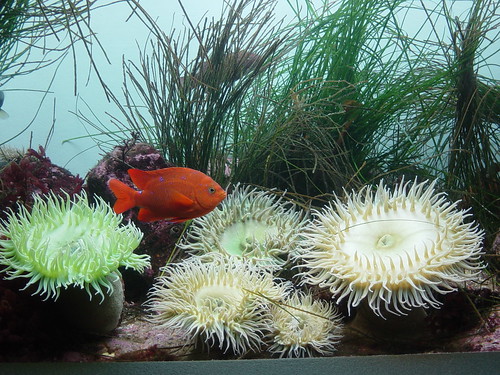
Photo illustrating Psalm 104:24-25

Sea anemones and orange fish

24 O LORD, how
manifold are your works!
In wisdom have you made them all;
the earth is full of your creatures.

25 Here is the sea, great and wide,
which teems with creatures innumerable,
living things both small and great. -
Psalm 104, ESV

My wife took this at the Monterey, California, aquarium. I don't know what the name of the orange fish is. The flower-like objects are sea anemones, which are animals belonging to the phylum Cnidaria, as I recall my zoology.

Some scientists think that there are millions of undiscovered species in the ocean, almost all of them smaller than these creatures. Maybe, maybe not. Are all marine species critical to human existence? Surely not, although some of them are important to us. Even if they aren't critical to our existence, as I understand Genesis 1, we have some responsibility to try to prevent them from becoming extinct. Their existence is a sign of God's grace, omnipotence, and glory.

There is a Flickr group of photos, entitled "Divine Creativity." This photo belongs to that group, which, I believe, can be seen by non-Flickr members.

* * * * *

Update, a few hours later: Whoops! I should have said something about God's apparent pleasure in human diversity, which is, I suppose, as remarkable as His pleasure in, say bacterial diversity.

You may want to see the Wikipedia article on biodiversity.

Thanks for reading.

Sunday, January 15, 2006

The Christian's Secret of a Happy Life, pt. 17

I conclude a series of excerpts from The Christian's Secret of a Happy Life by Hannah Whitall Smith, posted on Sundays (and occasionally Mondays) for over three months. The book, which is public domain, is available on-line in its entirety here. This version is somewhat different from the paperback I have in my physical possession. (New York: Ballentine Books, 1986) For an article on Smith, in Christian History, go here. This Chapter is entitled "The Chariots of God." The material below is quoted exactly, from the text at the first link in this post. However, where there are blank lines between paragraphs, I have omitted material.

Chariots are for conveyance and progress. Earthly chariots carry the bodies of those who ride in them over all intervening distances or obstacles to the place of their destination, and God's chariots carry their souls. No words can express the glorious places to which that soul shall arrive who travels in the chariots of God. And our verse tells us they are "very many." All around us on every side they wait for us; but we, alas! we do not always see them. Earth's chariots are always visible, but God's chariots are invisible.

But they do not look like chariots. They look instead like enemies, sufferings, trials, defeats, misunderstandings, disappointments, unkindnesses. They look like Juggernaut cars of misery and wretchedness, that are only waiting to roll over us and crush us into the earth; but they really are chariots of triumph in which we may ride to those very heights of victory for which our souls have been longing and praying.

Let us be thankful, then, for every trial that will help to destroy our chariots, and will compel us to take refuge in the chariot of God, which stands ready and waiting beside us.

Mount into them, then, with thankful hearts, and lose sight of all second causes in the shining of His love who will "carry you in His arms" safely and triumphantly over it all.

Saturday, January 14, 2006

Paganism and Christianity in Juliet Marillier's fiction

Juliet Marillier, author of fiction set centuries ago, in Europe, claims to be a pagan. She states that she belongs to a Druid order.

I read her Sevenwaters trilogy (Daughter of the Forest, Son of the Shadows, and Child of the Prophecy -- these books won, or were nominated for, various awards) some years ago. I read her Wolfskin recently. Without giving away the plot, I'd like to point out a few things about the book.

First, it presents two pagan religions as if they were real, and gave real connection to a supernatural world. These two are a pagan religion found in the Orkney islands, where much of the book takes place, and a Norse religion. The pagan priestess, in an extreme situation, summons beings from the earth and the sea to help her. The berserker warrior communes with his god in a vision.

The above wasn't a great surprise, both from my previous recollection of her books, and because I knew that Marillier claimed to be a pagan herself. The second thing I point out is that there is a Christian priest, who is presented as if Christianity, too, were real. Marillier says: "A discussion of religion and spirituality creeps into every book I write, because it's important to me. It was especially interesting in Wolfskin, because here we have three different sets of beliefs in potential opposition to one another." Her sympathetic portrait of a Christian was a surprise.

Here's an important passage:
". . . Doesn't your god love even sinners?"
Tadhg regarded her gravely. "Indeed. God is in all of us. Some are clothed in the brightness of the Holy Spirit, and goodness shines from them, a goodness which has its source deep within. Such a sweet wellspring never runs dry. No force or evil can pollute its clear water. But some are weaker vessels, and that small spark of the divine is hidden far within them. It takes a brave man or woman, Nessa, to open up his very being and examine what is there: to lay his soul bare to that burning light. Such a choice is fearful indeed, for one must recognize the fear and anguish, the deceit and duplicity, the lust and the violence, all the wretchedness that mortal man bears in his essential clay. Yet, if a man dare open himself to God's love, his sins are forgiven and the path made new. That is the wondrous truth of which our Lord Jesus told. It is the way of light. . . ." Wolfskin (New York: Tom Doherty Associates, 2002) p. 149.

C. S. Lewis said, in several of his writings, that paganism wasn't entirely wrong. (He did not propose that paganism was meant to be the way to God -- Christianity is that way.) Perhaps Marillier is a modern-day example of that.

Here's what David C. Downing had to say about this matter (in Into the Wardrobe: C. S. Lewis and the Narnia Chronicles. San Francisco: Jossey-Bass, an imprint of John Wiley & Sons, 2005):
. . . Lewis rejected both universalism and predestination as negations of free will. His position is better described as "inclusivism," the idea that Christ's reconciling work may sometimes apply even to those who are not aware of it. Lewis did not feel that he was being unorthodox in this matter. He refers several times in his letters to Christ's portrayal of judgement in which he welcomes those who fed the hungry, clothed the naked, and visited the sick, saying that all such service done for the least of his brethren is accounted as service done to him. (84-5)

and

In The Discarded Image . . . he spends two pages showing that pagans and early Christians had far more in common than either shares with modern thinkers. Pagan is one of those words . . . that has a specialized meaning in Lewis's books. In common usage, pagan and Christian are practically contraries, the first representing a secular, this-worldly attitude, and the second representing its opposite. Lewis saw no such antithesis; he called paganism "the childhood of religion . . . a prophetic dream" For him, paganism was an anticipation, Christianity the fulfillment. (109)

Added July 28, 2010: 
". . . Has it ever struck you what an odd creation Merlin is? He's not evil; yet he's a magician. He is obviously a druid; yet he knows all about the Grail. . . ." (Dr. Dimble, speaking to Jane Studdock, in That Hideous Strength, by C. S. Lewis. New York: Collier, 1962, p. 31.)

The third aspect of Marillier's writing that I want to mention is that her characters often suffer great hardship, and have to make difficult choices. That's not unique to Marillier, of course. But the main thing I recall about the Sevenwaters trilogy is the excruciating anguish of the heroine, Sorcha, over a long period, as she tries to perform a most difficult task, under difficult circumstances. (This was in the first book.) Marillier's main characters can be heroes, in the definition given by R. A. Salvatore.

The second part of this post is here.

* * * * *

I added the quotations from Downing on April 15, 2008.

On April 2, 2009, E Stephen Burnett wrote an essay, asking questions about how far a Christian author could go in writing fiction which has a God who is significantly different from the Christian God, and whether a Christian could legitimately create a fictional character who is in defiance of God. I posted tentative answers to these questions, which are related to the subject of the post above, on April 13, 2009.

Thanks for reading!

Friday, January 13, 2006

R. A. Salvatore interview: What makes a hero

I have never read a book by R. A. Salvatore, author, as I understand it, of what is sometimes known as sword and sorcery fantasy. His latest book is Promise of the Witch-King. However, I heard Tom Fudge, of KPBS radio, interview Salvatore as part of the "These Days" program, on December 28, 2005.

Among other topics, Salvatore described how he learned to love to read, how he tries to write sequels so that readers can read them without having to go back (but so they want to), and the influence of J. R. R. Tolkien on fantasy writing.

I was especially struck by what he said about heroes in fantasy:
"In fantasy traditionally, characters who make the right choices are rewarded, and characters who make the wrong choices are punished . . . A hero isn't the guy with a biggest sword necessarily, it's the guy with the biggest heart . . ." (I'm not sure I heard the last few words correctly, but I'm sure that his point was that heroes are not those who kill the most enemies, but those who make the right choices. I don't always speak, or hear, clearly myself.)

Thursday, January 12, 2006

Thank you, Robert Silverberg!

On October 19, two days before we left for California, I received an e-mail from Robert Silverberg. That's THE Robert Silverberg, author of many books of fantastic literature, including Lord Valentine's Castle, which won the Hugo award, and the other Majipoor books (He's written a lot more, and not all fiction). Mr. Silverberg had found my web page on these books.

Here's part of his e-mail to me:

In particular I was struck by your exploration of the religious themes buried in the series. I wonder if you've seen the most recent (and probably final) of my Majipoor stories, "The Book of Changes," in the LEGENDS II anthology, in which I hint as explicitly as I can at the appropriateness of equating Valentine and Jesus. At least, I think that's what I was saying. I'd be interested in your views.

I have, thanks to a local library which allowed me to have a card, been able now to read the novella Silverberg suggested. (Robert Silverberg, "The Book of Changes," pp. 287-345, in Legends II: New Short Novels by the Masters of Modern Fantasy, Silverberg, ed., New York: Del Rey/Ballantine, 2004)

The plot of the novel is that a prince, Furvain, with nothing much to do, has become a poet, but not a serious one. He doesn't write second drafts, and his topics are trivial. One day he decides to make a journey, and is captured. While in captivity, he dreams of part of the long past of Majipoor, and begins to write a poem, a serious one. It turns out to be a poem on the entire history of humans on Majipoor. The poet finds that he is guided, in dreams, by a Valentine, one of the royalty of Majipoor. There has been no such Coronal in the history of Majipoor, and no wonder -- Valentine will come many years in the future. Silverberg seems to think that it is appropriate to equate fictional characters with Christ, but I'm not certain of his intent.

In Silverberg's sub-creation, there is a divine being, and persons (of various species) who believe in him/her/it:

The Spirit of the Divine lingered high about that mighty ocean, Furvain perceived: impersonal, unknowable, infinite, all-seeing. Though the Spirit was without form or feature, Furvain recognized it for what it was, and the Spirit recognized him, touching his mind, gathering it in, linking it, for one stunning moment, to the vastness that was itself. And in that infinitely long moment the greatest of all poems was dictated to him, poured into him in one tremendous cascade, a poem that only a god could create, the poem that encompassed the meaning of life and of death, the destiny of all worlds and all the creatures that dwelled upon them. (Robert Silverberg, "The Book of Changes," pp. 287-345, in Legends II: New Short Novels by the Masters of Modern Fantasy, Silverberg, ed., New York: Del Rey/Ballantine, 2004, pp. 322-3)

Religious themes show up in more than one of Silverberg's works. If you are interested in reading more about what I think of Silverberg's work, see my web page. I greatly appreciate that Silverberg contacted me.

Thanks for reading.

Wednesday, January 11, 2006

Sunspots 39


Things I have recently spotted that may be of interest to someone else:


Slate has a slide show essay about bringing the quagga back to life. (This zebra-like animal has been extinct for over a century)

Slate also has an article on a woman who was disconnected from life support because her hospital bill was unpaid.

New Scientist says that there is evidence for some simple organic molecules surrounding a star.

Sara is pregnant. She discovers that there's another life growing inside her, besides the fetus.

The Librarian's Internet Index alerted me to an exhibit on the history of polymers.

Spirits in Bondage, a collection of poems by C. S. Lewis (written before his conversion, in 1919, and now public domain) is available from Project Gutenberg.

Edge's question for its large panel of experts (mostly scientists) is "What is your most dangerous idea?" I haven't read all 119 of these . . . I don't think Joe Carter has, either, but he's not happy with the whole thing.

Joe has also posted on a study of the psychology of torture, as related to what's happening with the media. The comments, unfortunately (he gets a lot) mostly degenerated to partisan finger-pointing.

From the CBC (That's a Canadian entity, for those not familiar with it) comes an article on the accuracy of the Wikipedia.

Christianity Today has an article on the commercialization of Narnia, or rather, on the non-commercialization of Calvin and Hobbes, whose creator does not want his comic strip used to sell fast food and shirts. (Those decals, showing Calvin engaged in a bodily function, on the back windows of pick-up trucks, are unauthorized.)

Some interesting models related to showing mathematical ideas are here.

Perry writes about how a Christian should respond to the death of a loved one.

Ken Schenck, bible scholar, comments on Pat Robertson's suggestion that Ariel Sharon's stroke was the result of giving part of Israel to the Palestinians.

This week's Christian Carnival is here. (For information on locating these Carnivals, see here)

Image source (public domain)

Tuesday, January 10, 2006

Ussher's chronology

I received an e-mail query, asking if I had a copy of Ussher's chronology on file. I don't, and hadn't really thought about having one, before the query. (For any who don't know, Ussher believed that the earth was created in 4004 B.C., based mainly on his interpretation of the genealogies in the Bible.)

I did some research on-line, and haven't discovered any such file. Perhaps some reader has, and can point me to one? If so, please do.

I did find what seem to be excellent Wikipedia articles on the Ussher-Lightfoot Calendar (Lightfoot also published a chronology at about the same time as Ussher.) and on Ussher, himself. Answers in Genesis has an article on Ussher, which indicates that that organization has re-published Ussher's history, and offers it for sale. I hoped that Project Gutenberg had re-published something by Ussher, but they have not. (He seems to have written entirely in Latin.)

As the Wikipedia articles indicate, there is considerable controversy over Ussher's date of 4004 B. C. for the age of the earth. Conservative, Bible-believing scholars of the 19th and early 20th centuries did not believe that the genealogies used in Genesis could legitimately be put to the purpose of determining dates. Neither did Francis Schaeffer, and many others, in the 20th century. However, there are Bible scholars living today who disagree, and think that they were meant to be so used.

The most complete Ussher's chronology I have ever seen is in a bible given me by my maternal grandmother, over a half-century ago. It has dates, based on Ussher's chronology, for many biblical events, as part of its center-column reference system. I don't know if all these dates were based on Ussher's work.

*  *  *  *  *
On February 9, 2015, I added the material in parenthesis to the first paragraph.  Thanks for reading!

Monday, January 09, 2006

Thoughts On Fairy Tales (by others)

A fairytale, like a butterfly or a bee, helps itself on all sides, sips at every wholesome flower, and spoils not one. The true fairytale is, to my mind, very like the sonata. We all know that a sonata means something; and where there is the faculty of talking with suitable vagueness, and choosing metaphor sufficiently loose, mind may approach mind, in the interpretation of a sonata, with the result of a more or less contenting consciousness of sympathy. But if two or three men sat down to write each what the sonata meant to him, what approximation to definite idea would be the result? Little enough--and that little more than needful. We should find it had roused related, if not identical, feelings, but probably not one common thought. Has the sonata therefore failed? Had it undertaken to convey, or ought it to be expected to impart anything defined, anything notionally recognizable? George MacDonald, "The Fantastic Imagination," in his A Dish of Orts, 1893

The definition of a fairy-story -- what it is, or what it should be -- does not, then, depend on any definition or historical account of elf or fairy, but upon the nature of Faërie: the Perilous Realm itself, and the air that blows in that country. I will not attempt to define that, nor to describe it directly. It cannot be done. Faërie cannot be caught in a net of words; for it is one of its qualities to be indescribable, though not imperceptible. It has many ingredients, but analysis will not necessarily discover the secret of the whole. J. R. R. Tolkien, "On Fairy-stories," in Tree and Leaf. Boston: Houghton Mifflin, 1965, pp. 3 - 73. Quote is from p. 10.

C. S. Lewis made a literary distinction between fantasy as magical happenings and fantasy as wish fulfillment. ''Lay the fairy tale side by side with the school story. . . . We long to go through the looking glass, to reach fairyland. We also long to be the immensely popular and successful schoolboy or schoolgirl.'' Lewis concludes that stories that satisfy the desire for magic are healthy for the imagination and the spirit, while stories that pander to the desire to be Head Boy or sports star are dangerous ''flattery to the ego'' and leave readers ''undivinely discontented.'' Gregory Maguire, review of Harry Potter and the Prisoner of Azkaban, by J. K. Rowling. New York Times, September 5, 1999. The quote of Lewis is from his "On Three Ways of Writing For Children."

Sunday, January 08, 2006

The Christian's Secret of a Happy Life, pt. 16

I continue a series of excerpts from The Christian's Secret of a Happy Life by Hannah Whitall Smith. The book, which is public domain, is available on-line in its entirety here. This version is somewhat different from the paperback I have in my physical possession. (New York: Ballentine Books, 1986) For an article on Smith, in Christian History, go here. This Chapter is entitled "Divine Union." The material below is quoted exactly, from the text at the first link in this post.

The usual course of Christian experience is pictured in the history of the disciples. First they were awakened to see their condition and their need, and they came to Christ and gave in their allegiance to Him. Then they followed Him, worked for Him, believed in Him; and yet, how unlike Him! seeking to be set up one above the other; running away from the cross; misunderstanding His mission and His words; forsaking their Lord in time of danger; but still sent out to preach, recognized by Him as His disciples, possessing power to work for Him. They knew Christ only "after the flesh," as outside of them, their Lord and Master, but not yet their Life.
Then came Pentecost, and these disciples came to know Him as inwardly revealed; as one with them in actual union, their very indwelling Life. Henceforth He was to them Christ within, working in them to will and to do of His good pleasure; delivering them by the law of the Spirit of His life from the bondage to the law of sin and death, under which they had been held. No longer was it between themselves and Him, a war of wills and a clashing of interest. One will alone animated them, and that was His will. One interest alone was dear to them, and that was His. They were made ONE with Him.


This installment got lost last week. I mis-used the calendar, not being familiar with 2006.

Thanks for reading.

Saturday, January 07, 2006

Culture and medical care

My daughters do wonderful things for me. One of them expected me to read a book recently, and I'm glad I did.

In an intermediate French class . . . the students were assigned a five-minute oral report. The second student to stand up in front of the class was a young Hmong man. His chosen topic was a recipe for . . . Fish Soup. To prepare Fish Soup, he said, you must have a fish, and in order to have a fish, you have to go fishing. In order to go fishing, you need to know whether the fish you are fishing for lives in fresh or salt water, how big it is, and what shape its mouth is. Continuing in this vein for forty-five minutes, the student filled the blackboard with a complexly branching tree of factors and options, a sort of piscatory flowchart, written in French with an overlay of Hmong. He also told several anecdotes about his own fishing experiences. He concluded with a description of how to clean various kinds of fish, how to cut them up, and, finally, how to cook them in broths flavored with various herbs. . . .

The Hmong have a phrase . . . which means "to speak of all kinds of things." It is often used at the beginning of an oral narrative as a way of reminding the listeners that the world is full of things that may not seem to be connected but actually are; that no event occurs in isolation; that you can miss a lot by sticking to the point; and that the story-teller is likely to be long-winded. Anne Fadiman, The Spirit Catches You and You Fall Down: A Hmong Child, Her American Doctors, and the Collision of Two Cultures. New York: Farrar, Straus and Giroux, 1997, pp. 12-13.

There's more to the book than that, but that part, illustrating the culture of the Hmong, but also showing that that culture is not entirely different from the way some non-Hmong talk, particularly arrested me. The book is about a particular young Hmong girl, and how the lack of understanding between U. S. culture, and the culture of Hmong immigrants, influenced her medical care. It's a sad, and fascinating, tale.

Friday, January 06, 2006

Three Questions: maybe this is a meme

On National Public Radio recently (sorry, I can't remember what the program was, or who was being interviewed) I heard a woman say that she was going around asking people three questions.

Here they are:
What do you live for?

What would you die for?

What would you kill for?

I know the answers I'd like to give, which are:
I live for Jesus Christ alone.

I would die rather than betraying my faith, and I would die to protect my family.

I would kill only if necessary to prevent some great evil.

How would these answers hold up in real life? I'm not sure, except for the first one, and I know I live too much for me.

Think about it. I'd be interested in your reaction. If anyone wants to make this into a meme, complete with tagging others, do so, please.

Wednesday, January 04, 2006

Sunspots 38

Things I have recently spotted that may be of interest to someone else:


The Internet Storm Center warns of a serious vulnerability in Windows, NOT BLOCKED BY ANTIVIRUS SOFTWARE, etc., and has some help in fixing it, until Microsoft gets around to it.

I have subscribed to a Bloglines search for "C. S. Lewis" posts for over a year. Beginning in November or so, and not to my surprise, the number of hits has climbed to one or two hundred or so per day. I just gave up trying to look at the hits. I can't decide whether I want the popularity of this subject to go up or down!

I did glance at one of these many listings, which led me to this article on "The Theology of C. S. Lewis: Somewhere Between Ransom and Reepicheep" The writer argues that Lewis did not believe in biblical inerrancy, and that he was somewhat confused about how salvation is received. He is less critical of Lewis on some other issues. (The actual article begins some distance down the page)

I am now running a search for "Eustace Narnia," which doesn't turn up nearly as much. One thing it did turn up is a post quoting J. K. Rowling, who said, in an interview, that Eustace was her favorite Narnia character.

The Botany Photo of the Day blog says that the place of origin of Lantanas is uncertain.

According to Nature News, the perception of color by the two hemispheres of the brain depends on their language ability.

Stephen L. Carter writes about "activist judges," for Christianity Today. He says the matter isn't as simple as many people seem to think it is.

This week's Christian Carnival is here. (For information on locating these Carnivals, see here)

Image source (public domain)

Tuesday, January 03, 2006

Under a big rock

under huge rock, Cloudland Canyon State Park, Georgia

1 I love you, O Lord, my strength.
2 The Lord is my rock and my fortress and my deliverer, my God, my rock, in whom
I take refuge, my shield, and the horn of my salvation, my stronghold.
3 I call upon the Lord, who is worthy to be praised, and I am saved from my
enemies.
Psalm 18, ESV
(The publishers of the English Standard Version of the Bible allow quotation
and citation in this manner)

Us, with a brother and sister-in-law, under a rock, on our way to the bottom of Cloudland Canyon, in Cloudland Canyon State Park, near Rising Fawn, Georgia, in mid-October. We all enjoyed the occasion very much. Thanks to some nice person who took the photo for us. For larger version of this photo, click on it.

Sunday, January 01, 2006

Resolutions for 2006 blogging

I hereby resolve to:

1) post regularly, unless, of course, I have more important things to do, or am providentially hindered

2) read at least one post, that I wouldn't have otherwise, from the Christian Carnival, every week

3) comment (if the blog allows) on every post I read, as opposed to glance at, and make sure that the comment makes it possible for the blogger to identify which post I was commenting on.

4) be charitable to views I don't agree with, and to ignorance (which isn't always the same thing!)

5) acknowledge all comments to my blog, unless the commenter hasn't left any kind of clue that allows me to do so

See also here, for previously posted guidelines for this blog, which are part of this resolution. See also my Flickr resolutions, if you wish to.

God's best in this new year. Thanks for reading.