Watson, near the close of his book, sets forth some rules for being contented:
Rule 16. Do not too much indulge the flesh. We have taken an oath in baptism to forsake the flesh. The flesh is a worse enemy than the devil, it is a bosom-traitor; an enemy within is worst. If there were no devil to tempt, the flesh would be another Eve, to tempt to the forbidden fruit. O take heed of giving way to it! Whence is all our discontent but from the fleshy part? The flesh puts us upon the immoderate pursuit of the world; it consults for ease and plenty, and if it be not satisfied, then discontent begins to arise. O let it not have the reins! Martyr the flesh! In spiritual things the flesh is a sluggard, in secular things an horse-leech, crying “give, give.” The flesh is an enemy to suffering: it will sooner make a man a courtier, than a martyr. O keep it under! Put its neck under Christ’s yoke, stretch and nail it to his cross; never let a Christian look for contentment in his spirit, till there be confinement in his flesh.
Thomas Watson lived from 1620-1686, in England. He wrote several books which survive. This blog, thank God, has posted excerpts from his The Art of Divine Contentment: An Exposition of Philippians 4:11, over a number of weeks, on Sundays.
My source for the text is here, and I thank the Christian Classics Ethereal Library for making this text (and many others) available. The previous excerpt is here.
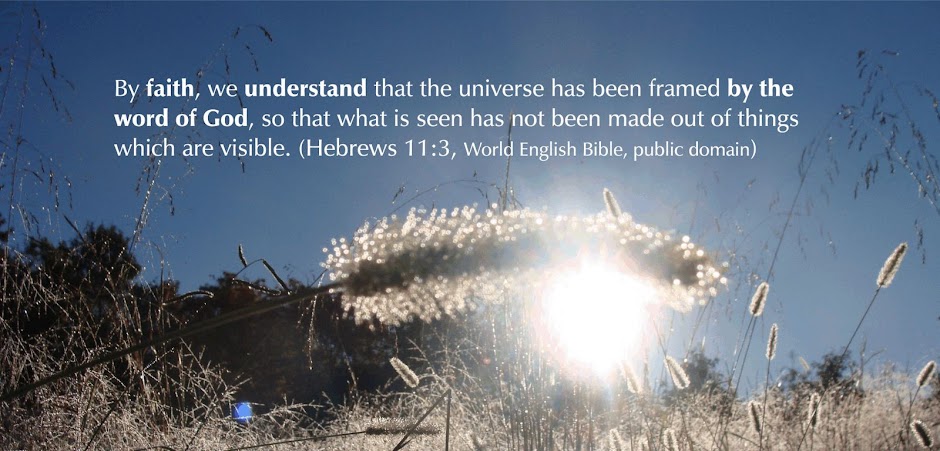
Musings on science, the Bible, and fantastic literature (and sometimes basketball and other stuff).
God speaks to us through the Bible and the findings of science, and we should listen to both types of revelation.
The title is from Psalm 84:11.
The Wikipedia is usually a pretty good reference. I mostly use the World English Bible (WEB), because it is public domain. I am grateful.
License
I have written an e-book, Does the Bible Really Say That?, which is free to anyone. To download that book, in several formats, go here.

The posts in this blog are licensed under a Creative Commons Attribution-NonCommercial-ShareAlike 3.0 Unported License. You can copy and use this material, as long as you aren't making money from it. If you give me credit, thanks. If not, OK.
The posts in this blog are licensed under a Creative Commons Attribution-NonCommercial-ShareAlike 3.0 Unported License. You can copy and use this material, as long as you aren't making money from it. If you give me credit, thanks. If not, OK.
Showing posts with label cross. Show all posts
Showing posts with label cross. Show all posts
Sunday, September 01, 2019


Sunday, August 19, 2018
The Art of Divine Contentment: An Exposition of Philippians 4:11 by Thomas Watson. Excerpt 40
Watson continues discussing reasons to be contented, or "contentation," as he puts it.
6th. excellency. Contentment sweetens every condition. Christ turned the water into wine; so contentment turns the waters of Marah into spiritual wine. Have I but little? yet it is more than I can deserve or challenge. This modicum is in mercy; it is the fruit of Christ’s blood, it is the legacy of free grace: a small present sent from a king is highly valued. This little I have is with a good conscience; it is not stolen waters; guilt hath not muddied or poisoned it; it runs pure. This little is a pledge of more: this bit of bread is an earnest of that bread which I shall eat in the kingdom of God; this little water in the cruise is an earnest of that heavenly nectar which shall be distilled from the true vine. Do I meet with some crosses? my comfort is, if they be heavy, I have not far to go; I shall but carry my cross to Golgotha and there I shall leave it; my cross is light in regard of the weight of glory. Hath God taken away my comforts from me? it is well, the Comforter still abides. Thus contentment, as a honey-comb, drops sweetness into every condition. Discontent is a leaven that sours every comfort; it puts aloes and wormwood upon the breast of the creature; it lessens every mercy, it trebles every cross; but the contented spirit sucks sweetness from every flower of providence; it can make a treacle of poison. Contentation is full of consolation.
Thomas Watson lived from 1620-1686, in England. He wrote several books which survive. This blog, God willing, will post excerpts from his The Art of Divine Contentment: An Exposition of Philippians 4:11, over a number of weeks, on Sundays.
My source for the text is here, and I thank the Christian Classics Ethereal Library for making this text (and many others) available. The previous excerpt is here.
Philippians 4:11 Not that I speak because of lack, for I have learned in whatever state I am, to be content in it. (World English Bible, public domain.)
6th. excellency. Contentment sweetens every condition. Christ turned the water into wine; so contentment turns the waters of Marah into spiritual wine. Have I but little? yet it is more than I can deserve or challenge. This modicum is in mercy; it is the fruit of Christ’s blood, it is the legacy of free grace: a small present sent from a king is highly valued. This little I have is with a good conscience; it is not stolen waters; guilt hath not muddied or poisoned it; it runs pure. This little is a pledge of more: this bit of bread is an earnest of that bread which I shall eat in the kingdom of God; this little water in the cruise is an earnest of that heavenly nectar which shall be distilled from the true vine. Do I meet with some crosses? my comfort is, if they be heavy, I have not far to go; I shall but carry my cross to Golgotha and there I shall leave it; my cross is light in regard of the weight of glory. Hath God taken away my comforts from me? it is well, the Comforter still abides. Thus contentment, as a honey-comb, drops sweetness into every condition. Discontent is a leaven that sours every comfort; it puts aloes and wormwood upon the breast of the creature; it lessens every mercy, it trebles every cross; but the contented spirit sucks sweetness from every flower of providence; it can make a treacle of poison. Contentation is full of consolation.
Thomas Watson lived from 1620-1686, in England. He wrote several books which survive. This blog, God willing, will post excerpts from his The Art of Divine Contentment: An Exposition of Philippians 4:11, over a number of weeks, on Sundays.
My source for the text is here, and I thank the Christian Classics Ethereal Library for making this text (and many others) available. The previous excerpt is here.
Philippians 4:11 Not that I speak because of lack, for I have learned in whatever state I am, to be content in it. (World English Bible, public domain.)
Tuesday, September 29, 2015
Thomas à Kempis on the cross
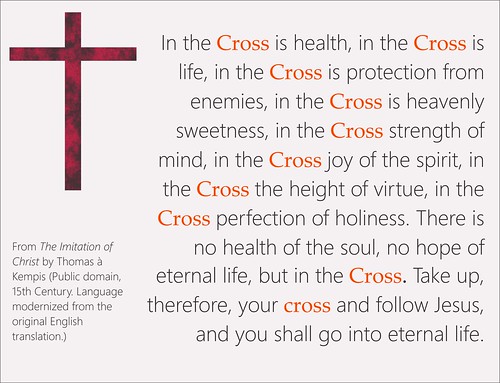
Modified into current English, à Kempis said:
In the Cross is health, in the Cross is life, in the Cross is protection from enemies, in the Cross strength of mind, in the Cross joy of the spirit, in the Cross the height of virtue, in the Cross perfection of holiness. There is no health of the soul, no hope of eternal life, but in the Cross. Take up, therefore, your cross and follow Jesus, and you shall go into eternal life.
May it be so. Thanks for reading!
Sunday, February 01, 2015
Excerpts from Orthodoxy, by Gilbert K. Chesterton, 7
Mysticism keeps men sane. As long as you have mystery you have health;
when you destroy mystery you create morbidity. The ordinary man has always been sane because the ordinary man has always been a mystic. He has
permitted the twilight. He has always had one foot in earth and the other in fairyland. He has always left himself free to doubt his gods; but
(unlike the agnostic of today) free also to believe in them. He has always cared more for truth than for consistency. If he saw two truths that
seemed to contradict each other, he would take the two truths and the contradiction along with them. His spiritual sight is stereoscopic, like
his physical sight: he sees two different pictures at once and yet sees all the better for that. Thus he has always believed that there was such a
thing as fate, but such a thing as free will also. Thus he believed that children were indeed the kingdom of heaven, but nevertheless ought to be
obedient to the kingdom of earth. He admired youth because it was young and age because it was not.
The whole secret of mysticism is this: that man can understand everything by the help of what he does not understand. The morbid logician seeks to make everything lucid, and succeeds in making everything mysterious. The mystic allows one thing to be mysterious, and everything else becomes lucid. The determinist makes the theory of causation quite clear, and then finds that he cannot say “if you please” to the housemaid. The Christian permits free will to remain a sacred mystery; but because of this his relations with the housemaid become of a sparkling and crystal clearness. He puts the seed of dogma in a central darkness; but it branches forth in all directions with abounding natural health. As we have taken the circle as the symbol of reason and madness, we may very well take the cross as the symbol at once of mystery and of health. Buddhism is centripetal, but Christianity is centrifugal: it breaks out. For the circle is perfect and infinite in its nature; but it is fixed for ever in its size; it can never be larger or smaller. But the cross, though it has at its heart a collision and a contradiction, can extend its four arms for ever without altering its shape. Because it has a paradox in its center it can grow without changing. The circle returns upon itself and is bound. The cross opens its arms to the four winds; it is a signpost for free travelers.
Orthodoxy, first published in 1908, by G. K. Chesterton, is in the public domain, and available from Project Gutenberg. The previous post in this series is here. Thanks for reading! Read Chesterton.
The whole secret of mysticism is this: that man can understand everything by the help of what he does not understand. The morbid logician seeks to make everything lucid, and succeeds in making everything mysterious. The mystic allows one thing to be mysterious, and everything else becomes lucid. The determinist makes the theory of causation quite clear, and then finds that he cannot say “if you please” to the housemaid. The Christian permits free will to remain a sacred mystery; but because of this his relations with the housemaid become of a sparkling and crystal clearness. He puts the seed of dogma in a central darkness; but it branches forth in all directions with abounding natural health. As we have taken the circle as the symbol of reason and madness, we may very well take the cross as the symbol at once of mystery and of health. Buddhism is centripetal, but Christianity is centrifugal: it breaks out. For the circle is perfect and infinite in its nature; but it is fixed for ever in its size; it can never be larger or smaller. But the cross, though it has at its heart a collision and a contradiction, can extend its four arms for ever without altering its shape. Because it has a paradox in its center it can grow without changing. The circle returns upon itself and is bound. The cross opens its arms to the four winds; it is a signpost for free travelers.
Orthodoxy, first published in 1908, by G. K. Chesterton, is in the public domain, and available from Project Gutenberg. The previous post in this series is here. Thanks for reading! Read Chesterton.
Friday, September 05, 2014
Why is there evil in the world?
The classic Christian answer is this: When God created
people, He gave them the power to choose. If the power to choose was real, then
people could choose bad things, with bad consequences. The first, and most
profound, bad choice was when Adam and Eve disobeyed God about the Tree of the
Knowledge of Good and Evil, whatever may have happened then. That choice resulted
in a fallen creation, with human death, necessity to work, diseases, extinctions,
parasites, hurricanes, earthquakes, pollution, wars, exploitation of other
people, and of animals, other types of sin, and violence of all kinds.
God’s answer to bad human choice (sin) is Himself. Christ,
who was God and man, paid the price for our sin by personally suffering on the
cross, a voluntary, sinless sacrifice. (The resurrection shows that the
sacrifice was acceptable.)
There will come a time when human suffering, for those who
have chosen to accept Christ’s sacrifice, and accept Him as Lord, will be over.
Our bodies will be restored to the state God planned for them in the first
place, free from aches and pains, aging and death. The earth will also be
restored to the state God planned for it.
God doesn’t send anyone to hell, a place of eternal
suffering. People choose to go there, and God honors that choice.
Suffering builds character. We can’t achieve salvation by
suffering, but undergoing suffering may help us serve God better.
“I ended my first book with the words no answer. I know now, Lord, why you utter no answer. You are
yourself the answer. Before your face questions die away. What other answer
would suffice?” – Orual, the main character of Till We Have Faces, by C. S. Lewis.
The book of Job is largely about the previous paragraph. Bad things happened to Job. They weren't his fault. He blamed God. (See here, for example.) But, in the end, Job realized that God was infinitely more wise, and good, than he was. (See here.) God also allowed Job to live a long time, restored his health, and replaced the possessions and children that he had lost. (However, there is no promise of that sort of earthly recompense for the suffering of all of God's followers. See Hebrews 11.)
Thanks for reading. Bad things will happen. The most important result of them is what my response will be.
Wednesday, November 06, 2013
Sunspots 443
Things I have recently spotted that may
be of interest to someone else:

The Arts: A photo of an amazing lavatory (two washbasins and a mirror) in a German railroad station, if I understand the description. There's a small cross on the wall, too.
Christianity: Why marriage isn't for you.
Politics: "Republicans seem uninterested in governing, Democrats seem incapable of it." - Michael Gerson, columnist.
(Sort of -- it's really about leading a church board) Ken Schenck discusses Persuasive versus Coercive Leadership.
Science: One of my Flickr contacts tells us, with a photo, that some monarch butterflies migrate to California for the winter.
National Public Radio on why you might want to have your gut bacteria analyzed, and why you might not. (It can be done, fairly cheaply.)
Sports: Kenyans are great long-distance runners. Actually, it's one tribe of Kenyans, according to a report by National Public Radio, which explores the question of why this is so.
Image source (public domain)
The Arts: A photo of an amazing lavatory (two washbasins and a mirror) in a German railroad station, if I understand the description. There's a small cross on the wall, too.
Christianity: Why marriage isn't for you.
Politics: "Republicans seem uninterested in governing, Democrats seem incapable of it." - Michael Gerson, columnist.
(Sort of -- it's really about leading a church board) Ken Schenck discusses Persuasive versus Coercive Leadership.
Science: One of my Flickr contacts tells us, with a photo, that some monarch butterflies migrate to California for the winter.
National Public Radio on why you might want to have your gut bacteria analyzed, and why you might not. (It can be done, fairly cheaply.)
Sports: Kenyans are great long-distance runners. Actually, it's one tribe of Kenyans, according to a report by National Public Radio, which explores the question of why this is so.
Image source (public domain)
Wednesday, April 03, 2013
Sunspots 412
Things I have recently spotted that may
be of interest to someone else:

Christianity: R. C. Sproul's The Truth of the Cross (Orlando: Reformation Trust Publishing, 2008) "I wonder whether Jesus was even aware of the nails and the thorns. He was overwhelmed by the outer darkness. On the cross, He was in hell, totally bereft of the grace and the presence of God, utterly separated from all blessedness of the Father. He became a curse for us so that we one day will be able to see the face of God."
Health: The New York Times reports on a Centers for Disease Control recommendation that babies should not be fed solid food until they are six months old.
Politics: (and maybe computing) A CNN opinion piece, arguing that unlocking your cell phone should not be a crime. (It is!)
Science: Wired discusses the possibility, and the sense, or lack thereof, of reviving the extinct Passenger Pigeon, using some tricks with DNA.
Image source (public domain)
Christianity: R. C. Sproul's The Truth of the Cross (Orlando: Reformation Trust Publishing, 2008) "I wonder whether Jesus was even aware of the nails and the thorns. He was overwhelmed by the outer darkness. On the cross, He was in hell, totally bereft of the grace and the presence of God, utterly separated from all blessedness of the Father. He became a curse for us so that we one day will be able to see the face of God."
Health: The New York Times reports on a Centers for Disease Control recommendation that babies should not be fed solid food until they are six months old.
Politics: (and maybe computing) A CNN opinion piece, arguing that unlocking your cell phone should not be a crime. (It is!)
Science: Wired discusses the possibility, and the sense, or lack thereof, of reviving the extinct Passenger Pigeon, using some tricks with DNA.
Image source (public domain)
Sunday, April 24, 2011
Prayers in the Bible: Jesus forgives His crucifiers
Luke 23:34 Jesus said, “Father, forgive them, for they don’t know what they are doing.” (WEB)
Jesus, again, our perfect example, prayed this, while He was on the cross, dying for me. He asked the Father to forgive those who crucified Him, Roman soldiers, temple servants, priests, probably Pilate. In a way, that includes me, too. But for my sin, He wouldn't have had to be crucified. What a thought!
This is one of a series on Prayers in the Bible. The previous post is here.
Jesus, again, our perfect example, prayed this, while He was on the cross, dying for me. He asked the Father to forgive those who crucified Him, Roman soldiers, temple servants, priests, probably Pilate. In a way, that includes me, too. But for my sin, He wouldn't have had to be crucified. What a thought!
This is one of a series on Prayers in the Bible. The previous post is here.
Sunday, April 17, 2011
Prayers in the Bible: Jesus, forsaken?
Matthew 27:46 About the ninth hour Jesus cried with a loud voice, saying, “Eli, Eli, lima sabachthani?” That is, “My God, my God, why have you forsaken me?” (WEB)
What a prayer! (Christ was on the cross at this time.) It is possible that God the Father had temporarily separated Himself from Christ, because Christ had my sins on Himself. It is possible that Jesus was undergoing such terrible physical suffering that He thought that the Father had left Him. Other interpretations are possible.
Sincere Christians have prayed such prayers, when tested severely. God the Father did not totally reject the Son. God the Father, and God the Son, and God the Holy Spirit, will not totally forsake us, so long as we are in God's will.
Thanks for reading. This is one in a series on Prayers in the Bible. The previous post is here.
What a prayer! (Christ was on the cross at this time.) It is possible that God the Father had temporarily separated Himself from Christ, because Christ had my sins on Himself. It is possible that Jesus was undergoing such terrible physical suffering that He thought that the Father had left Him. Other interpretations are possible.
Sincere Christians have prayed such prayers, when tested severely. God the Father did not totally reject the Son. God the Father, and God the Son, and God the Holy Spirit, will not totally forsake us, so long as we are in God's will.
Thanks for reading. This is one in a series on Prayers in the Bible. The previous post is here.
Sunday, August 29, 2010
The Only Argument we Need -- The Only One that has any Merit
The following poetry was assembled by me, based on three hymns, or gospel songs, which are in the public domain:
Alas! and did my Savior bleed
And did my Sovereign die?
Would He devote that sacred head
For sinners such as I?
Chorus: I need no other argument,
I need no other plea,
It is enough that Jesus died,
And that He died for me.
Was it for crimes that I had done
He groaned upon the tree?
Amazing pity! grace unknown!
And love beyond degree!
My faith has found a resting place,
Not in device or creed;
I trust the ever living One,
His wounds for me shall plead.
My heart is leaning on the Word,
The living Word of God,
Salvation by my Savior's Name,
Salvation through His blood.
My tears of grief can not repay
The debt of love I owe:
Here, Lord, I give my self away
'Tis all that I can do.
May I be willing, Lord, to bear
My cross for You each day;
Oh, live your life in me, O Lord,
For this, O Christ, I pray.
It can be sung to any hymn tune which is in 8.6.8.6 meter. The three songs it is based on are "My Faith Has Found a Resting Place," generally sung to the tune Landas; "Alas! And Did My Savior Bleed," sung to the tune Liberty Hall; and "Lead Me to Calvary," sung to the tune Duncannon. (The links will play these tunes for you.)
Not only do we need no other argument or plea to thwart the punishment that we deserve for our sin, but Christ's sacrifice, validated by His resurrection, is the only one that has any merit -- the only way to pay sin's penalty.
Thanks for reading!
Alas! and did my Savior bleed
And did my Sovereign die?
Would He devote that sacred head
For sinners such as I?
Chorus: I need no other argument,
I need no other plea,
It is enough that Jesus died,
And that He died for me.
Was it for crimes that I had done
He groaned upon the tree?
Amazing pity! grace unknown!
And love beyond degree!
My faith has found a resting place,
Not in device or creed;
I trust the ever living One,
His wounds for me shall plead.
My heart is leaning on the Word,
The living Word of God,
Salvation by my Savior's Name,
Salvation through His blood.
My tears of grief can not repay
The debt of love I owe:
Here, Lord, I give my self away
'Tis all that I can do.
May I be willing, Lord, to bear
My cross for You each day;
Oh, live your life in me, O Lord,
For this, O Christ, I pray.
It can be sung to any hymn tune which is in 8.6.8.6 meter. The three songs it is based on are "My Faith Has Found a Resting Place," generally sung to the tune Landas; "Alas! And Did My Savior Bleed," sung to the tune Liberty Hall; and "Lead Me to Calvary," sung to the tune Duncannon. (The links will play these tunes for you.)
Not only do we need no other argument or plea to thwart the punishment that we deserve for our sin, but Christ's sacrifice, validated by His resurrection, is the only one that has any merit -- the only way to pay sin's penalty.
Thanks for reading!
Thursday, March 20, 2008
The Physiology of Christ's suffering on the cross
I did a Google search for crucifixion physiology, and found a number of hits. Here are some of the results:
From an Azusa Pacific science professor. One page, with footnotes:
"The English language derives the word “excruciating” from crucifixion, acknowledging it as a form of slow, painful suffering."
Perhaps the most thorough treatment, from a physician, with footnotes.
"Dr. Barbet secured cadaver wrists to a wooden beam using spikes through the palms and found that the weight of a body when suspended from the cross would simply tear the spikes through the hands. If, however, the spikes were placed in the wrists, a body could be suspended successfully."
From a physician, a page, discussing Christ's last words, in conjunction with His suffering.
"Though very rare, the phenomenon of Hematidrosis, or bloody sweat, is well documented. Under great emotional stress of the kind our Lord suffered, tiny capillaries in the sweat glands can break, thus mixing blood with sweat. This process might well have produced marked weakness and possible shock."
Another good page from a physician, with footnotes.
"Jesus did this for me! He hung on that cross, and went through all this heinous, physical agony of the worst and most intense pain ever devised as torture that a human could conceive and be subjected to. He did this all for me; He took my place; He endured, as an innocent Person, what I deserved as a sinner. He accomplished, by Grace, what I should have born myself." [emphasis added]
They don't agree on all points, but all of them are worth reading. I have included a quotation from each.
Christ suffered for us!
Thanks for reading.
From an Azusa Pacific science professor. One page, with footnotes:
"The English language derives the word “excruciating” from crucifixion, acknowledging it as a form of slow, painful suffering."
Perhaps the most thorough treatment, from a physician, with footnotes.
"Dr. Barbet secured cadaver wrists to a wooden beam using spikes through the palms and found that the weight of a body when suspended from the cross would simply tear the spikes through the hands. If, however, the spikes were placed in the wrists, a body could be suspended successfully."
From a physician, a page, discussing Christ's last words, in conjunction with His suffering.
"Though very rare, the phenomenon of Hematidrosis, or bloody sweat, is well documented. Under great emotional stress of the kind our Lord suffered, tiny capillaries in the sweat glands can break, thus mixing blood with sweat. This process might well have produced marked weakness and possible shock."
Another good page from a physician, with footnotes.
"Jesus did this for me! He hung on that cross, and went through all this heinous, physical agony of the worst and most intense pain ever devised as torture that a human could conceive and be subjected to. He did this all for me; He took my place; He endured, as an innocent Person, what I deserved as a sinner. He accomplished, by Grace, what I should have born myself." [emphasis added]
They don't agree on all points, but all of them are worth reading. I have included a quotation from each.
Christ suffered for us!
Thanks for reading.
Saturday, October 14, 2006
Trees in the Bible (repost)
Trees are a major theme in the Bible.
Close to the beginning, there were the Tree of Life, and the Tree of the Knowledge of Good and Evil. At the end, there's the Tree of Life. The same Tree of Life? Maybe. Maybe not.
In between, a lot of trees. Here are a few:
Noah's ark was built from trees.
Moses had a staff, perhaps made from a tree.
Sacrifices were burned on wood.
David and Solomon had the builders use wood in the Temple, and in the palace.
Absalom was killed while hanging in a tree.
Psalm 1 compares a righteous person to a tree.
Zacchaeus climbed a tree.
Christ presented the Sermon on the Mount from a boat, presumably made of wood.
Boats played an important role in the New Testament. Jesus traveled on them, some of the apostles were fishermen, and Paul and co-workers made journeys in them.
Christ hung on a cross made of wood.
Why trees?
Probably several reasons.
There are a lot of them.
They are symbols of permanence. Living permanence, unlike that of rocks.
They are solid.
They provide housing for other plants, for animals, and for humans. For humans, the housing provided is usually after the death of the tree--they make excellent building materials.
They provide shade.
They have character. There are patterns in branches, in individual leaves, in bark, and in the grain, when it's exposed. No two trees are exactly alike in appearance.
They bear fruit.
They have flowers.
They can be climbed. We like to go higher. We like adventure. We like to see things we wouldn't otherwise see.
Their roots are anchoring systems.
They capture energy from the sun.
No doubt there are other reasons why God used them as symbols, and why they are prominent in scripture.
Taken from a post of February 4, 2005, from this blog. Thanks for reading.
I expect to post from MacDonald's Diary of an Old Soul tomorrow, but probably won't be able to post, or read blogs, much, if any, for about two weeks.
Close to the beginning, there were the Tree of Life, and the Tree of the Knowledge of Good and Evil. At the end, there's the Tree of Life. The same Tree of Life? Maybe. Maybe not.
In between, a lot of trees. Here are a few:
Noah's ark was built from trees.
Moses had a staff, perhaps made from a tree.
Sacrifices were burned on wood.
David and Solomon had the builders use wood in the Temple, and in the palace.
Absalom was killed while hanging in a tree.
Psalm 1 compares a righteous person to a tree.
Zacchaeus climbed a tree.
Christ presented the Sermon on the Mount from a boat, presumably made of wood.
Boats played an important role in the New Testament. Jesus traveled on them, some of the apostles were fishermen, and Paul and co-workers made journeys in them.
Christ hung on a cross made of wood.
Why trees?
Probably several reasons.
There are a lot of them.
They are symbols of permanence. Living permanence, unlike that of rocks.
They are solid.
They provide housing for other plants, for animals, and for humans. For humans, the housing provided is usually after the death of the tree--they make excellent building materials.
They provide shade.
They have character. There are patterns in branches, in individual leaves, in bark, and in the grain, when it's exposed. No two trees are exactly alike in appearance.
They bear fruit.
They have flowers.
They can be climbed. We like to go higher. We like adventure. We like to see things we wouldn't otherwise see.
Their roots are anchoring systems.
They capture energy from the sun.
No doubt there are other reasons why God used them as symbols, and why they are prominent in scripture.
Taken from a post of February 4, 2005, from this blog. Thanks for reading.
I expect to post from MacDonald's Diary of an Old Soul tomorrow, but probably won't be able to post, or read blogs, much, if any, for about two weeks.
Subscribe to:
Posts (Atom)